
increase in the availability of digital Indian government services between 2023 and 2025.
REPORT
Beyond digital: Readying for the AI era.

JUMP TO SECTION
The building blocks of future-ready service delivery
Improving digital services drives lasting impact
Measuring digital government performance
Digital ambitions in a complex landscape
Surface stability masks underlying divergence
AI readiness in focus: The next horizon for digital government
Anatomy of best-in-class digital government service delivery
India's digital government transformation has entered a pivotal new phase. Adoption is accelerating, ministries are modernising and citizens are increasingly accessing services online or via mobile platforms.
As this momentum builds, Adobe's new Digital Government Index for India examines the performance of digital public services across select ministries and offers insights into opportunities to enhance citizen experience delivery.
The report highlights how digital services must evolve as AI reshapes the way citizens search and use public information, and why some ministries are better prepared for this shift than others.
Read the full report to explore how leading governments are strengthening digital strategy, investment and service design to keep pace with changing expectations.

The second Adobe Digital Government Index (DGI) for India offers a nuanced view of this journey. While the national score has stabilised, reflecting a period of consolidation after years of foundational investment, the data reveals a complex picture beneath the surface. Progress is uneven — public-facing ministries are advancing rapidly, while others lag.
With each edition of the study, the interconnectedness of the measures becomes more evident, demonstrating how advances in one area can affect, or be affected by, changes in another. This ongoing view enables us to understand not only what is evolving, but also how these elements collaborate to drive overall progress.
However, challenges persist. Governments worldwide are operating under fiscal constraints. The demand to do more with less is colliding with the accelerating impact of AI, which is not only reshaping what citizens consider "good service", but also fundamentally changing how they search for, access and interpret information.
AI readiness has emerged as a defining capability for the next phase of digital service delivery. The DGI's new AI-readiness assessment highlights the related strengths and gaps. While government websites are generally trusted, their technical structure and discoverability lag, limiting their visibility in AI-generated responses. Ministries that embrace modular, AI-ready platforms and prioritise machine-readable content will be best positioned to maintain trust and relevance in an increasingly AI-driven era.
The lessons are clear. Digital government is not a set-and-forget exercise. Sustained strategic prioritisation and investment in technology, people and inclusive design are essential to keep the flywheel of progress spinning. Ministries must move beyond foundational infrastructure to targeted improvements that strengthen user-centric design, accessibility and day-to-day service performance. By embedding AI readiness and personalisation in their strategies and learning from global leaders in accessibility and content authenticity, India's public sector can continue to build trust, drive AI adoption and deliver meaningful outcomes for every citizen.
After more than a decade of sustained investment in digital government, the focus is shifting from rollout to optimisation and impact. As with governments worldwide, Indian ministries are expected to broaden their reach, enhance service quality and manage rising demand, often without commensurate increases in resources.
India's approach to accessibility combines legal mandates (the RPwD Act), national campaigns (Accessible India) and technical standards (WCAG and Harmonised Guidelines) to create a universally accessible Indian government presence for citizens. As needs evolve, users increasingly seek seamless, personalised experiences over traditional, one-size-fits-all websites. Simplifying self-service pathways is key to expanding adoption while achieving productivity and cost-efficiency benefits for governments.
AI readiness is becoming a baseline capability for government service design and delivery, as it exponentially shapes how citizens search for and access information online. Ministries are at different stages of preparedness, creating both risks and opportunities. While AI readiness doesn't always align with current digital maturity levels, it highlights the importance of building a trusted, unified digital presence that serves both people and machines.
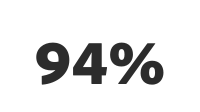
increase in the availability of digital Indian government services between 2023 and 2025.
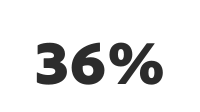
of citizens globally say ministry websites are effective in personalisation.
Adobe's DGI provides a clear view of how well ministries deliver online services. It not only benchmarks the digital maturity of ministries but also serves as a practical guide, helping identify opportunities to streamline and enhance citizen interactions.
Higher DGI scores translate into better civic outcomes. As more people easily engage with digital services, ministries gain efficiency, reduce delivery costs and reinvest in further enhancements.
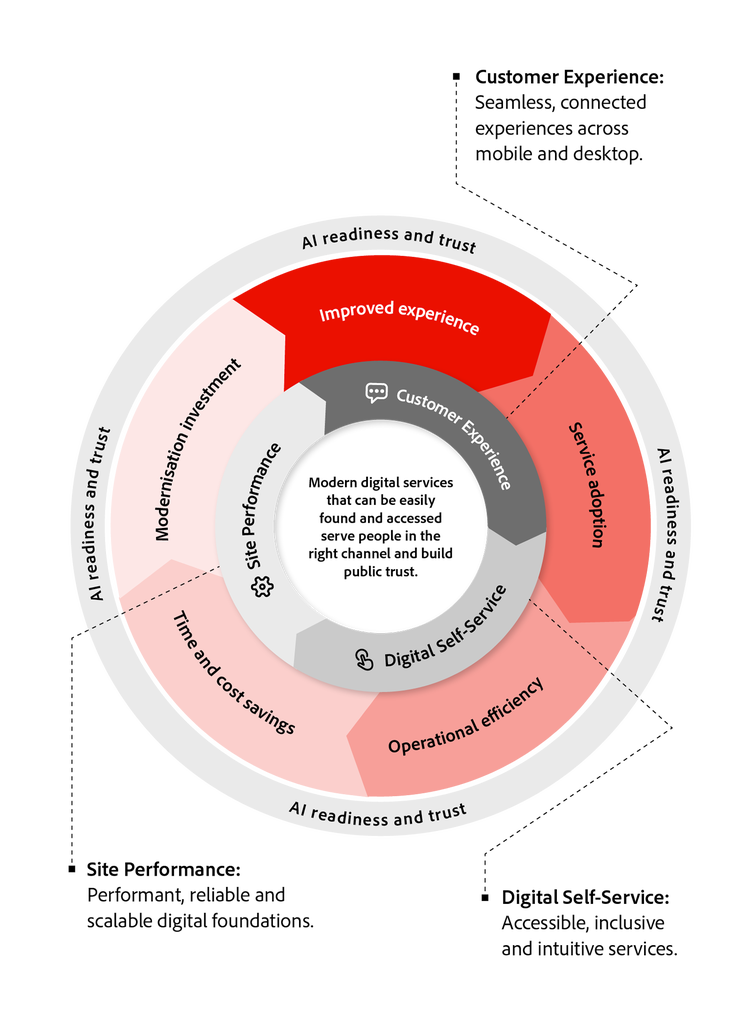
The DGI assesses effectiveness across three interconnected foundational digital maturity dimensions: Customer Experience, Site Performance and Digital Self-Service. It assigns a score out of 100 to each, then averages the results to produce a single index.
To capture what makes services accessible, usable and convenient for citizens, the report also evaluates two key digital enablers — personalisation capability, which measures how well ministries deliver relevant, user-centred experiences, and AI readiness, which reveals how easily websites can be found, trusted and accessed by both people and AI-assisted search tools.
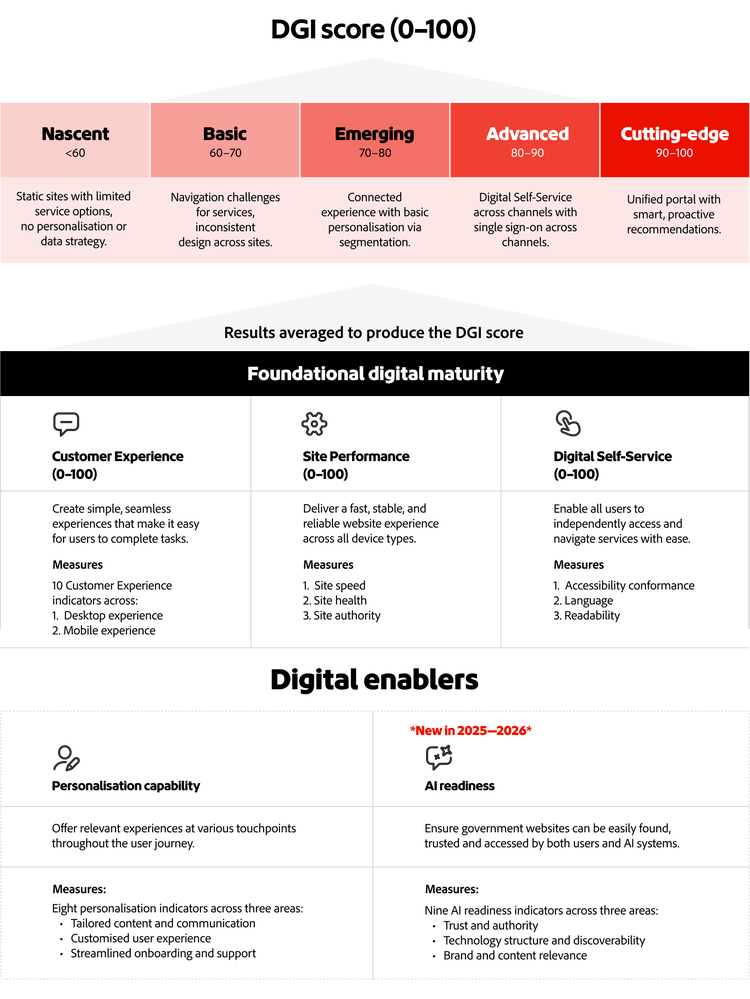
THE 2025 DGI RESULTS
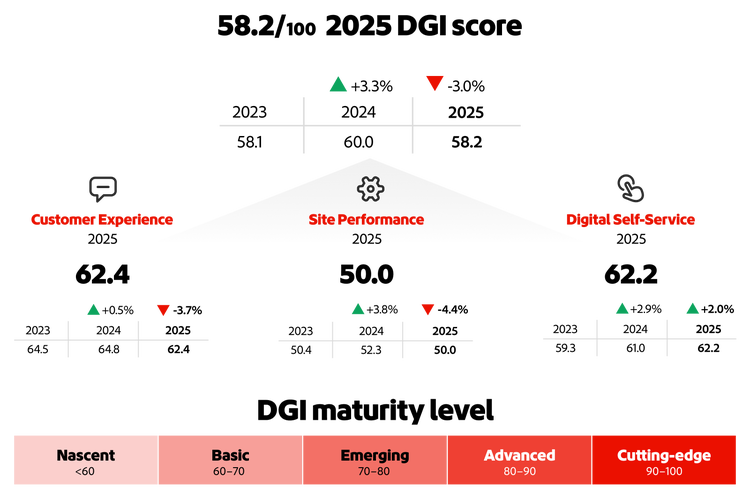
India's overall DGI score remained largely steady in 2025, despite significant national investments in digital transformation. The only minimal movement in scores over recent years suggests that while foundational efforts continue, improvements are not yet being reflected evenly at an aggregate level. A closer look reveals considerable variations between ministries, with public-facing departments making stronger progress, while others lag. The current initiatives are heavily focussed on expanding digital infrastructure and mobile-first services, with user-facing elements, such as readability and accessibility, improving more unevenly across ministries.
After rising in 2024, the national score, which aggregates all assessed ministries, has returned to the 2023 level and now stands at 58.2. Of the three measured categories, only Digital Self-Service showed improvement, continuing a growth trend and reflecting a national push to modernise government service delivery through digital channels, with accessibility a clear long-term priority across ministries.
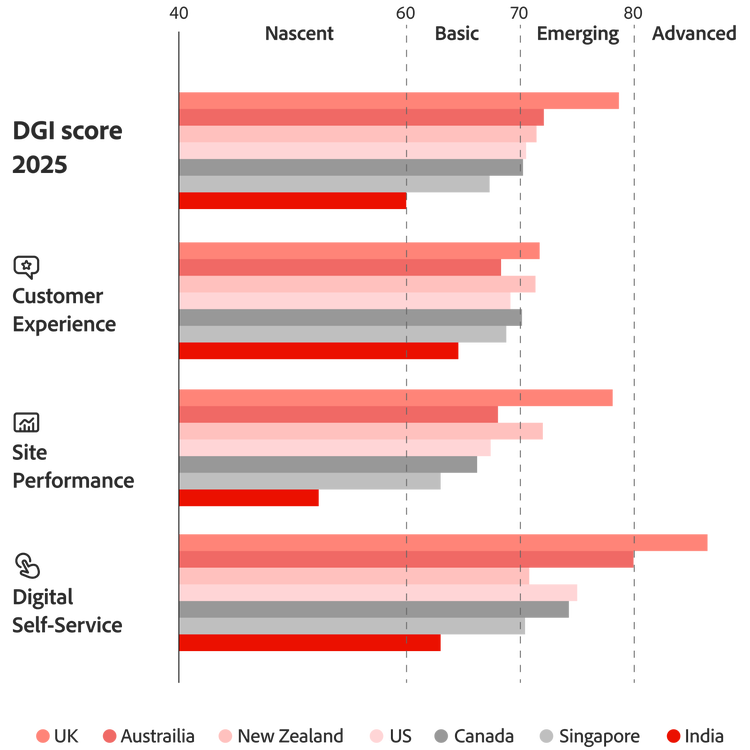
In 2025, the DGI assessed the websites of 115 government departments and ministries worldwide. The United Kingdom (UK) once again took the top spot, supported by strong oversight from the UK Government Digital Service, which helps maintain performance. UK government websites must meet specific accessibility standards and publish accessibility statements, as well as ensure ongoing monitoring and regular updates to make sure these commitments are upheld. This consistency reinforces the region's ongoing leadership and is key to maintaining the high quality of digital services over time.
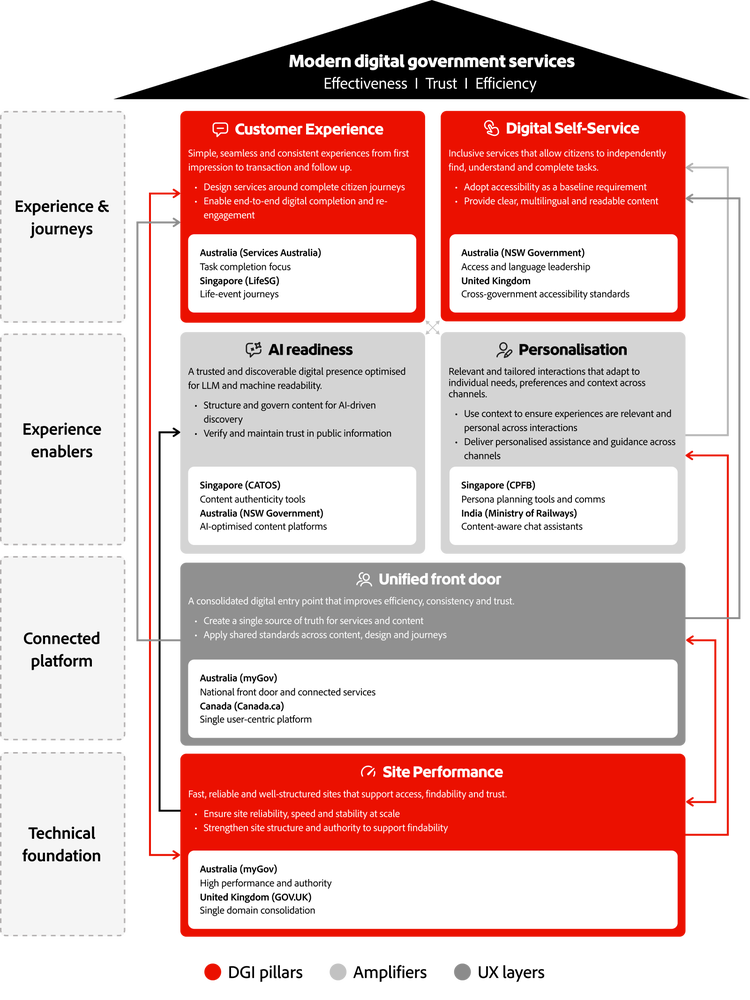
Across markets, DGI top performers share common traits: they serve as a central front door for citizens to provide a seamless experience across services, they maintain high accessibility standards and they offer more personalised, user-focussed experiences. These qualities explain why they consistently top the index.
UNPACKING PERFORMANCE
Customer Experience assesses how effectively a government delivers simple, seamless online interactions that enable users to complete tasks efficiently. It is tested on mobile and desktop devices, considering digital diversity and examining how an individual's unique circumstances, including any visual, cognitive, motor, or hearing differences, influence their experience.
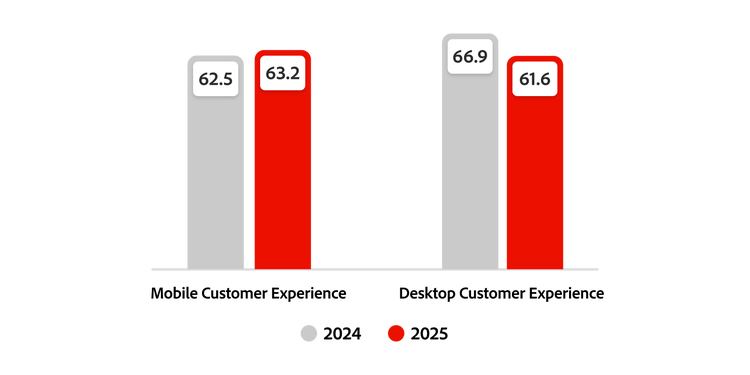
The 2025 DGI for India Customer Experience score was 58.2, a 3.7% decline overall. Mobile experience saw a modest improvement (1.1%). This reflects India's mobile-first approach and the increasing adoption of apps such as UMANG and DigiLocker. These apps streamline access to services for the 74%4 of users who access the internet via mobile devices. In contrast, desktop scores fell by 7.9%, likely reflecting legacy systems and infrastructure that have not been prioritised for modernisation. While mobile adoption is helping lift experiences, the proliferation of apps can also fragment navigation, limiting higher overall scores on this dimension.
The Ministry of Electronics & Information Technology (MeitY) recorded the highest Customer Experience score. Through initiatives like the Digital Brand Identity Manual, the MeitY enforces consistent layouts, navigation patterns and content structures, which directly improve task completion, learnability and time-on-task in user testing.
Site Performance is assessed across three metrics: site speed — how quickly a website loads on mobile and desktop devices, site authority — a measure of credibility and ranking potential, primarily driven by backlinks, and site health — a broader metric encompassing speed and other technical factors such as security, content and site structure. Together, these elements support both user experience and search visibility.
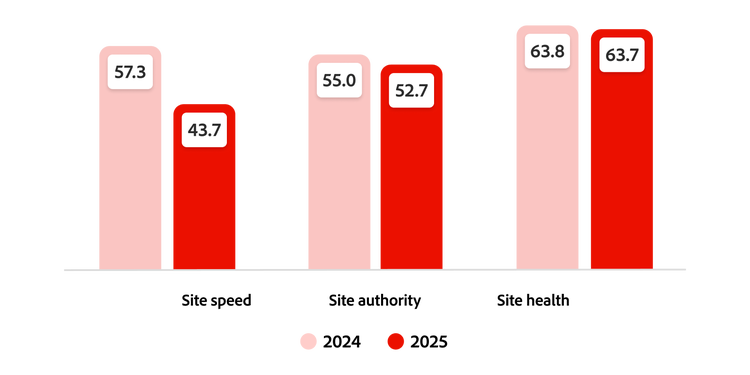
The 2025 national Site Performance score declined by 4.4% to 50. All three sub-measures fell, with average site speed experiencing the largest drop of 23.7%, including a 32.8% decrease in desktop speed and a 12.1% reduction in mobile speed. Site authority dipped by 4.2%, while site health declined by 0.2%. These results highlight opportunities to enhance Site Performance by updating infrastructure and refreshing content and optimisation practices to ensure government services remain trusted, efficient, accessible and future-ready.
The three measures are interrelated: faster load times improve user experience and site health, while a technically sound site is easier to index and rank, indirectly supporting stronger authority. Though each metric can be improved individually, a truly high-performing site requires attention to all three. As this report will explore in more detail, poor results in any of the Site Performance metrics can impact a ministry's AI readiness, as AI-powered search prioritises fast, reliable sites with strong authority.
The Ministry of Railways (MoR) exceeded all other ministries in Site Performance. Its significantly higher site authority score means the site is easily discoverable, trusted and reliable. This improves citizen confidence and helps drive higher self-service adoption.
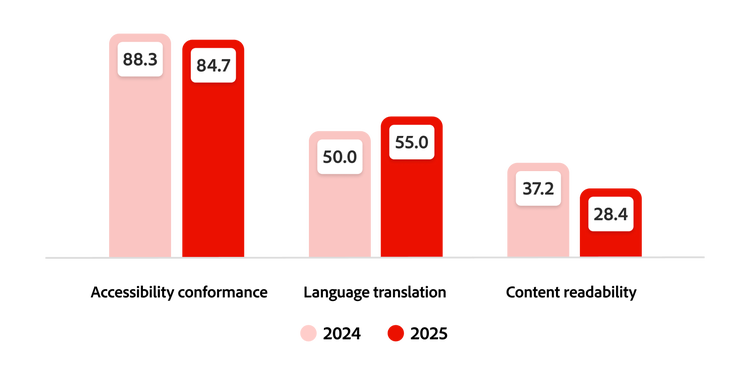
The Digital Self-Service assessment measures how easily users, including those with diverse needs or who use assistive technologies, can locate and navigate government services independently. It evaluates three areas: accessibility conformance, based on the Web Content Accessibility Guidelines (WCAG); the availability of digital and assisted language translation services; and content readability, assessed using the Flesch-Kincaid Reading Ease formula.
Digital Self-Service was the only dimension that witnessed positive movement, increasing by 2.0% to 62.2. The upward movement was driven primarily by improvements in language translation, an important development in a country with a highly multilingual population. For example, the UMANG platform, which aggregates hundreds of central and state government services into a single mobile app, supports 23 Indian languages and includes features such as text-to-speech and adaptable text spacing to support diverse users.
However, these gains were offset by a 4.1% decline in accessibility and a significant 23.7% drop in readability. In practice, this often reflects the pace at which services are updated or expanded, sometimes without accessibility checks being fully embedded into design, content and engineering workflows. Even relatively small changes to layouts, navigation or underlying codes can introduce barriers for users if compliance with the WCAG is not actively monitored or governed.
As part of building a digital government foundation, some ministries are experimenting with more inclusive approaches that harness AI. For example, Indian Railways has integrated Bhashini, the national AI-powered language platform, to support AI-enabled chatbots that help users navigate services and enquiries, in multiple Indian languages, using conversational interactions that reduce reliance on dense written content.
At a national level, Bhashini, led by the MeitY under the National Language Translation Mission, is aimed at enabling real-time translation and voice-based interfaces across government services. However, adoption remains uneven. These capabilities are currently concentrated in a small number of highly public-facing services and have not yet translated into consistently accessible, plain-language experiences across government websites and portals.
Readability remains a challenge for most ministries, with scores ranging from 2.4 to 41.5 out of 100. The evaluation rewards clarity and penalises dense or complex writing, highlighting the need to simplify language, improve content structure and prioritise communication that supports independent use. Without this shift, advances in translation and AI-driven interfaces face the risk of being undermined by complex source content that is difficult for users to understand, regardless of language or channel.
The Ministry of External Affairs topped the Digital Self-Service metric, thanks to digital service initiatives including the Global Passport Seva Program, which features AI-assisted chat and voice support, auto-filled forms and simplified document uploads, creating a more inclusive and user-friendly service experience.
AI READINESS IN FOCUS
Over the last decade, India has focussed on strengthening the foundations of digital government, with AI being an integral part of that agenda. Through the MeitY, the government has established responsible AI principles, policy frameworks and institutional guardrails, as well as attempted to build a stronger AI ecosystem by introducing initiatives such as the IndiaAI Mission, which was announced as part of the Global AI Summit. These initiatives signal a clear intent to develop a sovereign, trusted and inclusive capability that supports both public and private sector innovation. While much of the work so far has focussed on driving enablement and building capacity, India now stands at a pivotal point — moving from laying the groundwork to ensuring ministries are truly AI-ready, so they can adapt as AI reshapes how citizens discover, access and interact with government services.
In response to this shift, the 2025 DGI introduced an assessment to capture how effectively government departments perform in an AI-driven landscape. Alongside measures of foundational digital maturity, it evaluated how well government websites can be found, trusted and used by both people and AI systems. It examined three areas:
By combining these dimensions, the assessment not only reveals the current performance of government websites but also their readiness for an AI-enabled future.
The results range from an AI-readiness score of 51.1 to 73.1, highlighting the diversity of ministry functions. Ministries that offer open, unauthenticated services or public information tend to perform well on certain AI-readiness measures, as their content is more easily discoverable and referenced by LLMs. By contrast, those operating behind secure logins naturally record lower scores on specific indicators, though this does not necessarily reflect a lower level of overall digital maturity.
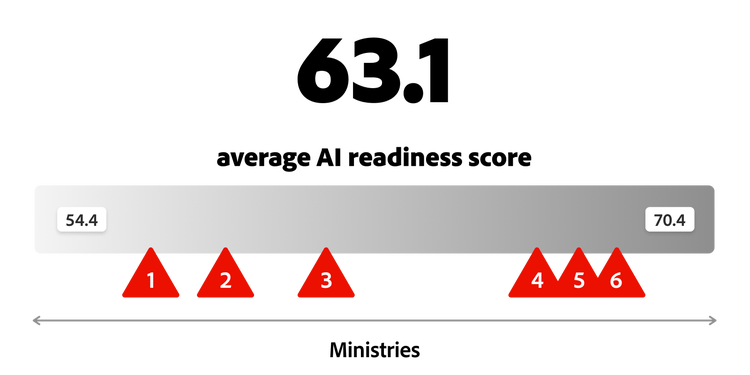
When examining the three key pillars of AI readiness, trust and authority scored the highest, reflecting the reliability and credibility of government information used by LLMs. However, the weakest area — technology structure and discoverability — stems from low AI visibility, suggesting that trustworthy information is not being effectively surfaced in AI-generated responses. The issue is compounded by slow page loading speeds, as LLMs favour faster, more accessible content.
Share of traffic is constrained by limited referrals from LLMs and low user demand for ministry-related keywords. This suggests that despite high levels of trust in government authority, official information may not be reaching citizens through AI-assisted channels, creating the risk that less reliable sources could fill the gap.

Across Asia Pacific, Singapore is a leading example of how governments can strengthen trust in digital content through innovation and standards. Singapore's Centre for Advanced Technologies in Online Safety (CATOS) initiative is exploring tools to verify the authenticity of digital content, including images and videos, by tracking provenance and modification history. This aligns with global efforts such as the Content Authenticity Initiative (CAI), which counts The Times of India among its signatories. Together, these efforts highlight a growing emphasis on content verification and provenance as a key lever for building trust in public information.
PERSONALISATION IN FOCUS
Connecting India's citizens with the right digital services, efficiently and when intent is strongest, depends on identifying individual needs and contexts. When ministries base their engagement on what they know about individual citizens, such as their location, primary language, ability or life stage, services become more intuitive, relevant and easier to navigate.
Adobe assessed eight aspects of citizens' digital journeys across government websites to understand the extent to which interactions are personalised. This acts as a more granular measure of personalisation capability, with each ministry assigned a ranking on a 100-point scale. Across Indian ministries, average personalisation scores ranged from 50 to 81.5. Despite this breadth, the top-scoring ministries were among the Asia Pacific leaders.
While citizen engagement with government doesn't always follow a linear path, the analysis identifies the stages where personalisation capabilities and gaps are evident. For Indian ministries, like many other countries in the broader study, personalisation capabilities are more prevalent in the early stages of a citizen's journey. However, personalisation is present across stages, including in half of offerings that provide chat assistance, which is higher than in other Asia Pacific countries.
We observed comparatively higher scores in areas such as services, updates and login experience, and in the consistently moderate personalisation of geo-based interactions and forms. This progress was likely supported by initiatives under the Digital India program — including the national identity system, Aadhaar, and the integration of the UMANG app with India's digital wallet, DigiLocker — which together help provide citizens with access to a wide range of services and personal documents through a single platform.5
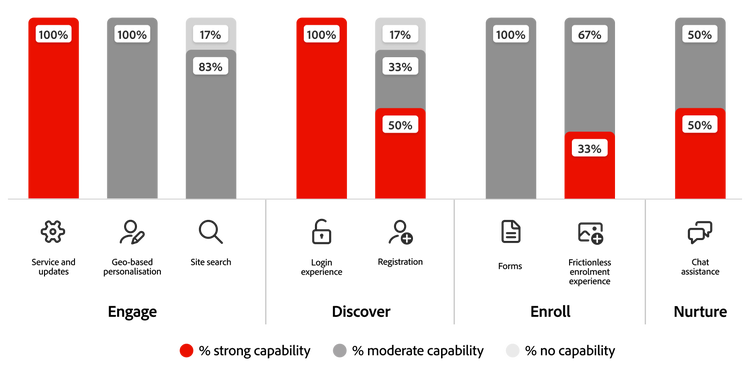
The MoR showed moderate to high levels of personalisation across citizen journey stages. One example is the voice-enabled, advanced virtual assistant, Disha 2.0, which supports next-gen AI-powered ticketing in multiple languages. The system stores passenger details and provides context-aware responses that become more relevant to users over time.
•Slow site speed creating barrier to access
• Accessibility not consistent across ministries
• Ensure site reliability and stability to support increased site traffic
• Adopt accessibility
Reduced:
• Call centre volume
• Pages per visit
• Returning visitors
Visit duration:
• Abandoned forms
• Customer complaints
Increased:
• Transactions initiated
• Transactions completed
• NPS
• Trust
• Low search authority impacting findability of content
• Content not optimised for LLM or AI-led discovery or agentic AI
• Inconsistent tagging or metadata
• Single source of truth for content across all areas and level of government
• Structure and tag content using machine-readable metadata
• Distributed authoring and approval capabilities with LLM publishing workflows
• Use AI to ensure adherence to brand and tone guidelines
• Verify AI-generated and summarised content through the use of data provenance tools
Reduced:
• Call centre volume
• Pages per visit
• Returning visitors
Visit duration:
• Abandoned forms
• Customer complaints
Increased:
• Transactions initiated
• Transactions completed
• NPS
• Trust
• Content not optimized for mobile
• UX is not optimised for mobile
• Mobile features are not utilised fully in design
• Design adaptive experiences optimised for mobile devices
• Enhance mobile security and login simplicity
• Provide voice- and chat-based support to improve access
Reduced:
• Call centre volume
• Pages per visit
• Returning visitors
Visit duration:
• Abandoned forms
• Customer complaints
Increased:
• Transactions initiated
• Transactions completed
• NPS
• Trust
• Citizens must repeatedly provide information
• Limited access and automation of application process
• Citizens unable to re-engage life journey from where they left off
• Lack of personalisation in digital interactions
• Enable end-to-end digital service completion enabled by automation and AI
• Use context to ensure each citizen's experience is relevant and personal
• Deploy generative AI to simplify forms and scale personalised communications
• Connect and share citizen data across the government based on privacy and consent
Reduced:
• Call centre volume
• Pages per visit
• Returning visitors
Visit duration:
• Abandoned forms
• Customer complaints
Increased:
• Transactions initiated
• Transactions completed
• NPS
• Trust
• Content not available in all languages
• Content is not suitable for lower literacy levels
• Content is not tailored for individual groups
• Provide multi-lingual and multi-modal content using AI or translation services
• Use AI-driven voice functionality or natural language chatbots with multi-lingual support
• Generate simplified summaries for low-literacy audiences and LLM consumption
• Provide the ability to have content served in easier to read formats or in video
• Personalise content based on preferences and behaviours of citizens to ensure timely support
Reduced:
• Call centre volume
• Pages per visit
• Returning visitors
Visit duration:
• Abandoned forms
• Customer complaints
Increased:
• Transactions initiated
• Transactions completed
• NPS
• Trust
Every year, Adobe's DGI evaluation aims to deepen the understanding of how digital government services are evolving in India and internationally. While the previous assessment reflected steady progress as ministries focussed and built their core digital foundations, more recent results indicate a period of consolidation, with overall performance stabilising rather than accelerating. This plateau highlights an opportunity for ministries to shift from establishing a strong foundation to driving targeted improvements that strengthen user-centric design, accessibility and day-to-day service performance.
We partner with government ministries to embed the index framework and strengthen ownership across the citizen journey. By leveraging digital enablers such as personalisation capabilities and AI readiness, we help build the digital maturity required to deliver services that meet citizen needs — today and in the future.
To understand how your benchmarking performance compares and discuss specific opportunities, please contact Deeksha Thakur at deethakur@adobe.com for a preliminary discussion.
Adobe's Digital Strategy Group developed the annual Digital Government Index for India in 2025. The analysis covered the official websites of the following ministries under the Government of India:
Each of the three foundational digital maturity dimensions below was assigned a score between 0 and 100, with the average
producing the overall DGI score.
The team also analysed the following digital enablers using the following methods: