VIDEO
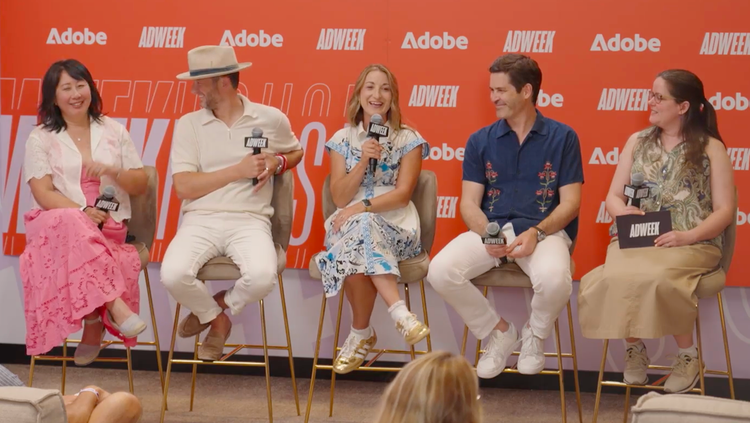
Adobe Sunset Series at ADWEEK House — The New Balance: Creative Experimentation Meets Brand Consistency.
As AI becomes part of the creative process, authenticity matters more than ever. At Cannes Lions, leaders from Walt Disney Imagineering, DICK'S Sporting Goods, WPP, and Adobe shared how they are scaling creative workflows without compromising brand identity.
Key Highlights
- AI may speed up creation, but authenticity is what keeps brands from blending into average.
- Leading brands use AI to scale expertise, deliver consistent experiences, and strengthen brand identity.
- The future of creativity isn't AI versus humans. It's AI helping teams move faster with people at the center, shaping the story.
Brittaney Keifer: Hi everyone! Welcome to our last session of the day at ADWEEK House. I'm Brittaney, I'm the creative editor, ADWEEK, and maybe we can just quickly go down the line. Everyone can introduce themselves.
Stephen Pretorius: Hi everyone, I'm Stephen Pretorius. I'm the Chief Technology Officer at WPP.
Kate Fedishen: Thank you for having me. Kate and I lead marketing transformation at Dick's Sporting Goods,
Kyle Laughlin: And I'm Kyle Laughlin. I lead technology and engineering for Walt Disney Imagineering.
Hannah Elsakr: And I'm Hannah. I'm with Adobe Gen AI new businesses.
Brittaney Keifer: Great. Great panel today. So, a word that you're going to hear a lot today, if you haven't already, or this week I mean is AI. It's a big, big buzzword of the festival. So, we're going to be getting into some real-world examples today. So I guess the big question is we're kind of in this AI-saturated market now, in this environment, what can brands do to avoid just blending in with everyone else? Kate, do you have any thoughts on that?
Kate Fedishen: Sure. I'll start us off. It sounds cliché, but I think part of the way we believe we stand out is by having a belief that we stand for and having a brand system that is true to us. So DICK’S. We say everything goes back to sports changing lives, and so that guides all of our work. It provides consistency in our work. And then I think, as we think about we call our customers athletes. We think about not just the one campaign or the one moment here, but truly, how do we build a mode of experiences consistently across that full journey? So it's things like, yes, campaigns, but also them using the Game Changer app, or coming into a House of Sport and doing the batting cage or coming in late night after a championship win, after the Knicks win and getting the shop or getting the shop in our stores late. So I think it's those consistent, emotive experiences that, over time, will allow the brand to stand out.
Brittaney Keifer: What about you? Kyle? Like, how are you thinking about this issue?
Kyle Laughlin: I mean, I think authenticity is an important part of brands standing apart from one another in this space. And I think the way that we think about it is we have 70 years' worth of proprietary data that helps us continue to train these AI models and create something that's incredibly authentic to the brand and to what we try and do from a design perspective. Within Imagineering, as we envision the future of our theme parks, cruise ships and our hospitality experiences, that authenticity and is what people pay for. It's what people want to come to Disney for, and our ability to do that is really important.
Brittaney Keifer: So, Hannah, you are advising some of the biggest brands about AI. What kind of challenges do they come to you with? Is it is that that concern about blending in or what are how are you advising them?
Hannah Elsakr: I mean, there's so many things we talk about. I think Kate and Kyle hit on two. One is standing out from the average right? And general AI models are trained to go to the mean and to the average. And so Disney's not average. DICK’S is not average. They have very special brand fingerprints. And I would say those are not in flat files like images. So, understanding what your special sauce is and making sure that you can deploy that in a model that you trust. So that's kind of the second word I think, is trust for the enterprise. Those are probably the two things I hear the most. Stephen, I, of course, work with lots of brands that are struggling with how to deploy in the most important way. I think Kate for DICK’S and Kyle with Imagineering have thought about the fundamental workflows and pipelines and deploying it there. So those are just some of the themes that we've started talking about in 26. And I'm glad we're here.
Brittaney Keifer: Yeah. What about you? Stephen, as you speak to brands, we're kind of past the hype cycle now. Now it's becoming real. Like what concerns are or challenges are you hearing? Yeah. I think consistency and accuracy are really important.
Stephen Pretorius: I think certain categories are much harder for AI to represent properly. You know, automotive as particularly hard because there's so much detail in so many, you know, elements of the product that have to be represented completely accurately. And I think the, you know, if you think about that, particularly over time, as the models have become more competent, the core, base models or the state-of-the-art models have become more competent. I think a lot of people got confused by that and thought that ultimately, one model would be able to contain all the IP in the world. In other words, one model will be able to represent all brands or products or places accurately. And I think where we're getting to is actually a much healthier, far more sustainable place where the model-making companies, but also, you know, all the players in the ecosystem, have now realized that that's not a realistic outcome and that's actually not a legal outcome. And so you're seeing a lot more of these sorts of smaller models being trained on particular pieces of IP or brand or product that then can live within a larger model that understands the world and physics and things like that. And so that, for me, is a kind of a much healthier way that we're getting to. So I think that's still a big concern. And people are still, you know, kind of inconsistently confused about that. The other big issue is obviously just representation, particularly of people and the ethics around that. So we have in some parts of the world where we operate, clients don't care about that at all. It's not an issue. It's not a cultural or social issue. In most other places, it is. And, you know, I think particularly for beauty brands. This is a and maybe it's the same thing for athletes. You know, if you're a beauty brand like Dove, for instance, and your brand platform is real beauty, using you know, synthetic people in ads would be a complete anathema to your brand platform. So I think, you know, brands are beginning to figure out what their own limits are. But I think those are the kind of the two consistency and, and sort of the representation of people. The two biggest issues still.
Brittaney Keifer: Interesting. Yeah. And Dove was actually an early brand to come out and say, we're not going to use any AI-generated images of people in their advertising. Right. So let's get into some more real-world examples. Kyle, we recently talked about an interesting story with Disney Imagineering. So obviously, you know, you're on this big push to kind of develop more parks and experiences for fans, but that can take years. Fans are very passionate. They don't always have the patience to wait that long. What is AI allowing you to do in that pipeline that you couldn't before?
Kyle Laughlin: Sure. So this is one of the most exciting times within Imagineering. We're investing 60 billion over the next ten years to create new theme parks, cruise ships, and there simply aren't enough Imagineers in the world today to do all of that work. And so we think about this with a designer and a creator. We've been a talent-led company since its inception, and so we believe there's a human in the loop as a part of the design process. But the partnership with Adobe on Firefly Foundry has given us this opportunity to deliver these experiences to guests faster. So, iteration cycles that would allow us to present three items to clients now, internally, can now allow us to create 30 options. We can create 300 options. Things that would have taken weeks, months, years to produce, we can now do in days. And so our opportunity here is to bring our experiences day and date to your favorite film. Toy Story 5 just opened. How do we ensure we're not waiting for five years before we develop the next Toy Story experience? And partnerships with companies like Adobe help us accelerate that process and deliver it faster to guests.
Brittaney Keifer: And you guys have a space over by the Palais I saw today, so people can go check it out, kind of what that looks like. What was mentioned earlier is just this idea of brand-safe creativity in the age of AI. Disney has such precious IP, like such a long legacy of needing to protect that. How are you navigating that? Well, not only are we trying to protect the IP, but we're trying to protect the creators of that IP. And so the opportunity to have a responsible model trained on Disney data gives us the opportunity to continue to work closely and recognize the incredible creativity of an individual without sacrificing that in terms of our ability to deliver those things on time and in a faster way.
Hannah Elsakr: We talked about, just when we're at the activation, how most of the Imagineers are working in Adobe tools; they've been working in them for a while, and so decades. Thank you. And I think the combination of responsibility in this new era, plus the fact that they have pipelines with tools in it that they're familiar with, has made this really.
Kyle Laughlin: Yeah. We don't have to learn those things over and over again. And so, we don't waste time doing that. We absolutely deliver it and stay focused on our guests.
Brittaney Keifer: And how are your Imagineers? Kind of like, how do they feel about AI now? Because I imagine some of them, when it was first brought up, might have been a little nervous.
Kyle Laughlin: Yeah, I think for every organization it's a process, right? And I think that sticking to the ethos of the company, the legacy of being creator-driven and doing things responsibly with partners like Adobe has endured a group of people to continue to try and innovate with the latest tools and move as fast as possible.
Brittaney Keifer: Yeah, so something that kind of comes up a lot in marketing conversations is this idea of building brands, building worlds for their consumers or their fans. You know, this is a kind of more concrete example, but what's the difference between using AI to achieve that and just creating more forgettable work like Kate, do you have any thoughts on that?
Kate Fedishen: I think if you approach using AI just to scale, I think you won't get the results that you're maybe looking for. I think we've learned AI can help us get the scale and achieve personalization at scale in a way that was never possible before, but I think having the intent at the beginning to be much more than that is incredibly important. And so, as we think about sports is a really fun place to be in, especially youth sports. We have athletes coming in with dreams of being a professional athlete or just making a high school team. And when we start to think about how AI could potentially change and put people in these worlds that they weren't before as part of their athlete journey with us, you know, whether it be apparel or their sporting goods equipment, I think it can start to get really exciting.
Brittaney Keifer: Yeah. Is there any specific example recently that where you've kind of gotten into that?
Kate Fedishen: Nothing I don't think specific. You can we can we've done we've done some really exciting work when we think about our, our fan journeys. So fans of professional athletes and we've changed how we bring that those communications to athletes in terms of making sure we are talking about the right sports team in the right moment, because we know AI can also help us be relevant at the right time, which for sports, it's incredibly important to be to be relevant at the right time.
Brittaney Keifer: How are you talking to brands about this?
Stephen Pretorius: I mean, look, I think the key realization and just building on what, what Hannah and Kyle was saying is that what we've learned is that AI in creativity is really about process engineering. It's about using AI tools and models, along with creative tools that people have been using to tell stories, make content animate and, you know, create videos and edit them and do VFX, etc. and so none of that has really changed. Right. And I think this is the key thing. I mean, if you speak to someone about about this, this area and they go, oh, well, AI is going to kill your business because I can make a video using a model. Good luck. I mean, it's not that easy. And candidly, if you don't have a great idea, you don't have a great story. You can't translate that great story into a great script. You can't translate that great script into a storyboard, into a visual system. I mean, you know, those things still are critical, you know, to get the outcome. That's all process, right? I mean, what's your question about how do you make things stand out? There's a great example of a piece of work that just launched today for Lexus, one of our creative businesses. We have been working with Lexus for more than a year now to really push the boundaries of AI filmmaking for car ads, right? And what's interesting is that the agency and the client have gone through this process together. They've sort of pushed the boundaries, thought about the possibilities. And, you know, they were really early on focusing a lot on sort of visual effects, like flying electric fish and all kinds of wonderful things. But what they did recently in this new campaign, you can find it on LinkedIn. If you look, they informed the entire storytelling and the narrative of the ad. It was about Lexus through summer. Like, what are you gonna do with your Lexus this summer? With cultural references that we picked up, actually using an AR cultural intelligence tool to see what trends are, are kind of, you know, sort of peeking in different parts of the world. And so all of the cultural references around things like handmade products and pottery and handmade jewelry and all these kind of things, these sort of, you know, summer experiences where you're getting, you know, more tactile, more sort of meaningful, purposeful, everyday experiences is then worked into the content. And so I think, I mean, there's one big theme already, I know it's only day one of can, but you know started yesterday already. But it's like I think a lot of people are beginning to amp up not only the human creativity, but the value of storytelling and the value of good stories. Right? I mean, and that to me is just kind of a really cool shift because, you know, we shouldn't be talking about the technology. We should be talking about, whether it's impacting consumers? Is it moving people?
Brittaney Keifer: Right. Yeah, I've noticed that as well. Like last year, there was a lot of talk about AI's potential and over the past year, much more concrete, you know, real world examples, but also taking brands, taking a stand for like the human craft, the storytelling and weaving those two together. Hannah, is that something that comes up when you speak to brands like, are you noticing that trend as well?
Hannah Elsakr: Yeah, well, one thing I just want to add, because Stephen and I have talked about this, is bad creatives and bad movie plots have existed for a long time before AI. Probably we're seeing it because it's speeding up, but nothing takes away from the human narrative, right? Great storytelling, great empathy, great ad campaigns speak kind of deep into deep for us, and that's why we engage. I think what's really interesting when I talk to both enterprise brands or creators is that they can greenlight themselves, in a sense, by showing visually versus giving a written brief, which sometimes it's hard for us to imagine. What did you mean by that? I can actually show you a previous one now without a lot of time. And you've talked about this, which is I can show you 30 ideas, and you pick, versus me trying to explain that. So, I think the idea of being able to visualize what's in our minds, and we work with lots of artists. Norman Teague, who's a furniture designer, says, I'm unlocking my sketchbook. Movie directors are saying I'm greenlighting myself for less money because I can show you where I'm going with that plot line. I think that's the most exciting time. So, this idea of replacing us is a little bit odd. I hope next year we're not actually talking about AI separately from the work and the process engineering and everything we're doing. So that's where I think we are.
Brittaney Keifer: Yeah, I think like going back to Disney, I was really intrigued by this idea that someone who doesn't know anything about AI could go to a Disney park and be experiencing something in real life that was enabled by AI and maybe not even realize it, you know? What do you think like AI will make possible for those fans when they actually visit it in person?
Kyle Laughlin: I mean, so much of our work is in kind of the design process over multiple years, and so decisions that you make early on in the process can have big ramifications when you're in the field constructing steel and laying concrete and building something. And if you make critical errors there, you make trade-offs from a cost perspective. And that ultimately comes at the cost of the guest and the experience they have. If you can make those errors up front, that then allows us to put more of that in front, more of that investment in front of the guest. And so that iteration, that acceleration of our process, the ability to work through that, to be able to take and find bad ideas earlier and what not to do. I mean, that is a huge unlock in terms of the billions of dollars that we invest in these experiences.
Brittaney Keifer: Yeah. What about for you, Kate, like this idea you talked about fan journeys, like the idea of the physical and the digital meeting? What is AI allowing your brand to do in that sense?
Kate Fedishen: Yeah, that's an exciting space for DICK’S because we have a really big store presence. We have 50,000 square foot stores. We have 100,000 square foot stores with our House of Sports stores. And we also have a meaningful presence with our app and our site. And we know that athletes do not shop on one or the other. It's all seamlessly throughout digital and in the store. And so previously, the only way you would get expert knowledge from DICK’S is by going to a store and talking to one of our teammates and trying to understand what would be the best running shoe for you, or how to best train for a marathon. And now we recently announced that we're launching Coach by DICK’S, which is a digital coaching agent. It's powered by AI. We partnered with Adobe's Brand Concierge and our own Dick's knowledge and content to really be able to provide that experience now through the app that previously you had to go to a store. So through the app, they're going to be able to be able to get product information and get guided on what product might be best for them, or better, be able to a training plan and have it all be tailored to them. So it's really being able to seamlessly, and I think the tool even be helpful for our store teammates who are so knowledgeable and just closing the loop to be able to provide that consistent experience.
Brittaney Keifer: Yeah, consistency is a big one too. I know a lot of brands are concerned about that, and that must be something you've thought about with Disney. Like if you go to a Disney park, you would know it's a Disney park even if you didn't see the branding. So how to how does it AI help you maintain that?
Kyle Laughlin: Well, 70 years of experience is kind of tied up in laptops or machines that are under people's desks or in people's minds. Those people are retiring. They're, you know, working in, in different areas. And so if there was a way to be able to unify all of that, use that data to train a model that now every Imagineer that starts on day one has access to, that gives us an incredible ability to create consistency across every touchpoint. We talk a bit about Crookedology, which is a unique design aspect of Disney parks that is trained over years, decades of experience. And now we can give every associate, every architect, every landscaper, all of that insight on day one, which is hugely powerful.
Hannah Elsakr: I have to give a funny example. So, you know, average models are trained for buildings that have right angles. That's how the walls stand. Crookedology is if you've ever been to a park, it's like everything is a little topsy-turvy, right? It's about to fall. Look at Olaf like he's about to fall over. And so having to say deep tune this model to deeply understand and respect Crookedology, not right angles on the buildings, was a thing we did together. And that was really fun. I learned a lot about that. I hadn't noticed but now notice when I go back to the park, that's the kind of deep tuning and what Kate said, not just about athlete knowledge that they have merchandizing. You are so specific around drape and how things look when they're on the web page and PDP. That's deep tuning that you all wanted to pursue so that it really reflected your product and your brand. So anyway, those are some fun stories.
Stephen Pretorius: I mean, one thing just to add on that one is, I think the most interesting thing about using AI for brand consistency is that you've got to think both forward and backwards. So forward is do you have a set of encoded standards that you can say to a model, make content that looks like this and so that it is brand consistent and the and the backwards is this thing that's been made brand consistent. So I mean like Transformers, it always goes forward and backwards. Right. But what's also really interesting is that the process of encoding a brand system into code to make it ready for AI generation is also what you need to do in order to make LLMs understand your brand elements properly. And I think sort of starting to get off of piece. But massive issue today in the fact that LLMs perceive brands differently from humans. So if you do brand value studies of any brand today and you compare how LLMs see the same brand, there's a Delta and it's either it's other positive or, in some cases, negative. In fact, probably in most cases it's negative, in some cases positive.
Brittaney Keifer: So why is it mostly negative.
Stephen Pretorius: Because a lot of human brand perception is legacy and it's based on personal experience and it's not written down. And so if you think about where LLMs get their data from: Reddit reviews, social, etc. The point is brands that rely more on legacy perception and experience. I mean, and I want to say brands like maybe Wendy's or McDonald's or whatever else, you know, people write less about them, and there's less content on Reddit and whatever else about them. And so, the LLMs, no less about them and therefore don't rank them as favorably. And so there's a real issue. Right. Because what happens is that if you now go to ChatGPT or your favorite chatbot, and you say, you know, what's the best burger joint? And they're going to talk about the one that is trending on Reddit, they're not going to talk about Wendy's. Right. So how do you interfere and/or how do you influence that process is now becoming a real issue.
Brittaney Keifer: What should brands do about that.
Stephen Pretorius: So I mean I've got a let's discuss it because I mean we have some theories. Content marketing is one big thing. So brands to do a lot of good strategic content marketing brands you have a lot of content that is scientific or detail about their product. So medical kind of cosmetics with high kind of, you know, sort of clinical data around them tend to do better. Brands who emphasize social and influencer do better with LLMs because there's more chat on the internet about them. And then, you know, brands that are just part of culture. I mean, like, you know, sort of, you know, Ozempic, Mounjaro, these brands are like massively over on LLMs compared to what consumers say.
Hannah Elsakr: Also, I just think thinking about two audiences, right? We always think about demos and how many audiences we have in human demos. I do think you have to think of the agent and you know, the as another or the LLM as another audience for you to think about. This is part of why Adobe acquired SEMrush, because they're the thank you. You were like, looking at me. You're going to say SEMRush, because they were the number one in SEO, and they have this huge database about what works well from an L standpoint, authority not marketing straight up, which is why the influencer economy, which has essentially every brand, is working with influencers. You sent some to the park yesterday. That's number one, right? That's authority. And being out there in trending, being Zeitgeist in the moments that matter, whether it's the Knicks, Go Knicks or the Superbowl or something else that's coming, making sure your brands are present there, it's not about just indexing your web page anymore, which was SEO.
Brittaney Keifer: Yeah. It's interesting, kind of like things like content marketing, social and influencer that's really about storytelling if you do it well. So, it's coming back to these like principles that marketers have known about for a long time. And also, just this, you know, the emphasis on human connection is becoming more important, the personalization. Kate, is there anything that, you know, AI enables you to do in that sense that you weren't able to do before?
Kate Fedishen: Yeah, I think I mentioned a couple of the examples. I think we talk a lot about athletes as athletes, but also athletes are fans. And I think fans are complicated. Where you live might not be the team you root for. You might change your allegiance the next day. And leagues are complicated across professional leagues and NCAA, so I think AI would just allows us to connect the dots of who our athletes are and connect the dots of who our athletes are and again, not who they are as athletes, but who they are for. And really, we're focused on designing what is the right experience and journey for them as they go on. Start every year with all the optimism in the world for their team.
Brittaney Keifer: All right. So to wrap up, I'm going to ask you each two questions. One, what is like a question or challenge that you want to get into this week in Cannes about AI that you hope more people talk about?
Stephen Pretorius: Is that both questions?
Brittaney Keifer: Well, the first one that's number one.
Stephen Pretorius: Number one, Cost control. Management economics.
Kate Fedishen: We've talked with Adobe about how thinking of the agent as another audience. And I think that's something that sparked a lot of conversation. So I think learning more about that will be great.
Kyle Laughlin: And we're going to continue to try and work on how to responsibly create these experiences and want to hear more options and more opportunities from all the small, medium and large companies out there that are doing really exciting things in that space responsibly.
Hannah Elsakr: I want to hear about two things. Sorry. I'm going to say two. One is responsible. So, you know, I think legislation in Europe, in US, I'd like to see us move and declare, like, what do we think is responsible, and what IP and copyright protection really mean? And I'm with Stephen, which is economics. If we can't make the economics work not just for large enterprises, but mid-size starter influencers, I think this peters out over time. So that's on us to figure out where in the workflow to make it most efficient.
Brittaney Keifer: Cool. And so last question what are you excited about? You know, what do you want to do more of with your brand or the brands that you work with or what excites you about this space?
Stephen Pretorius: I mean, I think the thing I'm the proudest of that I've been part of, or, you know, managed to shape it through a WPP in the last 4 or 5 years is that we launched a creative technology apprenticeship program because we didn't have the right capability and skills in the market. We couldn't find the people with the right skill sets, you know, and so one of the people that that I think you know him as well and how you work with them, Perry Nightingale and my team came to him one day and said, I want to build a school. And I said, okay, great. Sounds like a cool idea. Let's do that. And I mean, it was so successful that it's now become an AI creative studio. We launched last month. It's called Hex Studio, and with Adobe, we're now training a thousand for deployed creatives on complex, creative technology pipelines that combine Anthropic and NVIDIA and Adobe models and skills into tools that we can deploy with clients. And so, the sort of, you know, growing of the industry, grassroots up is the thing that I'm most excited about and proud about. And and it's we're just getting started. But it's a it's a unique skill set of combining, you know, AI-native, much younger people in our industry who are incredibly creative, incredibly kind of curious, who learn these tools quickly and can quickly innovate and turn things, turn technology into tools for storytelling.
Brittaney Keifer: Yeah, that is exciting. What about you? Kate?
Kate Fedishen: I mean, look, I'm really excited about the conversations we're having here in the narrative around AI and how it is evolving. And it'll be interesting to fast forward a year and see where we're at. And then I mentioned Coach by DICK’S. I think we have a lot of exciting projects in the hopper at DICK’S Sporting Goods, and so I'm excited that we're close to getting them out for our athletes.
Kyle Laughlin: I'm excited about how fast everything is changing. And so, for a company that's 100 years old and, you know, it's been very careful along that creative process, the amount of change that we're seeing from today to tomorrow to next month is exciting because we're moving, and we're trying to continue to innovate when there's something new every single day. And so, there are going to be a thousand new things we're going to be talking about a year from now. And our goal is to kind of continue to drive where the brand and the company can go and utilize all the tools necessary to make that happen.
Hannah Elsakr: I think we're about to enter a new creative renaissance, right? It happens every time that we have new technology. And the first thing is we're afraid that's just human nature is we don't know what to do with it. So this week, I'm personally excited to connect with lots of artists and creators to be amazed myself of what they're doing. You know reinventing themselves in many senses. You know, they were a 2D artist. Now they can actually work in 3D, when that used to just be for people who understood math. Right. So, I'm super excited about what we're going to see in the next couple of years around creativity and just new experiences that will happen.
Brittaney Keifer: Yeah, I'm excited about that, too. I bet a year from now, when we're all back here, we won't even be having the same conversation. But thank you so much for sharing all your insight and your experience. This is our last ADWEEK house session of the day, but please stick around for our Adobe Sunset series and come back tomorrow. Thank you, thank you.
Recommended for you