Video
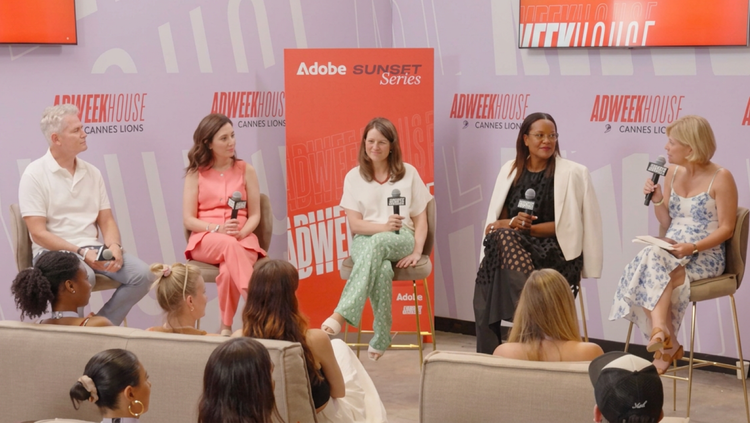
Adobe Sunset Series at ADWEEK House — Making a Moment: When Creativity Becomes Culture.
Creativity becomes culture when brands underwrite the moment instead of interrupting it. At Cannes Lions, marketing leaders from YouTube, Ulta Beauty, Adobe, and the NFL shared what that takes. Watch them discuss how brands earn relevance by joining cultural conversations, empowering creators, and scaling with AI.
Key Highlights
- The best cultural moments happen when brands join the conversation, not try to own it.
- Creators bring authenticity, trust, and community that brands can't build on their own.
- AI is helping marketers move faster and scale creativity, but humans still make the decisions that matter.
Jenny Rooney: Welcome. Welcome to the ADWEEK House for those of you who are here for the first time, and welcome back to those of you who have been with us all week. And it is only Tuesday, but it feels like a lifetime in the best way possible. Am I right, Tim?
Tim Ellis: Yes.
Jenny Rooney: Thanks for backing me up. Thank you all so much for joining me. I am Jenny Rooney with ADWEEK, and I'm really excited to have this conversation on Making a Moment: When Creativity Becomes Culture. So, you can let that kind of simmer a little bit. And we're going to dive into what that really means. But I'd love for you to introduce yourselves and tell us a little bit about what you do. So, starting here.
Anne-Marie Nelson Bogle: Okay. Hi. My name is Anne-Marie Nelson Bogle, and I lead our global YouTube ads marketing business. So, from a B2B perspective, we are speaking to brands about how to not only build their business and their brand presence on YouTube, but also to drive performance. So, in a nutshell, that's what I do. And while I'm at YouTube now, I also worked in the beauty industry for 18 years before that.
Jenny Rooney: Okay. So, you've experienced being on...
Anne-Marie Nelson Bogle: I've experienced being on the other side of that as well too. So, yeah. And what I like to tell people is that I started in beauty when I was ten, which is why I look so young. No. Or I'm just using great products.
Jenny Rooney: I love it. Hi.
Stacy Martinet: Thank you, Jenny, for having me.
Jenny Rooney: Thanks for being here.
Stacy Martinet: Thank you. And I had to come to Cannes to be reunited. I know, right. I'm Stacy Martinet. I'm the Chief Content and Creative Officer of Adobe. So, I have a few things I need to do. One is really bring our mission of empowering everyone to create to life through inspiring stories, partnering with creators, and bringing the best of our customers into all the content, the creative that we do, and along the way, doing that by really transforming how we work inside the company from a brand studio to becoming a media company. So, thank you to all of our Adobe customers in the audience for being here. Awesome.
Kelly Mahoney: Hi, I'm Kelly Mahoney, Chief Marketing Officer at Ulta Beauty and client of Adobe. Thank you.
Tim Ellis: Oh, I'm Tim Ellis, and we're partners of Adobe. Thank you. I'm the Chief Marketing Officer of the NFL. I'm in charge of growing, developing, diversifying the fan base and monetizing that fan base to the best of our ability. I was informed two years ago that I'm now also the global marketing guy. So, like, it's an exciting time for the NFL. We're now expanding globally. So, you know, we're really committed, all the way from the commissioner to everybody who works suddenly that we all decided, okay. And now we're global. And it's been, it's been quite a journey. So, yeah.
Jenny Rooney: How did it really go down, Tim.
Tim Ellis: Yeah.
Jenny Rooney: No, it's exciting. It's exciting to see what's going on there. You also represent various facets of this conversation in this concept of, you know, when creativity becomes culture. There's something really interesting in that. Like I said before that we want to unpack. Everybody wants to create a moment, right?
You just want to be that thing. What separates the ideas people simply see from the ones they remember? Is there a recent campaign or creative moment that made you think, I wish we'd made that. And anybody can jump in.
Kelly Mahoney: You were telling me about that. That one right before we came out here?
Tim Ellis: Well, no, I was talking. Yeah, because I was talking about the L'Oréal campaign that they did with Durant because it was in culture. Right. So, they noticed that his skin was ashy. And so, they did this big campaign around, you know, moisturizers for men, which I thought was really fun and cool and tapping into culture and everything and tapping into sports, which I liked.
Jenny Rooney: Well, there you go. Yeah. Perfect. Anybody else? I mean, as marketers, you sit there, and I mean, because your radar is on all the time, right? You're just watching. You're waiting. And then, because we're all competitive people, right? We love to win and have these moments. So, Kelly, your perspective.
Kelly Mahoney: I mean, I think I have that moment every day when I'm looking out on social, especially. And you see, like, oh, that was just a really, really unique way in, or you just really capitalized on a given moment, and it moved fast, right? Like, there's always something that we could be playing from a cultural perspective. I think one of the things I'm most proud of right now, for Ulta Beauty, is what we're doing with Supergirl. I don't know if you caught it, but Supergirl is coming out. It's going to be premiering in the US on Friday. We're at the heart of that. So, we're into music. We're into sports, for sure. But entertainment's kind of a new space for us, and we're really testing our ability to play in a cultural moment with beauty and a superhero. We like to talk about the superpowers of beauty because it's more than what you just put on. It's what you put out in the world. And I think this is a really interesting character and kind of a match made in heaven for our brand.
Jenny Rooney: Yeah, no, I love that. Stacy, the reality, though, is that, like, as much as we want to believe in luck and serendipity, there's actually a lot of work that has to go into making these cultural moments happen. What is the work behind the work that most people never see?
Stacy Martinet: Yeah, I don't think a brand can create a cultural moment. I don't think because the job we have now is to underwrite culture, not interrupt it. And therefore, you must have a concept or an idea that is big enough for anyone to play with, especially when so much of the content is geared towards social or your app or other channels. So, it's that connection point where you can put it out, but people can build on it. I think those are the best moments.
Jenny Rooney: What's some examples, either that you share or anybody here shares?
Stacy Martinet: Yeah, I think if you come to mind, I think it's not every year. I think this is Spotify Wrapped, which is like they came up with this concept, and one is very personal, and people take it and they share it, and they're competitive. And then they have holiday parties around their playlist. Right. And then every year they just build on it and make it better along with their audience. So that's one example. And then I think other moments happen because, you know, you had a really like great brief with a lot of science behind it. You know, I mean, we talk about the art of creativity and marketing, the science of it. And that hasn't changed. So, the more information you have about what works, you keep tapping into those kernels of ideas. And I think you just keep trying until something hits. But you have to bring an idea of participation into the beginning of the idea.
Anne-Marie Nelson Bogle: And I think just building off of that one thing we see on YouTube is that we have a lot. Almost every cultural moment that happens out there happens on YouTube. And it's not just the moment itself, but it's all the conversation around that moment. And that's where I think as brands, you can lean into that because that's where you can build that emotional, deeper connection with the audience. We've seen that, you know, for example, around some of the big moments like Coachella, etc., there are more than 300,000 posts from creators around those moments. So, think about that conversation that's happening, and that becomes a relevant and very interesting way for brands to participate in a moment without having to create it.
Jenny Rooney: Yeah. That's incredible. Tim, I know the NFL creates moments that capture the attention of millions at the same time. What's the secret to turning a moment into something the last long after the game is over?
Tim Ellis: Listen.
Jenny Rooney: We know exactly what Anne-Marie was talking about, right?
Tim Ellis: Yeah, well, I would argue that the Bad Bunny moment was a cultural moment, you know, that was created. That was when I was going to talk about. But I do think that that decision and running and going with that and really leaning into it and embracing it, regardless of some of the controversy that was out there, was an important moment in culture and whether it was the NFL or whether it was Bad Bunny himself or whatever it was that his fans, it felt like it was something important. I think, you know, we always think carefully, particularly when we go into either the kickoff of the season or a big moment like the Super Bowl. We think very carefully about how we're where our role is or where our position is at that moment in culture, you know, and there are times when we have had ideas that we really loved. And then as we got closer to beginning to launch with it, you know what? This isn't right anymore. This doesn't feel right. And we should pivot and move. And so I think understanding what's happening at that moment in culture, understanding your role in your ability to impact or ride something right, I think has always been very important. And I think that we've whether that's been after 2020, after the George Floyd murders or the pandemic and so forth, in the moment of how the NFL showed up that year, or whether it's something like Bad Bunny, we've always thought carefully about, okay, we're a uniter, we're here to bring people together, and we're here to sort of kind of like be a light, if you will. And we've got to make hard choices, and we've got a really commit, right, and go all in. And I think when you reach people on a very emotional level, and you're also connecting with something which is, which is deep inside and culturally, you know, it's going to be you're going to have your best chance to really create something memorable.
Kelly Mahoney: Well, I think it's really the fact you build on that. Just a second. I think it's interesting because we have social, and we have the power of social to really test this concept out, and we do that like we do that. You're right. Gone are the days where you're spending weeks and weeks and weeks trying to build a campaign, generate the content, release it, and hope people like it, like, we're able to test that in social right away. And sometimes you do find, like, maybe we struck a chord, maybe there's something here where we've got to kind of learn from this, and we've got to change our, you know, change our direction or change the way we're talking about it. So, social has been a really great breeding ground for us to really understand how to shape culture and how to show up in the right way in culture. And we're so fortunate. I mean, Ulta Beauty is such an amazing community. People typically want to engage with us and want to have a conversation with us. So typically, we're in a spirit of learning together, growing together, as opposed to polarizing.
Jenny Rooney: Yeah, it's challenging, though. I mean, this is really hard stuff, like what you're talking about because, you know, culture moves fast, and brands are expected to keep up with it. But, you know, how do you make the decision between jumping into something and letting it pass? I mean, this is sort of the when do you say no, and when do you say yes?
Stacy Martinet: I do think I will talk about becoming more like a media company. I mean, I came from the media. And so, you know, I mean, you're publishing every day, all day. And so, you're just looking for singles, not home runs at that point, right? And that is the mentality which is such a massive shift from we have a brief we brief an agency, we plan for six months, we launch a global campaign. We hope it sets the world on fire with love. And that's not the world anymore. You have to be able to, one be okay with a little bit of risk. Now you have to know what your place and culture is. I think Tim's points are really important and what your value is like, the value you bring to the market and your values, your values as a company or in a product. And that's the lens you must run it through, and you have to do it very quickly. So, you do have to have a filter. But also, it's like things move so fast, even five years ago. Are you going to get some negative coverage from ADWEEK? Maybe, you know, like, oh, that was a flop or a faux pas, but it's like you move on, you move on, and you learn. As long as you are not disrespectful or alienating your customer base, it's like, so what? So that kind of DNA has to be the new normal for marketers. That's hard. That's a big shift. Alongside, we also have to learn how to use agentic AI capabilities. So, the whole profession is radically changing. But it's a mindset, Jenny.
Anne-Marie Nelson Bogle: And I think what I would add to that is, you know, it also is transforming with the work that I'm sure many of you are doing with creators. Sure, a lot of conversations you've been having this week is how to work with creators, how to tap into their communities, because that's also, I mean, they are the most authentic, trusted voices, storytellers, etc. So, you know, just also getting into the mindset is with respect to you don't only having to jump on one trend. Tapping into a cohort of creators allows you to be relevant within their communities when the trend is right. So, you know, I think that also unlocks a whole new world and a new way of thinking for marketers as well, too.
Jenny Rooney: It's a total asset for that ability. Stacy, there's something you said a minute ago because we're talking about this concept of, like, jumping in the moment, but when you mentioned Spotify Wrapped, it caused me to think about this concept of balancing surprise with expectation. Like, both are good things, right? If you can build sort of momentum, you meet expectations like people rely on. Spotify Wrapped every year now, right? They kind of a and there's a, there's a joy that comes from like expecting it, knowing it's coming. Then there's the flip side of being totally surprised by something, right? Taken aback by something. As a consumer, I don't know. It's just an interesting concept. How do you sort of regard the balance of those two things as priority? Anybody can jump in.
Kelly Mahoney: Well, I'll start and love to hear your perspective. But, you know, I really love the idea of creating and expecting what's expected from us. So, I'm 18 months in as the Chief Marketing Officer of Ulta Beauty. So I'm now in my second year, so I feel like it was the first year of the first year, for those first 12 months. It's kind of exciting to be in the second year because we can start to build on momentum that we created. So, you know, when we did our, for instance, our holiday ad last year, it was like very unexpected. Where did we come from? We featured all these founders that are, you know, celebrities in our ad. It was really with a with a custom music. Like we'd never done something like that. How do we build on that as opposed to recreating and starting from scratch, but actually hearing can some of my team members are here. We started talking about what's the cherry on top of really great ideas, and that could be the element of surprise. So it's like 90% of it is kind of what your customers are really expecting, although the way you execute it might be next level. And then the cherry on top is what kind of creates that element of surprise.
Tim Ellis: You know, we always try to take our biggest moments and, you know, expand the view of the NFL, right? Like, there are things that people think and feel and think they know about the NFL. And so, we think hard about all right, we have a bigger audience. If it's a big moment, you know, it's important for us to bring out something that, yes, they expect to be inspiring. They expect it to come from the heart. They expect to be good creative quality. But let's tell them something that they didn't know, right? So, for example, when we, for the first time, brought flag football to the Super Bowl, right? And we starred the Mexican captain of the flag team, right, Diana Flores. Nobody expected us to do that. That was a zag for sure. And we just leaned, leaned in and w and went all in, and half the ad was in Spanish. That had never been done by the NFL. And I think surprising people and expanding their view of the NFL, it helped us sort of bring in, you know, more diverse audiences and really change perceptions of what they thought about the NFL.
Jenny Rooney: So, what I'm hearing is it's very layered, right?
Tim Ellis: It is.
Jenny Rooney: Stacey, Anne-Marie, from your perspective, how do you think about this balance?
Anne-Marie Nelson Bogle: Well, some of the conversations we have, both with creators and brands, are one-way. One way to formulate or organize yourself around it is to think about a format. So, for example, you're saying I have a format for a holiday campaign. I'm going to lean into that format, but I need to think about how I could add surprise and delight to it. Or I may have a format that says, okay, from a brand perspective, this is how I want to do, like how two videos. So if you work with a creator, like, here's the format of how I do how-tos; do it in your own way. And I think that's something that seems so simple, but we often don't think about it because we're thinking about what's the next big thing. So it's, you know, sometimes it's just good to come back to those principles. And the beauty of working with creators is that they are so principled in their approach because they have to get their audience to come back time and time again. So they can't just do, oh, today I'm talking about burgers; tomorrow I'm talking about politics. They'll be like, what just happened? So, if you think about your favorite creator, so like taking those learnings and applying them as marketers. I think it really just gives a good frame for how we can build upon what works and still create surprise and delight and big moments for your brand.
Stacy Martinet: And to your point, Jenny, on the layers. Two examples for different lens. So, one, we worked with Johnny Harris, one of the biggest creators on YouTube, and we just won an Emmy. We just won an Emmy. I know, incredible. So, it really says something about the moment. And we partnered with him on this epic trip to Sweden. And he did behind-the-scenes of how he's editing on the train and how he's using Adobe products to get everything ready for his next shoot. Now he's already doing that with every shoot he does, but now he's showing them behind the scenes. So, in many ways. Oh, Johnny Harris, I follow him for travel. Unexpected Adobe, but also expected because, of course, he is editing his videos on Premiere Pro. And what I'm proudest of is the comments that were like, that's a dope sponsorship, man. Like, whoever comments on the marketing. So that's how we knew it worked. The flip side to that is we want people to know that Adobe Acrobat, you know, the standard in PDF is more than just a static PDF. And so, we created this series called The Marketers, which brings Hassan and Patty, two comedians, together as these marketers who are in competition to launch a campaign. And it's a spoof on marketing. So, it's like unexpected from Adobe. Adobe. You're funny. I don't know, but people really, really gravitated towards it because it was unexpected for Adobe. With Acrobat. Also, like, not a humorous product; you would think there. And the other thing I would say is that while we're constantly having to be on culture but also have to look at a world where you tell us, like, you know, you put something on YouTube, you start to see a spike like 30 to 90 days after, not three minutes after. And that really matters. That really matters. So you have to look at that, too.
Anne-Marie Nelson Bogle: I mean, building off of that, some of what we see is that like content that happens around a big moment. Whether it be sports, Coachella, like I mentioned earlier, doubles 56 days after the content is posted. And then when you think about and that really speaks to the durability of content and how you should be thinking about durability of content, then the other piece of that is what we see is like 40% of the clicks on a video happen more than 30 days after. So, it really speaks to you that you don't have to be in this wheel of I need to get views in 48 hours. You can do that. Of course, it's a formula. But on top of that, you need to think about the durability of content and why someone's going to come back to that content. Because it definitely is the flywheel we see on YouTube.
Kelly Mahoney: I really like that you just talked about that because, so we created a little cultural moment of our own. It was Ulta Beauty world, and it happened in April. And this is an event where we bring we opened it up to customers, and it's where all a lot of our brand partners exhibit, and we typically do this for our field associates so that they're learning about the brands and they're learning about the education. And you get to experience the product, learn about the product, and then take home the product. So, there's definitely a lot of freebies here. We said, wouldn't that be great if we could open this up to the consumer? And it was great. So, we did it second year. But what I'm the point of the story is that when we look at our analytics to say like what content is performing the best right now, it's from April, when we did UB world. And it's shocking how it's still it's got such staying power.
Tim Ellis: Yeah. I think what's kind of interesting about the whole discussion here is that, you know, whether be content creators or anybody else, are you willing to allow others to express your brand, right? And will you work with them in such a coordinated, collaborative way where you can trust that they're going to express the brand according to your values and according to what you're trying to achieve? But then also, are you willing to actually take some risks and let somebody go out with your brand like that? And I think whether it's a creator, obviously they need to be authentic, and they need to be someone that you form a partnership with. And it's not just a transaction, but it's also you can extend that into partnerships, for example. Right. Or, you know, just how do you really look at your ecosystem? How do you build that ecosystem? Because we know how difficult it is to hit certain segments today, with what? I don't even know what traditional means anymore. But. Right. But like the more that you can collaborate and coordinate and have others speak on your behalf in a powerful way, the more successful you will be.
Jenny Rooney: Yeah, coordinate, but make sure it's obvious. I mean, I don't want to use the A word, but authentic is important, you know what I mean? So, but it's reaching that relationship where there's the trust piece to your point. And then they can just go, you know. Interestingly, Anne-Marie, you said you were at beauty brands before. And Kelly, I want to ask you both because, specific to the beauty category, I think this can apply elsewhere. We've talked about just to reiterate, we've talked about, you know, jump in and let things go by. We've talked about the layer between, you know, meeting expectations versus surprise and delight. But then there's this kind of third piece that's related, which is trends, you know, especially in the beauty category. By the way, I have a 17-year-old daughter and I know what beauty trends look like firsthand. My chequebook does. They can appear overnight and disappear just as quickly. Right. So, like poom, it's gone. So, I mean, that's like an example of how you sort of separate passing trend from something that has staying power.
Kelly Mahoney: I think that's the beauty of our model. So, I mean, Ulta Beauty is all ages, all life stages. Our assortment is from low all the way to lux. We can accommodate trends because it's a really, really important part of our business model. Discovery is something that our beauty enthusiasts want to do every single day, but they also have the replenishment needs that they need. And we're there for both. All of it, all of the above. So, we have to participate across the entire journey. And neither one is more important than the other. But I do think as we think about what keeps people interested and what keeps people kind of on the edge of their seat, like what's exciting. What's going to be the next big thing? The trend is definitely in our category. It really important one for us to be staying on top of and for us to be partnering with creators, partnering with our brands that we carry because we're a multi-brand retailer, in order to make sure that we are known as the destination where you will find the next great thing or the next great trend, but at the same time replenish all your beauty needs and wellness needs.
Anne-Marie Nelson Bogle: Yeah, no, I agree. I mean, that's exactly it. Working in beauty, you had to focus on the trend like and but at the same time, your base catalog or your core catalog was so important for replenishment. But also, your core catalogue usually holds your brand values. Very true. So, it was important to say, hey, here's a trend and I'm jumping on it. But you don't want the consumer to forget what the core values of your brand are. And usually, those core products would represent that. So, it was a dance. Sometimes you don't always get that dance right, but you knew that like it allowed you to have conversation, tap into new audiences while still being true to your core consumer?
Jenny Rooney: Yeah, I just I'm going to say artificial intelligence. I know, I'm so sorry.
Tim Ellis: Have you guys heard that this week?
Jenny Rooney: Sorry. Honestly, I think we need to figure out how to rebrand that. I don't know what we call it. You know, I don't know. Do you want to talk about it or you don't want to talk? I mean, it can help create and scale content faster than ever. This is for sure the case. Where does human judgment still make the biggest difference? And speak from your own point of view in how you're doing this? Because, as everybody knows. And by the way, I'm a big fan of not breaking things like we do too much bifurcation of things like it's not either or. It really is all an ‘and’. And that's just my personal opinion. So how do you make the ‘and’ come to life in the most powerful way for your brand, the ‘and’ can feel your brand?
Stacy Martinet: I can start off here. Can we call it Ex Machina or something? There you go. We were talking about beauty, replenishment and Bad Bunny, but from content and creative lens. It is changing how we make things. That does not change what we make, who we are, or what motivates us to make things at the highest level. You know, whether that's a film, a documentary, or just want to express yourself. And that has gotten lost in the conversation because rightly so. When things change, people are concerned. They're concerned about their jobs or concerned about how they work. But certainly, at Adobe, we are integrating AI into our products across the board. We have AI-first products, and what we found is it is reducing mundane tasks, you know, like looking around Cannes. Hopefully you saw some Adobe marketing. There's like 180 screens. There's like thousands of aspect ratios. No one wants to do each aspect ratio change. Right. So, like, this is where AI can help. On the other hand, it can help with ideation. So, you have something in your mind's eye. You can type it in a,nd you get a notion of something that existed. We didn't have that before. You know, for the most talented creatives, yes. But for everyone else, especially in the marketing department. This is a new unlock. It also changes how we communicate together, because now the creative team can bring what we call boards, Firefly boards, and they can say, do you want it like this? Do you want it like that? Is this the right color palette or not? And it's not like three hours of move it to the left. No, to the right. More yellow, right. Like, no one wanted that either. So, it is changing how we work. But it's another tool. It's another tool in the workflow for that. Now, all of that said, as I'm going to say, another one, agentic capabilities come, which is, you know, talking to an agent that can then go do stuff for you that will actually that will open up the possibility for more people to do different jobs, because creatives will be able to ask for insights and analytics from a piece of content and creative. So how powerful is that? But then the analyst will move up to more of a strategic layer. And I think what this means is more people will make things like hands-on keyboard. We have a lot of layers of management now just in business, and I do think that will change with more agent capabilities. And that's something that we all have to think about as leaders and prepare for. So, I do think ultimately, it's an accelerant to creativity. It's accelerant to marketing, but it's going to look different.
Tim Ellis: How do you spell agentic?
Stacy Martinet: A G E N T I C. Agentic.
Tim Ellis: You know, listen, I think of it any technology, whether it's AI or anything else, anything that allows you or not allows you anything that enables you to know more and to get closer to your audience and be more relevant and know them more, then that's an opportunity and you should use that opportunity. The other thing is, is that just, you know, you talked about speed and everything that's incredibly important in some ways, in some instances, we have this program, which is really I mean, it's been such a success. It's simple. But we have these LCCs, okay, and LCCs are local content creators. So, when you, when you, when you're at a game, you have NFL films; you have the broadcasters. All these guys are getting footage of the game, but nobody is really like, going around the players and getting this intimate, authentic. Is that word authentic? Content. And we found that not only were these guys incredibly powerful in terms of getting that content that particularly younger audiences, but our audiences loved, but then we were getting that content outside the game as well. So, they were not only following the guys during the game on the sidelines, but they were going. They were getting their haircuts and getting there, you know, whatever they were doing, buying clothes, fashion, all that. So, the point being that we started using these Adobe products and with the LCCs and it allowed them to get literally, with the software and with the apps, it allowed them to get that content out, like lightning fast.
And I mean, you know what I mean? So, when you're watching the game and you see something happen, and then you see these guys doing these things on the sidelines, which just happened a few seconds ago, it's incredible. And it really enhances the experience. So that's just one small example that if you always think about, how are you going to leverage that technology in order to give more to your audience, give them a better experience and maybe thrill them or surprise them and make it a deeper, more interesting experience, then you know you're winning. And ultimately, you're still going to be a judgment layer.
We're still before you push go. There's going to be that personal judgment of, do I want to do this? Do I not want to do this? But anything that can help you get there in a more meaningful, relatable, faster way to me is fantastic.
Anne-Marie Nelson Bogle: I agree with everything that's been said, and I think we're just hitting this on your last point is like it's an enabler; it's an accelerant. And at the end of all of this, all the outputs that you get from it, you still need a human at the end of it, so that's something to keep in mind. And, and I think if you embrace that, it really unlocks the speed, the scale, and so much more. So still think about the human, and the human that can bring all these inputs to drive the big idea of creativity at scale that you just didn't have access to before.
Kelly Mahoney: Couldn't agree more. I think we have it at Ulta Beauty. So, we're so fortunate. We've had 47 million members in our loyalty program, and 95% of all of our sales come from those members. So that's a really staggering statistics. So, you can only imagine just how much data we have that allows us to leverage something like AI.
We've been doing this for years, and then we've just been just evolving our capabilities and getting faster and better at it, which is really, really cool. Powered a lot of our growth. So, we're not afraid of it. And so, we've adopted a mantra in our organization: Unleashing using AI to Unleash Human Potential. Because at the end of the day, this is all great, sort of the right side, which is this AI-fication of the digital experience. But the payoff is really the human experience you create every day that somebody decides to walk in our store. And we do believe that we can actually leverage something like AI to make the humans even more powerful, more educated, more ready associates to be able to create an amazing experience. So that's really our take. That's how we're really trying to leverage AI, because we do believe it's kind of this barbell effect. You know, it's very, very digital. But it's going to be even more important to get the human right.
Jenny Rooney: You know what I love about this last year; we were talking about it at Cannes. It was sort of like this, the sort of like out their concept. Now we're getting examples and I love hearing the examples. So, thank you all so much for bringing those.
Jenny Rooney: Thanks for this incredibly interesting conversation. And thanks everybody for joining us. Thank you. Thank you.
Recommended for you