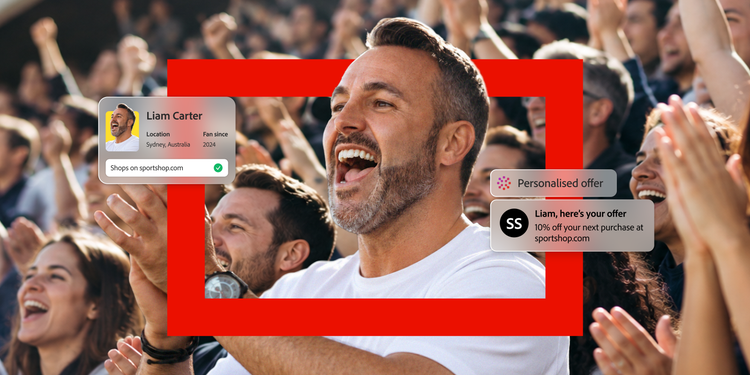
In 2026, three football codes took centre stage in Australia within a few weeks. The NFL played its first-ever regular-season game in the country, followed by the AFL and NRL Grand Finals. The way fans responded shows how much room there is for fandom to grow, and how much opportunity there is for brands to connect with fans beyond the match itself.
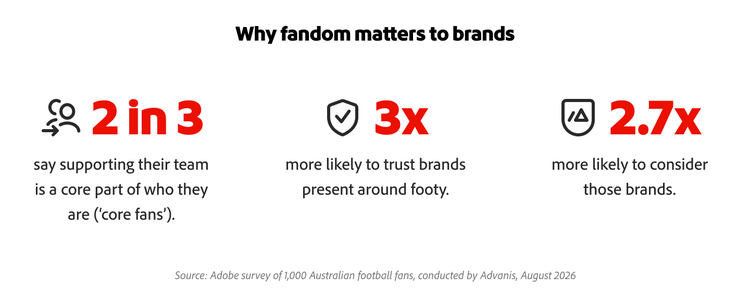
For many Australians, these games are personal. In an Adobe survey of Australian football fans, two-thirds (65%) said supporting their team feels like a core part of who they are. We call this group ‘core fans’, and the remaining third ‘non-core fans’.
This connection also shapes how fans perceive brands. Almost half of core fans (45%) said a brand's presence around football makes them trust it more, compared with 15% of non-core fans, and 47% said it makes them more likely to consider the brand, compared with 17%.
Fans find a way to be part of game day.
From Melbourne to Sydney, sold-out crowds filled the MCG and Accor Stadium, with fans travelling from across Australia and beyond. Those crowds are the visible edge of a much wider fan base. Most watch the matches that matter most at home (62%) or with others at a pub, club, or friend's place (23%). Only 6% are usually at the ground.
For fans who aren't at the stadium, game day still starts well before kick-off. Almost a third (32%) wear team colours to celebrate, and ADI’s online shopping data reveals a broader game-day spending boost, from team merchandise to screens, food and drink.
How fans got ready for game day, compared with average August 2026 levels.
September 11
September 26
October 4
Fans are also weighing the cost. More than four in 10 (43%) say the cost of living has changed how they plan to celebrate, and ahead of the finals, around three in 10 said a new TV or team merchandise would be the first thing they'd cut. Yet merchandise traffic and screen spending still jumped around each game. Fans spend where it feels worth it, so whether you're offering a streaming subscription, team merchandise, or a party pie, the opportunity is to be there wherever fans take part, with an offer that suits the moment.
The second screen is part of the broadcast.
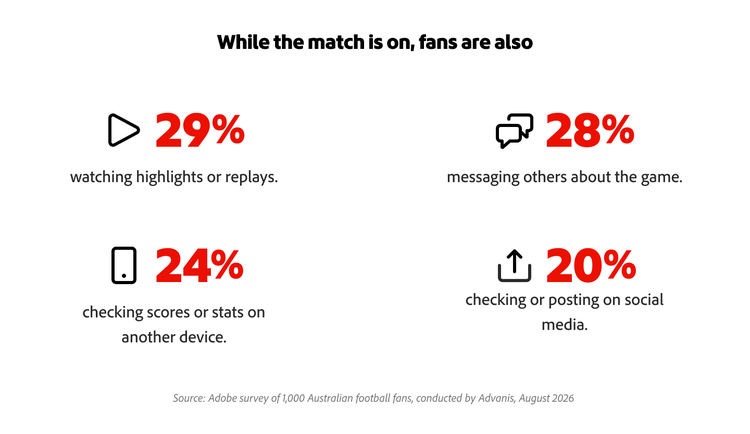
Fans do more than watch while the game is on. Each extra screen is a chance to add to the fan experience, or conversely, to miss it.
Speed often decides the outcome. Nearly three-quarters of marketers (72%) believe fans can tell real-time content from pre-planned or generic content, and 44% of fans say it matters to them, rising to 54% among core fans. Yet only a third of marketers (34%) can publish content the same day something unexpected happens, and 64% say keeping teams and channels in step with a live moment is one of their biggest operational challenges. Closing that gap depends on the content supply chain: how quickly a moment can be captured, adapted, approved, and published while fans are still talking about it. AI is already helping, with 54% of marketers saying it has improved their content production over the past year.
AI is becoming part of how fans follow the game.
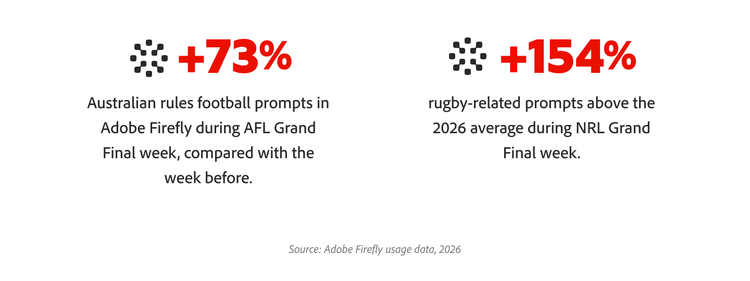
Fans are bringing their fandom into AI. Adobe Firefly data showed prompts related to Australian rules football rose 73% during AFL Grand Final week compared with the week before, with Dockers-related prompts up 819% and Lions-related prompts up 374%. Rugby-related prompts climbed to 154% above the 2026 average during NRL Grand Final week.
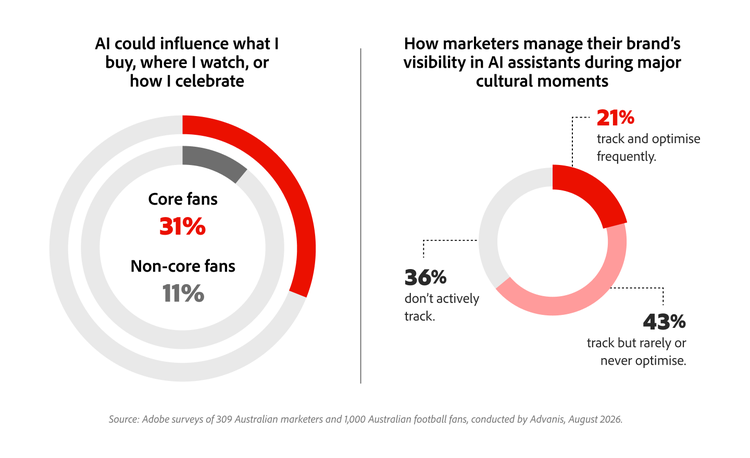
AI is also changing how fans find what they need. More than half of marketers (57%) say fans are using AI assistants more during major events than a year ago, with younger and more engaged fans leading the shift. A third of fans (33%) don't use AI assistants, but that falls to 14% among 16- to 34-year-olds, and 31% of core fans say AI recommendations could influence what they buy, where they watch, or how they celebrate, compared with 11% of non-core fans. The most common uses, like checking scores, finding where to watch, and looking for deals, are the questions that lead fans to a ticket, a stream, or a store. Yet while 64% of marketers track how their brand shows up in AI assistants, only 21% act on that insight frequently.
Sponsorship works hardest where fan connection is strong.
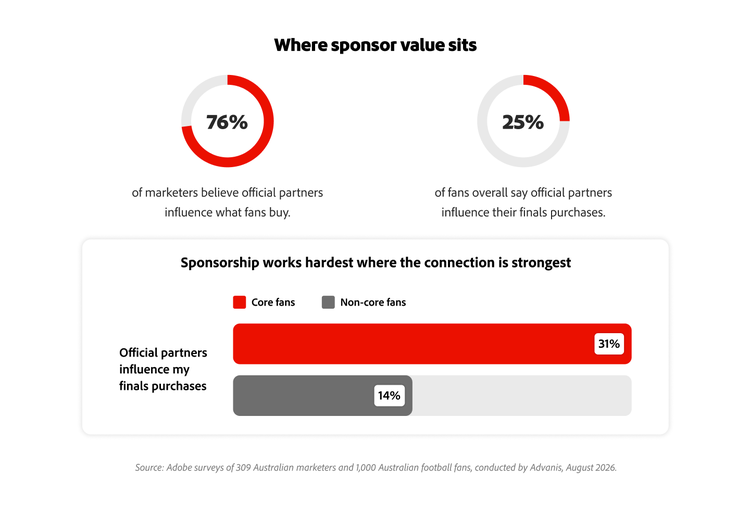
Brands are investing more in these moments. More than half of marketers (55%) increased their investment around major cultural moments compared with last year and two-thirds (67%) create their own branded moments within them, from hosted events to original content series. Three-quarters (76%) believe official partners and sponsors have a moderate to strong influence on what fans buy.
Among fans overall, a quarter (25%) say official partners influence their finals purchases. Among core fans, that rises to 31%, more than double the 14% of non-core fans. Realising the value of a sponsorship depends on knowing who those fans are and how they want to be engaged.
That fan knowledge is often spread across clubs, leagues, broadcasters, ticketing, and partners. Half of marketers (51%) say the lack of a shared, real-time view of their audience has caused them to miss a moment to engage a fan, and 47% say fans sometimes receive duplicate messages because their channels aren't fully connected. Personalisation shows the same gap: 55% say one-to-one messaging during a major moment is very important or essential, but only 17% can deliver it well while the moment is live.
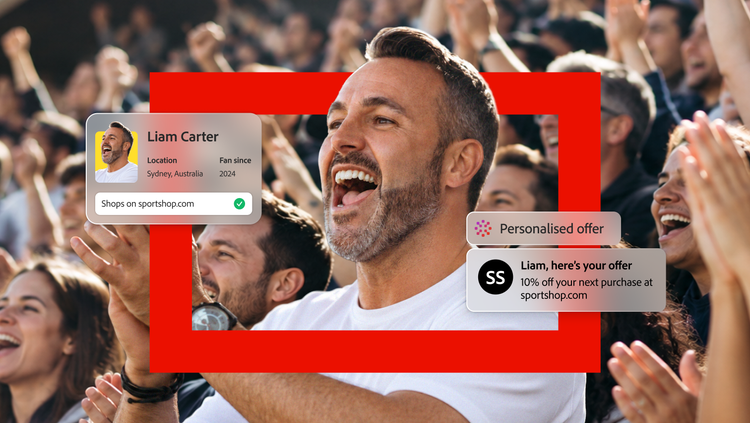
Fans are open to a better exchange, within limits. Close to four in 10 (38%) are comfortable with brands partnering with sporting organisations and using their information to send personalised offers, while 28% are not. Among core fans, comfort rises to almost half (49%). When rights holders and partners collaborate on data with care and transparency, sponsor presence becomes shared audience insight. That matters as more marketers judge success by the depth of the relationship built (46%), alongside directly attributed sales (44%).
A new code adds to the fandom.
The NFL's arrival in Melbourne showed global fandom growing alongside local loyalties. Almost four in 10 fans (39%) say a new code like the NFL adds to their existing footy fandom rather than competing with it, rising to 48% among core fans. Nearly a quarter (24%) planned to watch the Melbourne game despite not following the league.
That brings a wider mix of fans into the same moment, from dedicated followers to curious first-timers. With 41% of fans saying they have no understanding of NFL rules, a first-timer needs a very different experience from a lifelong supporter, and delivering both across more codes and platforms depends on knowing who each fan is.
Key takeaways for marketers: Building fan experiences beyond the final siren.
- Know who the core fans are. Two in three fans say their team is core to who they are, and they’re 3x more likely to trust brands present around football. A unified view of each fan shows you who they are and how they want to be engaged.
- Look beyond the gate. Only 6% of fans usually watch the biggest matches at the ground, and most take part from home, the pub, or a second screen. Game day starts well before kick-off, so the experience needs to reach fans wherever they are.
- Move at the speed of the game. 72% of marketers believe fans can tell real-time content from generic content, but only 34% can publish the same day something unexpected happens. A faster content supply chain closes that gap.
- Make sure fans can find you in AI. 57% of marketers say fans are using AI assistants more during major events, yet only 21% frequently optimise how their brand shows up. The answers fans get today lead them to a ticket, a stream, or a store.
- Treat fan data as a shared asset. Half of marketers (51%) have missed a moment because they lacked a shared view of their audience, while 49% of core fans are comfortable with partners using their data for personalised offers. Collaborating with care turns sponsorship into measurable audience insight.
Teams, leagues, broadcasters, and brands that understand what drives fandom, and respond in the moment, will be best placed to turn a season of sport into relationships that last.
About the research: Adobe Digital Insights analysed online shopping activity in Australia around each event. Advanis conducted the fan and marketer surveys on behalf of Adobe in August 2026, among 1,000 Australian football fans aged 16 and over and 309 Australian marketers whose organisations sponsor or activate around sporting or cultural moments. Core fans are those who agree that supporting their team feels like a core part of who they are (65% of fans); non-core fans are the remaining 35%.
Recommended for you
https://business.adobe.com/fragments/resources/cards/thank-you-collections/digital-insights
caas:content-type/blog
caas:products/brand-visibility
caas:products/adobe-journey-optimizer
caas:products/customer-journey-analytics