What is business intelligence (BI)? Definition, purpose, and importance

Business professional using a laptop at a train station, with floating graphics showing audience metrics and overlap data analysis.

What is business intelligence in simple terms?

At its core, business intelligence is a form of data analytics – involving gathering, analysing, and visually presenting data. With the right knowledge, that data can be turned into actionable insights to inform better decision-making.

In short, it analyses data and makes it actionable. This is typically done through BI tools, drawing on a wide range of in-house, third-party, current, and historical data.

Why is business intelligence so important?

Business intelligence (BI) is essential for organisations that want to use data-driven insights to make smarter decisions. Companies that integrate BI effectively gain a competitive edge, drive innovation, reduce risk, and improve overall business performance.

According to McKinsey, in 2025, data-driven enterprises will significantly outperform competitors by using advanced analytics, AI and automation to anticipate market trends, enhance customer experiences and optimise business processes.

How does business intelligence work?

To understand how business intelligence works, here are the core processes and methods that make it up:

Green icons representing stages of data handling: data collecting, data preparation, analysis, reporting, and data visualisation.
  • Data collection (mining). Data collection, also known as mining, involves gathering data from a range of sources – for example, website analytics, customer purchase data from a POS system, or information about customer behaviours.
  • Data preparation. Once collected, data preparation and storage ensure your data is accurate, consistent, and ready to generate meaningful insights.
  • Analysis. To deliver insights, data must first be analysed, checked, and consolidated into meaningful information to support accurate reporting.
  • Reporting. Reporting involves organising and presenting data in a structured format to support decision-making, then distributing it to the relevant decision-makers.
  • Data visualisation. Data visualisation makes data-driven insights easier to digest and typically sits alongside reporting. Reports, dashboards, and graphs help communicate information visually for clearer decision-making.

These core processes work together to generate actionable insights by analysing data against key performance indicators (KPIs) and building an action plan. That plan can drive process optimisation, sharper marketing strategies, supply chain improvements, and a better customer experience – all contributing to stronger business performance.

What do organisations use business intelligence for?

Companies use business intelligence solutions to improve their decision-making based on reporting and the visuals in front of them. The goal of BI is to improve business operations through data – covering everything from strategy to execution.

Say your company launches three new products. You set quotas and performance metrics for salespeople, customer success managers, and others to drive those sales. BI tools analyse financial data sources each quarter, visualise that data in a report, and use it to determine what’s working and what isn’t. The real strength of BI software is the ability to view many different types of historical data in a single environment – helping you make better, more informed business decisions.

Different sectors use business intelligence to track different metrics, but the goal remains the same. Whether you’re a retail chain comparing stores region by region to find cost savings, a sales company building a detailed targeting report, or a security firm looking to strengthen protection – BI gives you the data you need for more effective decision-making. The result: more time on action, less time on accumulation.

Why is good data governance important?

Many new businesses overlook setting up their data analytics and business intelligence, focusing instead on sales and other seemingly more pressing priorities. But good data governance – making sure data is used and managed correctly – is a fundamental part of business intelligence.

One of the biggest challenges in modern business intelligence is the time it takes to get answers from data queries – a BI tool can take anywhere from two days to two months to respond. This has driven the rise of self-service BI, which delivers answers faster, though not always with 100% accuracy. That’s not necessarily a problem, as results can still be reasonably reliable. However, without sound data governance, multiple people in your organisation may draw different conclusions from the same data – and those conclusions can easily conflict.

Ongoing, consistent data monitoring is equally important – data needs to be accurate, secure, and private. Typically, you’ll rely on a data analyst to ensure those standards are met, putting the right access controls and security protocols in place, and delivering data in a clear, usable format.

It may seem like a significant undertaking, but starting these initiatives early in your BI implementation pays off. And given the sensitivity of this information, keeping it in-house is usually the right call.

What is a business intelligence platform and its core functions?

A business intelligence platform is the technology that brings BI to life – helping organisations gather, process, and visualise data to make data-backed decisions. If business intelligence is the concept, the platform is how it gets done.

Business intelligence core functions

  • Business monitoring and measurement. Business intelligence tools can track key metrics like KPIs. Where older systems took time to pull reports, today’s BI tools deliver that information fast – enabling quicker decisions and a more proactive approach.
  • Data analysis. Tracking data is just the starting point – analysis goes much further. BI tools process your data to surface insights that inform critical business decisions, driving faster and more strategic decision-making.
  • Reporting and information delivery. Data is valuable, but it can slow things down – or worse, lead to poor decisions when misread. BI tools improve how data is delivered, helping you visualise exactly what your team needs to see. The result is data that’s easy to read, quickly understood, and ready to act on – no lengthy manual reports required.
  • Predictive analysis. BI analyses historical data alongside real-time data. Predictive analysis adds data forecasting to the mix, letting you query and plan for all those what if scenarios – so you can mitigate risk and capitalise on trends as they emerge.

How can I develop a business intelligence strategy?

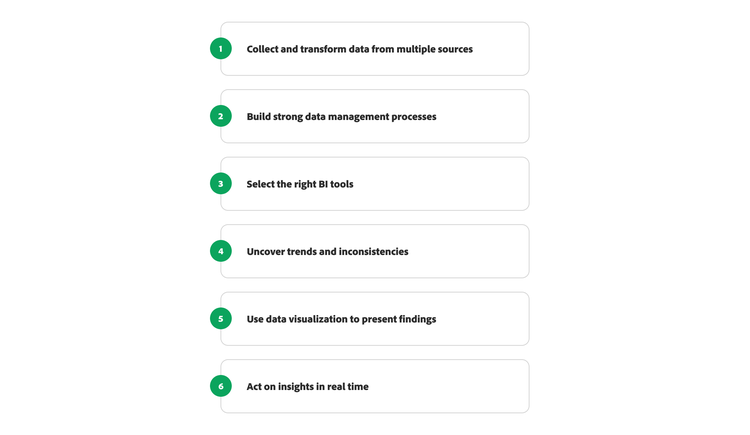
List of steps in data strategy: collect data, build processes, choose BI tools, identify trends, visualise findings, and act on insights.

1. Collect and transform data from multiple sources

Getting data from across your business starts with ETL (extract, transform, load) processes – an essential function for pulling both structured and unstructured data from a wide range of sources into a single, easily accessible repository. This means you can apply BI best practices across multiple areas of your business, backed by clean, consistent, and up-to-date data.

2. Build strong data management processes

A strong data management process is the foundation for keeping data usable, secure, and manageable. It also ensures your BI tools are working with high-quality, relevant data. Without it, data can quickly become unreliable or compromised – and that puts sound decision-making at risk.

3. Select the right BI tools

Choosing the right BI tools for your business is one of the fastest ways to set yourself up for success. In some cases, you may need more than one tool to meet the needs of different departments.

Ultimately, aligning your tool selection with your specific business needs and user requirements ensures your business intelligence solutions fit your organisation’s structure and goals.

Data mining draws on exploratory, descriptive, statistical, and predictive analytics to identify trends, patterns, and anomalies in your data. Automation can further strengthen this process by rapidly processing large datasets, improving accuracy, and delivering real-time insights.

5. Use data visualisation to present findings

Turning complex data into clear visual formats is essential for informed decision-making. When findings are communicated clearly and concisely, direction becomes sharper and decisions happen faster. Dashboards, charts, graphs and maps are all effective tools for making complex data easier to understand and act on.

6. Act on insights in real time

Having data is only part of the equation – without action, it quickly becomes outdated and irrelevant. BI drives real-time decision-making by giving you immediate access to the data and insights that matter. Your business can then make short and long-term changes to tackle challenges, adapt to market shifts, prepare for predicted outcomes, and improve operational efficiency.

How does business intelligence help improve a company’s efficiency and decision-making?

Business intelligence tools, methods and practices aren’t just add-ons – they change the way your business thinks and operates. When implemented properly, BI drives a culture shift and delivers a range of benefits:

  • Data consolidation. BI brings all your data – internal and external – into one place. This gives you a complete analysis and the full picture when shaping your business strategy or rolling out changes.
  • Clear reporting. Data reports are presented clearly, so you can ask questions and get answers in a format that’s straightforward and easy to understand.
  • Efficiencies. Businesses can measure their operations against KPIs or performance benchmarks to improve processes using data insights. For example, BI can help you resolve supply chain issues, manage staff performance, and identify where organisational changes may be needed.
  • Data insights. Adopting BI practices and tools moves your business towards a more data-driven approach, leading to new opportunities, improved performance and productivity, and a competitive edge. Data insights can reveal customer trends, preferences and behaviours, as well as significant market shifts – giving you what you need to capitalise quickly.
  • Customer and employee satisfaction. Equipping your customer service team with the ability to analyse information leads to faster and more proactive outcomes for customers. Internally, BI helps employees make informed decisions – speeding up workflows through better access to information and streamlining routine tasks.

Business intelligence spans every part of an organisation, drawing on multiple data channels to give you a clear picture of what’s happened across your business. Understanding the key developments within your company puts you in a strong position to reassess and refine your existing strategies.

Better decision-making and efficiency go hand in hand – the more efficient you are, the better and faster your data-driven decisions become. Business intelligence helps you draw out stronger insights for greater efficiency, especially when you’re using a tool like Adobe Analytics with Adobe Customer Journey Analytics. Other BI tools are slower and less capable compared with Adobe Analytics. The ability to pivot immediately and use BI or augmented analysis to answer your questions in real time is critical.

How does business intelligence evolve – and what does that mean for your business?

As a business’s big data evolves, so does its business intelligence. Business intelligence lets you bring many different data channels into a single storage location: financial data, supply chain data, and even HR data. You don’t need all your data channels in place at once – you can add new ones as you go. Each new data set delivers fresh insights about your company as it’s combined with the others.

These are insights you simply wouldn’t get by looking at each data set in isolation – and they go a long way towards improving your business’s efficiency.

What are some of the challenges of implementing business intelligence?

Conflicting interpretations and bias in self-service BI

Self-service BI tools can be valuable for individual teams, but they can also produce conflicting conclusions and undermine a unified organisational strategy. Unconscious bias can influence data and skew analysis, with a negative flow-on effect on decision-making. Staying critical, impartial and logical when working with data is essential.

Data integration complexity and skills gap

Data integration is inherently complex – particularly when consolidating raw data from multiple sources before it can be shaped into meaningful reports. Your team needs strong expertise across data science, engineering, and architecture to keep your data accurate and reliable.

High upfront investment and long-term ROI

Business intelligence isn’t something you can dabble in – it demands significant upfront investment in both knowledge and implementation. Don’t expect immediate, sweeping gains to your ROI either. It’s a long-term commitment that strengthens decision-making and operational efficiency, rather than delivering instant cashflow.

Examples of business intelligence use cases

Customer service

A unified data source gives your customer service team what they need to resolve queries and identify pain points across the purchase journey. The result is a better customer experience – and a stronger, more enjoyable connection between your customers and your brand.

Retail

Retailers can use BI to analyse customer behaviours in response to marketing campaigns, review regional sales data, and keep track of inventory. It also helps them identify and address supply chain issues before they escalate.

Sales and marketing

Sales teams can use BI tools to draw on customer data, identify market trends, assess campaign performance, and make data-backed decisions that drive new strategies to boost sales.

Healthcare

BI simplifies inventory tracking and management, freeing up your staff’s time from manual checking and calculations. Keep essential medication in stock and give customers a way to get answers to time-consuming questions without having to wait for medical personnel.

Finance

Financial firms can use predictive data to make smarter decisions today for long-term success. Identify investment opportunities, track performance metrics at a branch level, and make well-informed decisions backed by granular data.

What will business intelligence look like in the future?

Business intelligence technology has evolved significantly – not only have the tools improved, but users have become far better at putting them to work. Looking ahead, there are some notable changes on the horizon:

  • Emergence of new analytics approaches. New forms of BI analytics are constantly emerging, giving users access to a broad suite of analysis tools. This includes composable analytics, which takes a building-blocks/modular approach to developing BI applications using a range of tools. Methods like continuous intelligence also combine BI and AI to deliver real-time data analytics and insights consistently – so you’re always in the know.
  • Increased focus on governing BI use. Governance is central to BI use – regulatory requirements expand alongside the technology, and remaining compliant is non-negotiable. As organisations increasingly rely on BI, data security carries even greater weight.
  • Low-code and no-code development. No-code and low-code development are BI vendor-led initiatives designed to let teams build applications without needing any coding experience.
  • Efforts to improve data literacy. Data literacy is increasingly essential, particularly with the rise of self-service BI and its growing role in day-to-day business operations. As a result, it’s set to become a key focus area for company training programmes.
  • Shift to the cloud. BI systems are migrating to the cloud as cloud data warehouses become increasingly commonplace.

Can I hire an outside agency to manage my company’s data?

Given the breadth, sensitivity, and confidential nature of your company data, bringing in a third-party team to manage it isn’t advisable. Beyond the security risks, an in-house team is a better fit because every business has its own processes, goals, and needs. Developing a data governance plan tailored to your organisation is far more straightforward with an internal team. It doesn’t have to be their sole responsibility – but it should be a defined role for a group within your organisation.

It’s also worth weighing up the costs of outsourcing data management against building your own in-house team. Having an internal team not only gives you greater control over how data is managed, but it can also be scaled as your needs grow — while building expertise that’s unique to your organisation.

How does business intelligence differ from business analytics?

While business intelligence and business analytics are often used interchangeably, there are some fundamental differences between them. The two are closely related, but business intelligence is actually a subset of business analytics.

Business analytics takes a forward-looking approach — drawing on data mining, modelling, and machine learning to predict future events. Business intelligence, on the other hand, focuses on evaluating past business data to make sense of existing information. It’s about letting historical data and business KPIs guide decisions, rather than simply forecasting what’s ahead.

Get started with business intelligence

Before you get started with business intelligence, you’ll need a solid grasp of its core components — data analysis, data visualisation, and database management. With those skills in place, you can start using business intelligence solutions to drive better data-driven decisions and growth by transforming raw data into actionable insights.

Tools like Adobe Customer Journey Analytics deliver real-time, omnichannel insights by consolidating data from multiple channels, enabling smarter, data-driven decision-making for your business.

Let’s talk about what Adobe can do for your business.

Get started