The brand recall report: How AI is reshaping brand discovery and recall.
07-06-2026
This post covers:
- Brand forgettability as a dual threat
- Why ads fail to make an impression
- Platforms and formats that drive recall
- The psychology of lasting brand messages
- Winning back consumers who’ve forgotten you
- Future-proofing for AI-driven discovery
Summary of key findings.
- The 24-hour recall gap: Only 17% of consumers are confident they can recall the names of the last three ads they saw after just 24 hours.
- Top impression killers: Advertisements primarily fail to make an impression due to irrelevance (71%), clickbait or misleading content (56%) and a lack of trust (55%).
- The rule of four: Shoppers need to encounter a message at least four times within a 24-hour window for it to stick, a self-reported benchmark that underscores the demand for high-frequency, consistent brand presence.
- Platforms for lasting impact: YouTube (46%), cable/streaming TV (40%) and Instagram (27%) are the top three platforms for driving long-lasting brand impressions.
- AI discovery deficit: While 31% of consumers use AI chatbots to rediscover brands, only half of those users find the correct name at least 50% of the time.
- Drivers for re-engagement: Price drop alerts (54%), specific discount codes (52%) and free delivery offers (41%) are the most successful strategies for re-engaging consumers who have forgotten a brand.
Brand forgettability is a dual threat — for humans and AI.
Fewer than one in five consumers can name a brand from an ad they saw in the last 24 hours. That’s the central finding of Adobe’s survey of over 1,000 consumers and it signals a challenge that goes beyond creative quality. In an era where AI tools increasingly mediate discovery, brands face a dual threat: being forgotten by consumers and being invisible to the AI systems consumers rely on to find them again.
Creating memorable, personalised content is only half the battle. Brands need to leverage automated Generative Engine Optimisation (GEO) to ensure AI systems cite them in discovery experiences. By adopting an AI-first content supply chain to scale up the high-velocity content consumers are seeking out, brands can stay top-of-mind for both humans and the technology that guides them.
Our study highlights that brands must be citable by AI to remain relevant in an era when “forgettability” poses a dual threat. To stay relevant, brands must ensure that AI tools can easily find and share their information. Our study shows that being "citable" is the best way to stay visible as more people use AI to search.
Another way to improve your brand presence is by optimising your site's structure and data. This enables AI to better understand and prioritise your content, helping shoppers easily rediscover your brand across major search platforms. This emphasis on visibility helps your business stay ahead as search habits continue to evolve.
Ad irrelevance is the top reason brands don’t stick.
Cutting through today's attention economy takes more than good creative, it takes speed and consistency at scale. An AI-first content supply chain enables teams to produce personalised, brand-compliant content without sacrificing quality or pace. Integrated brand governance ensures that every generative output is accurate and aligned with the brand, fostering trust and authority that drive long-term recall.
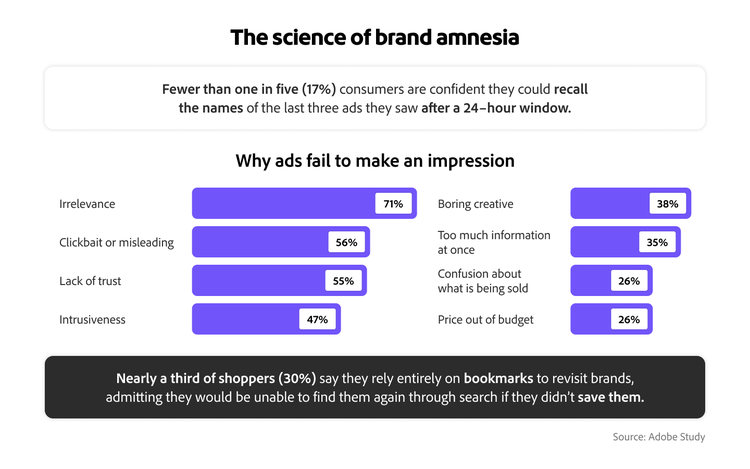
When asked about their recall ability, only 17% of shoppers surveyed could name a brand from an ad they saw within the last 24 hours, with irrelevance, misleading messaging and a lack of trust cited as the top reasons.
The devices shoppers use also affect how much they remember about a product. Shoppers surveyed were 129% more likely to remember product details they saw on a computer than on a mobile device. Even with this gap, 44% of shoppers surveyed believe the device makes no difference to their memory.
That gap breaks down differently by generation. Gen Z and baby boomers both favour desktop for recall (41% and 48%, respectively) while millennials and Gen X are largely indifferent to the device.
What makes Gen Z interesting is the contradiction: despite preferring desktop for retention, they're still 131% more likely than older groups to hold onto information seen on mobile. For brands, this can be a helpful indicator of where and how to show up.
Consumers are tuning out ads that feel irrelevant or untrustworthy and closing that gap requires more than better creative. Breaking through requires personalised content at scale, grounded in integrated brand governance and real-time performance insights.
Top reasons why brand names don’t stick.
- Length (3+ syllables): 44%
- Unique spellings: 29%
- Competitor similarity: 22%
- Puns/wordplay: 10%
- Included numbers: 6%
Even when shoppers are paying attention, certain naming conventions work against recall, according to those surveyed. Complexity is the top culprit consumers cite, from names with three or more syllables to unconventional spellings.
But attention itself is increasingly scarce: 51% of shoppers say multitasking actively hurts their ability to remember brand names. For younger audiences, the bar is even more specific. Gen Z is 40% more likely than older generations to tune out when the creative is too boring to break through.
Platform and format determine which brands consumers remember.
To evolve from simple awareness to long-term recall, brands must move beyond static placements to dynamic storytelling that engages their audiences. Supported by a unified supply chain, brands can deliver on this by creating brand-compliant assets across the platforms that drive the longest-lasting impressions (from YouTube to TikTok) combined with large language model (LLM) optimisation and Generative Engine Optimisation (GEO) strategies to strengthen a brand’s visibility in the AI-driven discovery journey.
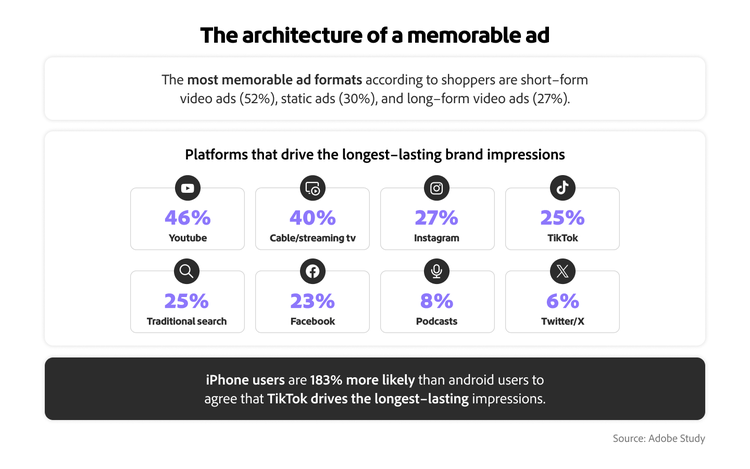
When asked which platforms drive the longest-lasting brand impressions, consumers ranked YouTube (46%) and cable/streaming television (40%) at the top. Instagram (27%), TikTok (25%), traditional search (25%) and Facebook (23%) fell in the middle, with podcasts (8%) and X (6%) at the bottom.
Those rankings change significantly when segmented by generation. Gen Z is 115% more likely than older generations to agree that TikTok drives the longest-lasting impressions. Gen Z is also 91% more likely than older generations to agree that Instagram drives the longest-lasting impressions. Android users are 24% more likely than iPhone users to agree that YouTube drives the longest-lasting impressions.
The shift toward highly visual, social and third-party platforms is reshaping brand discovery through AI. With a LLM optimisation strategy, you can translate brand authority built on platforms like YouTube and TikTok into AI search visibility.
By utilising brand citation tracking and LLM analytics, marketers can ensure that AI assistants accurately summarise and recommend memorable campaign moments, connecting social engagement to conversational discovery.
Most memorable ad formats.
The platform is only part of the equation and format can matter just as much. Shoppers ranked the most memorable formats as:
- Short-form videos: 52%
- Static images/photography: 30%
- Long-form video: 27%
- Text-based search ads: 25%
- Influencer endorsements: 24%
Short-form video holds a significant advantage: shoppers are 73% more likely to remember it compared to static image ads. This gap widens with Gen Z, who are 111% more likely than older generations to remember influencer endorsements and 94% more likely to remember interactive ads. Meanwhile, Apple users are 56% more likely than Android users to recall influencer content, highlighting how audience and device, in addition to format, influence receptivity.
This preference for video is reinforced in findings from a previous Adobe study, which found that short-form video was already the top format for increasing engagement at 42%. This solidifies the need for brands to master video content optimisation. A Generative Optimisation (GEO) strategy paired with high-affect creative ensures that the formats consumers find most engaging are also the ones that LLMs and generative engines find most authoritative.
Humour, repetition and relevance are what make brand messages endure.
Platform and format set the stage, but they don't explain why some brand messages resonate while others vanish the instant they're no longer visible. The key lies in understanding the psychology of recall, specifically the emotional or contextual triggers that transform a momentary impression into a lasting memory.
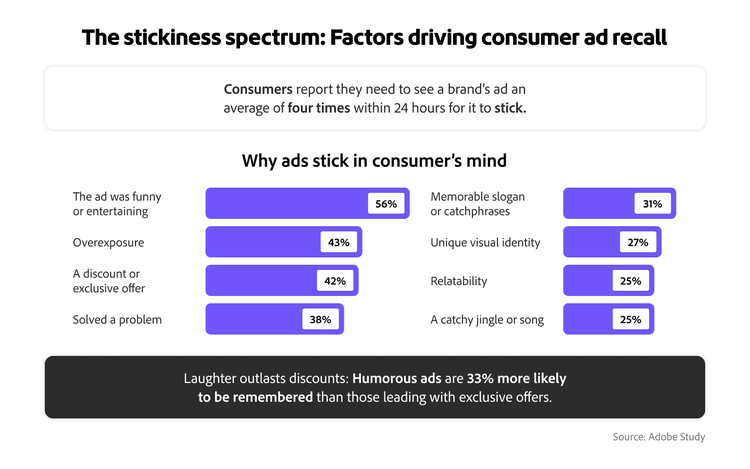
Top five reasons why ads leave a lasting impression.
- The ad was funny or entertaining: 56%
- Overexposure: 43%
- A discount or exclusive offer: 42%
- Solved a problem: 38%
- Memorable slogan or catchphrase: 31%
Humour and entertainment top the list of factors that make ads sticky by a clear margin. Exposure follows, reinforcing that consistency and repetition still play key roles in building recall. Rounding out the top factors are exclusive discounts and problem-solving; the latter is particularly relevant for personalisation, as generative tools are well positioned to match solutions to individual shopper needs in real time.
That need for repetition is more demanding than some may think. When asked, shoppers reported needing to encounter a message at least four times within 24 hours for it to feel memorable, a finding that reinforces the case for high-frequency, cross-channel brand presence. What makes a message memorable also varies by audience: Gen Z is 24% more likely than older generations to remember brands with a distinct visual identity, while women are 29% more likely than men to cite a catchy jingle or song as a recall driver.
Maintaining the four-touch frequency consumers report needing (without tipping into creative fatigue) requires infrastructure, not just intention. Adobe GenStudio for Performance Marketing is built for exactly this: accelerating content production while keeping every asset on-brand, so high-frequency campaigns don't sacrifice quality or consistency.
To ensure brand identifiers break through, Generative Engine Optimisation (GEO) and content optimisation accurately index and prioritise them within generative engines, extending recall into the discovery phase. Furthermore, when a campaign gains cultural momentum, brand citation tracking highlights positive sentiment in authoritative summaries of LLM search results, transforming a fleeting spike into sustained AI search visibility.
When recall fails, recovery strategy determines whether customers return.
When brand recall falters, the recovery strategy often determines whether a customer returns or is lost to a competitor. To find a solution, forward-thinking brands should move beyond static retargeting and adopt a more intelligent, responsive discovery model.
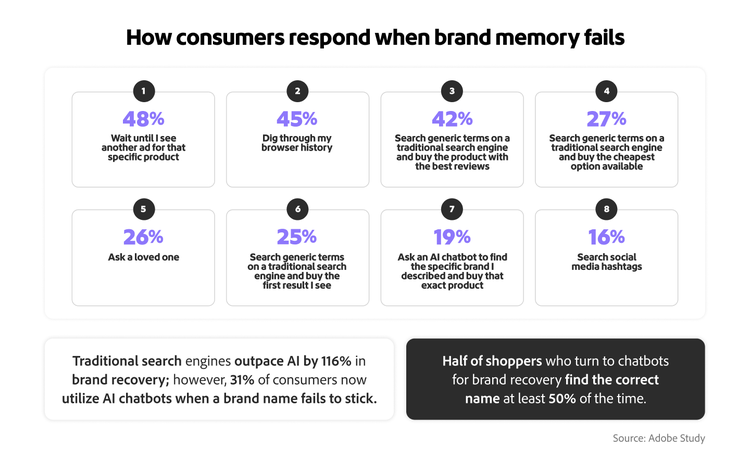
When researchers asked how consumers would respond if they forgot a brand or product they had previously searched for, 48% said they would simply wait until another ad reaches them for that product. Slightly fewer would revisit their search history or experiment with keywords.
Almost one in five said they’d turn to an AI chatbot, a behaviour more common among Gen Z, who are 23% more likely than older generations to use AI to recover forgotten brand names and among men, who are 29% more likely than women to do the same.
How to win consumer re-engagement.
When shoppers do need a nudge, incentives drive re-engagement more than content. The top retargeting methods likely to win them back are:
- Price drop alerts: 54%
- A specific discount code: 52%
- A free delivery offer: 41%
- A 5-star review or customer testimonial: 24%
- A video showing the product in use: 20%
Price drop alerts lead across nearly every generation except millennials, who prioritise a specific discount code (58%). Women are 73% more likely than men to say free delivery seals the deal.
To meet the high demand for specific re-engagement triggers, such as price-drop alerts and customer testimonials, brands need to move beyond generic retargeting. Re-engagement is won on specificity: the right incentive, at the right moment, on the right platform. Adobe GenStudio for Performance Marketing enables marketers to build and deploy personalised, platform-specific retargeting content at the speed and scale that price-drop alerts and time-sensitive offers demand.
Top categories worth the ‘deep scroll’.
Not every forgotten product gets the same effort. These are the categories shoppers are most willing to search through multiple pages to find:
- Apparel & Accessories (e.g., clothing, jewellery)
- Travel & Accommodation
- Home Goods & Furniture
- Electronics (e.g., TVs, smartphones)
- Books & Media
- Beauty & Personal Care
- Health & Wellness Products
- Groceries & Food Delivery
On average, shoppers said they would scroll through two pages of results before giving up.
As consumers increasingly turn to AI chatbots to find the brands they’ve forgotten, an LLM optimisation strategy ensures your brand is ready to capitalise on the conversation through enhanced AI search visibility and content optimisation.
LLM analytics and brand citation tracking provide a clear view of how effectively these engines are recommending your products to shoppers during the recovery phase.
Winning in 2026 means unifying human and AI-driven brand discovery.
To win in 2026, brands need to unify the human and machine discovery journey. This requires moving beyond siloed marketing strategies toward a unified content supply chain that satisfies both the human desire for entertaining, relevant creative and the technical requirements for Generative Engine Optimisation (GEO).
Turning “forgotten” into “found” with intelligent automation ensures that, by linking high-impact production and LLM search visibility, organisations can keep their products discoverable through authoritative AI search summaries and personalised re-engagement triggers, even when a brand name fails to stick.
Learn more about Adobe GenStudio for Performance Marketing by watching the overview video.
Methodology.
This article is informed by proprietary research conducted by Adobe. The study surveyed 1,002 consumers across the United States, providing a 95% confidence level with a ±3% margin of error.
Researchers asked respondents about brand recall and how to create a lasting impact. As with all self-reported data, results may reflect personal perceptions and experiences that could differ from actual behaviours.
Recommended for you
https://business.adobe.com/fragments/resources/cards/thank-you-collections/genstudio