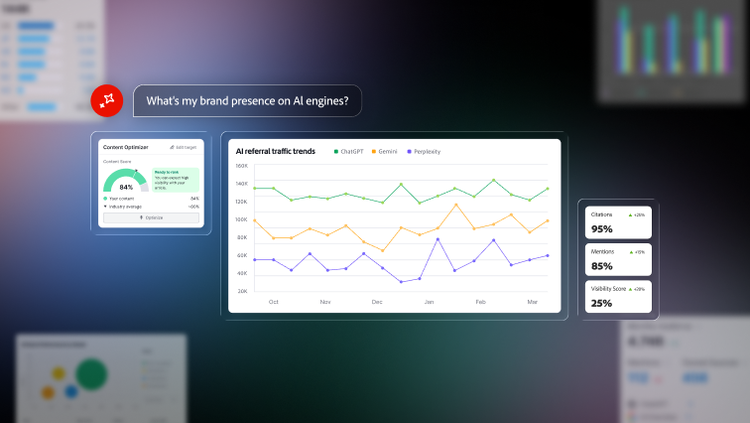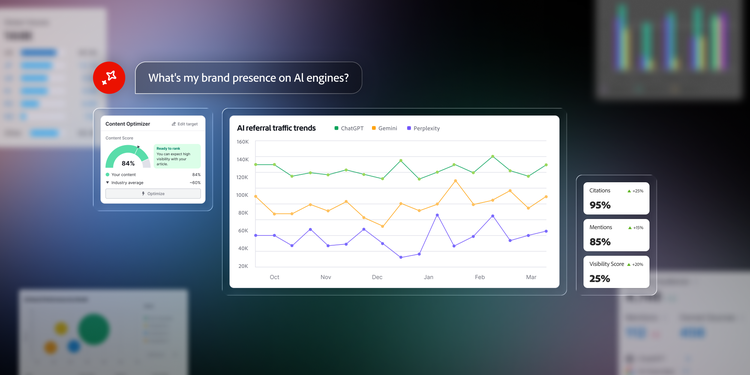
Earlier this year, we wrote about what it takes to build a generative engine optimisation (GEO) practice — the discipline of measuring how your brand appears across AI-generated answers, acting on the gaps you find and making optimisation a continuous, cross-functional habit. The foundational case was already clear. AI-referred traffic converts at 4.4 times the rate of organic search. Google searches fell in Safari for the first time in 22 years. Eighty per cent of brands have significant gaps in their AI presence today.
What has become equally clear since then is that measurement alone is not enough to close those gaps. The brands we work with have made real progress and the ones moving fastest have all run into the same ceiling: knowing where you stand is only useful if you know why you are there, what specifically would change it and whether the work you do to fix it will actually move the business. That is the challenge Adobe Brand Visibility is built to solve.
What the market has taught us.
Adobe LLM Optimizer gave brands something they hadn't got before — a window into how AI systems perceive them, where competitors are winning and which content is shaping the answers users receive. That was a meaningful first step, but as GEO programmes have matured, three gaps have become consistently clear.
- First, AI presence cannot be evaluated in isolation. A brand's presence in AI-generated answers only makes sense in the context of the full competitive landscape: who is winning the prompts you are losing, why they are winning and what it would take to close the gap. Without that market-wide lens and a clear diagnosis of root causes, optimisation efforts have no real foundation.
- Second, even well-diagnosed gaps do not close on their own. GEO teams need to move fast, because every week of delay widens the competitive gap and makes recovery more difficult. Speed requires more than deployment tools for owned content. GEO teams need a way to deliver the right recommendations to cross-functional partners and channel owners who shape earned media, community forums and third-party publications. The ability to act across the entire enterprise is what separates programs that compound from programmes that tread water.
- Third and most consequentially, GEO investment without revenue proof cannot scale. Marketing organisations cannot bring GEO programmes to a board-level conversation if the attribution loop stops at citation share.
Closing all three gaps requires something that did not previously exist — a unified platform that moves seamlessly from signal to action to verified outcome and does it at the speed that AI-native competition demands.
Introducing Adobe Brand Visibility.
Today, we are introducing Brand Visibility, Adobe's unified GEO platform for enterprise brands. Brand Visibility brings together the rich market intelligence and AI search data from Semrush with the execution and attribution capabilities from Adobe, built as a single integrated system.
The differentiation starts with data. Brand Visibility brings together four intelligence dimensions that no competitor has unified in a single system: 261 million real AI search prompts (not modelled estimates), agentic traffic from content delivery network (CDN) log analysis invisible to standard analytics, LLM referral traffic connected to business outcomes through Adobe Analytics and SEO query fan-out analysis revealing the sub-queries AI systems use when formulating answers.
Each dimension tells a different part of the story. Together, they give enterprise teams a basis for decision-making that is simply not available anywhere else.
From signal to action to outcome.
Having the right intelligence is only half the equation. What Brand Visibility does with it helps brands create a genuine competitive advantage — enabling teams across the enterprise to go from signal to action to verified outcome, across every dimension of GEO.
- See the complete picture of how AI systems actually see your brand. Not just whether you appear in answers, but who's winning the prompts you're losing, what third-party sources are shaping AI perception and how AI bots are actually crawling your site.
- Know what to create before committing resources. Query fan-out analysis shows where your authority exists but isn't translating into citations and where closing one content gap improves brand presence across an entire topic cluster. Teams can stop producing content for the wrong gaps and start working from a clear, prioritised picture of what will actually move AI citation share.
- Ship optimisations across every surface without waiting on engineering. CDN-edge changes go live in minutes. CMS updates ensure durability. And coverage extends beyond owned content to the sources LLMs weight most heavily when forming answers, such as Wikipedia, YouTube, Reddit, community forums, review sites—surfaces most GEO tools can't reach at all.
- Prove GEO is driving revenue in the system that leadership already uses. Native Adobe Analytics and Customer Journey Analytics integrations connect every optimisation — with server-level confirmation that AI bots read the updated content — directly to conversions and revenue. No separate reporting silo. The kind of proof that moves GEO from a cost centre to a growth initiative.
Underpinning all four of these capabilities is an enterprise collaboration layer: a shared opportunity workspace where web, content, PR, social and demand generation teams work from the same priorities — ownership, progress tracking and governance built in. GEO has always touched the full marketing organisation. Brand Visibility is the first platform designed to operate that way.
The results are already there and the window to lead is open now.
The results from early deployments speak for themselves. WK Kellogg deployed content optimisations and saw a 350% increase in AI citations within eight weeks. Slalom increased citations 10 times in four weeks. General Motors saw a 23% increase in AI presence and 35% increase in citations within weeks of deployment.
The brands that build GEO infrastructure today are not just winning today's queries. They are establishing a position that grows more durable with every passing month, because AI systems continuously update their understanding of the market based on the content they encounter. Brands that close the gaps in how they are represented across AI surfaces now will find that position reinforcing itself over time. Brands that wait will find the distance harder to close, not easier.
Adobe Brand Visibility is the platform built for brands that understand this dynamic and intend to lead it.
Karthik Muralidharan is a Group Product Marketing Manager, leading a team focused on go-to-market and product strategy for Adobe's agentic web applications and growth product lines in Adobe Experience Manager. During his 8+ years at Adobe, Karthik has helped organisations elevate their digital experiences across a wide variety of use cases — including brand visibility, content management, forms management, digital signage and more. Before Adobe, he worked as a management consultant, advising clients on sales force optimisation, channel effectiveness and customer loyalty programmes.