
of citizens globally rank agency websites as top engagement channels


REPORT
Beyond digital: Readying for the AI era.

JUMP TO SECTION
The building blocks of future-ready service delivery.
The Digital Government Index framework.
Australia’s national score bounces back, but rate of improvement slows.
Steady results mask a growing performance gap risk.
Top rankings tighten as five states lift performance.
AI readiness in focus: The next horizon for digital government.
Personalisation in focus: Sustaining relevance and trust across every citizen journey.
Australia’s digital government services are at a crossroads. The latest Digital Government Index (DGI) for Australia shows a sector in transition – modernisation is underway, but the gap between expectations and delivery persists.
Each new DGI edition deepens our understanding of the challenges and opportunities facing government agencies. Although there are signs of progress, it is not keeping pace with the shifting digital landscape. This year, the report expands to assess ‘AI readiness’, examining the impact of AI-driven search tools and agentic AI applications, and finds that many agencies are not yet prepared.

Now in its fourth year, Adobe’s Digital Government Index for Australia report offers a deeper and more connected view of how governments are delivering digital services. With each iteration, the relationships between the distinct dimensions we measure have become clearer, revealing how progress in one area can influence, or be influenced by, movement in another. This longitudinal view allows us to see not just what is changing, but how these elements interact to shape the direction of progress.
That perspective has never been more important. Governments today are operating in an environment of tightening budgets and rising expectations. The demand to do more with less is colliding with the accelerating impact of artificial intelligence, which is not only reshaping what citizens consider ‘good service’ but also fundamentally changing how they search for, access, and interpret information.
As AI becomes embedded in the way people find and use government services, agencies must keep pace with this shift in behaviour or risk losing share of voice online and the ability to communicate effectively with citizens. That’s why we have introduced an AI readiness measure this year that complements the core Index dimensions that have been tracked over time.
This is in direct response to citizens’ rising use of AI-driven search and agentic AI applications, and reveals opportunities for agencies to strengthen the discoverability, authority and trustworthiness of public services and information in the AI era. It highlights that maintaining momentum and building capability across strategy, technology investment, and service design and delivery will be critical to meeting these new expectations.
Our 2025 findings make clear that improvement is neither linear nor finite. A strong result in one dimension doesn’t mark completion; even small shifts can signal the beginning of new challenges or unintended trends. This is a reminder that digital service delivery is not a set-and-forget exercise and that real progress depends on sustained, balanced effort across every measure.
Deliberate, sustained reinvestment in capabilities, technology and people keeps the digital service flywheel spinning. Each improvement fuels greater adoption, drives efficiency and creates savings for further service modernisation. Breaking the cycle creates more than stagnation; it risks eroding public trust in the government’s ability to deliver for its citizens in the digital age.
As economic conditions ease, a period of heavy investment in digital transformation has given way to a focus on fiscal constraint. Agencies are expected to do more with less – maximising resources, demonstrating investment efficiency gains, and maintaining service quality while driving adoption. This creates a need for solutions that reduce cost-to-serve without compromising outcomes.
With the DTA’s Digital Experience Policy (DXP) now in effect, all new federal government agency websites must meet clear standards for accessibility, usability and consistency. Timelines have been established for existing sites to align with these standards, creating a more cohesive government digital ecosystem. At the state level, agencies are advancing their own digital inclusion strategies and service design standards, aiming to deliver similarly seamless and equitable user experiences. As citizen needs evolve, users increasingly seek seamless, personalised experiences over traditional, one-size-fits-all websites. Streamlining self-service pathways is key to unlocking broader adoption while delivering the productivity and cost-efficiency gains governments seek.
AI readiness is becoming a baseline capability for government service design and delivery, as it increasingly shapes how citizens search for and access information online. Agencies are at different stages of preparedness, creating both risks and opportunities. While AI readiness doesn’t always align with current digital maturity levels, it highlights the importance of building a trusted, unified digital presence that serves both people and machines.
of citizens globally rank agency websites as top engagement channels

of citizens say Federal Government services have neither improved or worsened in the past four years

of citizens globally say agency websites are effective in personalisation
Chris Fechner, CEO, Digital Transformation Agency
Adobe’s Digital Government Index (DGI) provides a clear view of how well agencies deliver online services. Applied across Federal and State websites, it not only benchmarks digital maturity but also serves as a practical guide, helping identify opportunities to streamline and enhance citizen interactions.
Higher DGI scores translate into better civic outcomes. As more people easily engage with digital services, agencies gain efficiency, reduce delivery costs, and reinvest in further enhancements. In last year’s report, Mandala research estimated
the impact of accelerated digital service adoption over the next 10 years. It noted that citizens would spend 800 million fewer hours and government could save $12 billion in service delivery costs4.
One year on, the proportion of citizens preferring to engage with government digitally has risen to 94%5 globally, a figure that was 90%6 in Australia last year. However, a relatively flat Index score suggests only moderate progress in digital service performance, reach and access. In 2023-24, 79%7 of public service interactions were online, and it is unlikely to have significantly changed.
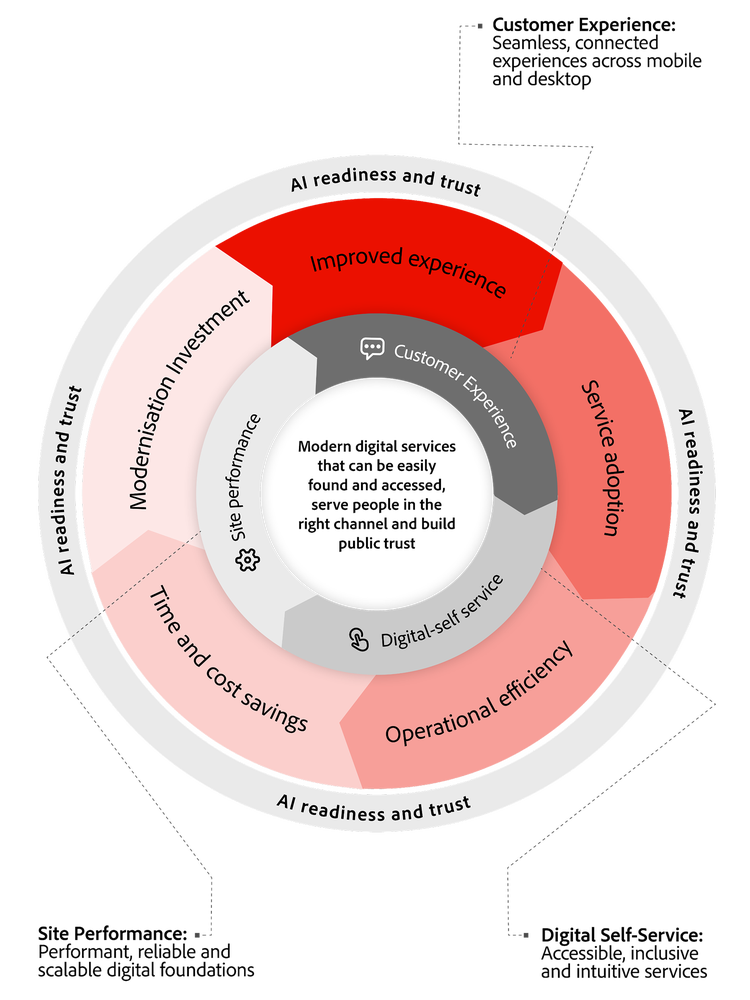
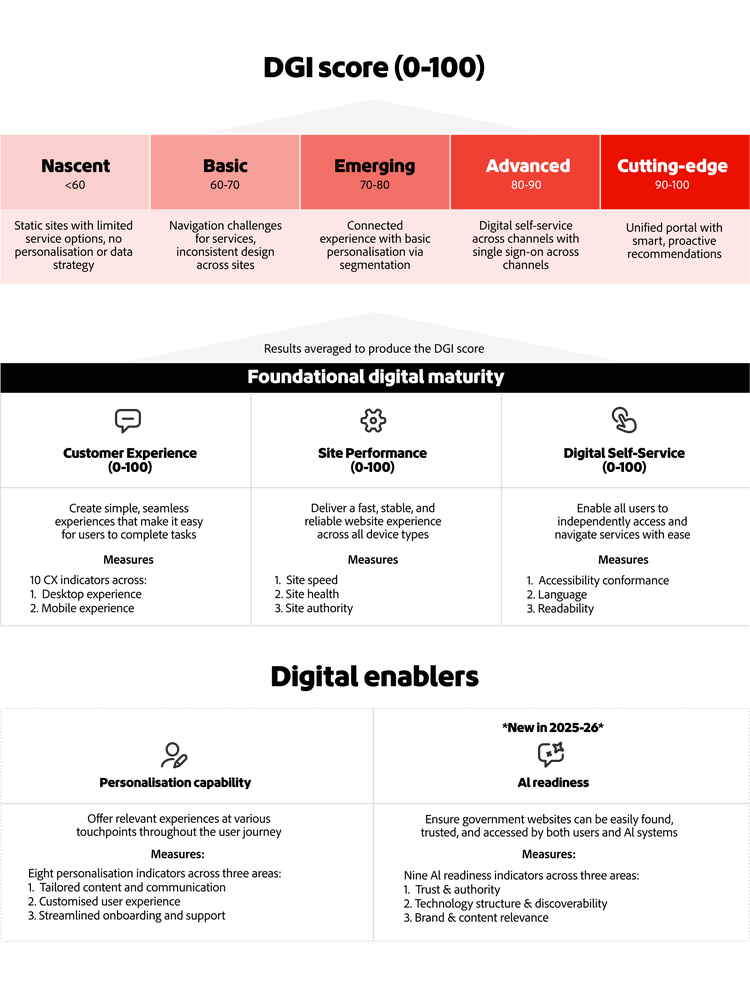
The DGI assesses effectiveness across three interconnected foundational digital maturity dimensions: Customer Experience, Site Performance and Digital Self-Service. It assigns a score out of 100 to each, then averages the results to produce a single index.
To capture what makes services accessible, usable and convenient for all citizens, the report also evaluates two key digital enablers. Personalisation capability measures how well agencies deliver relevant, user-centred experiences, while the new AI readiness assessment reveals how easily websites can be found, trusted, and accessed by both people and AI-assisted search tools.
THE 2025 DGI RESULTS
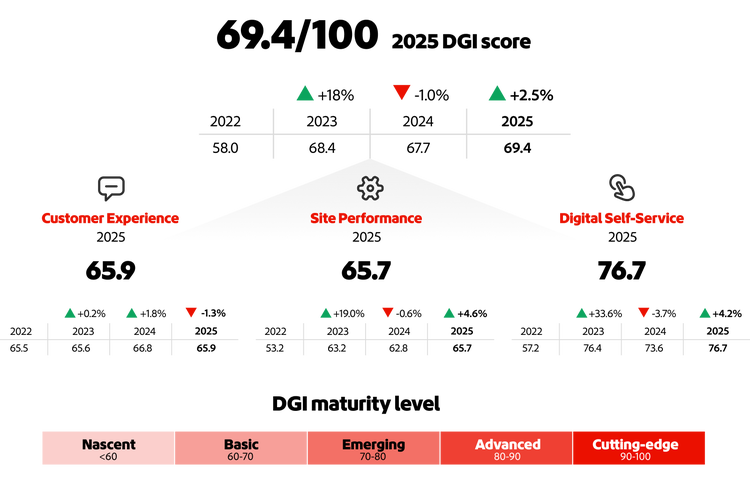
Australia’s 2025 national DGI score has reversed last year’s decline, supported by improvements in both Site Performance and Digital Self-Service. Despite this recovery, overall momentum has eased, even as agencies continue to modernise public service delivery and respond to shifting citizen demand.
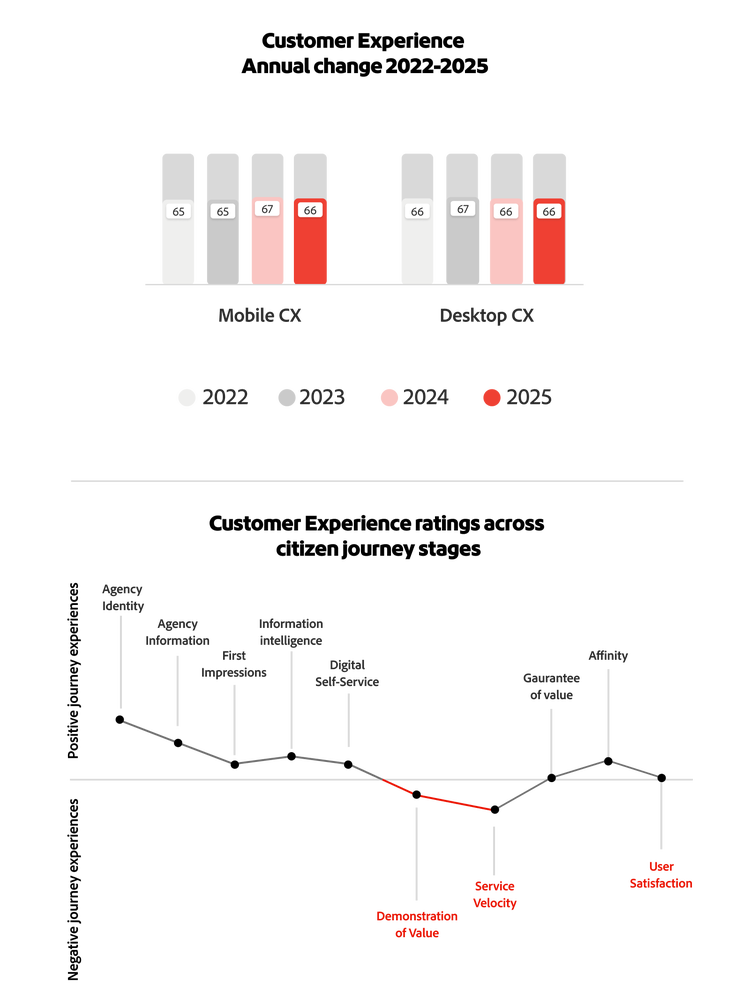
The national score, which aggregates all evaluated agencies, has risen from a baseline of 58.0 in 2022 to 69.4 in 2025, placing it in the middle of the Emerging maturity level for the third consecutive year. After rising more sharply in earlier years, with double-digit increases across two dimensions and the overall score, more recent years have shown only modest movement. Of the three measures, Customer Experience has recorded the least change over time, with only minimal variation since 2022.
Though the national DGI produces a single score, individual agency results vary, ranging from 60.4 to 78.0 in this evaluation. This places some only just within the Emerging maturity band, while others sit closer to the Advanced level. Examining the strategies of top performers and those with strong year-over-year improvement reveals why some are moving ahead faster than others.
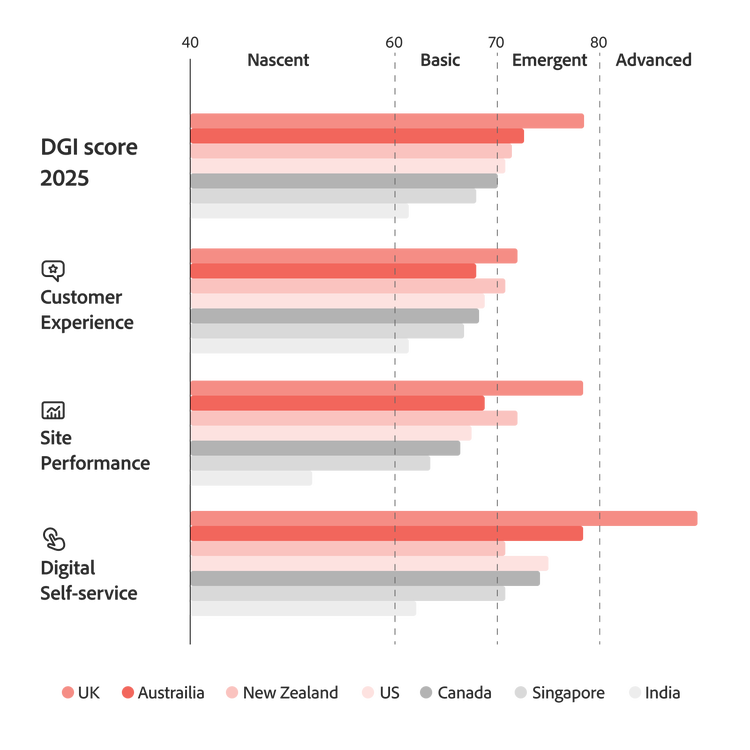
Globally, Australia again sits just behind the United Kingdom, which holds the top spot in 2025. The UK leads in Digital Self-Service and Site Performance, and ranks second worldwide for Customer Experience – the measure with the smallest international variation, and where Australia’s progress remains modest. Strong oversight by the UK.
Government Digital Service helps sustain performance. UK government sites are required to meet defined accessibility standards and publish accessibility statements, with ongoing monitoring and regular updates ensuring these commitments are upheld. This consistency contributes to the region’s continued leadership and provides insight into how it maintains digital service quality over time.
Across all markets, DGI top performers share common characteristics: they perform as a central front door for citizens, offering a unified experience across services; they uphold strong accessibility standards; and they deliver more personalised, user-centred experiences. The presence of these traits explains why certain agencies routinely lead the index.
In 2025, the global DGI assessment reviewed the websites of 115 government agencies globally. Australia’s myGov platform was the highest ranking across the Asia Pacific nations that formed part of the evaluation. Services Australia was the second highest in Asia Pacific, with the Australian Taxation Office, the National Disability Insurance Scheme (NDIS) and the NSW Government also featuring in the top 10.
UNPACKING PERFORMANCE
Customer Experience assesses how effectively government agencies deliver simple, seamless online interactions that enable users to complete tasks easily and efficiently. It is tested on mobile and desktop devices, considering digital diversity and examining how an individual’s unique circumstances – including any visual, cognitive, motor, or hearing differences – influence their experience. Since the evaluation began, Customer Experience has shown the least movement of all dimensions.
Services Australia repeatedly ranks among the top-performing agencies. Charged with delivering high-quality, accessible services and payments on behalf of the government, the agency’s goal is to “make government services simple so people can get on with their lives”. Users report that Services Australia is easy to navigate with information that is clear, relevant and tailored to their individual needs. This approach sets a benchmark for citizen-centred service delivery across government.
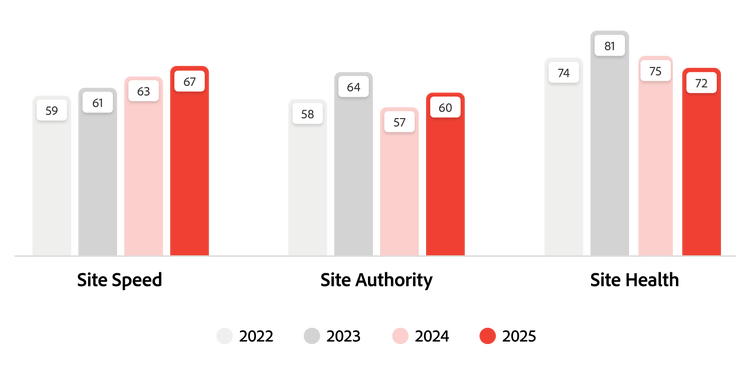
Site Performance is assessed across three metrics: site speed – how quickly a website loads on mobile and desktop devices; site authority – a measure of credibility and ranking potential, primarily driven by backlinks; and site health – a broader metric encompassing speed and other technical factors such as security, content and site structure. Together, these elements support both user experience and search visibility.
The 2025 national Site Performance result has improved, driven by gains in site speed and site authority. Mobile site speed rose by 23%, narrowing the persistent gap with desktop performance, which is a positive shift after years of disparity. The lift in site authority indicates agencies are strengthening their digital presence through improved content, stronger backlinks and reduced fragmentation across multiple sites. In contrast, site health has declined by nearly 4%, marking the second consecutive year of lower performance and the weakest annual result since the DGI was established.
The three measures are interrelated: faster load times improve user experience and site health, while a technically sound site is easier to index and rank, indirectly supporting stronger authority. Though each metric can be improved individually, a truly high-performing site requires attention to all three. As this report will explore in more detail, poor results in any of the Site Performance metrics can impact an agency’s AI readiness, as AI-powered search prioritises fast, reliable sites with strong authority.
The myGov website continues to demonstrate excellence in Site Performance, improving on its 2024 result to record the highest score of all measured agencies. It leads in site health, defying the national downward trend, with a score of 90. Gains in mobile site speed also delivered one of the top results, meeting a growing citizen preference for accessing websites via mobile devices.
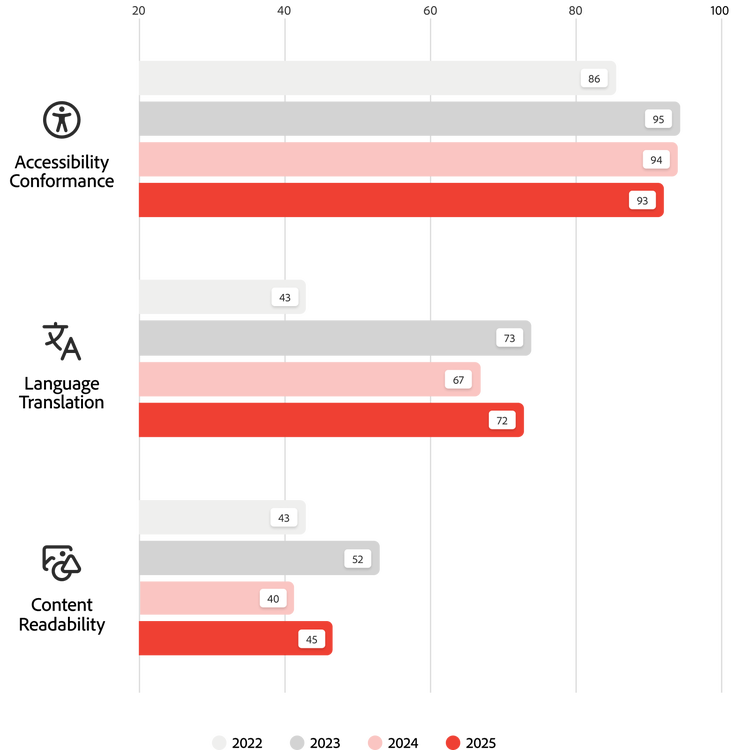
The Digital Self-Service assessment measures how easily users, including those with diverse needs or who use assistive technologies, can locate and navigate government services independently. It evaluates three areas: accessibility conformance, based on the Web Content Accessibility Guidelines (WCAG); the availability of digital and assisted language translation services; and content readability, assessed using the Flesch-Kincaid Reading Ease formula.
While uniformly high across most agencies, accessibility conformance has edged down for a second consecutive year. Drops can occur when updates to design, content or underlying code unintentionally introduce barriers for users. Even small changes can impact WCAG compliance if accessibility is not continually monitored and integrated into development and content processes.
Language translation improved, with five agencies achieving a perfect score and another six scoring between 80 and 90. The remaining agencies fell short, highlighting opportunities to expand digital and assisted translation services. Progress in this area also supports alignment with the Digital Inclusion Standard under the Australian Government’s DXP. Despite an overall 14% improvement, content readability remains a challenge. Scores showed wide variation, ranging from 9 to 74, and kept the average below 50 – a benchmark that only five agencies surpassed. The test rewards clarity and penalises dense or complex writing, highlighting the need to simplify language and structure content more clearly, prioritising communication that enhances accessibility and usability.
The NSW Government achieved perfect scores for both accessibility conformance and language translation in the 2025 report. Accessibility is a key pillar of the state’s Digital Inclusion Standard, which requires digital products to be usable by everyone, regardless of ability or circumstance. The agency offers automatic website translation in over 70 languages, as well as face-to-face, video, and telephone interpreting services for more comprehensive personalised assistance.

AUSTRALIAN STATE AND TERRITORY RESULTS
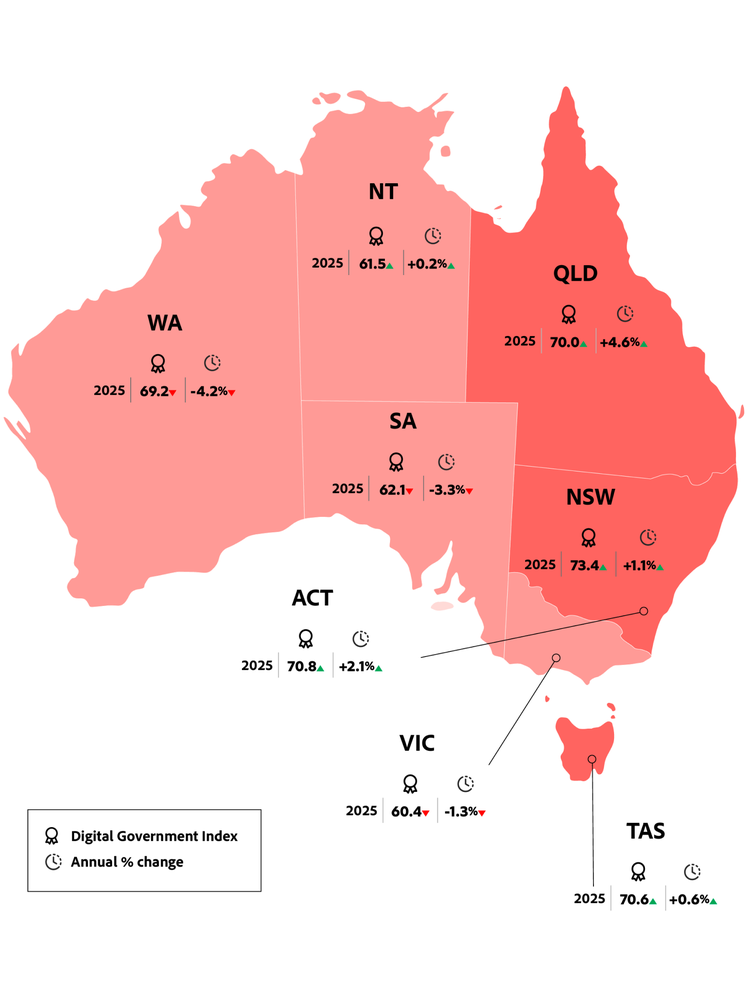
Five of the eight states and territories improved their DGI score in 2025. NSW retained its leading position for the third year running, but the margin is narrowing, with only four percentage points separating the top five. This indicates that digital maturity is levelling across Australia as governments implement both policy and practical initiatives to enhance the citizen experience.
The ACT and Queensland recorded the fastest gains, while the rankings of most other states remained unchanged. Western Australia was the exception, sliding from second place to fifth.
Queensland, which trended down in the previous assessment, reversed course to climb into fourth place. The result was driven by a significant (13.2%) boost in Site Performance, reflecting mobile and desktop speed improvements paired with stronger site authority. This is consistent with the state’s increased digital investment and a new strategic focus on improving service delivery for all Queenslanders.
The ACT moved from fourth to second place, led by a 6.4% improvement in Customer Experience and a moderate lift in Site Performance. Digital Self-Service remained steady.
Western Australia’s Customer Experience remained flat, concealing other challenges. Digital Self-Service dropped 7%, due to a steep decline in readability, and despite stable accessibility and language support scores. Site Performance fell nearly 4%; faster speeds were outweighed by declines in site health and site authority, which could draw down the state’s AI readiness.
Jihad Dib, Minister for Customer Service and Digital Government, NSW Government
AI READINESS IN FOCUS
While the public sector is laying essential foundations for AI, deployment continues to lag due to budget constraints, legacy integration, and organisational silos.8 Beyond these immediate challenges, a broader government blind spot has emerged: AI readiness. Without taking intentional steps, agencies risk being left behind as AI reshapes how people search and access information. While the focus has been on AI enablement – using tools to improve service delivery and engage citizens – AI readiness is now an equally critical driver.
In response to this shift, the 2025 DGI introduces a new assessment to capture how effectively government agencies perform in an AI-driven landscape. Alongside measures of foundational digital maturity, it evaluates how well government websites can be found, trusted, and used by both people and AI systems. It examines three areas:

The credibility and reliability of an online presence. This considers domain authority, reflecting a website’s overall strength, and the integrity of the sources that AI language models (LLMs) draw on when retrieving information. Essentially, it shows how confidently both users and AI can depend on the content as authentic and accurate.

The technical foundation that shapes how easily a website can be surfaced and navigated. This covers visibility and sentiment on AI search platforms, site speed (because LLMs prioritise faster pages) and how content can be accessed and indexed.

The significance and authority of a website in the broader information ecosystem. This includes active backlinks, user recognition and trust, keyword demand, and the share of traffic generated through LLM referrals. Together, these indicators reveal whether an agency is being sought out, cited and recommended, reinforcing its visibility in AI-driven discovery.
By combining these dimensions, the evaluation highlights not only how government websites perform today, but also how well-placed they are for an AI-enabled future.
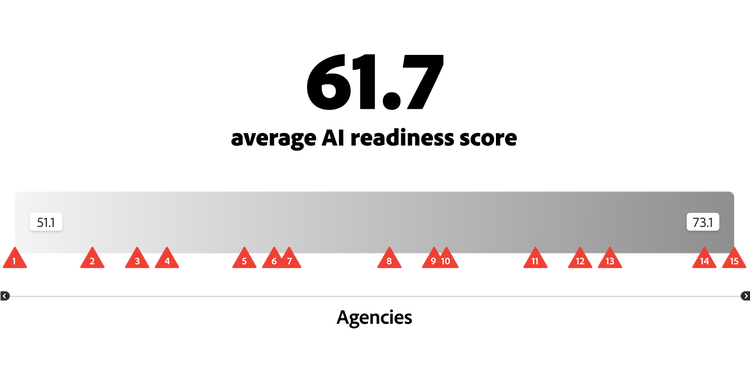
The results reveal a broad spread ranging from an AI readiness score of 51.1 up to 73.1, reflecting both the diversity of agency functions and the interconnected nature of the measures used to assess digital maturity. Agencies that provide open, unauthenticated services or public information perform well on some AI readiness measures, as their content is more easily discoverable and referenced by LLMs. By contrast, service delivery agencies operating behind secure logins will naturally record lower scores on specific indicators, though this does not necessarily reflect a lower level of overall digital maturity.
When examining the three key pillars of AI readiness, trust and authority scored highest, reflecting the reliability and credibility of government information used by LLMs. While agency sites also perform well on crawlability, indicating content is technically accessible, AI visibility remains low. This means trustworthy information is not being surfaced as effectively in AI-generated responses.
The weakest area, Brand and content relevance, is held back by limited traffic referrals to LLMs and user demand for agency keywords. This suggests that despite strong authority, government information may not be reaching citizens through AI-assisted channels, presenting a risk that less reliable sources fill the gap.

Services Australia Automation and Artificial Intelligence Strategy 2025-27
The New South Wales Department of Education has employed AI tools to accelerate the replatforming and modernisation of 2,200 school websites. The new platform brings next-generation authoring and content design capabilities, with all sites optimised for LLMs.
PERSONALISATION IN FOCUS
Connecting citizens with relevant services and support depends on meeting individual needs. By understanding each citizen’s context, like location, ability or life stage, and personalising services accordingly, governments can help people engage more easily and efficiently.
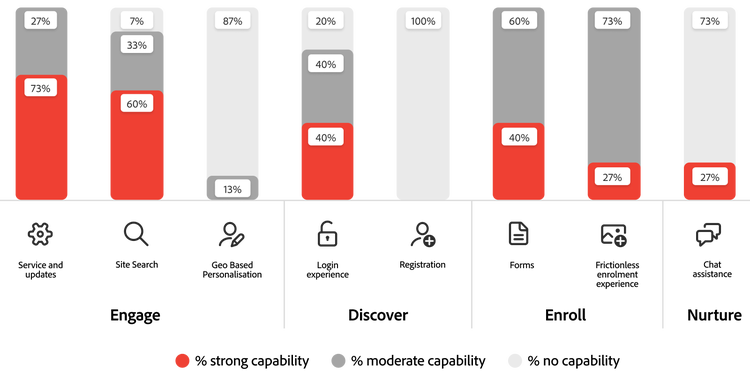
To assess the extent of personalised service delivery, Adobe evaluated eight metrics, each representing a key user journey stage. On a 100-point scale, the average personalisation score across all agencies is 48.8, with a range from 37.5 to 81.3.
While citizen journeys across government sites aren’t always linear, the analysis identifies the stages where personalisation is most advanced and where capability gaps lie. Personalisation capability is strongest in the earlier stages of digital engagement, such as dynamic site search, but tends to moderate as citizens move toward completing a transaction and into post-completion support.
This aligns with separate Adobe research showing that only 8% of citizens receive personalised follow up. With higher levels of reported personalisation before and during the transaction, it can send an unintended message to citizens that relationships are transactional rather than continuous9.
Australian government departments and agencies can improve their DGI scores by taking practical steps. These can modernise service delivery, promote self-service and accelerate citizen adoption of digital services.
• Slow site speed creating barrier to access
• Accessibility not consistent across agencies
• Ensure site reliability and stability to support increased site traffic
• Adopt accessibility
Reduced:
• Call centre volumes
• Pages per visit
• Returning visitors
Visit duration:
• Abandoned forms
• Customer complaints
Increased:
• Transactions initiated
• Transactions completed
• NPS
• Trust
• Low search authority impacting findability of content
• Content not optimised for LLM or Al-led discovery or agentic Al
• Inconsistent tagging or metadata
• Single source of truth for content across all areas and level of government
• Structure and tag content using machine-readable metadata
• Distributed authoring and approval capabilities with LLM publishing workflows
• Use Al to ensure adherence to brand and tone guidelines
• Verify Al-generated and summarised content through the use of data provenance tools
Reduced:
• Call centre volumes
• Pages per visit
• Returning visitors
Visit duration:
• Abandoned forms
• Customer complaints
Increased:
• Transactions initiated
• Transactions completed
• NPS
• Trust
• Content is not optimised for mobile
• UX is not optimised for mobile
• Mobile features are not utilised fully in design
• Design adaptive experiences optimised for mobile devices
• Enhance mobile security and login simplicity
• Provide voice and chat-based support to improve access
Reduced:
• Call centre volumes
• Pages per visit
• Returning visitors
Visit duration:
• Abandoned forms
• Customer complaints
Increased:
• Transactions initiated
• Transactions completed
• NPS
• Trust
• Citizens must repeatedly provide information
• Limited access and automation of application process
• Citizen was unable to re-engage with life journey from where they left off
• Lack of personalisation in digital interactions
• Enable end-to-end digital service completion enabled by automation and Al
• Use context to ensure each citizen's experience is relevant and personal
• Deploy generative Al to simplify forms and scale personalised communication
• Connect and share citizen data across government based on privacy and consent
Reduced:
• Call centre volumes
• Pages per visit
• Returning visitors
Visit duration:
• Abandoned forms
• Customer complaints
Increased:
• Transactions initiated
• Transactions completed
• NPS
• Trust
• Content is not available in all languages
• Content is not suitable for lower literacy levels
• Content is not tailored for individual groups
• Provide multi-lingual and multi-modal content using Al or translation services
• Use Al-driven voice functionality or natural language chatbots with multi-lingual support
• Generate simplified summaries for lower-literacy audiences and LLM consumption
• Provide the ability to have content served in easier to read formats or in video
• Personalise content based on preferences and behaviours of citizens to ensure timely support
Reduced:
• Call centre volumes
• Pages per visit
• Returning visitors
Visit duration:
• Abandoned forms
• Customer complaints
Increased:
• Transactions initiated
• Transactions completed
• NPS
• Trust
Every year, Adobe’s DGI evaluation deepens our understanding of how digital government services are evolving in Australia and internationally. Where earlier assessments highlighted steady progress as agencies built their digital maturity foundations, recent results suggest that momentum has slowed and performance is levelling off. This plateau underscores that delivering effective, user-centric digital services remains a complex challenge for many agencies.
We partner with government departments and agencies to embed the index framework and strengthen ownership across the citizen journey. By leveraging digital enablers such as personalisation capability and AI readiness, we help build the digital maturity required to deliver services that meet citizen needs – today and into the future. To understand how your benchmarking performance compares and discuss specific opportunities, please contact Vincent Lam at vlam@adobe.com for a preliminary discussion.
Adobe’s Digital Strategy Group undertook the Australian analysis for the annual DGI in 2025. It covered the official websites for the following departments and agencies:
ACT Government, Australian Taxation Office, Brisbane City Council, Department of Health and Aged Care, Department of Veterans Affairs, Government of South Australia, myGov, NDIS, New South Wales Government, Northern Territory Government, Queensland Government, Services Australia, State Government of Victoria, Tasmanian Government, Western Australian Government.
Each of the three foundational digital maturity dimensions below is assigned a score from 0-100, with the average producing the overall DGI score.


User testing of 300 participants via script with citizens aged between 18 and 65, testing mobile and desktop user experience across 10 categories.

Using third-party tools such as Google PageSpeed and SEM rush to measure the speed and functionality of 15 government websites across devices.

Using third-party tools such as axeDevTools, Web FX and manual analysis to assess the accessibility and inclusion of 15 government websites.
Further analysis was undertaken to evaluate the following digital enablers with associated methods, including: