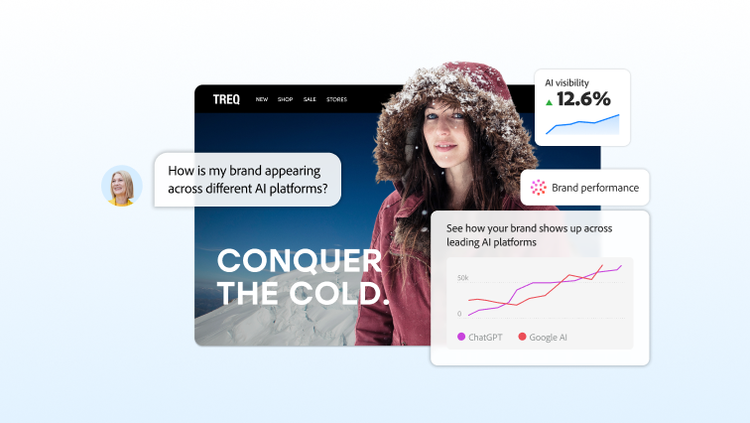
Experiences are changing rapidly. It’s no longer just about appearing on the first page of Google. It’s also about being the primary recommendation in a ChatGPT query, a Claude analysis, or a Gemini travel plan. As we enter the era of agentic commerce, teams must shift their focus toward large language model optimization (LLMO).
If a brand isn't visible to the AI models that customers increasingly rely on for discovery, they effectively don’t exist in the modern buyer’s journey.
The high cost of AI invisibility.
Traditional organic traffic is facing a structural decline. In a recent deep dive into Adobe’s AI roadmap, there's clearly a critical shift — the "empty search box" problem. When a customer starts their journey in an LLM and follows a link to a merchant’s site, only to find a blank search bar, the experience breaks down.
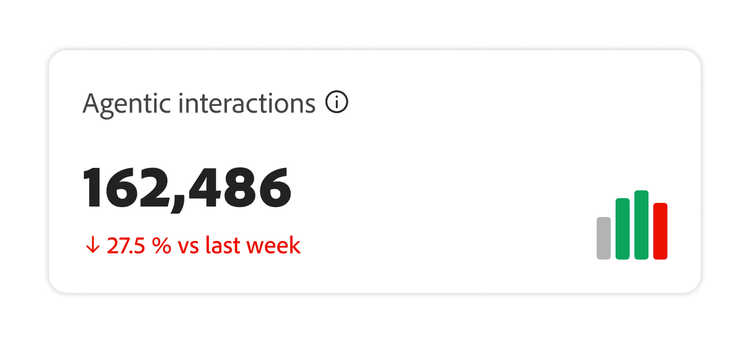
To stay ahead of the competition, organizations must prioritize brand visibility because it’s not just a vanity metric, but a critical part of brand discovery and growth. Blue Acorn iCi recently worked with a major furniture retailer whose overall AI visibility score was just 25%, while referral pageviews declined 27.5% week over week. These metrics highlight how the retailer risks losing market share to competitors better optimized for AI citations and referral traffic.
Moving from chat to commerce with Universal Commerce Protocol.
The competitive advantage of AI visibility is amplified when brands can turn a conversation into a transaction. That’s where Universal Commerce Protocol changes the game.
Universal Commerce Protocol acts as the standardization layer that structures LLM-derived intent into bounded shopping actions. For example, while the LLM handles the conversation, Adobe Commerce remains the authoritative source of truth for pricing, inventory, and checkout.
By prioritizing AI visibility, brands can create a seamless flow:
- Discovery: A customer asks AI to find a configurable couch that fits a one-bedroom living room.
- Intent: Universal Commerce Protocol extracts these customer preferences and constraints.
- Execution: Adobe Commerce returns live availability and executes the order.
Competitors who lack this architecture will force customers to restart their search from scratch, creating friction that kills conversion.
The path forward: Measure, pilot, and win.
Organizations cannot compete for what they cannot measure. Adobe Brand Visibility Model Context Protocol now provides programmatic access to sentiment analysis, source analysis, and agentic traffic signals. This allows teams to build custom dashboards and executive digests that track:
- Visibility scores: A brand’s share of voice within LLM responses.
- Sentiment shifts: Monitoring changes in how customers view the brand. For example, customer reviews of a product going from mostly positive to mostly negative after a bad update.
- Referral impact: Tracking qualified AI-referred visits and engagement.
Through Blue Acorn iCi’s work to improve a major furniture retailer’s AI visibility, the brand achieved significant results in just a few weeks — a 140% increase in ChatGPT citations, 100% content visibility to AI models, and a 91% increase in referral traffic from LLMs.
For teams looking to outpace the competition, the recommendation is clear — start with a four- to six-week brand visibility pilot. This pilot allows organizations to understand their current AI footprint, address declining organic traffic, and optimize the brand’s presence on AI surfaces. By prioritizing AI visibility today, teams aren't just optimizing for a new search engine. They’re building the infrastructure to win the next decade of retail.
Gary Howell is VP of Adobe Experience Manager Digital Solutions at Blue Acorn iCi and has been an Adobe Experience Manager Champion for 4 years. His expertise spans enterprise digital experience strategy, Adobe Experience Manager implementations, and helping organizations leverage innovative solutions to optimize content management and deliver exceptional customer experiences.
Recommended for you
https://business.adobe.com/fragments/resources/cards/thank-you-collections/brand-visibility