For most of the web's history, content infrastructure solved one problem - getting content in front of a person. Everything underneath the content architecture assumes a human on the other end of the request: how pages get composed, how they're cached, how we measure whether they worked. That held up for about thirty years, but it doesn't hold up anymore. Most content systems were architected to deliver content, at best optimized for reusability. Yet, what brands have always wanted is to deeply engage with their customers and build their brand. A brand that encapsulates a company’s reputation, identity, and customer perception. That has always been Adobe Experience Manager’s north star and what we’ve architected for.
The reckoning every content architecture now faces.
That question lands on the content system, because it provides the context to the answer. This content and context system that authors, structures, governs, and serves your content that not only optimizes and persuades human experiences, now also has to be the system that interacts, reasons, and persuades agentic traffic – whether it comes as an LLM or search agent, or an outcome driven OpenClaw / personal agent. The agentic brand experience is vastly different from human brand experience, which turns the content system into one of the most strategic systems that manages the brand and its value.
This has been the genesis of Adobe’s CXO strategy. A content system with breadth and depth of signals to understand brand presence and market context, an agentic workflow that shortens the path from creative ideation to omnichannel delivery, the right modality for every channel — LLM, web, emerging surfaces — and a learning flywheel that makes every interaction smarter than the last. Our Semrush acquisition is a major signal to realize this opportunity. With the true experience flywheel, we are bringing a modern experience system that brand owners can build, run, and operate their brand visibility and engagements across the customer lifecycle.
The market is acknowledging and attesting to the north star that we’ve already been marching towards. With Salesforce acquiring Contentful to fill the content layer in their stack, and Sitecore acquiring Scrunch to elevate brand presence in AI-driven discovery, it's great for brands to have options – trust the system that drives outcomes, or invest in infrastructure tooling that leaves their brand to a guessing game. When a content layer gets acquired into a platform built around a different center of gravity — a customer database, a sales pipeline — content becomes subordinate to the system it's attached to. That's backwards for where the web is going. In an agentic world, what AI reasons with, surfaces, cites, and trusts is governed, structured content, and that needs to be the foundation, not a downstream feature of a system designed for something else.
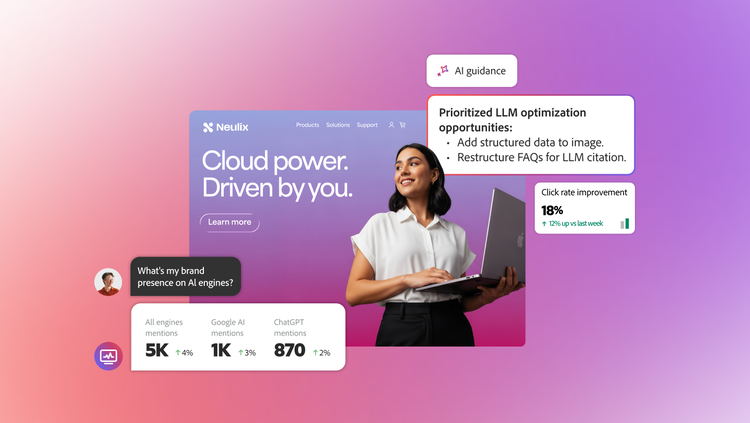
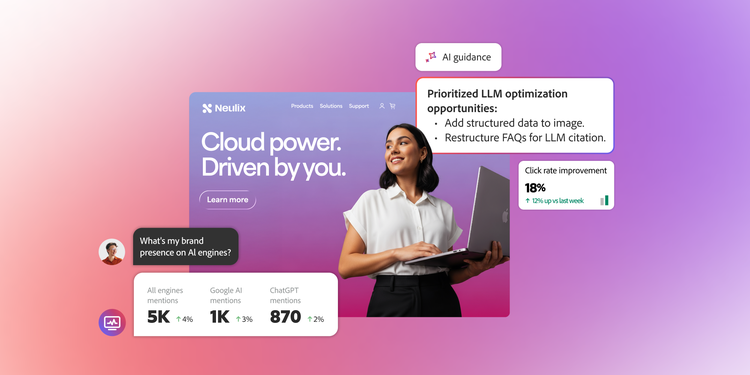
Adobe is already working with customers to solve the AI-era visibility. We have the signals that show where a brand is surfaced, cited, or missing in AI answers, which flows directly into the same system that authors and governs the content. LLM agent activity is also visible alongside customer behavior and business performance, creating a direct connection between AI visibility and real business outcomes. That means brands can move beyond measuring mentions and rankings to understanding which AI interactions actually drive results. The continuous insights-to-action loop is built to close with agents: an optimization recommendation isn’t a ticket for a human to work on later, it’s an action an agent can take against the brand’s governed ground truth, so the fix ships on-brand and in-policy.
The differentiator isn’t content, it’s what constrains it.
AI is collapsing the economics of content production for everyone, equally. When every vendor can prompt the same foundation models, content volume stops being an advantage – it becomes table stakes. So does customer data; everyone has a database. The value moves to something neither a CRM nor a content repository was built to hold: a structured, AI-readable representation of what your brand actually is – what it can say, what it can’t, what it looks like, what it’s allowed to claim, and how it’s positioned. Without that, AI-generated output starts to look generic. It sounds like every other brand that prompted the same model.
This is the brand’s ground truth. It's the reason a generated product page sounds like your brand, which is exactly why a platform built around customer records can't simply buy its way into it. Brand voice, approved claims and their substantiation, product facts by market, design standards, compliance rules, competitive positioning: this knowledge lives in, and is governed by, the content system. It must be authored, versioned, scoped by market and channel, and passed to every agent and model as the constraint they generate within. A customer database knows who the customer is, but it does not know what your brand is permitted to say to them. And in an agentic world, that's the knowledge that decides whether the experience builds your brand or becomes a liability generated at scale.
What the right foundation actually does.
Infrastructure built for brand visibility must do four things, and it must do them now, not in a future release. Adobe Experience Manager is natively integrated across the CX Enterprise in ways that acquired components are not yet integrated with each other.
First, it has to be structured for machines from the start, not patched to fake it later. Content modeled as structured, reusable pieces, delivered by API to wherever it needs to go, and rendered into pages that are fast and actually crawlable; that's what makes your brand readable to an AI and good for a person at the same time. The structured source and the page human sees are the same system. They're not two systems your team gets handed and told to reconcile. This is the part decoupled-only setups leave to the customer to engineer, but it shouldn't be the customer who engineers.
Second, it has to let people author fast. When content requests start multiplying across surfaces and audiences, the bottleneck moves from delivery and onto creation. The fix isn't a separate AI app or layer you tab over to and copy out of, but having generative and agentic capabilities built into the authoring environment and across workflows. Agents that draft and adapt content, surface what to create next, and carry brand context into the work mean a team can produce and tailor at the pace the moment demands — without leaving the system that governs everything else.
Third, it has to be governed at brand scale. A bigger, partly autonomous audience raises the stakes on consistency, rights, and compliance, because more of what speaks for your brand gets assembled and served without anyone reviewing each request. Multi-site, multi-brand, multi-language governance, with role-based control, approvals, and audit trails built into the platform, is the thing that lets you trust automation instead of bracing against it.
Fourth, it has to connect to the rest of the content ecosystem. Content doesn't run on its own. It leans on assets, feeds into forms, and gets decided by data in real-time. When all of that lives in one integrated platform — content and decisioning in the same loop – experiences can be dynamically assembled and tailored based on a complete view of the customer. These experiences also draw on behavioral signals, transactions, engagement history, and content interactions together, instead of relying on a thin customer record alone. The system gets better at serving customer experiences, not just better at knowing who the customer is. That's a different design goal than connecting content to a database, and it shows what the platform is actually good at.
Adobe Experience Manager Sites is built on this. And built is the word that matters: it's in production, doing this for enterprises today.
Where this goes.
The brands that come out ahead in the agentic web won't be the ones making a clever bet on the future. They'll be the ones already treating content infrastructure like the strategic asset it became — integrated instead of stacked, structured from the ground up instead of retrofitted, governed at scale.
And the lead compounds. It shows up everywhere that matters now: in whether AI answers describe you accurately, in experiences delivered through agents, and on the ordinary parts of the web people never stopped using. The web didn't lose its audience; it picked up a second one. The infrastructure that serves both is already here, and the gap between the companies that saw it early and the ones still guarding a shrinking patch gets a little wider with every request that comes in — human or not.
Recommended for you
https://business.adobe.com/fragments/resources/cards/thank-you-collections/experience-manager-sites