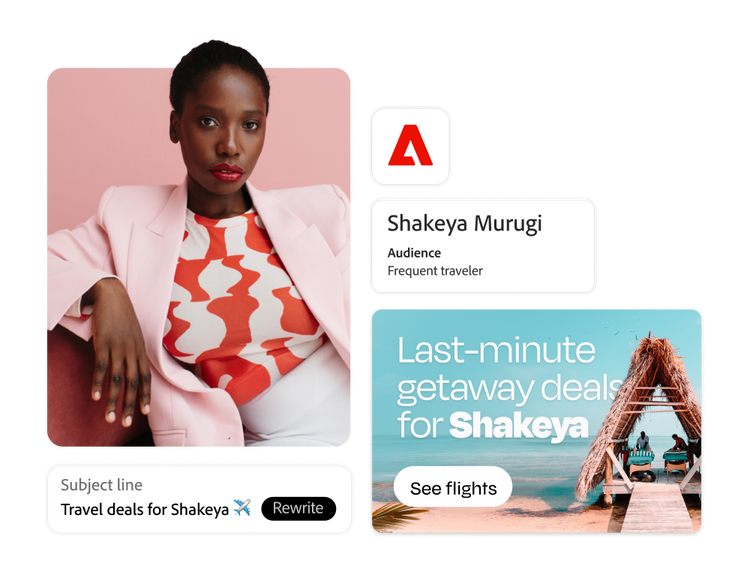
In this era of AI and agentic marketing, content creation has scaled beyond anything traditional workflows were designed to support. Using generative AI and agents, campaigns are now built across channels, audiences, and formats at once, and can be taken live just as quickly. But speed alone doesn’t guarantee audience resonance. Without a system to guide it, the scale could put your brand identity and campaign impact at risk.
Adobe Brand Intelligence is built to help organizations scale content without losing brand integrity — turning brand knowledge into a living system that evolves with every decision. It goes beyond static guidelines to capture both explicit rules and the implicit knowledge that shape a brand’s ethos. Brand Intelligence helps brands truly scale impact by guiding teams on not just whether content aligns with the brand, but whether it will make a lasting impression with the market.
Simulate, a core skill within Brand Intelligence, is designed to capture insight on what will drive resonance before it’s put to work.
Why post-launch learning isn’t enough.
Marketing today has more data than ever before, yet it’s still largely reactive. Teams track performance across every channel, analyze engagement in real time, and continuously optimize campaigns. But despite all this visibility, one challenge remains: understanding what will actually resonate with the audience before content goes live. By the time performance data tells you what worked, the moment to influence the outcome has already passed. And as content volumes grow with AI, many inefficiencies scale alongside them:
- Campaigns become expensive, requiring multiple iterations to find what works.
- Decision-making becomes slow while waiting for performance results.
- Creativity is often constrained, as teams default to safer options rather than informed risks.
Generating more variations doesn’t guarantee better outcomes if teams still rely on post-launch signals to guide decisions, especially when audience preferences are constantly evolving. To keep pace, insight must move earlier in the process — shaping choices, not evaluating them after.
Shifting insight upstream with Simulate — and how it works.
Instead of relying solely on post-launch analytics, Simulate brings foresight into the campaign development process. This allows teams to understand how value propositions, branding concepts, campaign assets, and more land before they reach an audience. At the center of this capability are synthetic audiences — modeled representations of your customers, grounded in your actual customer data.
These audiences are built as individual personas, which are then aggregated into audience segments or panels that reflect your real audience mix. This lets teams evaluate ideas against a realistic, representative cross-section, not a simplified segment or generic profile. Essentially, it creates a scalable, always-on virtual focus group.
Teams can test how various audiences will think and react at any stage of development, from early concepts and messaging options to rough cuts and finished assets. And unlike traditional testing, the feedback goes beyond directional scoring to include qualitative insight into the messaging, tone, clarity, and overall perception. This transforms the role of data in marketing from measuring results to helping shape them.
It gives teams the ability to:
- Identify which ideas are most likely to resonate.
- Increase speed to market on insights from traditional research or experimentation.
- Align stakeholders earlier with a shared, data-backed direction.
This is where Simulate extends the value of Brand Intelligence. While the Validate skill ensures every asset stays true to the brand, Simulate ensures those assets are set up to resonate before they reach an audience. And when you bring insights upstream, you extend brand value downstream, strengthening impact like brand recall and favorability.
The future of marketing is proactive.
In a world where AI-enabled content is effectively infinite, reacting to performance is no longer enough. The competitive advantage lies in anticipating what will work — and acting on that insight early.
Simulate makes this possible by embedding insight directly into your workflows. It reduces uncertainty, improves efficiency, and unlocks more confident decision-making. Instead of asking “What worked?” after the fact, teams can ask “What will work?” while it still matters. As AI-driven and agentic marketing continues to accelerate, that shift from reactive to proactive won’t just improve content impact, it’ll define leading brands. See how Xfinity embedded brand governance directly into production before content ever reached review.
Learn more about how Adobe Brand Intelligence can make your brand stand out.
Claudia de Lavalle is a Senior Manager of Product Marketing at Adobe, driving go-to-market strategy for Firefly Enterprise solutions. Her days are spent connecting dots between product, marketing, and voice of customer, with the goal of helping Customers scale effective, on-brand content and helping Adobe innovate on the respective solutions. She believes in the power of brand to keep experiences human, and the power of AI to bring brands to life. Claudia has also held growth and product marketing roles at Spotify, Google and Pinterest, always focusing on the intersection of creative and marketing.