Powering the future of industrial manufacturing with AI-driven customer experiences.
Jonathan Burdette
02-17-2026
Industrial manufacturing is entering a new phase of transformation. While operational and engineering excellence remain foundational, they no longer define market leadership on their own. Growth now depends on how intelligently manufacturers engage customers across increasingly complex, multi-stakeholder journeys — using data, personalization, and AI to inform decisions, strengthen relationships, and create long-term value.
As customer expectations evolve and value chains grow more interconnected, manufacturers must rethink how they engage buyers across marketing, sales, and post-purchase enablement. To understand how prepared the industry is for this shift, Adobe commissioned Incisiv to survey 559 industrial manufacturing leaders across nine global markets, with the majority representing enterprises generating more than $1 billion in annual revenue. The findings reveal where progress is being made, where foundational gaps persist, and how AI is reshaping the future of industrial customer experience.
Customer journeys are complex — but largely untracked.
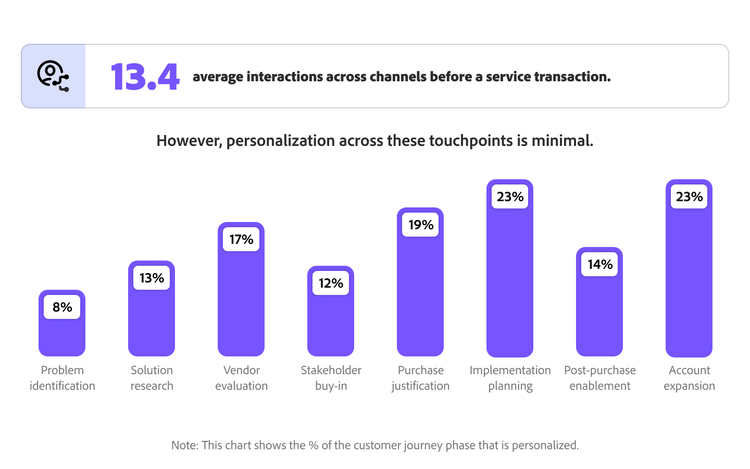
Industrial buying journeys are long, high-stakes, and multi-stakeholder by nature. On average, buyers engage in 13.4 interactions across channels before completing a service transaction. Despite this complexity, most manufacturers lack visibility into the interactions that influence decisions across research, evaluation, and post-purchase stages.
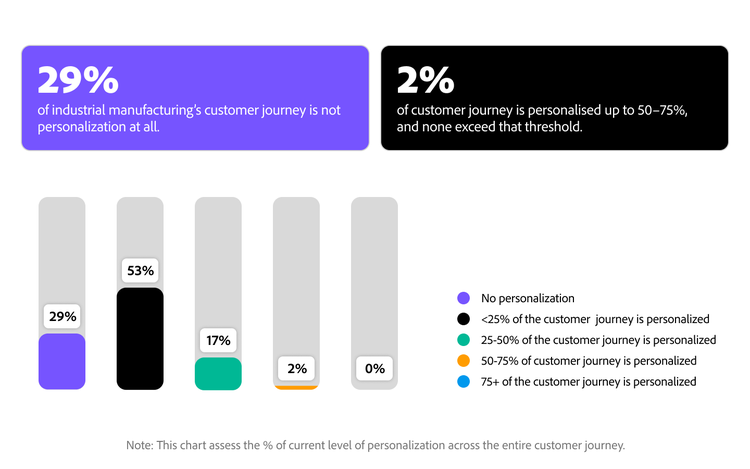
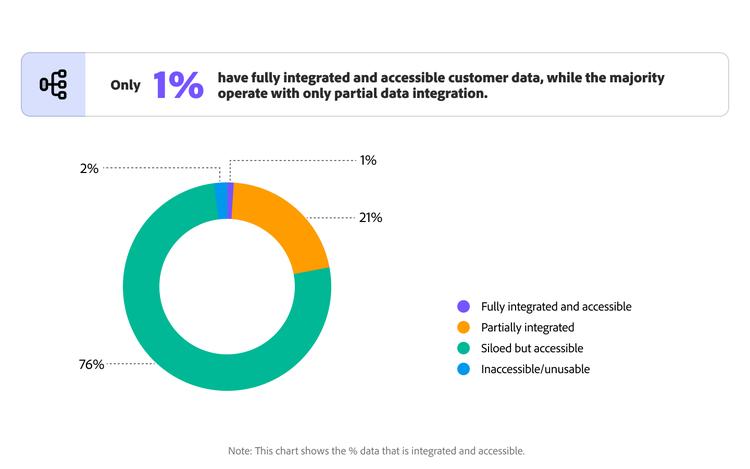
This means personalization across these touchpoints remains limited. Nearly 29% of the industrial customer journey is not personalized at all, and no respondents report personalization exceeding 75% of the journey. Without connected interaction data, marketing and sales teams struggle to align outreach, prioritize accounts, or influence buyers early — undermining revenue predictability and deal velocity. This gap is reinforced by the fact that only 1% of manufacturers report having fully integrated and accessible customer data, helping explain why connected journeys remain elusive despite the rise in omnichannel engagement.
While personalization is widely viewed as a strategic priority, its effectiveness continues to fall short of its perceived importance. This creates a growing execution gap and untapped revenue opportunity across today’s long, multi-touch buying journeys.
Personalization ambitions outpace operational readiness.
Manufacturers recognize the value of personalization but adopt it cautiously. Structural realities such as long sales cycles, complex configurations, regulated environments, and fragmented legacy systems make scaling personalization feel risky. As a result, most initiatives remain confined to narrow use cases such as quoting tools or post-sales support.
This cautious approach isn’t resistance, it’s pragmatism. Industrial leaders prioritize proven ROI and operational stability over experimentation. But the data shows that without broader personalization embedded across the lifecycle, manufacturers miss opportunities to improve sales productivity, retention, and account expansion.
AI can help unlock personalization at scale, but only when supported by unified data and clearly defined workflows.
In-person relationships still anchor customer acquisition.
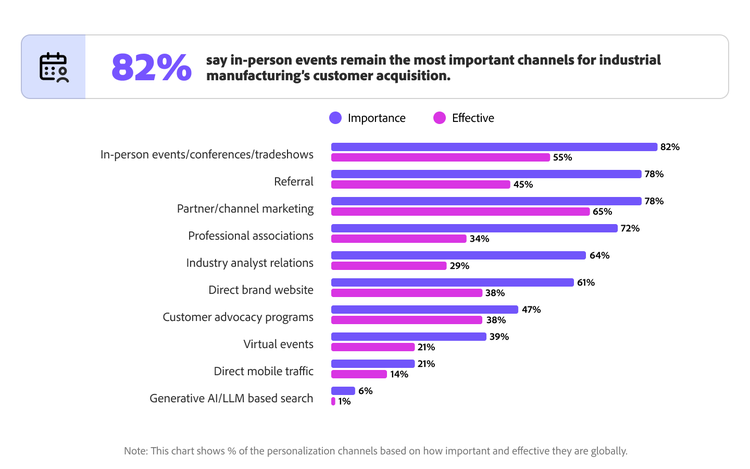
Unlike consumer-led industries, industrial manufacturing remains deeply relationship-driven. 82% of leaders cite in-person events, conferences, and tradeshows as the most important acquisition channel, far outweighing purely digital touchpoints. Trust, expertise, and consultative selling continue to shape buying decisions.
Digital channels still play a critical role — but as enablers, not replacements. The most effective acquisition models blend digital discovery and engagement signals with human-led follow-up. Manufacturers that use digital insights to prompt timely, high-value interactions gain efficiency without sacrificing relationship depth.
Marketing is being redefined as a commercial growth engine.
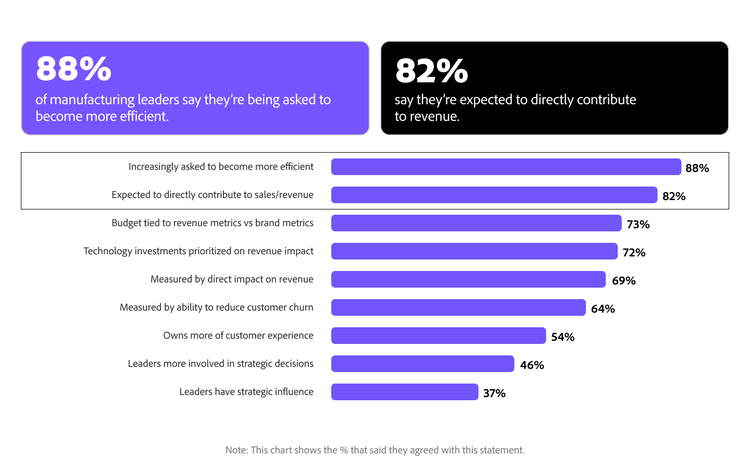
Marketing’s role in industrial manufacturing is changing fast. Once viewed primarily as a support function, marketing is now under pressure to demonstrate direct business impact. 88% of leaders report increased expectations for efficiency, and 82% say marketing is expected to contribute directly to revenue.
This shift is forcing marketing teams to rethink how they operate — moving from activity-based reporting to outcome-driven performance. Success is increasingly measured by pipeline contribution, conversion rates, and cost efficiency. AI and analytics are critical enablers, but only when supported by unified data and closer alignment with sales.
Siloed data is undermining scale and execution.
Despite growing pressure to perform, most manufacturers lack the data foundation needed to support connected journeys or AI-driven decisioning. In fact, 97% say their customer data is siloed or only partially integrated, which is why personalization, analytics, and AI activation are so often stuck at the pilot stage rather than scaled across the business. This fragmentation limits far more than personalization. It weakens forecasting, obscures performance insights, and forces teams to rely on intuition rather than signals. As AI becomes more embedded in marketing and sales workflows, these data gaps become a critical blocker, not just an inefficiency.
AI adoption is advancing — but readiness lags behind.
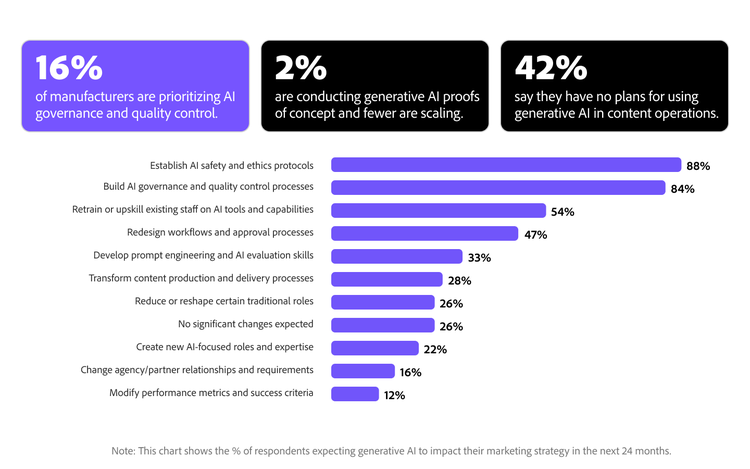
Interest in AI is growing across industrial manufacturing, but adoption remains measured. Many organizations recognize that generative AI has the potential to improve efficiency and support complex marketing and content workflows. At the same time, the industry’s risk-aware operating model means leaders are hesitant to scale AI without clear governance, compliance, and quality controls in place.
The challenge is that while governance is widely understood to be a prerequisite, few organizations are actively building it today. Only 16% of manufacturers say they are prioritizing AI governance and quality control. This leaves most companies caught between rising expectations for AI-driven efficiency and a lack of operational readiness to move beyond experimentation.
Agentic AI follows a similar pattern. Nearly all manufacturers require security audits, regulatory compliance, and risk assessments before expanding autonomous AI initiatives. In an industry built on precision and control, AI must earn trust through structure — not just speed.
The road ahead: Building AI-ready industrial customer experiences.
To close the gap between rising expectations and operational reality, industrial manufacturing leaders should focus on three priorities:
Unify customer data to enable precision selling.
Create a single source of truth across regions, products, and partner channels to support connected journeys and reliable insights. This requires bringing fragmented customer records together across systems and touchpoints and connecting behavioral and transactional signals into a unified customer profile — turning disconnected interactions into actionable journey intelligence.
Scale personalization with operational rigor.
Embed relevance across the full lifecycle, from discovery to post-purchase, using modular content, AI-driven insights, and account-based strategies. Achieving this at scale depends on modular content frameworks and always-on experimentation. It also requires intelligent orchestration that can localize experiences by persona, role, and buying group across long, multi-stakeholder journeys.
Adopt AI intentionally and responsibly.
Establish governance frameworks, upskill teams, and deploy AI where it enhances efficiency, trust, and long-term value. This means operationalizing AI-powered content generation, insights, and automation within enterprise-grade workflows that include built-in controls for compliance, versioning, and quality — so innovation never outpaces trust.
The future of industrial manufacturing will be shaped by how effectively organizations connect data, operations, and customer engagement across increasingly complex customer journeys. Manufacturers that embrace unified data platforms, embed personalization, and scale AI responsibly will lead the next era of industrial growth.
Explore the full report to see how industrial manufacturing leaders are transforming customer experience in an AI-driven world.