Why Most Adobe Workfront Planning Implementations Struggle—And What Successful Teams Do Differently
10-09-2026
Successful Adobe Workfront Planning implementations are rarely defined by the number of record types they contain. Instead, they succeed because they help organizations make better decisions before work begins. This article explores the architectural principles that separate Planning environments people simply use from those that become part of how the business plans and prioritizes work.
Organizations have become increasingly sophisticated at managing work. Project delivery is often supported by mature workflows, automated approvals, standardized processes, and dashboards that provide visibility into operational performance.
Yet many leadership teams still struggle to answer surprisingly simple questions:
- What are we planning next quarter?
- Which initiatives compete for the same budget or audience?
- Where are we over-investing—and where are we missing opportunities?
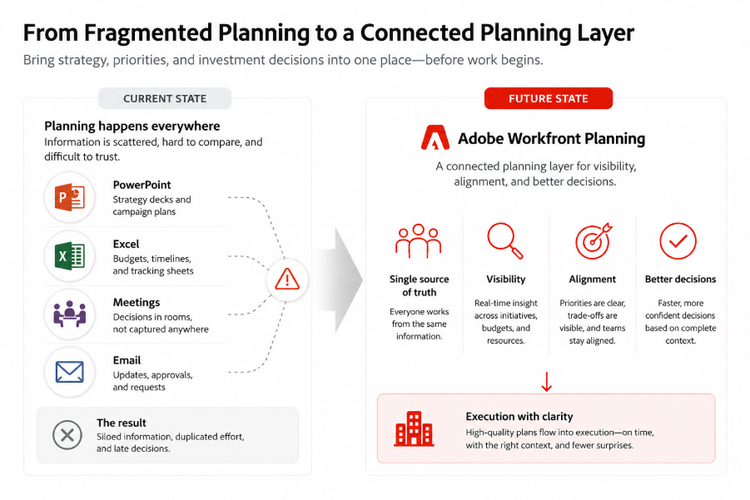
The challenge is rarely a lack of information. Instead, planning information is scattered across presentations, spreadsheets, documents, and departmental tracking systems. By the time initiatives enter a delivery platform, many of the most important decisions have already been made elsewhere—and often without a shared view across the organization.
Adobe Workfront Planning was designed to close exactly this gap by providing a centralized environment for strategic planning before execution begins.
However, organizations that achieve lasting success with Planning typically approach implementation very differently from traditional system configuration projects.
Rather than starting with technology, they begin by designing how decisions should be made.
Start with Decisions, Not Objects
One of the first questions administrators often ask is:
“Which record types should we create?”
It’s an understandable place to start—but usually not the most productive one.
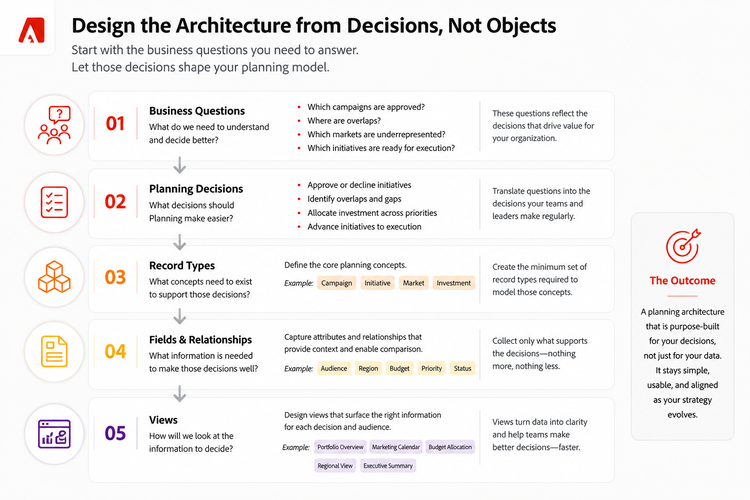
Successful Planning implementations begin by understanding the decisions the organization wants to improve rather than the objects it wants to configure.
Consider a global marketing organization preparing campaigns for the next quarter. Regional teams maintain their own planning spreadsheets, leadership manually consolidates information before quarterly reviews, and campaign overlaps are often discovered only after budgets have already been committed.
Before designing a single workspace or record type, the organization should first identify the questions Planning needs to answer:
- Which campaigns are approved?
- Which markets are underserved?
- Where are duplicate investments occurring?
- Which initiatives are ready to move into execution?
These business questions naturally shape the planning architecture. Record types, relationships, and fields become a consequence of the desired decision-making process—not the starting point.
Planning and Workflow Solve Different Problems
One of the most common misconceptions is that Workfront Planning simply exists to create Projects.
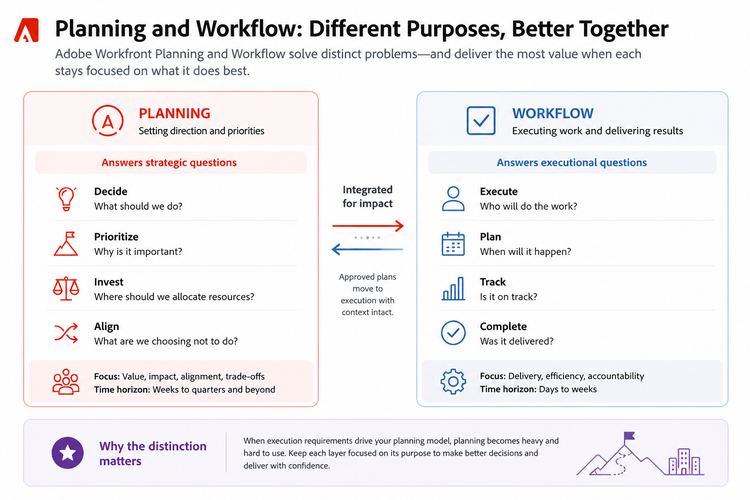
While Planning and Workflow integrate exceptionally well, they serve different purposes.
Planning helps organizations determine:
- What should we do?
- Why is it important?
- What are we choosing not to do?
Workflow focuses on execution:
- Who owns the work?
- When will it be delivered?
- Is execution progressing as expected?
Maintaining this distinction is essential.
When execution requirements begin driving the Planning model, record types often become project substitutes, lifecycle states resemble task workflows, and planning environments gradually accumulate operational complexity.
Over time, Planning risks becoming another project management system instead of remaining the strategic decision layer it was designed to be.
Simplicity Scales Better Than Complexity
Many first-time implementations assume that stronger governance requires more structure.
The result is often an expanding collection of record types, mandatory fields, workspaces, and increasingly detailed lifecycle states.bWhile this appears comprehensive, it frequently introduces unnecessary complexity for users.
Campaign planning provides a good example.
Instead of creating separate record types for Brand Campaigns, Product Campaigns, Regional Campaigns, and Event Campaigns, many organizations achieve greater flexibility by modeling a single Campaign record type. Characteristics such as region, audience, business unit, product, or channel can then be represented using structured fields and consistent taxonomies.
This creates a conceptual model that is both easier to understand and significantly easier to maintain as planning evolves.
The Most Valuable Deliverable Is Often the View
Administrators naturally spend considerable time designing fields.
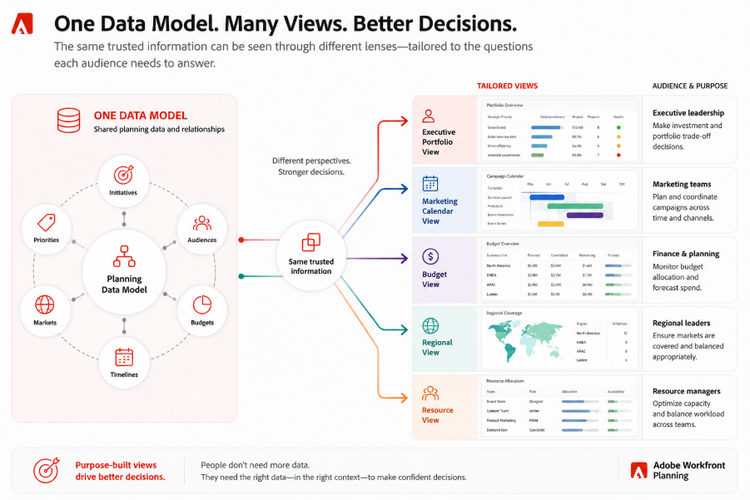
Experienced Planning architects devote just as much attention to designing views.
Why?
Because decisions are rarely made by examining individual records.
They are made by comparing priorities, identifying gaps, reviewing portfolios, and evaluating trade-offs across multiple initiatives. A quarterly executive portfolio review requires a different perspective than a weekly campaign planning meeting, even when both rely on the same underlying data. Well-designed views reduce complexity by presenting only the information required for a specific decision. Over time, they become part of the organization’s regular operating rhythm.
Eventually, stakeholders stop requesting PowerPoint summaries—they open Planning directly.
AI Accelerates Design—It Doesn’t Replace It
Artificial Intelligence is already changing how administrators work with Adobe Workfront Planning.
Capabilities such as the AI Workspace Creation Agent can generate an initial planning structure from natural language, while the AI Assistant helps explain formulas, summarize information, and guide users through increasingly sophisticated planning environments.
These capabilities significantly reduce the effort required to build an initial solution.
What they do not replace is architectural thinking.
AI can accelerate implementation, but it cannot determine which planning concepts matter most to your business, how governance should work, or which decisions Planning should ultimately support.
Those remain design decisions—and they are exactly where experienced administrators continue to create the greatest value.
Adoption Happens in Meetings
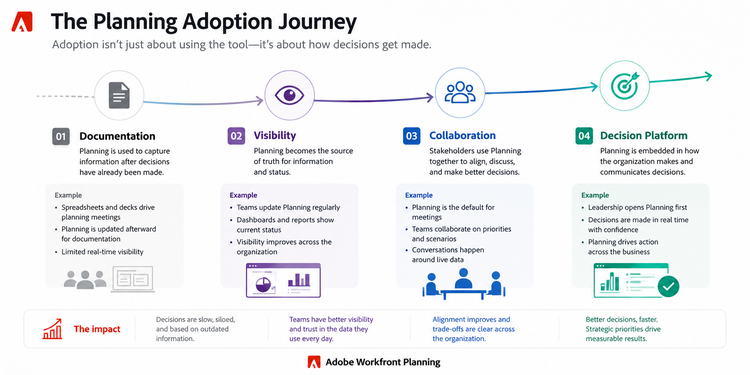
Successful implementations are not measured primarily by the number of records created or users onboarded. A far better indicator is observing how planning meetings change.
If quarterly planning sessions still rely on PowerPoint presentations while Planning is updated afterward for documentation, adoption remains limited.
In mature implementations, Planning becomes the meeting itself. Leadership reviews live information rather than screenshots, stakeholders discuss current data instead of static reports, and planning conversations happen directly within the platform.
One simple question often signals this transition:
“Is it already in Planning?”
When that becomes part of everyday conversations, Planning has evolved from another application into an integral part of organizational decision-making.
Integration Should Extend Planning—Not Define It
As organizations mature, many naturally explore tighter integration between Planning and Workfront Workflow.
For some, this creates a seamless transition from strategic planning into execution.
For others—particularly organizations coordinating work across multiple delivery systems—Planning serves as an independent decision layer while execution continues in different operational platforms.
Both approaches can be successful.
The more useful question is not whether Planning should integrate with Workflow, but whether integration helps the organization make better decisions without introducing unnecessary complexity.
Planning should remain the place where priorities are established. Integration should support those priorities—not determine how Planning itself is designed.
Planning Is Becoming Decision Infrastructure
Perhaps the most significant shift is not technological but organizational.
Increasingly, organizations are recognizing that Planning is more than a staging area before execution. It is becoming the environment where priorities are evaluated, investments are aligned, and strategic trade-offs become visible across the business.
This changes how implementations should be approached.
The strongest Adobe Workfront Planning environments are rarely the most complex. They are the ones that provide leaders with greater clarity, help teams align around shared priorities, and make better decisions possible.
Because ultimately, Planning is not just about organizing work.
It is about deciding which work deserves to exist.
Closing
As organizations become increasingly data-driven, the ability to execute efficiently is no longer enough.
Competitive advantage is increasingly determined much earlier—when priorities are set, investments are allocated, and opportunities are evaluated.
That is exactly where Adobe Workfront Planning creates value.
It provides a shared environment where strategy becomes visible, trade-offs become transparent, and better decisions can happen before work begins.
Because the organizations that outperform tomorrow won’t simply execute faster.
They’ll decide better.
Recommended for you
https://business.adobe.com/fragments/resources/cards/thank-you-collections/workfront