

#000000

Connecting people and their planet digitally.

Natural History Museum builds global planet advocacy with content tailored to every audience.

2X

increase in revenue from personalized campaigns

Six-figure

boost in donations from a single test of donation messaging

80%

email open rates and higher-than-average click throughs

Partner
IMS

Featured products:

Adobe Experience Manager Sites

Adobe Analytics

Adobe Real-Time Customer Data Platform

Adobe Target

Adobe Commerce

“What was really impressive about Adobe is the willingness to explore our challenges with us, to show us what’s possible, and to connect us with others who have done it.”

Richard Hinton

Chief Information Officer, Natural History Museum

Reimagining legacy for a global future.

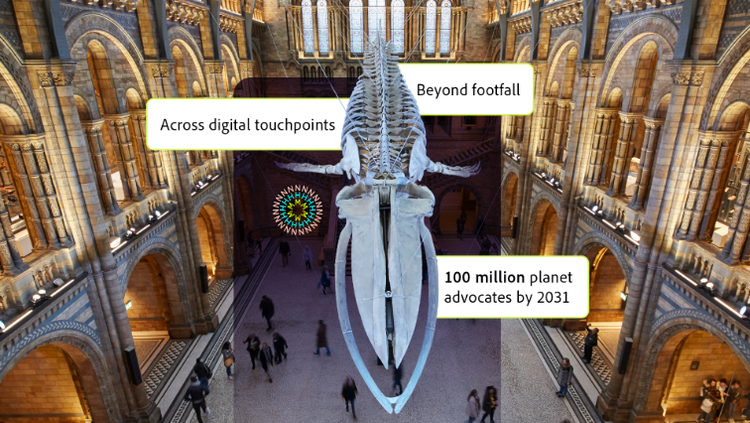
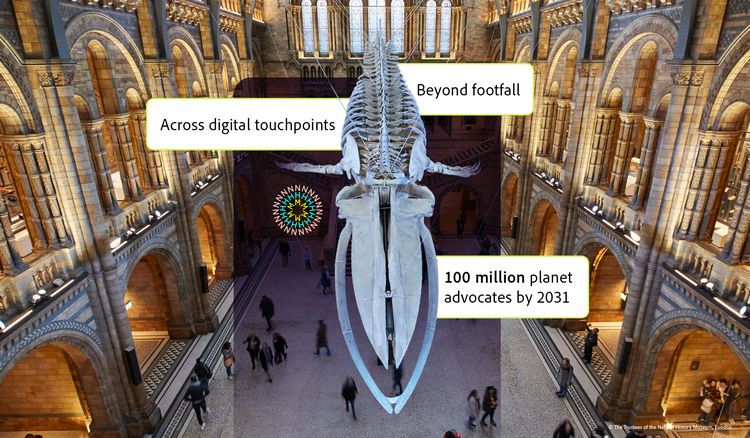
The Natural History Museum in London has inspired generations through its exhibitions and world-class research. But to meet its bold 2031 goal — creating 100 million advocates for the planet — the Museum had to look beyond its physical walls.

“We want a future where people and planet thrive,” says Richard Hinton, Chief Information Officer. “That means reaching people globally, and digitally. We can’t rely on footfall alone.”

With audiences ranging from schoolchildren and citizen scientists to global visitors and online readers, expectations were changing quickly. The team recognized that to engage this growing and diverse community, they needed a modern digital platform that could deliver more personalized, scalable, and data-driven experiences for everyone, from a family in Barnsley to a student in Brixton or a teacher in Cape Town.

That realization sparked a digital overhaul, supported by Adobe Experience Cloud.
Experiences that start with people, not platforms.

The transformation began in 2022 with a deceptively simple challenge handed down by the Museum director: enable personalization. Hinton quickly realized that the real work wouldn’t just be technical: the Museum’s teams were used to traditional ways of operating, content was scattered across more than 8,000 web pages, and data silos meant there was no consistent view of the visitor.

To address this, the Museum rebuilt its site architecture around a hybrid, headless content management system (CMS) based on Next.js and powered by Adobe Experience Manager Sites. This setup gives developers and content teams more flexibility to manage content across different channels and makes the site easier to maintain. Because Experience Manager can work as both a traditional CMS — with page authoring and templates — and a headless CMS, it’s well suited for this kind of hybrid model.

To streamline the ticketing and purchasing experience, the team introduced a more efficient transaction layer supported by Adobe Commerce.  And to power personalization, experimentation, and audience insight at scale, the Museum brought together behavioral data and content delivery using  Adobe Analytics, Adobe Target, and Adobe Real-Time Customer Data Platform.

“What stood out to us about Adobe was the strength of its ecosystem,” says Hinton. “We weren’t spending time wrestling with integrations. Instead, the tools worked together from the outset, allowing us to focus on creating meaningful experiences for our audiences.”

The new platform enabled the Museum to consolidate its sprawling digital presence, reducing the number of web pages by nearly 40% to around 5,000 while rebranding its visual identity and improving accessibility. Hosting was migrated from on-premise to a hybrid cloud environment, improving performance, scalability, and resilience. These changes empowered small, multidisciplinary teams to move faster and collaborate more closely, aligning their work to clear outcomes.

Customizing content to spark curiosity.

Understanding how people interact with the Museum’s digital touchpoints — whether they’re reading an article, exploring an exhibit, or donating — is vital to delivering experiences that resonate. The team captures detailed behavioral insights that inform personalization strategies, content decisions, and testing across channels with Analytics. These insights are integrated into Real-Time CDP and Target, allowing the Museum to respond to real-time signals rather than assumptions.

“The ability to measure what’s working and quickly refine our approach has improved engagement while also strengthening internal alignment,” says Sam Baber, Product Manager, Customer Data Platforms. “That test-and-learn mindset, paired with clear, data-backed results we can share with leadership each month, has helped sustain momentum and build trust in the Museum’s digital evolution.”

What truly brought the transformation to life, however, were the results. One of the early breakthroughs came when using Real-Time CDP to segment audiences and tailor communications. In a personalized version of the Museum’s monthly email campaign, recipients received content that reflected their previous interactions, such as past exhibition views, interests indicated through site activity, or preferences gathered through email engagement.

For example, a family who had browsed dinosaur-related content might receive a feature on a new family-friendly paleontology exhibit, while an adult science enthusiast might be shown exclusive after-hours programming or a lecture series.

This shift from generic, one-size-fits-all messaging to curated, interest-based journeys delivered nearly double the revenue compared to the non-personalized version.

“Adobe enables us to understand how people are engaging with us so we can tailor content accordingly. We want people to feel like we’re speaking to them, not at them.”

Sam Baber

Product Manager, Customer Data Platforms, Natural History Museum

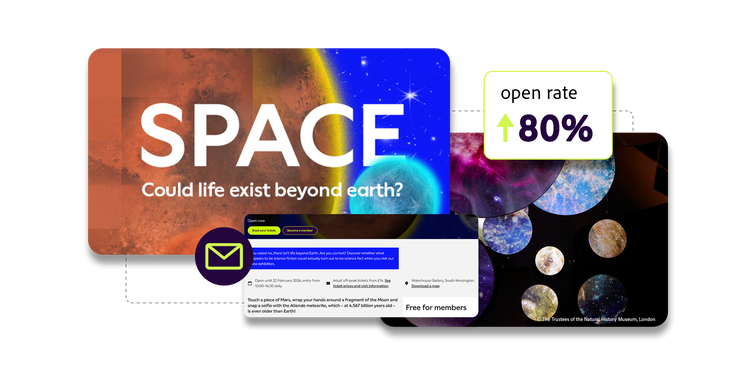
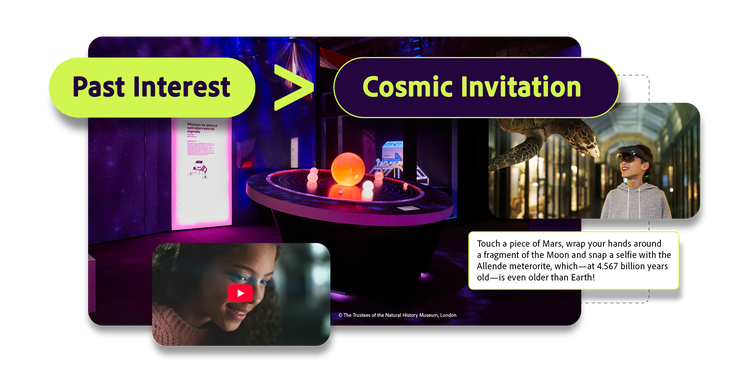
That success gave teams the confidence to embed personalization more deeply into their everyday workflows. When promoting the Museum’s new space exhibit, the marketing team set out to engage a specific audience segment: families who responded positively to playful, light-hearted content. They analyzed behavioral and demographic signals from previous website visits and email interactions to build rich audience profiles in Real-Time CDP.

The team then launched a segmented campaign that asked a cheeky question — did alien life exist in the stars? — and delivered tailored content across both email and web. Open rates soared past 80%, with click-through rates significantly higher than average.

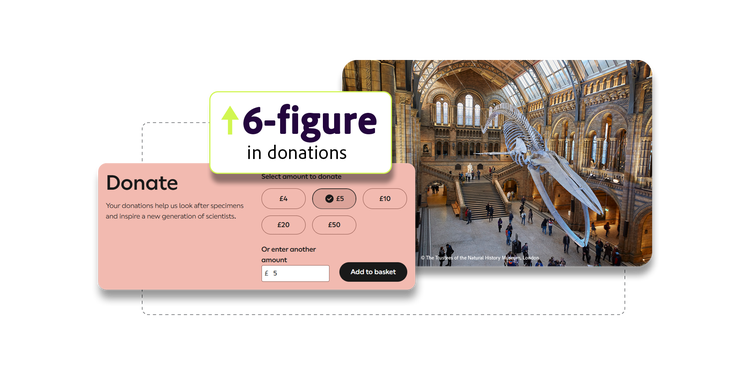
The Museum also embedded Target into the ticketing journey to test subtle variations in donation prompts and messaging. In one case, a single test generated nearly six figures in additional donations over the course of a year.

“The science is the same, but the stories we tell need to feel local, accessible, and human,” says Baber. “Adobe enables us to understand how people are engaging with us so we can tailor content accordingly. We want people to feel like we’re speaking to them, not at them.”

An evolution of teams, tools, and thinking.

Encouraging staff across the organization to think digitally, to embrace data, and to test and iterate required a shift in mindset. But the Museum’s approach — focusing on a few high-impact ideas, starting small, and building cross functional teams — has paid off. “We’re past the storming phase,” says Hinton. “We’re in the norming now and moving into performing.”

Long-time Adobe partner, IMS, became the Museum’s implementation partner and played a crucial role in bringing the Adobe platform to life, translating vision into action with technical expertise and an understanding of the mission. Just as importantly, the role of Adobe extended beyond the platform itself to include innovation briefings and hands-on support that helped steer the team through each phase of transformation.

“What was really impressive about Adobe is the willingness to explore our challenges with us, to show us what’s possible, and to connect us with others who have done it,” says Hinton.

From digital confidence to lasting change.

With support from Adobe, the team is now exploring how AI can help them move faster and more intelligently.  Whether it’s adjusting tone and imagery for different demographics, surfacing hidden gems from its vast archive, or suggesting content that’s aligned to visitor interests, Adobe enables a more agile, experiment-driven approach to engagement.

Despite all the change, the Museum’s mission remains clear: to inspire a love for the natural world and drive meaningful action on behalf of the planet. “A year ago, we were given a one-line brief: personalize our content,” says Hinton. “Now we’re sitting in the boardroom showing the value realization of that investment.”

https://main--da-bacom--adobecom.aem.live/fragments/resources/cards/thank-you-collections/mediaentertainment