Security by design
Protect documents and data with built-in security capabilities in Acrobat, including protected mode, sandboxing, encryption, and other layered protections.


Get inspired by top leaders in customer experience. Join us online or in Las Vegas. March 22-25.
Information is spread across documents, people, and disconnected workflows, making it difficult for teams to find what they need and make decisions quickly. Acrobat helps them find trusted answers, create polished business content, verify AI-generated output with traceable sources, and keep work secure and compliant — turning information into action faster.

The trusted PDF standard
Built on the world’s leading PDF platform, Acrobat helps teams confidently create, edit, review, compare, sign, and manage business-critical documents.

AI-driven document intelligence
Uncover trusted insights from documents with AI that understands document context, extracts structured data, and grounds responses in traceable sources.

Business-ready content creation
Turn trusted document insights into polished, on-brand reports, presentations, proposals, and more without starting from a blank page.
Understand, create, and collaborate on complex documents with AI-powered document intelligence, secure workspaces, and trusted PDF capabilities — all in Acrobat's most comprehensive solution.

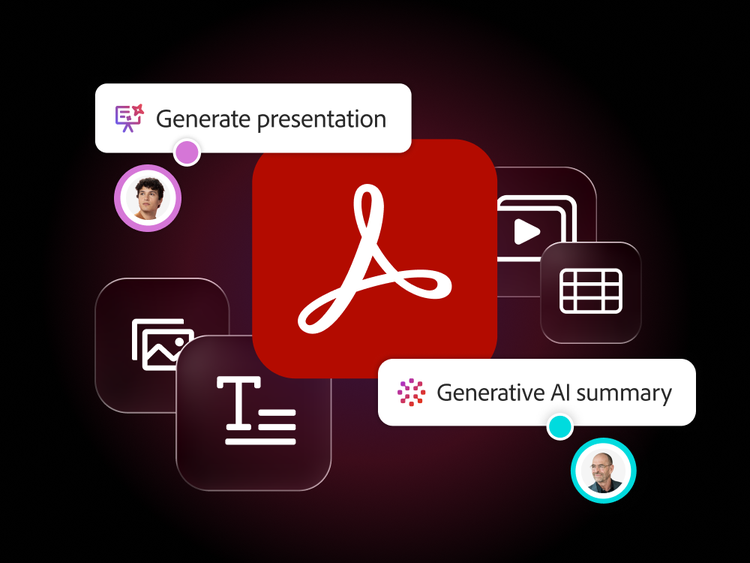
Instantly turn document insights into presentations, summaries, and on-brand content with AI-powered creation tools, so teams spend less time reformatting and more time communicating.

Edit, protect, convert, and prepare business-critical documents with conversational AI, advanced PDF capabilities, and integrated e-signatures.

Send, sign, track, and manage agreements with trusted e-signatures, enterprise-grade compliance, and the integrations your teams rely on.


Security by design
Protect documents and data with built-in security capabilities in Acrobat, including protected mode, sandboxing, encryption, and other layered protections.

Enterprise governance
Manage Acrobat at scale with centralized administration, access controls, policy management, and integrations with your approved tools and managed devices to help your organization maintain security, compliance, and control.

Responsible AI
Use AI features designed with privacy and commercial use in mind. Acrobat does not use customer content to train generative AI models, and Adobe applies responsible AI practices across AI-powered experiences.
Acrobat Studio
Acrobat Express
Acrobat Pro
Core PDF capabilities

Advanced PDF capabilities

Adobe Acrobat AI Assistant
PDF Spaces
Adobe Express Premium
On-brand presentations
The right Acrobat solution depends on the document work your teams need to accomplish:
Many organizations deploy more than one Acrobat solution. For example, organizations may use Acrobat Studio as their primary document productivity platform while using Acrobat Sign to manage agreement workflows.
Not sure which solution is right for you? Contact Adobe to discuss your organization's needs.
Acrobat uses AI to help people do more than summarize documents. It helps teams understand, create, collaborate, and take action on trusted business documents throughout the enterprise.
Depending on your Acrobat solution, AI can help you:
Throughout Acrobat, AI is grounded in trusted documents and designed to help organizations work faster while maintaining confidence in their results.
Adobe Acrobat is designed to help organizations deploy AI-powered document workflows while maintaining enterprise security, governance, privacy, and administrative control. Enterprise capabilities include encryption for data in transit and at rest, document sandboxing with Protected Mode and Protected View, authentication through Adobe Identity Management Services (IMS), permissions, redaction, and centralized administration through Adobe Admin Console. Acrobat AI capabilities provide source attributions where applicable to help users verify generated responses against their documents, and Adobe does not use customer content to train Adobe generative AI models.
Together, these capabilities help organizations securely create, edit, share, sign, and use AI with their documents while maintaining administrative control over user access, document handling, and AI capabilities. Learn more at the Adobe Trust Center.
Yes. Acrobat integrates with the business applications, repositories, and collaboration tools your teams already rely on — so they can work with documents without disrupting existing workflows.
Whether employees are creating PDFs, collaborating on projects, signing agreements, generating business-ready content, or unlocking knowledge from document collections, Acrobat works with popular enterprise platforms like Microsoft 365, Microsoft Teams, Microsoft SharePoint, Google Drive, Slack, Salesforce, and more. Acrobat also offers APIs and integrations that connect document workflows with ERP, CRM, CLM, and other business systems.
By connecting document productivity, agreement workflows, content creation, and enterprise document intelligence to the tools your organization already uses, Acrobat helps teams stay productive while keeping document work secure and connected.
Acrobat Studio for enterprise brings advanced document intelligence capabilities into Acrobat workflows.
Together with AI Assistant and PDF Spaces, these capabilities help organizations move from reading documents individually to understanding and acting on information across large collections. Availability is subject to the enterprise offer, administrator provisioning, and applicable usage policies.
Administrators can use the Adobe Admin Console to deploy Acrobat solutions, assign licenses, create product profiles, manage users, and control access to supported services. Automatic assignment rules can help provision licenses based on organizational criteria, while organization-managed identity types can support enterprise authentication and single sign-on.
For Acrobat Studio, administrators can configure supported services such as PDF Services, AI Assistant, AI Assistant chat history, and Adobe Express. Organizations can assign different solutions or product profiles to different user groups based on their roles and document workflows.
Enterprise capabilities such as Analyzer and Knowledge Base are provisioned according to the applicable Acrobat Studio enterprise offer and administrator configuration.
Acrobat solutions support document-intensive work across departments.
Organizations can match each team to the Acrobat solution that best fits its work, then connect those workflows through shared systems, integrations, and enterprise administration.