ADOBE 2026 AI AND DIGITAL TRENDS REPORT
The AI strategy shift is here — and your brand can’t afford to wait.
Generative and agentic AI are transforming the customer journey faster than organizations can adapt. This year’s AI and Digital Trends report highlights the promise and pressure of this shift, the critical gaps holding brands back, and what it takes to deliver experiences that move as fast as the technology shaping them.
Jump to a Key Section to Learn About the Trends






Section 1
AI Is Reshaping Customer Experience
The ongoing rush of developments in artificial intelligence (AI) is reshaping how brands and customers interact across every step of the journey from product discovery to purchase. As people increasingly experiment with AI-powered tools and services in their everyday lives, organizations are racing to understand how generative and agentic AI can meaningfully improve experiences and strengthen business performance. And in a market this fluid, organizations are grappling with questions about where to invest, how quickly to scale, and what now defines a competitive customer experience (CX).
Our global survey of 3,000 executives and practitioners in CX roles, conducted for the Adobe 2026 AI and Digital Trends report and research program, reveals early wins from generative AI and ambitious plans for agentic AI. But it also shows that many organizations lack the foundations needed to turn these ambitions into reality, as data remains fragmented, alignment between executives and day-to-day practitioners is uneven, and enterprise-wide deployment is still rare.
We also surveyed 4,000 customers across major global markets, and their responses point to cautious optimism about AI. But in several areas — especially agentic AI — organizational assumptions do not always align with customer comfort or readiness.
These gaps reflect the reality that AI capabilities are evolving faster than organizations can keep up, and customer expectations are shifting just as quickly. In fact, the window for brands to make an impression is already narrow. Half of customers say promotional emails, ads, and social media posts have only two to five seconds to capture their interest. Bridging these divides is essential for organizations to deliver the breakthrough customer experiences they envision for the next few years, which they believe will be:

Highly personalized and anticipatory of customer needs in real-time (80%).

Seamless across digital and physical touchpoints (72%).

AI-powered while still feeling human and brand-aligned (60%).

Section 2
Generative AI Is Delivering Early Wins
The past three years have brought significant market shifts — from the adjustment to post-pandemic norms to the rapid mainstreaming of emerging technologies like AI. Organizations report measurable improvements during this period in key CX performance metrics, such as personalization (70% say this metric has somewhat or significantly improved), lead generation (64%), and customer retention (59%). Yet these gains coexist with modest self-perceptions of digital CX maturity, with more than half (57%) saying their organization is on par with or behind peers and only about a third (36%) considering themselves ahead of the curve.
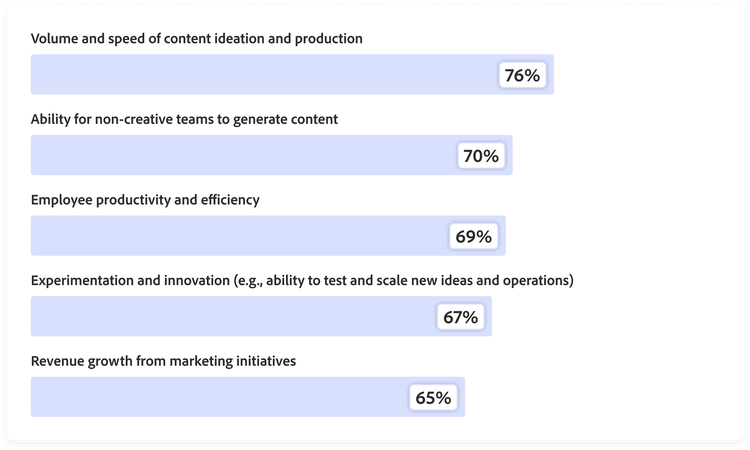
Despite doubts about their digital capabilities, organizations are making some progress in deploying generative AI. Across most customer experience workflows we examined — from marketing content creation to customer support, personalization, and back-office operations — experimentation with generative AI is widespread, with roughly one-quarter to one-third of organizations running limited pilots in these areas. The vast majority of organizations report improvements driven by generative AI in areas including content ideation and production, employee productivity and efficiency, and even marketing-driven revenue growth (Figure 1).
“Strongly improved” and “moderately improved” responses combined. 5 out of 10 responses shown.
Organizations have much of the technical infrastructure they need to scale generative AI, such as supporting cloud technology (89%) and shared customer data platforms (71%). Yet across workflows, only a minority — between roughly one-fifth and one-third — say generative AI is integrated across multiple functions, and even fewer have embedded it organization-wide. A large share of organizations say they have no active use of the technology in key workflows, though many plan to explore these areas in the next 18 months.
Looking ahead, priorities for AI investment span both customer-facing and internal needs, including delivering more personalized customer experiences (56%), improving customer satisfaction, loyalty, and engagement (46%), and automating repetitive tasks and workflows (45%).
Generative AI Is Making Its Way into Everyday Experiences
Customer behavior adds urgency to the uneven pace of AI adoption. AI is becoming an integral part of everyday shopping behavior, with many customers saying they would use it to search for personalized product recommendations (49%) or access instant customer service (44%).
Meanwhile, one in four customers already turn to AI-powered platforms as their primary source when searching for information, making purchase decisions, or finding recommendations — surpassing brand websites and online reviews. For simple inquiries, the vast majority of customers prefer AI-enabled interactions over human ones or want both options.
Brands recognize this shift. Roughly two-thirds of organizations say AI-powered conversational platforms are important for brand relevance — and almost as many go further to say future customer experiences will need to be designed as conversational-first. AI in general is seen as essential to future customer experience. In fact, 60% of organizations say AI-powered service and support will define breakthrough CX over the next two to three years.

Section 3
The Ambitious Leap Toward Agentic AI
As organizations move beyond early experimentation with generative AI, many are turning their attention to agentic AI — systems designed to take autonomous action across internal and customer-facing workflows. These systems can automate routine tasks, surface insights across systems, initiate customer transactions, or resolve service issues with limited human intervention. Organizations are betting on rapid, large-scale deployment of agentic AI for these use cases. In fact, about a third say they are prioritizing the implementation of emerging technologies like agentic AI over more widely adopted ones like generative AI.
The anticipated benefits of agentic AI cover a wide range. For example, 63% of organizations expect agentic AI to give employees more time for strategic and creative work, and 42% plan to design distinctive AI agent personalities for different audiences. For roughly half of organizations, the ability for their AI agents to interact seamlessly with other agents is considered a crucial factor in their vendor selection process.

Despite this enthusiasm, agentic AI adoption is still in the early stages for all organizations. Across surveyed workflows, a majority report no active use of agentic AI, and fewer than a quarter say they are running limited pilots. Only 16% say they have embedded agentic AI organization-wide for customer support, and just 13% for brand discovery and search (e.g., optimizing content so that it is interpreted and surfaced effectively by AI-powered discovery tools). Organization-wide adoption is significantly lower for all other areas.
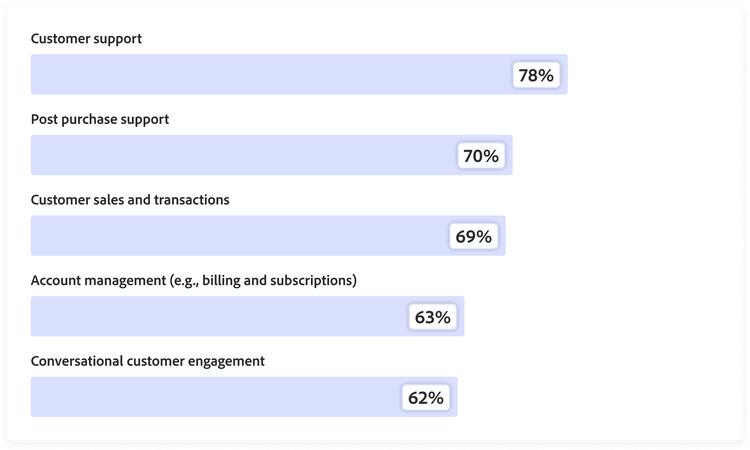
Still, the scale of planned expansion is striking. Many organizations believe that within the next 18 months, agentic AI will directly handle most of their customer interactions, particularly in customer support and post-purchase support (Figure 2). Organizations are also optimistic about where agentic AI will fit into broader workflows. A majority expect to have agents in the near future that can:
- Assist employees with research, insights, and knowledge retrieval (69%).
- Support sales with autonomous product recommendations or lead qualification (58%).
- Act as a brand-facing digital representative (54%).
- Interact with other agents deployed by customers, vendors, or procurement (49%).
“About half of the interactions,” “more than half of the interactions,” and “all or nearly all of the interactions” responses combined.
Customer Curiosity in Agentic AI Meets Clear Limits
Customers are curious about AI agents — 43% would be willing to interact with a brand’s AI personal concierge or agent if the service is offered — but their comfort has clear boundaries that organizations may be misreading.
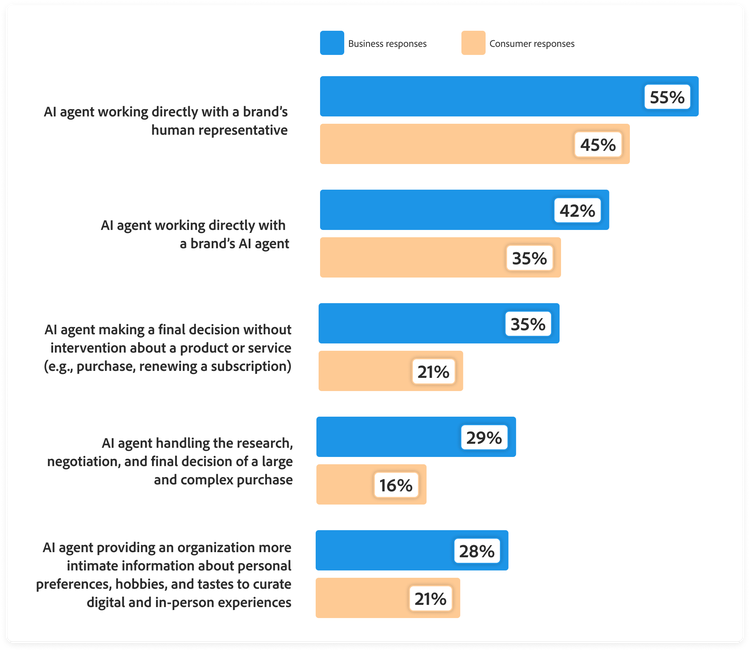
One-fifth of customers are not open to creating their own personal agent, and close to 40% have not even considered this prospect. And while almost half of customers would be comfortable having their personal agent work with a brand’s human representative, significantly fewer would let their agent work with a brand’s AI agent, hand over personal information, or make a large or small purchasing decision. Across each of these use cases, organizations consistently overestimate customer comfort (Figure 3).
These perception gaps between organizations and their customers extend to broader expectations as well. For example, 49% of organizations believe customers will eventually want AI agents to become their primary way of interacting with brands, but just 19% of customers agree with this prediction. Similarly, 36% of organizations believe customers will trust AI agents to make difficult purchasing decisions more than they trust themselves, whereas only 21% of customers share that view.
Business Q. Imagine a future where your customers have their own AI agents carrying out tasks on their behalf. How comfortable do you believe your organization’s customers would be with the following scenarios?
“Very comfortable” and “somewhat comfortable” responses combined.
Customer Q. Imagine you had your own personal AI agent to help with everyday tasks (e.g., shopping, travel booking, customer service). How comfortable would you feel with your AI agent handling the following scenarios?
“Very comfortable” and “somewhat comfortable” responses combined.
Customer trust will determine whether agentic AI succeeds at scale. Only one-fifth of customers say they can reliably detect AI in interactions. Yet unexpected AI involvement can cause disengagement. For instance, a third of customers say they would disengage upon discovering content is AI-generated, and 37% say the same if they learn they are interacting with AI when expecting a person. For customers, the option to switch to a human at any time is considered the most important form of disclosure when a brand uses an AI agent.
Organizations appear largely aligned with these expectations. Clear disclosure of AI interactions (68%) and easy escalation to human support (61%) are ranked by organizations as the most important factors for building customer trust in agentic AI.

Section 4
The AI Readiness Gap
Organizations are eager to scale generative and agentic AI, yet many still fall short on the foundational tools, data structures, and measurement practices required to support organization-wide deployment. More than half (53%) say their content supply chain remains largely linear and resource-intensive, and only 47% are using generative or agentic AI for journey design or omnichannel activation — capabilities essential for delivering personalization at scale.
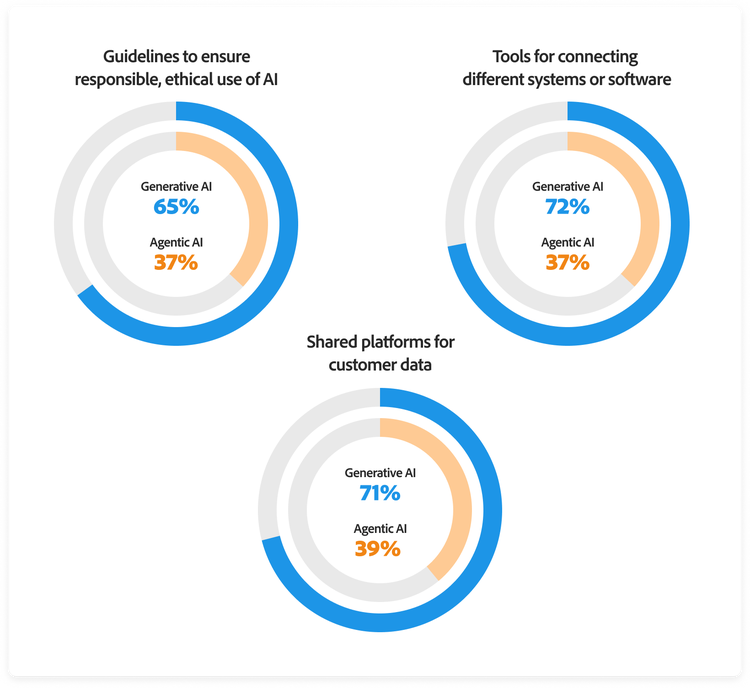
One major challenge for organizations is that agentic AI lacks the necessary supporting infrastructure. Only 51% have cloud-based technology for agentic AI, compared to 89% that have the technology to support generative AI. Investments in responsible use guidelines, integration tools, customer data platforms, data management processes, and employee training are all significantly lower for agentic compared to generative AI.
The ability to measure and communicate the true impact of AI remains a critical stumbling block. When asked which metrics matter most for evaluating AI success, organizations overwhelmingly point to customer satisfaction and loyalty metrics such as Net Promoter Score (NPS), retention, and churn. However, 52% say their organization struggles to demonstrate measurable returns on AI investments using CX-related metrics, and over half (56%) report that leadership at their organization prioritizes purely financial outcomes when assessing the success of AI initiatives.
Tools for tracking ROI remain underdeveloped for AI across the board. Only 44% have implemented a measurement framework for generative AI, and even fewer (31%) for agentic AI. Nearly half (47%) have neither framework in place nor are unsure whether one exists.
Internal Gaps Limit Brands’ Ability to Deliver Relevant Experiences
Internal challenges with AI implementation limit organizations’ ability to meet rising customer expectations. Customers reward relevance, clarity, and convenience, and they react quickly when brands fall short. Half of customers say they will disengage with a brand if promotions feel irrelevant or mistimed, and 45% will disengage if they receive too many promotions, regardless of relevance. The sweet spot for engagement is short — half of customers say promotional content has two to five seconds to capture their attention, and about one-fifth judge in less than two seconds. The key drivers of engagement are immediate personal relevance, unique content, visuals and sound, and special offers.
Delivering consistently relevant experiences requires AI trained on unified, high-quality data and the ability to act on that data in real time. Yet less than half (44%) of organizations say their data quality and accessibility is currently adequate for AI in general, and just 39% have a shared customer data platform capable of supporting agentic AI.


This readiness gap persists even as organizations acknowledge the problem. When asked about their priorities for AI investments, only 32% named data quality, unification, and governance as a top focus, and just 20% prioritized increasing the value and understanding of data. This is despite the fact that 52% admit that their current data unification and structure limits advancement of AI initiatives, and a full 75% cite data integration and quality as the top challenge for implementing agentic AI solutions. Data integration ranks ahead of other challenges, such as lack of relevant talent and limited upskilling resources (71%) and unclear return on investment or business case (68%).
These constraints extend beyond data into content and experience operations more broadly. Just 54% of organizations are preparing to optimize content for AI-powered discovery tools, even as customers increasingly rely on such tools to navigate digital shopping experiences. Further, only 39% of organizations have a unified customer data foundation that enables them to extract insights from all the data created by their AI agents and conversational interfaces.

Section 5
Internal Frictions Slow Down AI Progress
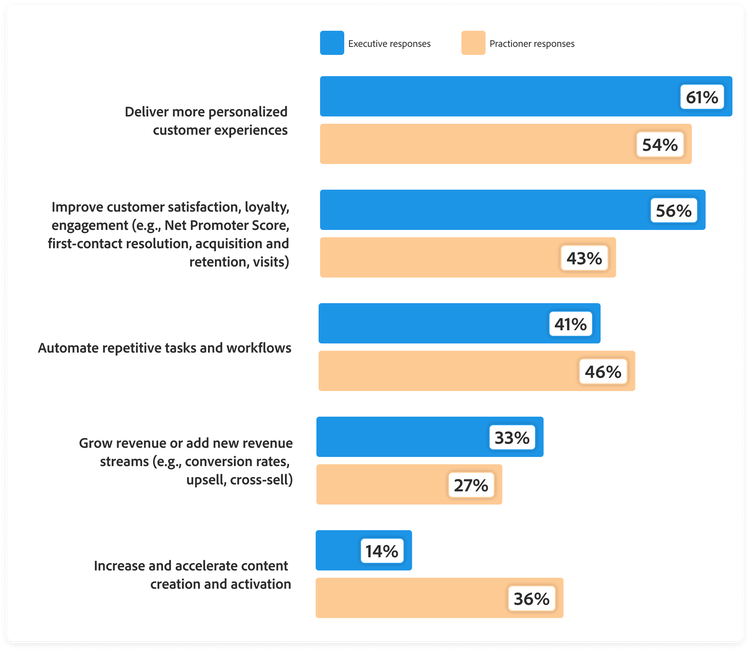
Differences between executives and day-to-day practitioners threaten progress in AI deployment. Both groups agree on broad priorities for AI investments — personalization, customer satisfaction, and workflow automation — but their views on readiness, impact, and performance diverge in consistent ways.
Nearly one-third of respondents say executives and day-to-day practitioners at their organization are misaligned on AI strategy, and 47% say alignment is only partial at best. The drivers of alignment include clear communication of AI goals (72%), collaborative planning (69%), and strong leadership support (59%). The top challenge causing misalignment is executive misunderstanding of AI (61%) — outranking other factors like resistance to change or technology adoption (52%), insufficient communication about AI’s role (52%), and unclear measurement of AI’s value and ROI (39%).
These differences show up in how each group defines goals for AI investments. Practitioners are more likely than executives to focus on the operational realities that let them deliver better experiences, like content creation and operational activation. Executives, meanwhile, are more likely to emphasize goals like revenue growth and customer satisfaction (Figure 5). Financial outcomes are a priority for most respondents, but 62% of executives consider metrics like operational efficiency and cost savings a top or large priority, compared to 54% of practitioners.
5 out of 9 responses shown.
These disconnects, especially executive misunderstanding of AI, may explain misaligned perceptions of AI readiness and adoption. Practitioners consistently report deeper integration of AI in day-to-day work than executives do. More practitioners say their teams are already augmented or automated by AI and that their organization has identified high-value AI use cases. And this trend holds true for both generative and agentic AI. Practitioners are more likely than executives to report meaningful adoption across workflows such as customer support, sales assistance, creative tasks, brand discovery, and digital experience.
Practitioners also project a much faster shift toward agentic AI. They are more likely than executives to believe that most or all customer interactions will be handled by agentic AI within the next 18 months, particularly in content recommendations, post-purchase support, or conversational engagement. They also expect to have AI agents that will automate routine customer service tasks, manage internal workflows, act as brand-facing digital representatives, participate in agent-to-agent interactions, and assist employees with knowledge retrieval. These expectations are crucial for practitioners — 49% of whom believe organizations that do not adopt agentic AI will become obsolete, compared to 41% of executives.
Despite these gaps, satisfaction with generative AI is high for both groups — but practitioners again express stronger confidence in its impact on decision-making, productivity, customer engagement, and innovation. Compared to practitioners, executives are more likely to say benefits have been minimal or non-existent — a misalignment that may contribute to underinvestment in foundational capabilities that practitioners say are urgently needed.
The Broader Challenge: A Workforce Asked to Adapt Faster Than It Can




Section 6
Key Insights and Next Steps
Since becoming mainstream, AI has reshaped how organizations design, deliver, and scale experiences to include more of what customers care about most — relevance, authenticity, and uniqueness. This year’s AI and Digital Trends report points to real progress being made by organizations across industries, from early gains with generative AI to strong interest in agentic systems. Still, moving from experimentation to enterprise-wide deployment will require working through growing pains, especially as customer expectations for AI-enabled experiences continue to outpace the data, tools, and governance needed to support them.
Organizations can take key steps to close the AI readiness gap and deliver the experiences their customers are demanding:
- Strengthen data foundations to make AI useful at scale. Improve your data quality, unification, accessibility, and integration across systems so AI can respond to customer needs and preferences in real time.
- Adapt content supply chains to support relevance and personalization at scale. Move beyond linear, resource-intensive processes toward more dynamic workflows that allow AI to support journey design.
- Close the gap between executive vision and practitioner reality. Align executives and day-to-day teams around clear AI objectives and collaborative planning. This includes agreeing on how success will be measured beyond cost savings and revenue gains, and ensuring executives have enough fluency in AI to support informed decisions.
- Design AI experiences around customer comfort. Build transparency and choice into AI-enabled interactions and prioritize experiences that feel authentic and unique. Trust, clarity, and relevance matter as much as speed to market.
APPENDIX 1
Research Methodology
Business and Customer Demographics
- North America: United States (25%) and Canada (5%)
- Latin America: Brazil and Mexico (8% each)
- Europe: United Kingdom, France, Spain, Italy, Germany (6% each)
- APAC: India (8%), Australia (7%), New Zealand (2%), Singapore (3%)
- Middle East: United Arab Emirates and Kingdom of Saudi Arabia (3% each)
Business Industries
- Financial Services and Insurance: 17%
- Retail and Consumer Goods: 17%
- High Tech: 17%
- Media and Entertainment: 17%
- Healthcare: 8%
- Public Sector: 8%
- Others (i.e., automotive, industrial manufacturing, travel and hospitality, consumer goods manufacturing): 17%
Business Roles
- Practitioners: Managers, Team Leads, Directors, and Senior Directors — 75%
- Executives: VPs, SVPs, and C-suites (i.e., Chief Marketing Officers, Chief Information Officers, Chief Data Officers, Chief Digital Officers, Chief Innovation Officers, Chief Technology Officers) — 25%
Business Sizes by Revenue (USD)
- $250 million to $999 million 38%
- $1 billion to $9.9 billion 38%
- $10 billion or more 23%
APPENDIX 2
Key Definitions
Executive Survey
Generative AI
Agentic AI
Customer Survey
Recommended for you