linear-gradient(34deg, rgba(184,159,227,1) 0%, rgba(207,210,251,1) 21%, rgba(251,233,230,1) 94%, rgba(255,255,255,1) 100%

Adobe Real-Time CDP Use Case

Create and enhance your customer profiles.

Build actionable profiles that power more targeted and relevant omnichannel experiences.

Watch video | Watch video Adobe Real-Time CDP Use Case

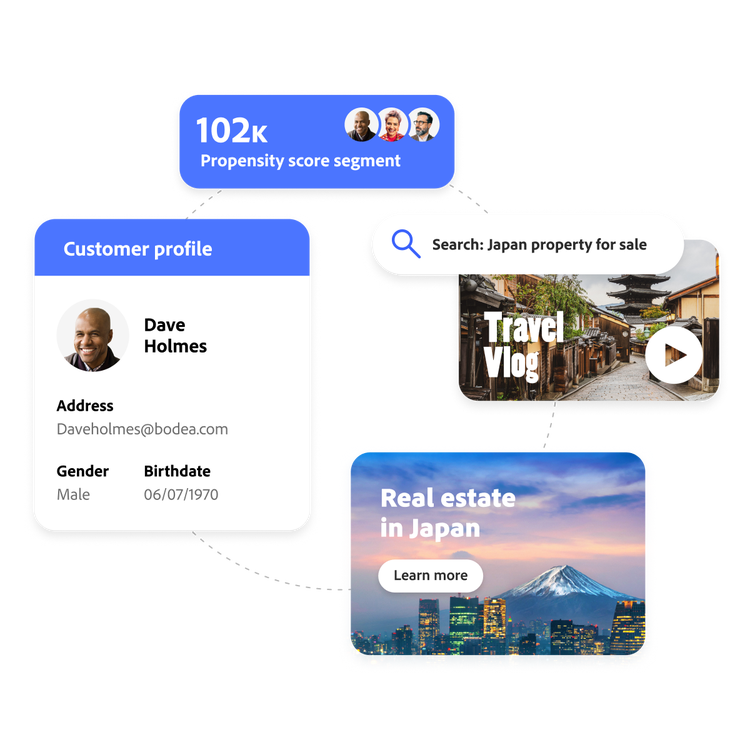
A customer’s online activity enriching his profile and qualifying him for a new audience segment

Use profiles to drive exceptional experiences throughout the customer lifecycle.

Real-Time Customer Data Platform (Real-Time CDP) lets you build robust, unified profiles that can be activated to deliver personalized messages and content across every touchpoint. These dynamic profiles help businesses improve customer engagement, increase loyalty, and drive ROI.

Continuously enrich your customer profiles.

Real-time profiles for individuals and accounts can be created, updated, and activated using cross-channel data, customer preferences and behaviors, contextual data, and linked identities. In addition, leverage your data warehouse investments by federating datasets into Real-Time CDP to further enrich profiles without copying underlying data.

Marketers can use Adobe’s identity service to link disparate identities together. This provides a visual representation of how customers interact across channels.

Discover and create new audiences in milliseconds.

Real-Time CDP collects and distributes data in the moment, letting you segment and qualify audiences at speed no matter their origin. Ingest, organize, and govern existing audiences from other platforms, including warehouses to manage audiences end-to-end. Additionally, use look-alike audiences to discover high-value profiles with similarities to existing audiences that are ready for you to deliver relevant offers and communications to in real time.

Identify opportunities and reduce churn.

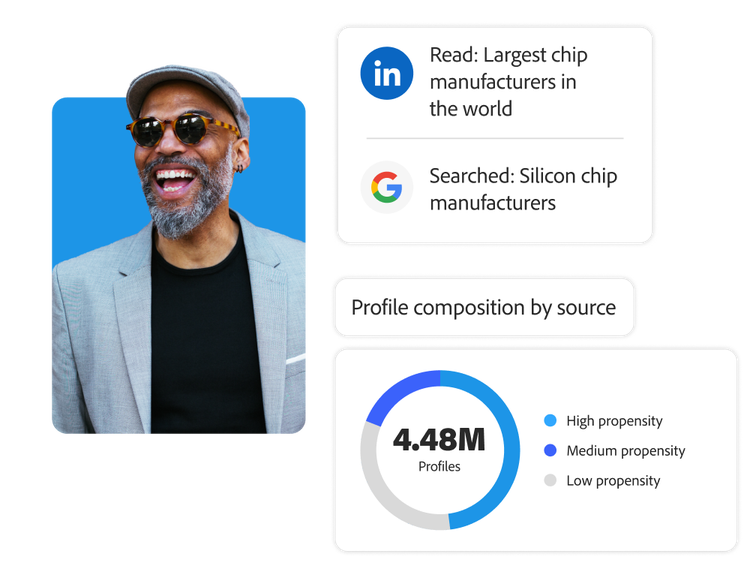
Propensity scoring with Adobe Customer AI enables you to proactively identify and engage audiences with high conversion potential or risk of churn, so you can prioritize and optimize your customer engagement.

TSB customer story

Builds dynamic profiles that evolve with customers and provide in-the-moment data.

Read more | Read more TSB customer story

Tvnz customer story

Reduced ad audience customization time from four weeks to under an hour.

Read more | Read more tvnz customer story

Telefónica Germany customer story

Creates targeted customer scores for customers to determine purchase probability forecasts.

Read more | Read more Telefonica customer story

Learn more about creating and enhancing your customer profiles.

Content as a Service v3 - Create and enhance - Friday, January 10, 2025 at 17:24

Questions? We have answers.

What makes a Real-Time CDP profile different from a customer record in my CRM?

A Real-Time CDP profile is a continuously updated, cross-source view of a person that spans known and anonymous data and is built for activation, whereas a CRM record is typically a system-of-record view of a known customer's relationship and transactions. The CDP profile stitches together behavior from your website, app, offline systems, and your CRM into one identity-resolved record, updated in real time, and it is designed to be turned directly into audiences and activated. It complements the CRM rather than replacing it: the CRM stays authoritative for the relationship, the CDP makes the full picture actionable across channels.

How do I enrich profiles with data from across my business?

You enrich profiles by connecting more sources into the profile and by adding warehouse attributes without copying them, then layering AI-derived signals on top. Prebuilt connectors bring in data from Adobe and non-Adobe systems; Federated Audience Composition can enrich a profile with attributes queried from your data warehouse without ingesting them; and Customer AI adds predictive attributes such as propensity and churn risk. The profile becomes richer as you add sources and signals, without a rebuild each time.

Are profiles updated in real time, or on a batch schedule?

Profiles update in real time from streaming sources, so a customer's latest behavior is reflected in the profile as it happens rather than after an overnight batch. Streaming data collection feeds the Real-Time Customer Profile continuously, which is what lets segmentation qualify a person in the moment and activation act on the current state. Batch sources can still be ingested on a schedule, but the profile itself is built to be current, not a daily snapshot.

What do I need to start building actionable profiles?

You need your data sources connected and mapped to Experience Data Model schemas, and identities configured with merge policies, so records resolve into one profile. Prebuilt connectors and auto-mapping do much of the schema work, and Identity Service handles resolution once your identifiers are in place, so the setup is connecting sources and defining how they stitch together rather than building a data model from scratch. Once profiles are forming, audiences, personalization, and activation apply on top of them.