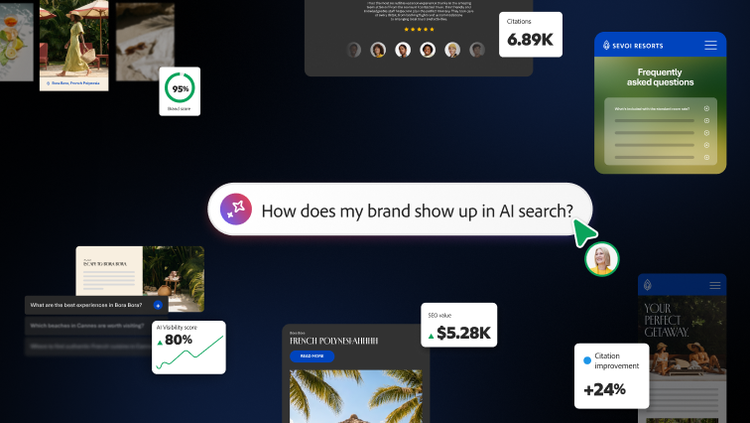
Take control of brand visibility in the age of AI-led discovery.
Learn how Adobe helps brands strengthen AI presence and owned experiences.
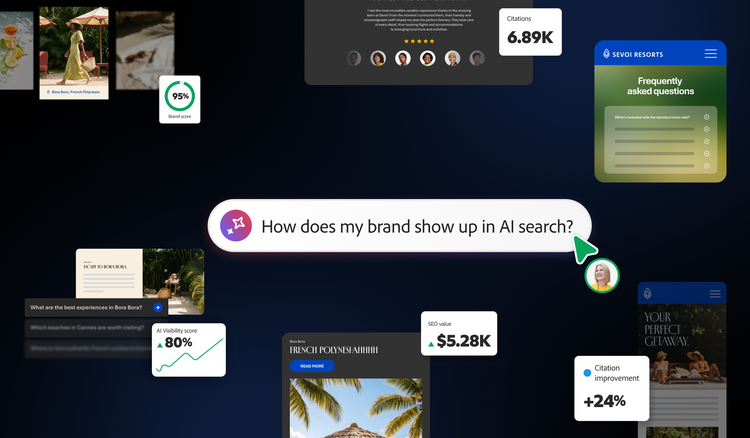
Create a connected brand visibility strategy.
Brand visibility now depends on two things: how well a brand shows up across AI platforms, and how effectively it engages customers once they arrive. Adobe's four-stage model addresses both, turning market and customer signals into stronger content, experiences, and performance. Brands can start where pressure is highest, build on existing enterprise context, and expand into a connected strategy that strengthens affinity and loyalty over time.
AI search is reshaping how customers choose brands.
A growing number of buying journeys now begin with a question, not a search. Customers hand over the research, comparison, and shortlisting to AI-powered platforms that synthesize information and return a judgment. These platforms mediate discovery in a way that changes how customers experience brands and redefines how brands establish their market position. Traditional search also hasn’t gone away. Most consumers move between AI tools and search engines in the same journey, but AI increasingly shapes which brands make the shortlist.
That leaves brands with two problems.
The first is a problem of representation. AI systems build their answer from whatever signals about a brand they can find, and those signals are often incomplete or inconsistent. They might misrepresent what the brand offers, steer consideration toward a competitor instead, or leave the brand out of its answer entirely. The brand cannot directly control these outcomes. It only sees the result.
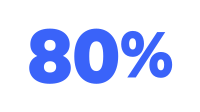
80% of companies have significant gaps in how their content surfaces in AI-generated answers1
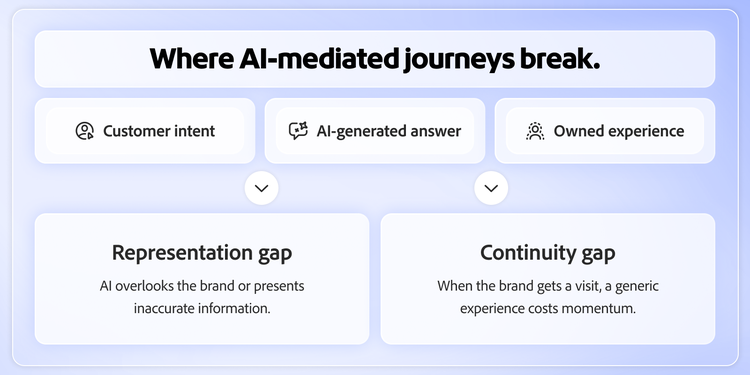
The two challenges are inseparable. A strong owned experience offers little value if AI never sends customers to it. And getting recommended by AI offers just as little if the website gives those customers no reason to stay, act, or come back.
That’s why brands need to pursue both goals at once. On one side, they need to improve how AI systems understand and represent the brand, so visibility grows into affinity and the brand is seen as credible enough to recommend. On the other, they need to build owned experiences differentiated enough to turn that AI-influenced affinity into loyalty.
Building brand visibility now means winning on two fronts.
AI visibility and owned experience may require different capabilities, but they cannot be managed as separate strategies. Brands create value only when the two work together.
That’s because humans and AI systems do not evaluate a brand in the same way. People respond to relevance, personalization, and the quality of the experience, while AI systems look for authoritative information presented in a structured manner so they can understand and act on it.
Optimizing for one side without the other simply shifts where the customer is lost.
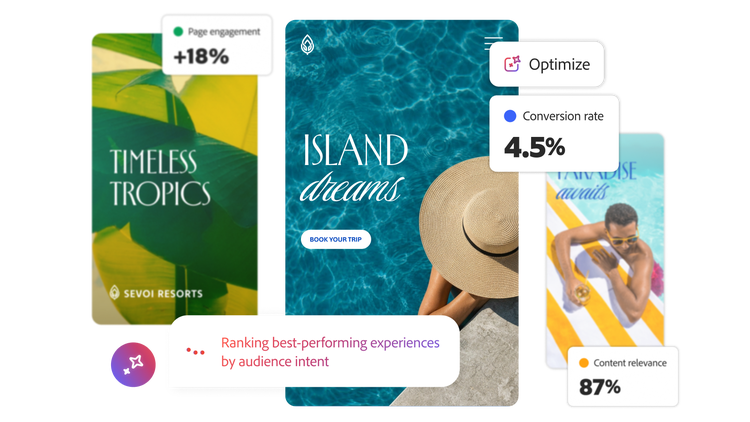
Optimize only for the owned experience, and the brand risks becoming invisible.
A brand can invest heavily in its website, content, and customer experience, and still lose, because none of it reaches a customer who never arrives. If AI systems cannot find, understand, or accurately represent what the brand offers, those experiences may never enter the customer’s consideration.
The result is a strong destination with no reliable path to it. Competitors that appear more clearly in AI-generated answers gain the referral, the traffic, and the opportunity to build the relationship. The brand may deliver the best experience on its owned properties, but AI increasingly influences who gets there in the first place.

51% of consumers who have tried AI tools use AI during early product discovery.2
Optimize only for AI, and the brand risks becoming interchangeable.
A brand that focuses only on appearing in AI-generated answers may gain visibility without earning preference. It can make the recommendation set but remain one option among many if the experience that follows is generic, undifferentiated, or disconnected from what the customer came to do.
That makes the relationship fragile. Visibility may earn the visit, but relevance, trust, and a differentiated experience are what give customers a reason to come back.
The two risks stem from the same mistake: treating AI visibility and owned experience as separate mandates instead of building one strategy around dual optimization.
The answer is to connect the efforts. Insights into how AI represents the brand should shape what content teams create, and the experience customers have on owned channels should reveal what needs to improve next. That requires a continuous system that can detect gaps, respond with the right content, deliver a stronger experience, and learn from the outcome.
Adobe’s four-stage model for continuous brand loyalty.
Adobe thinks about these efforts as one continuous system for brand loyalty and has developed a solution designed to help brands continuously improve how they are discovered, represented, and experienced across AI and owned channels. Rather than treating visibility as a one-time optimization, Adobe helps teams bring together the signals, content, experiences, and performance insights needed to keep adapting as AI systems and customer expectations change.
At the center of the solution is enterprise context: external market signals, the brand’s own data, and its brand identity. That shared context gives teams and agentic tools a consistent foundation for deciding what matters, what to create, and how the brand should show up.
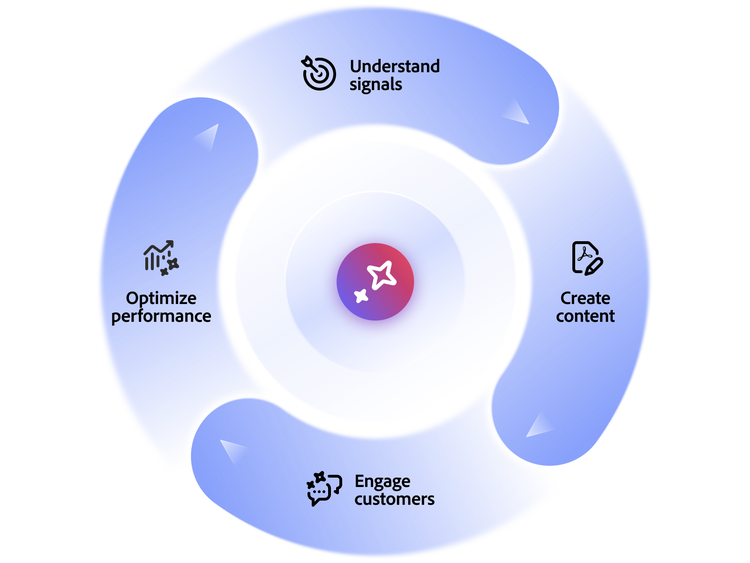
The solution puts that context to work through four connected stages:
- Understand signals. Find out how AI represents the brand, how customers experience it, where competitors are gaining ground, and which gaps matter most.
- Create content. Turn those signals into on-brand content for AI and human audiences at the speed the market demands.
- Engage customers. Activate those experiences across AI and owned channels so customers can discover, explore, decide, and act.
- Optimize performance. Measure what changed across visibility, engagement, and conversion, then use the insights to improve the next cycle.
These four stages reinforce each other, so what a brand learns at the end of one cycle improves the decisions and actions in the next. People stay in charge of judgment, what’s on-brand, and what the business should prioritize, while the system handles the speed and scale that AI now demands.
Stage 1
Understand signals: See the brand the way AI sees it.
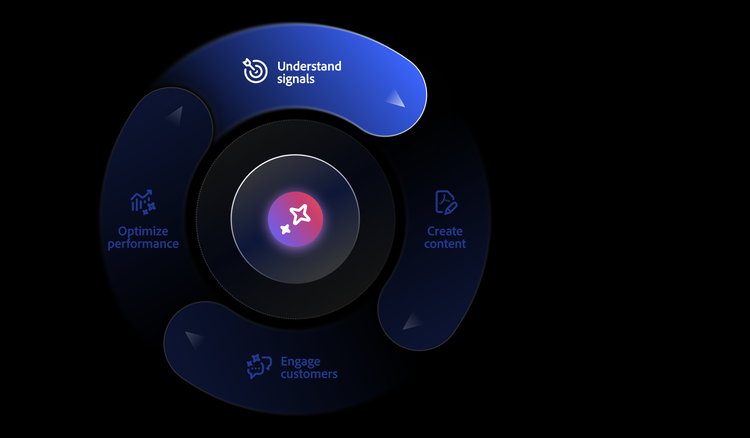
Most brands don't have a clear view of what AI knows or doesn't know about them. Teams may see referral traffic fall or competitors appear more often in AI-generated answers, but those outcomes do not explain what is driving the gap. AI may be working from incomplete product information, content it cannot interpret clearly, or signals that no longer reflect how the brand wants to compete.
Adobe’s brand visibility solution combines Brand Visibility, Experience Manager Sites, Assets, and Forms, Brand Concierge, and Commerce to connect what AI is saying about the brand with signals from the market, website, and product data. That makes it easier to see where the brand is underrepresented, misunderstood, or missing an opportunity. This visibility is the starting point for a generative engine optimization (GEO) practice: knowing what AI gets wrong before deciding what to fix.
- Adobe Brand Visibility shows where the brand is appearing or missing across major AI platforms, benchmarks visibility against competitors, and identifies structural and content gaps that may limit citations and recommendations. Using Semrush SEO data, it adds external market signals, including what customers are searching for, which topics are gaining traction, and where the category conversation is heading, so priorities reflect real market demand.
- Adobe Experience Manager Sites Optimizer continuously scans your site for performance, accessibility, and experience issues that may be suppressing visibility or affecting engagement and conversion.
- Adobe Commerce brings product and catalog signals into the picture, helping teams see where incomplete or poorly structured information is limiting discovery and recommendations across AI-driven shopping journeys.
The goal at this stage is a clear brief for action: which gaps matter most, what needs to change, and where the brand should respond first.
Stage 2
Create content: Turn insight into on-brand action.
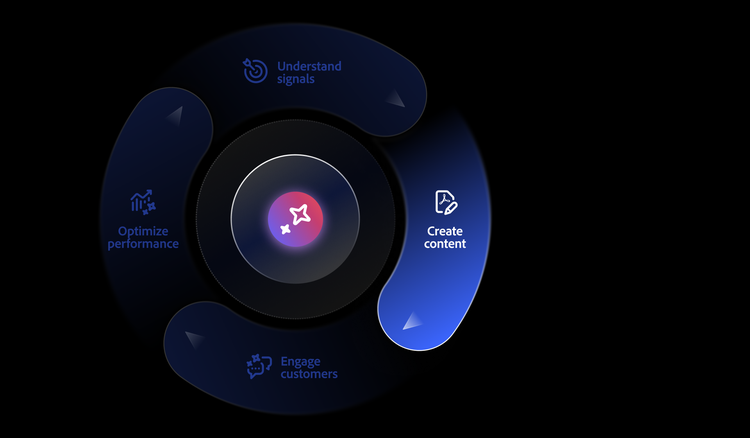
Seeing the gaps is only useful if teams can respond fast enough to close them. That’s where many content operations break down. Teams may know which topics are gaining traction, which pages need updating, or where AI representation is weak, but traditional production cycles are often too slow to keep pace with changing demand.
The challenge is not simply producing more content. Brands need content that is current, relevant, and built to earn attention from people and trust from AI systems. That means grounding it in authoritative information, verifiable claims, brand expertise, and approved assets, while still meeting brand, legal, and governance requirements.
https://main--da-bacom--adobecom.aem.page/assets/resources/reports/adobe-brand-visibility-guide/resource-center-long-form-abv-solution-guide-number-41-200x112.svg
≤ 40% citation probability
Authoritative content grounded in statistics, quotations and cited sources increases the likelihood of being cited by AI platforms.3
Adobe’s brand visibility solution connects market and visibility signals directly to content creation, helping teams respond quickly without losing quality, relevance, or brand control.
- Adobe Brand Visibility connects gaps in AI visibility with what customers are searching for and which topics are gaining traction. It helps teams identify the structural and content changes needed to respond and deploys optimizations at the edge without affecting human visitors.
- Adobe Experience Manager Sites uses agentic skills to support content updates, variant creation, governance checks, and optimization cycles, helping teams move from insight to execution faster.
- Adobe Experience Manager Assets grounds that work in approved brand content and media, making the right assets easier to find and adapt for different channels and audiences.
People still set the strategy and decide what the brand should say. AI agents handle more of the production work, helping teams respond at speed without giving up control. The result is a faster path from signals to published content.
Stage 3
Engage customers: Meet them wherever they decide.
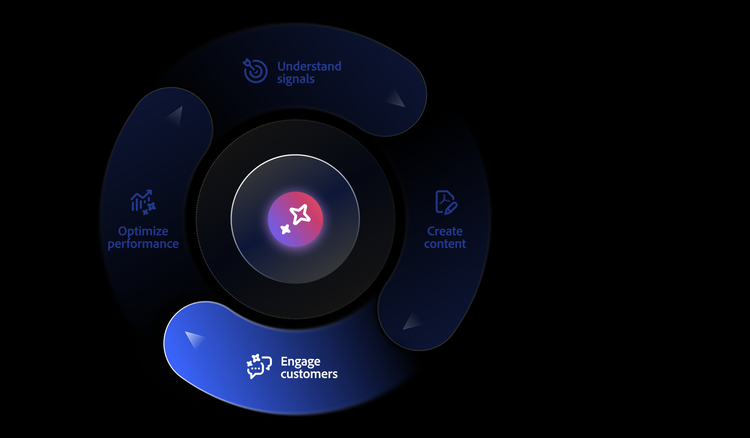
In AI-mediated journeys, brands need to activate relevant experiences across both third-party AI surfaces and their own channels. Adobe’s brand visibility solution brings together the content, commerce, and engagement capabilities needed to support customers as they move from discovery toward decision and action.
On AI-powered platforms, that means giving customers richer, more useful information as they compare options, helping build both visibility and affinity. On owned properties, it means carrying that customer journey forward rather than making customers start over.
- Adobe Experience Manager Sites lays the foundation for fast, consistent owned experiences across web, mobile, and app journeys. Its Edge Delivery Services improve page speed and performance, helping keep customers engaged and supporting conversion.
- Adobe Brand Concierge provides the conversational layer on owned properties, using brand-approved content and first-party data to guide customers from exploration to decision. When connected with Adobe Commerce, it brings real-time product information, pricing, and inventory into those conversations, while more complex journeys continue through live-agent handoffs or meetings.
- Adobe Experience Manager Assets helps ensure the content customers encounter remains relevant and on-brand across surfaces, while helping teams adapt imagery and rich media for different screens, channels, and surfaces.
- Adobe Experience Manager Forms supports the moment of action with conversational, context-aware forms and enrollment flows that adapt to customer intent and reduce friction in high-value conversion moments.
- Adobe Commerce extends product discovery across AI-led and human shopping journeys. It helps make product information easier for LLMs to discover and interpret, and supports emerging agentic commerce protocols, including Universal Commerce Protocol (UCP) from Google and Agentic Commerce Protocol (ACP) from OpenAI. On owned channels, it provides the live catalog, pricing, inventory, storefront, and transaction capabilities needed to convert customers.
When discovery, engagement, and conversion work as one connected experience, brands have a better opportunity to turn AI-influenced demand into relationships they can deepen directly. Each of those interactions creates new signals about what customers need and what helps them move forward. Those signals become the basis for optimizing performance.
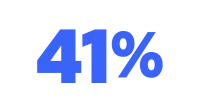
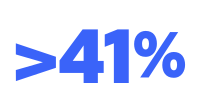
41% increase in referral traffic
Adobe saw a 41% lift in LLM-driven referral traffic to Adobe Acrobat within one week of optimizing content with Adobe LLM Optimizer (now Adobe Brand Visibility).4
Stage 4
Optimize performance: Improve with every cycle.
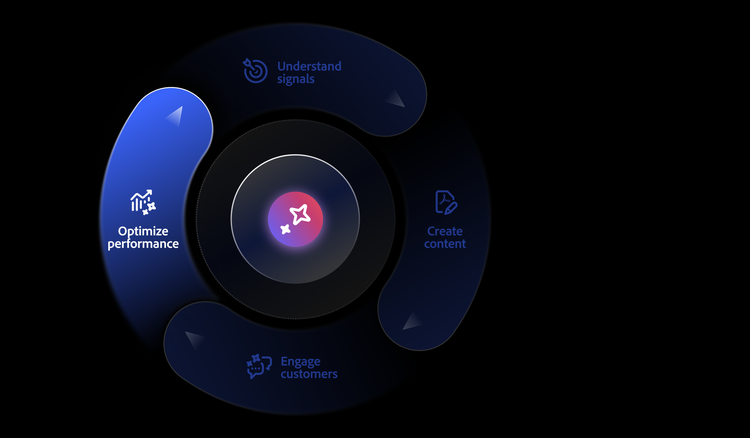
Most brands only measure activity, not actual change. The real test is whether they can connect shifts in AI visibility and customer behavior back to the content and experiences that influenced them and use those insights to improve what happens next.
Did a content fix increase citation share or change how accurately AI represents the brand? Did a better-guided conversation move a customer from browsing to making a decision? Without tracing that line, teams can stay busy without knowing whether the work is improving brand performance.
Adobe’s brand visibility solution keeps that learning connected to ongoing optimization:
- Adobe Experience Manager Sites Optimizer continuously monitors how the site performs for AI and human audiences, surfacing opportunities across performance, accessibility, AI-readability, engagement, and conversion so teams can see what needs to improve.
- Adobe Brand Concierge generates conversational analytics from customer interactions, revealing not only whether customers convert but what they are trying to achieve, what questions they ask, and where friction remains in the experience.
Those insights feed into the next cycle. Every correction a team makes along the way also becomes part of that learning, helping the system respond more precisely over time. What the brand learns shapes what it does next.
Case Study
How one global sports retailer increased AI citation share nearly 5x.
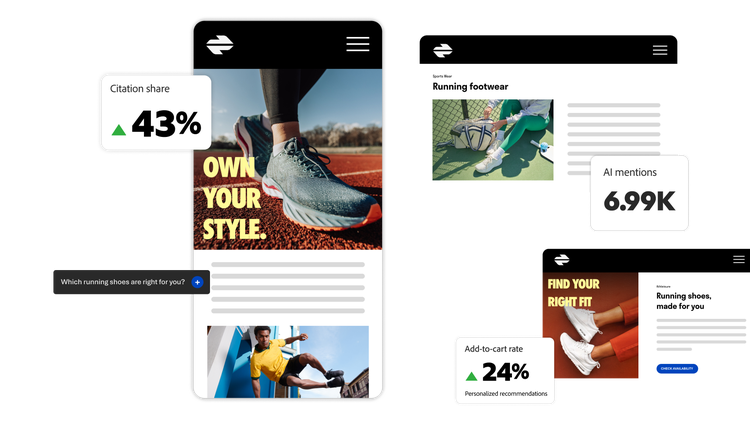
A global sports retailer had a visibility problem in one of its strongest categories. When customers turned to AI search tools to find the best running shoes for trail beginners, competitors were recommended instead. The brand held just 9% citation share compared with 58% for a leading competitor.
The issue went beyond visibility. Product pages were missing the technical specifications and use-case context that AI systems needed to find and recommend them effectively. When customers did reach the site, the generic homepage also failed to engage and convert them effectively.
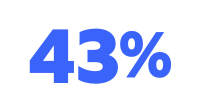
The retailer’s AI citation share grew from 9% to 43% in just eight weeks.
Adobe’s brand visibility solution helped the retailer close all those gaps at once. Within days, the brand created and published richer, on-brand product specifications, comparison content, product pages, and buying guides. On owned channels, Adobe Brand Concierge added a personalized quiz to help customers find the right products and drive higher add-to-cart rates.
Within eight weeks, citation share grew to 43%. The richer content earned the brand a stronger presence in AI answers, while the personalized experience lifted conversion. Along the way, customer behavior also surfaced a new signal, a recurring fit problem, feeding directly into the next round of improvements.
Start where pressure is highest and build toward full visibility.
Brands do not all encounter the visibility challenge in the same way, which means there’s no single right place to start.
A company might use Adobe’s brand visibility solution to understand and improve how it appears in AI-generated answers, bring in content capabilities when it needs to respond faster, and add experience and conversion capabilities when AI-driven demand grows.
That’s possible because you don’t need every capability to be in place at once. Adobe Brand Visibility works with any CDN and tech stack, while open API and Model Context Protocol (MCP) help connect capabilities with the technology environment already in place.
This flexible approach gives brands room to start with the capabilities they need for their most pressing use cases. As marketing needs evolve, they can add capabilities that build on specific Adobe products already in place. Adobe Brand Visibility is built to also evolve alongside, so the overall approach can scale and stay relevant as new technologies emerge.
Over time, those different starting points can converge into one connected workflow, allowing value to compound. A visibility issue does not remain a standalone insight, and an experience problem does not become a disconnected fix. What the brand learns in one part of the journey can inform what happens down the line.
Shared enterprise context is what helps hold that workflow together. The brand’s own data, content, standards, approved assets, and institutional knowledge provide a common foundation across capabilities, while external market intelligence adds a view of what is changing beyond the business. That shared context helps turn insight into coordinated action, so each decision is informed by both what the brand knows and what is changing around it.
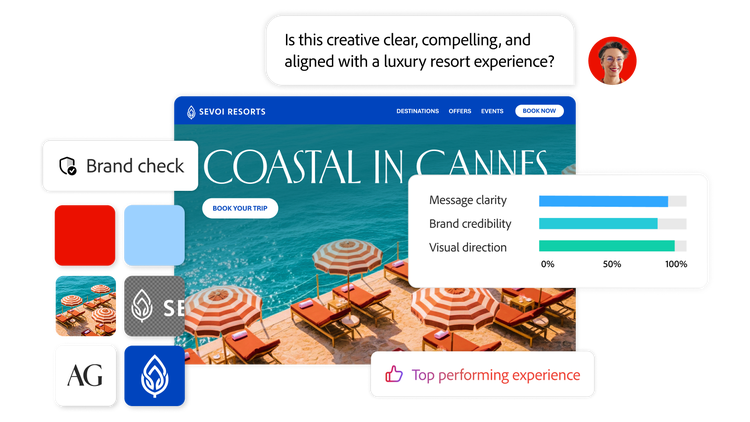
Build the next brand advantage with Adobe.
AI discovery is still evolving, which means the rules of brand visibility are being written in real time. Brands that wait for the landscape to stabilize risk giving competitors a head start that compounds as AI systems learn which sources to trust and which brands to recommend.
Keeping pace requires more than visibility data alone. Brands need a view of what is changing in and beyond the business, the enterprise context to understand what those signals mean, and the ability to turn that intelligence into action at scale.
That is where Adobe brings a distinct advantage. Adobe combines deep market signals with the data we already store and manage for brands across content, customer data, assets, commerce, and digital experiences. Adobe brings external market signals together with each brand's own content, customer data, assets, and commerce information so teams act on a complete picture, not fragments.
Our AI and experience capabilities then help teams act on that intelligence, improving how the brand appears in AI-generated answers while strengthening the experiences customers encounter next.
That combination gives brands a way to keep learning as the market moves. Each new signal sharpens how AI represents and recommends the brand, and how customers experience it once they arrive, turning visibility into affinity, and affinity into lasting customer loyalty.
Learn how Adobe can help your brand compete in the AI era.
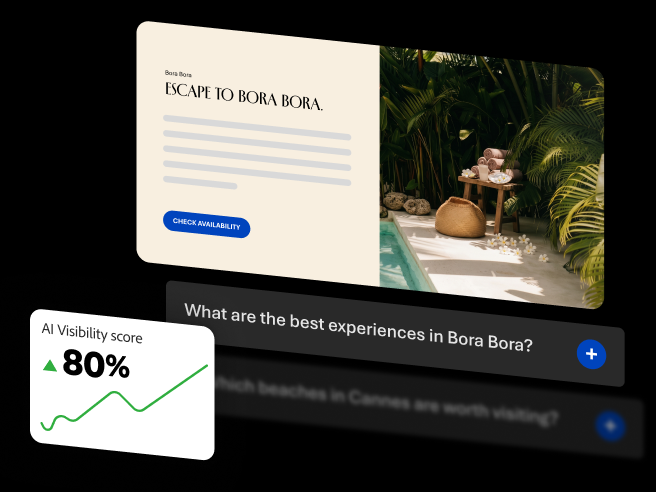
Recommended for you
https://business.adobe.com/fragments/resources/cards/thank-you-collections/brand-visibility