#000000

2026 AI AND DIGITAL TRENDS IN CUSTOMER ENGAGEMENT

Progress and Pressures in AI-Powered Customer Engagement

Agentic AI is reshaping customer interactions while exposing a gap between ambition and reality. Organizations are setting bold expectations for real-time personalization, but success hinges on closing gaps across data readiness, analytics infrastructure, and alignment from leadership to execution.

This year's report surfaces insights on how brands are shifting from recognizing agentic AI’s potential to realizing its returns. It explores data such as:

con-block-row-bgcolor
#000000

2026 AI AND DIGITAL TRENDS IN CUSTOMER ENGAGEMENT

Progress and Pressures in AI-Powered Customer Engagement

Agentic AI is setting a new standard for customer engagement, raising expectations for real-time personalization. But this year’s AI and Digital Trends in Customer Engagement report shows most organizations don’t yet have the data, analytics, or alignment to keep up — bringing priorities for scale into sharper focus.

#F8F8F8

Jump to a Key Section to Get Insights on
Customer Engagement

Introduction

Brands are building toward a future where agentic AI manages the bulk of customer interactions and operational workflows, leading to increased employee productivity and creative outputs. Yet our global survey of 3,000 executives and practitioners for the Adobe 2026 AI and Digital Trends report finds that ambitions for AI-powered, real-time personalization at scale are running well ahead of organizational readiness.

Few have the data quality, harmonized profiles, or analytics frameworks required to scale their AI investments. While AI is already leading to improvements across key marketing workflows, teams are struggling to translate those benefits into quantifiable returns to leadership. Persistent misalignment on AI strategy between executives and day-to-day practitioners only compounds these challenges. To effectively scale AI-driven engagement, organizations must focus on closing three gaps simultaneously: data readiness, measurement infrastructure, and executive-practitioner alignment.

Organizations are betting heavily on real-time personalization as the future of customer experience (CX), while simultaneously acknowledging that their current digital capabilities may not be equipped to deliver it at scale.

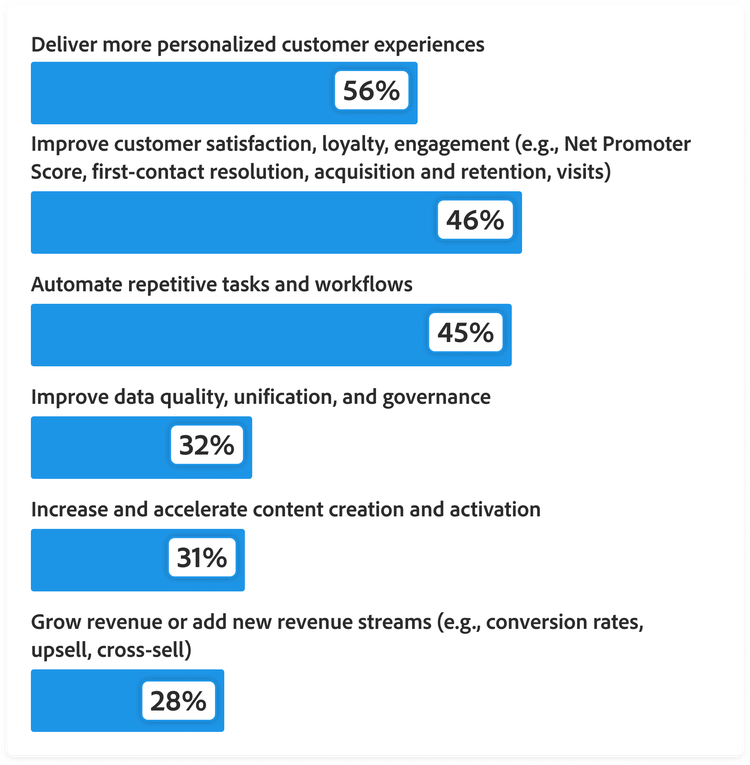
More than half of organizations cite providing more personalized customer experiences as a top AI investment goal over the next 18 months, outpacing other priorities like automating repetitive tasks and workflows, improving data quality and governance, and accelerating content creation (Figure 1). When asked what will define breakthrough CX over the next two to three years, 80% point to highly personalized experiences that anticipate customer needs in real time.

Figure 1
Organizations Are Investing in AI to Increase Personalization
Q. What are your organization’s top three goals for AI investments over the next 18 months? Top six out of nine responses shown.
Bar chart showing how organizations are prioritizing AI investments to increase personalization: Deliver more personalized customer experiences, 56%. Improve customer satisfaction, loyalty, and engagement, 46%. Automate repetitive tasks and workflows, 45%. Improve data quality, unification, and governance, 32%. Increase and accelerate content creation and activation, 31%. Grow revenue or add new revenue streams, 28%.
However, many organizations would benefit from improving the technology infrastructure, tools, and integrated capabilities they currently have in place to better deliver on customer experience goals. When asked to compare, 57% of brands consider their own digital CX maturity merely on par with or behind industry peers. Only 36% view themselves as ahead of the curve.

Brands are setting aggressive timelines for agentic AI, but today’s deployment progress points to a more uneven reality. Less than one-third of organizations have moved beyond the pilot stage into organization-wide or cross-functional deployment of agentic AI for customer support (30%) — an area that many expect to automate in the near future. Even fewer have deployed agentic AI to the same degree in marketing content creation and activation (22%) and personalization and recommendation (18%).

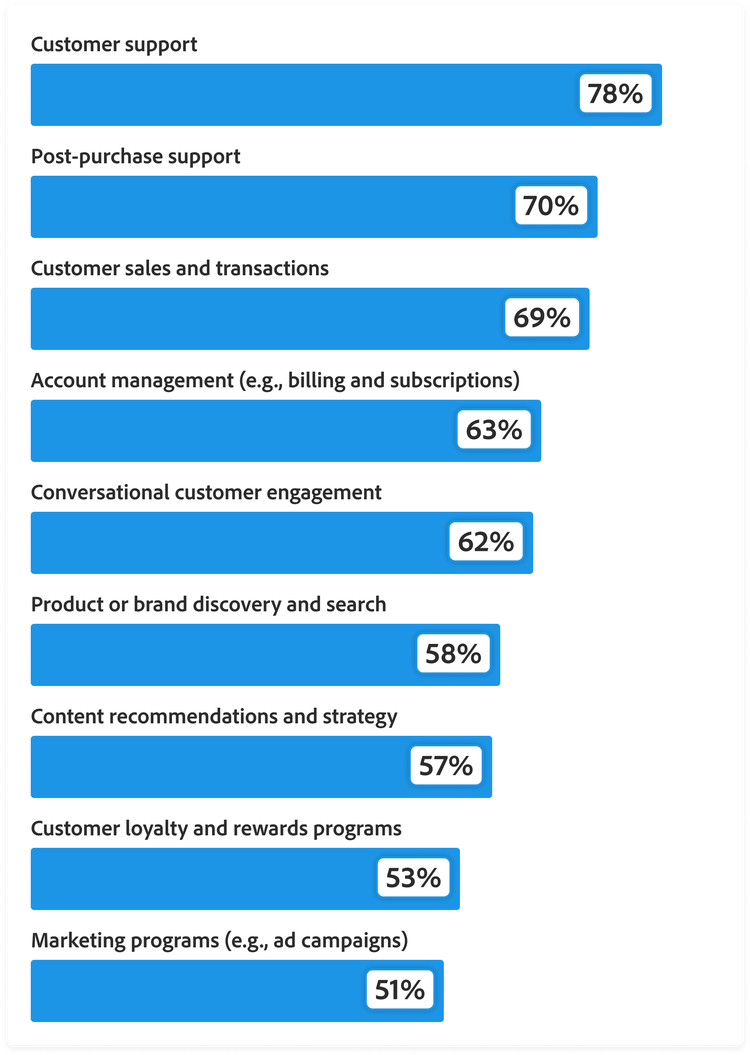
Despite their limited progress in scaling agentic AI, a majority of brands anticipate that the technology will directly handle a substantial share of all interactions across customer touchpoints. Within the next 18 months, more than three-quarters believe agentic AI will manage at least half of all customer support interactions. They hold similar expectations for agentic AI’s role in post-purchase support, customer sales and transactions, and conversational engagement (Figure 2). These aspirations about agentic AI’s growing role in customer engagement extend beyond scale — 42% of brands also plan to design distinctive AI agent personalities for different audiences, pointing to a broader reimagining of how customers experience AI-driven touchpoints.

Figure 2
Agentic AI Will Directly Handle Most Customer Interactions
Q. Within the next 18 months, what share of your organization’s customer interactions do you expect agentic AI will handle directly in each of the following? “About half of the interactions,” “more than half of the interactions,” and “all or nearly all of the interactions” responses combined.
Bar chart showing what share of customer interactions organizations expect agentic AI will handle directly within the next 18 months: Customer support, 78%. Post-purchase support, 70%. Customer sales and transactions, 69%. Account management such as billing and subscriptions, 63%. Conversational customer engagement, 62%. Product or brand discovery and search, 58%. Content recommendations and strategy, 57%. Customer loyalty and rewards programs, 53%. Marketing programs such as ad campaigns, 51%.

Plans for agentic AI are equally bold when it comes to optimizing internal processes. Within the same timeframe, organizations expect agentic AI to be assisting employees with research and knowledge retrieval (69%), automating routine customer service tasks (63%), assisting marketing with campaign orchestration (52%), and creating content for marketing campaigns (44%).

These ambitions clearly indicate that brands are optimistic about the transformative benefits agentic AI can deliver. Nearly two-thirds (63%) believe it will free their organization to focus more on strategy and creative work, and 47% go further, saying businesses that fail to adopt agentic AI will become obsolete. Roughly one-third are already prioritizing agentic AI investment over more widely adopted approaches like generative AI. Yet as the gap between conviction and deployment suggests, moving agentic AI from experimentation to scale will require organizations to confront several operational barriers that ambition alone cannot resolve.

AI can help organizations achieve their vision of real-time personalization at scale, but fragmented data is a major barrier to implementation. Most have not established the data foundations (i.e., quality, harmonization, and accessibility) required to make AI applications effective.

The basic prerequisites remain unmet for a substantial share of organizations. Only 44% say their data quality and accessibility are currently adequate for AI, and roughly half say their ability to advance AI initiatives is limited by their current level of data unification and structure.

Fewer are prepared for agentic AI. Just 39% have a shared customer data platform capable of supporting the widespread adoption of agentic AI, and only 44% have clear data management rules and processes for the technology. When asked to identify their top implementation challenges, 75% cite data integration and quality, ahead of talent gaps (71%) and unclear ROI (68%). Without a strong data foundation, organizations will struggle to deploy agentic AI to effectively manage tasks like generating audience segments, creating complete customer profile overviews, and providing real-time engagement updates.

Infrastructure investment reflects the same disparity. While 89% of organizations have invested in cloud technology for generative AI, only 51% have done so for agentic AI. The contrast is wider still for systems integration: 72% have tools to connect different software and systems for generative AI use cases, compared to just 37% for agentic ones. And only 39% say they have a harmonized customer data foundation capable of extracting insights from the data generated by their AI agents and conversational interfaces, suggesting that most organizations still cannot meaningfully interpret what their AI applications are actually doing.

Teams report experiencing significant gains from their AI applications — especially generative AI — but few have developed the measurement frameworks needed to formally demonstrate the technology’s ROI to leadership.

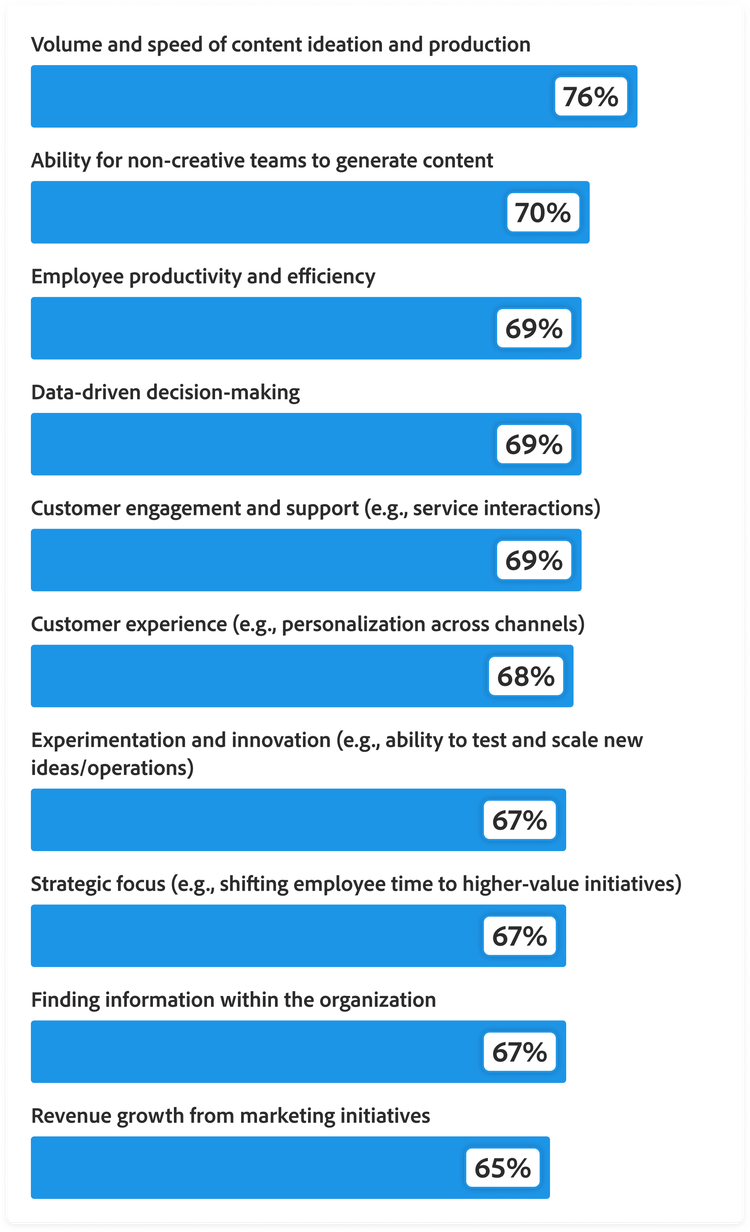
Nearly two-thirds of organizations have identified practical, high-value AI use cases, and almost half are already using agentic or generative AI for journey design and omnichannel activation to achieve personalization at scale. Generative AI, in particular, is already driving momentum across a range of workflows and operations. A majority of organizations say it has improved the volume and speed of content ideation and production, enabled non-creative teams to generate content, increased employee productivity, and enhanced data-driven decision-making (Figure 3).

Figure 3
Generative AI Is Helping Teams Increase Productivity and Creativity
Q. To what extent has generative AI improved the following in your organization? “Moderately” and “significantly” responses combined.
Bar chart showing how generative AI is helping teams increase productivity and creativity. Volume and speed of content ideation and production, 76%. Ability for non-creative teams to generate content, 70%. Employee productivity and efficiency, 69%. Data-driven decision-making, 69%. Customer engagement and support, 69%. Customer experience, 68%. Experimentation and innovation, 67%. Strategic focus, 67%. Finding information within the organization, 67%. Revenue growth from marketing initiatives, 65%.

Despite the widespread perception of these benefits, demonstrating AI’s value is a persistent challenge. While organizations rank customer satisfaction and loyalty (e.g., Net Promotor Score, retention, churn) as leadership’s most important indicator of AI success — ahead of revenue growth and cost savings — more than half (56%) report that leadership ultimately evaluates AI outcomes purely through a financial lens. This disconnect is compounded by the fact that 52% of organizations struggle to demonstrate measurable returns on AI investments using any CX-related metrics, leaving the case difficult to make on either front.

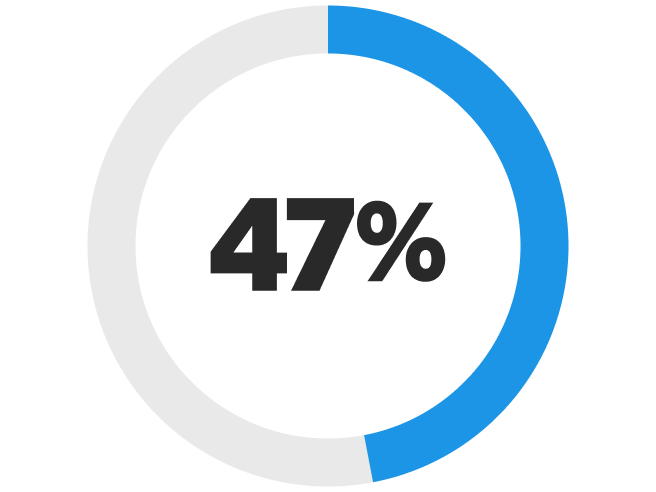
Underlying both challenges is a lack of formal measurement infrastructure. Only 44% have implemented a framework for tracking the ROI and value of generative AI, and just 31% have done so for agentic AI. Nearly half (47%) have neither framework in place or do not know whether they do.

Statistic showing that 47% of organizations have no framework in place for tracking ROI and the value of generative AI.
Nearly half have no framework in place for tracking ROI and value of generative AI.

The organizations best positioned to deliver on AI-driven engagement are those where executives and practitioners share a clear strategic vision. Yet only 21% of organizations report that their executives and day-to-day practitioners are very aligned on AI strategy. Nearly half (47%) describe their alignment as partial, and nearly one-third report outright misalignment.

According to those experiencing it, misalignment is driven by factors such as resistance to change or technology adoption (52%), insufficient communication of AI goals and strategies (52%), limited practitioner involvement in strategic planning (39%), and unclear measurement of AI’s value and ROI (39%). Where alignment does exist, it is built on clear communication of AI goals and objectives (72%), collaborative planning and decision-making (69%), and strong leadership support (59%).

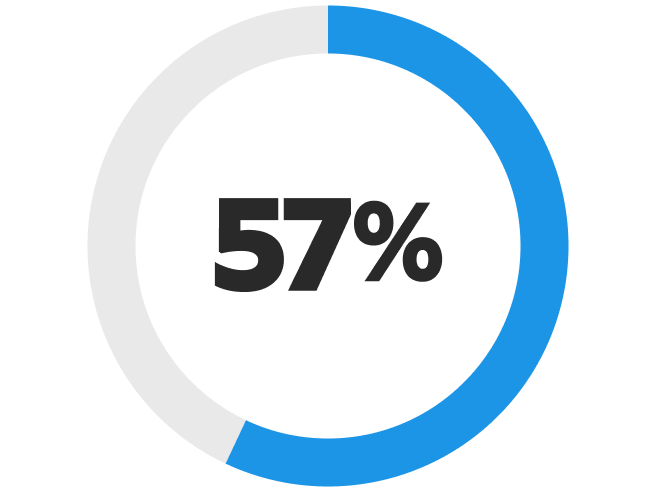
Misalignment also carries consequences for the broader workforce. More than half (57%) of organizations say AI is changing roles and workflows faster than employees can adapt, and 58% say employees who do not embrace AI will fall behind. Without alignment between the people setting AI strategy and those executing it day to day, neither group will be well positioned to deliver on AI’s potential.

Statistic showing that 57% of organizations say AI is changing roles and workflows faster than employees can adapt.
More than half of organizations say AI is changing roles and workflows faster than employees can adapt.

Brands are convinced of agentic AI’s potential to reshape how they engage customers, from cross-channel campaign orchestration and real-time journey decision-making to continuous optimization driven by AI-generated analytics. These transformations can drive critical business results: reducing churn, increasing retention, delivering always-on personalization, and fueling growth.

But many lack the structural foundations and operational readiness — including strong measurement frameworks, unified data infrastructure, and executive-practitioner alignment — to keep pace with these ambitions.

Organizations can take key steps to close these gaps and scale AI-driven engagement:

  • Strengthen data infrastructure to make agentic AI effective. Improve data quality, harmonization, and accessibility so AI applications successfully transition from pilot stages to real-time personalization at scale.
  • Formalize measurement frameworks to prove AI's value. Define how AI success will be evaluated across both financial and customer experience metrics before scaling agentic AI.
  • Bridge leadership’s AI vision with workforce realities. Establish collaborative planning, clear objectives, and workforce training so that strategic ambition translates into coherent, day-to-day execution.

Discover how to bring your customer engagement strategy to life with Adobe.

Learn more | Learn more Adobe Customer Engagement solution overview

APPENDIX 1

Research Methodology

For Adobe’s 16th annual AI and Digital Trends research, Oxford Economics, in partnership with Adobe, conducted global surveys of 3,000 executives and practitioners and 4,000 customers to better understand how organizations are leveraging AI to capture customer interest, build brand loyalty, and augment CX workflows — and how customers are responding to these changes. The surveys were fielded online and via computer-assisted telephonic interviewing (CATI) from October through November 2025.

https://main--da-bacom--adobecom.aem.page/fragments/resources/cards/thank-you-collections/digital-trends