Content as a Service v3 - rtcdp - Tuesday, July 15, 2025 at 14:09

Executive Summary
Agentic AI is pushing customer data platforms (CDPs) into a new phase. CDPs will still be needed to unify profiles, support activation, and connect customer experience services, but the use cases and expectations around them are changing quickly.
What organizations use CDPs for today looks markedly different from what they expect to need in three to five years, as AI agents become more central to customer engagement. This report examines how that shift is unfolding, what it means for customer data strategy, and where enterprise teams need to focus next.
Research Highlights

say CDPs are essential for preparing for the agentic future.

say managing data for AI, including agents, will be the primary use case in 5 years.

say data warehouses perform better when integrated with a CDP.
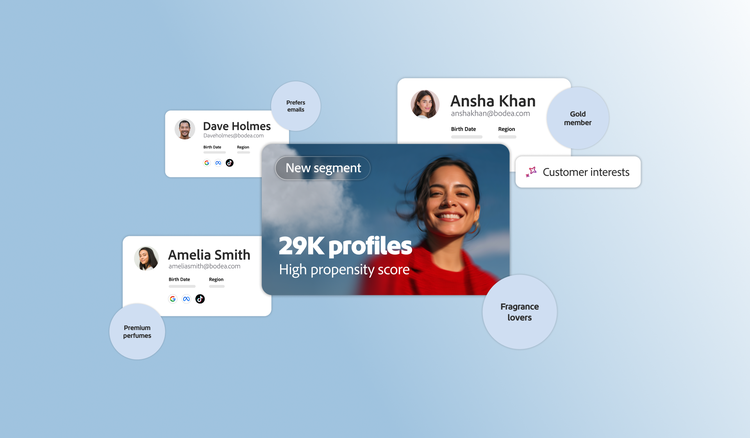
Enterprises have long relied on customer data platforms to bring together fragmented data, create unified customer profiles, and activate personalized experiences across channels. Those capabilities remain critical, but the operating environment around them is shifting.
As AI agents begin to shape more customer interactions, organizations are having to rethink the data infrastructure behind customer engagement and the role CDPs play within it.
Agentic experiences depend on context that reflects what is happening now, from recent behavior and new signals to decisions that need to be made in the moment. This context also needs to move across systems with the right controls, so agents can act without requiring manual review at every step.
This is a fundamentally different set of requirements from the marketing workflows CDPs were originally built to support.
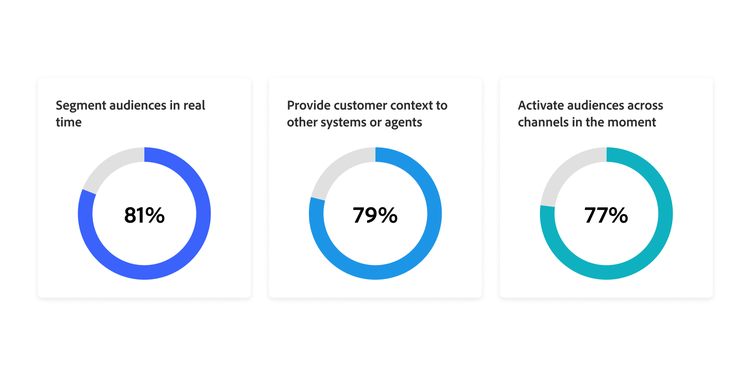
Adobe surveyed 150 CDP executives and practitioners to understand how this transition is playing out. The response was near-universal: 98% say CDPs are essential for preparing for the agentic future. The value of a CDP is increasingly tied to whether it can make customer data usable in real time, with enough context and control to support AI-powered engagement. This expectation shows up clearly in what respondents say creates business value for agentic experiences.

say real-time customer understanding increases business value.

say real-time customer data activation increases business value.

say real-time customer data segmentation increases business value.
The question now is whether today’s CDP implementations can support the shift. This report examines how CDPs create value today, how enterprise expectations are changing, and what organizations will need from their customer data infrastructure as agentic experiences become more common.
Real-Time Engagement Is the Main Value Driver

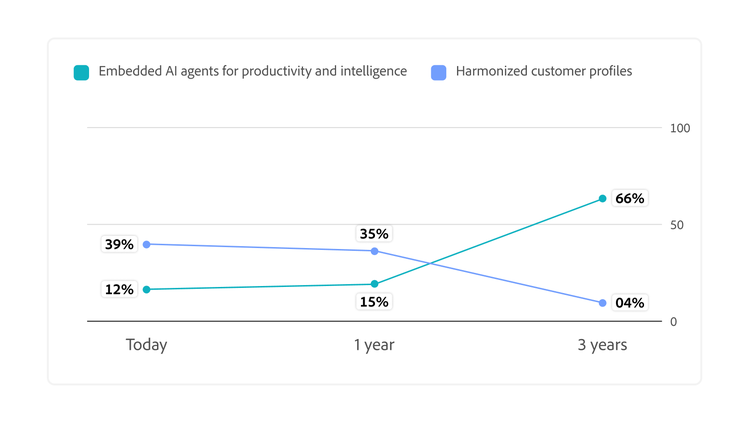
The CDP’s role in the enterprise is already broader than the use cases that first defined the category. Customer data unification remains its primary anchor, with 39% of survey respondents ranking harmonized customer profiles as the most critical CDP capability today. But the research shows that organizations are no longer evaluating CDPs only by their ability to create a single customer view.
Increasingly, the value comes from what that view makes possible in the moment. When asked which capabilities drive greater business value, 65% point to real-time profile updates and segmentation, while 64% cite real-time activation (Figure 1). Real-time engagement is no longer a future-state ambition for most organizations and is already becoming an integral part of how customer experience operates.
Figure 1:
Real-Time CDP Capabilities Are Becoming the New Baseline
These capabilities show how the CDP is moving closer to the point of customer interaction. It gives data and marketing teams a way to manage complex integration at scale, recognize new signals, update audiences in real time, and feed live customer context into connected systems.
CDP Value is Expanding Across the Enterprise Stack
The value of that architecture now extends beyond owned-channel personalization. Respondents say CDP integration improves the performance of a wider enterprise stack, led by analytics platforms (83%) and CRM environments (82%).
Marketing automation, data warehouses, advertising, business intelligence, and journey orchestration also show strong gains from CDP integration (Figure 2).
Figure 2:
Key Enterprise Systems Perform Better When Integrated With a CDP
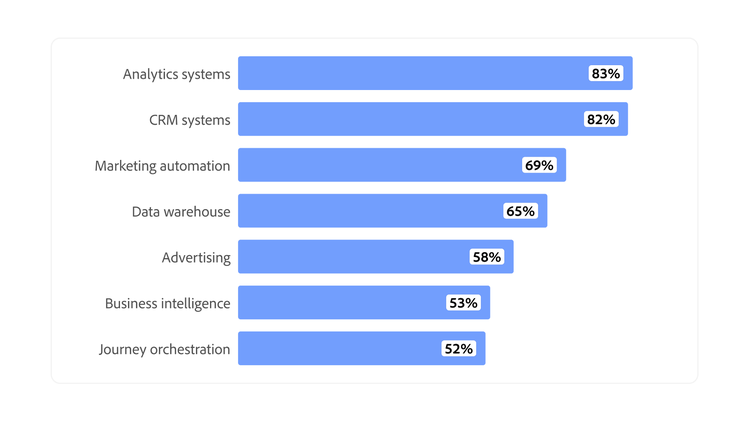
That broader role extends into paid media as well. As third-party data continues to erode, the ability to activate first-party customer data in advertising environments with precision and governance is becoming more important. More than half of the respondents (58%) say advertising performs better when integrated with a CDP, placing it alongside core systems, such as marketing automation and business intelligence, in the value a CDP creates across the enterprise.
It makes today’s real-time foundation more strategic than it may appear. The CDP remains central to profiles, segmentation, and activation, but its value increasingly comes from helping more parts of the customer experience stack operate from a consistent view of the customer. These capabilities are also becoming the foundation for the next set of expectations enterprises are placing on the CDP.
AI Agents Are Overtaking Unifying Customer Profiles in Priority
The CDP category is being redefined by what organizations expect it to power next. It will still support marketers building audiences and data teams managing profiles, but its future value is increasingly tied to agentic systems that need customer context to recommend, decide, and act.
That is a step change, and organizations expect it to happen fast. Embedded AI agents for productivity and intelligence remain an early priority today, with 12% ranking them as the most important CDP capability. But within three years, that figure rises to 66%, making AI agents the dominant priority (Figure 3).
The result is a reordering of the CDP roadmap. Harmonized customer profiles, the capability that has long defined the category, fall sharply as a top-ranked priority as AI agents move to the forefront.
Figure 3:
Embedded AI Agents are Becoming the Top-Ranked CDP Capability
The shift is even clearer when organizations think about the CDP’s primary use case. Today, only 15% say their main CDP use case is managing data for AI. Five years from now, the figure rises to 71%.
This also changes the requirements for the data layer. Agentic experiences need more than a static customer profile or a prebuilt audience segment. They need current customer context, the ability to interpret new signals, and the governance to determine what an agent can know, decide, and do.
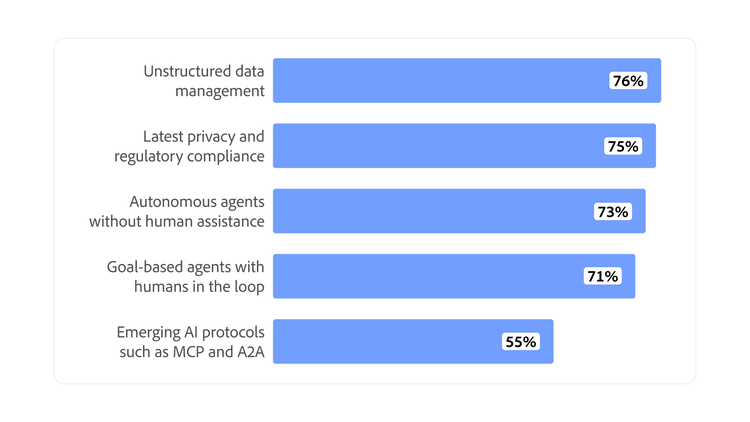
Organizations are already prioritizing CDP capabilities that can make those experiences usable in practice. This includes bringing more types of customer data into the profile, governing how that data is used, and supporting agents that can work across systems with the right level of human oversight (Figure 4).
Figure 4:
Organizations are Prioritizing CDP Capabilities Needed for Agentic Experiences
Executives Are Ready for Autonomy. Practitioners Are Preparing for It
Confidence in the agentic future runs high across the board, but the timeline looks different depending on where you sit. Executives are more eager to move toward autonomy, with 71% saying they want autonomous agents in their CDP today, compared with 29% of practitioners.
Three years out, that picture changes almost entirely. Practitioner appetite for autonomous agents rises to 97%, higher than the overall figure of 92%. Practitioners are also more likely than executives to expect embedded AI agents to become the most important CDP capability in three years, at 78% versus 55%.
This gap shows that the agentic future is as much a question about execution as it is about strategy. Enterprise teams want the benefits of autonomous agents, but the people closest to the systems are looking for the data quality, governance, controls, and operational confidence needed to make that autonomy work.
AI Readiness Requires CDP-Data Warehouse Alignment
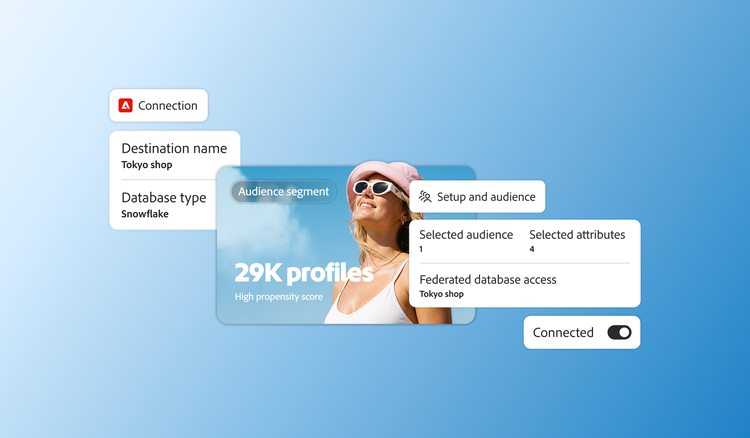
AI agents are also raising the bar for data architecture around CDPs. To recommend, decide, and act in the moment, they need customer context that is timely, governed, and ready to use.
That puts new pressure on the relationship between the CDP and the data warehouse. Warehouses remain essential to enterprise data strategy, but confidence in what they can deliver changes significantly when the focus shifts from managing data at scale, which they are built to do, to powering real-time customer decisions.
Nearly half of respondents (47%) are very confident their warehouse can ingest data in real time. Confidence drops sharply, however, when that data needs to power real-time customer experiences.
Only around three in ten are very confident in their warehouse’s ability to inform AI agents with real-time customer context, activate data in real time, or prepare data for agentic customer experiences. Just 27% say the same for updating profiles, qualifying segments, and serving the next-best experience, capabilities that sit close to the point of decision and make timely customer context critical.
Figure 5:
Strong Confidence in Warehouse Readiness Remains Limited
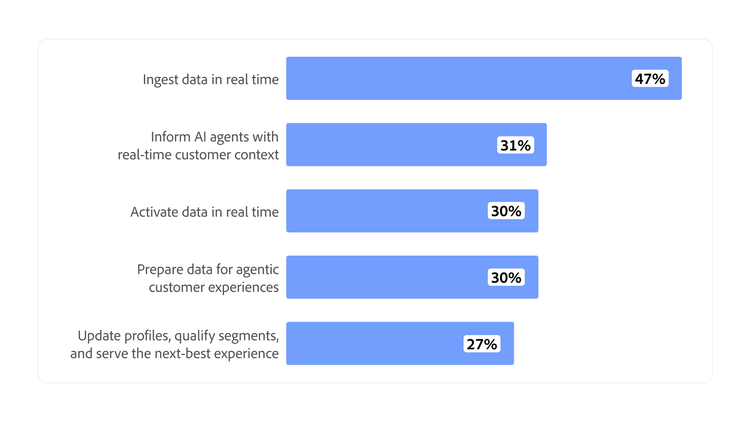
The role-based results show that confidence also varies by perspective. Executives tend to express higher confidence in warehouse readiness across these tasks, while practitioners are more cautious, particularly when it comes to real-time customer decisioning and informing AI agents with live context.
Warehouse Fit Is Now Part of CDP Evaluation
Agentic customer engagement is asking more of the architecture around the data warehouse. That makes the warehouse-CDP relationship more important, not less. The question is whether the two can work together to make enterprise data usable in real-time customer experiences, with the governance, identity, segmentation, and activation logic those experiences require.
Buying criteria show that enterprises are already evaluating CDPs through this connected-architecture lens. Real-time performance is the top priority, cited by 69% of respondents. Interoperability with existing technologies, such as data warehouses, follows closely at 65%, while 61% prioritize AI innovation and integration (Figure 6).
Figure 6:
Top CDP Buying Priorities
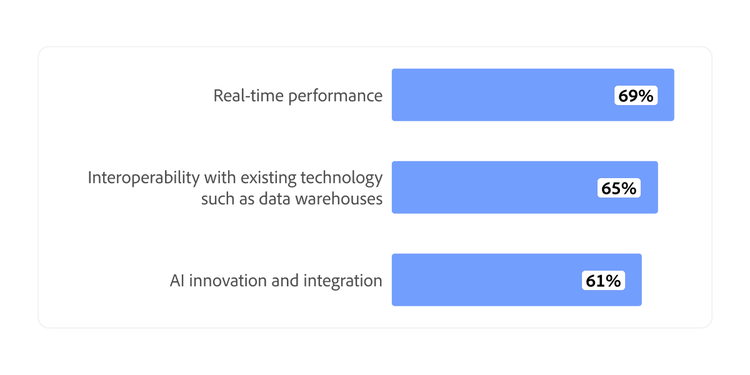
The top three criteria point to the same direction: enterprises want CDPs that can perform in real time, work within the existing data environment, and support AI-powered customer engagement.
Translating the CDP Shift Into Action

The findings in this report point to a category in transition. CDPs are performing well in their current role, but AI-powered customer engagement is expanding what enterprises need from them.
This shift changes the CDP’s role from supporting customer data workflows to becoming the control plane for AI. They need to help determine what agents know, what they can act on, and how that context moves across systems. The priority now is to operationalize that shift across the teams responsible for customer data, activation, and architecture.
Marketing and Activation Leaders
Cross-channel personalization is where most organizations focus their CDP efforts today, but many are already thinking beyond it. Within five years, 71% expect AI data management to become their primary CDP use case. The decisions you make in the next 12 to 18 months will shape how ready you are for that shift.
- Reframe the CDP investment case: If the CDP is still positioned solely as a personalization tool, it will lead to the wrong investment decisions. Build the business case around the infrastructure needed for AI-powered engagement.
- Identify the friction in today’s activation workflows: Determine where audience creation, profile updates, segmentation, or channel activation still depend on delayed data, manual handoffs, or disconnected systems.
- Prioritize capabilities that will support agentic systems: Evaluate whether the CDP can support real-time profile updates, governed activation, and customer context that AI agents can use when decisions need to be made in the moment.
Data and CDP Practitioners
You are closest to the constraints that will determine whether AI-ready customer data works in practice. Use the confidence gap around warehouse readiness to steer architecture discussions beyond broad AI ambitions and toward operational realities.
- Challenge warehouse-only assumptions: Document where the current architecture cannot support real-time agent context and use those gaps to define implementation requirements. The 45-point confidence gap between executives and practitioners on warehouse readiness is evidence worth bringing into those conversations.
- Set requirements for foundational capabilities: Real-time profile management, governed identity resolution, and unstructured data ingestion will determine whether your data infrastructure can support agentic use cases. Build the case for prioritizing them now, before architecture decisions are locked in.
- Define readiness before autonomy scales: Establish the data quality, governance, profile accuracy, and activation standards agents must meet before they are used in customer-facing workflows. Setting these requirements now gives you a clearer implementation target and a stronger basis for decisions.
IT, Architecture, and Governance Leaders
In this research, the top three buying criteria for CDPs point to the same architecture requirement: real-time performance, interoperability with existing technology such as data warehouses, and AI integration. That gives you a practical lens for evaluating where current investments stand and what needs to change.
- Treat CDP evaluation as an architecture decision: Do not assess the CDP only as a marketing application. Evaluate how it fits into the broader data environment, how it connects with the data warehouse, and how it supports real-time customer engagement.
- Extend the value of the data warehouse: The CDP should not replace the data warehouse. It should make warehouse data more actionable by adding real-time context, identity resolution, segmentation, governance, and activation logic.
- Make AI readiness part of the governance model: Before agents use customer data in live workflows, define controls for consent, profile accuracy, data access, decisioning, and activation.
Take the Next Step
Learn how Adobe Real-Time Customer Data Platform helps enterprises unify customer data, activate it in real time, and deliver the governed customer context that agentic experiences require.
About the Research
This report is based on findings from the CDP Study 2026, a survey of 150 CDP users sponsored by Adobe and conducted by Advanis between March 18 and April 8, 2026.
- Role split: 51% of respondents are executives and 49% are practitioners.
- Functional area: 59% of respondents are in marketing, 29% in IT, 11% in C-suite or company executive roles, and 1% in business operations and services.
- Industry representation: 28% of respondents are from the technology industry, 20% from financial services and insurance, 17% from retail and consumer packaged goods, 17% from healthcare and life sciences, and 17% from other sectors.
- Market reach: 46% of respondent organizations serve national markets, 38% serve international markets, 13% cater to regional markets, and 3% serve local markets.
- Annual revenue: 29% of respondents represent organizations with annual revenue between US$100 million and US$999 million, 58% represent organizations with revenue between US$1 billion and US$9 billion, and 13% represent organizations with revenue of US$10 billion or more.
Title
Adobe State of the CDP Report 2026.
cardDate
2026-09-30
cardImage
CardDescription
Discover how the value of customer data platforms is shifting from unified profiles to real-time use, AI readiness, and agentic experiences.
primaryTag
caas:content-type/report
Tags
caas:content-type/report, caas:products/adobe-real-time-cdp, caas:topic/data-&-analytics
Let’s talk about what Adobe can do for your business.