of CIOs say AI is already reshaping their operations or beginning to.2


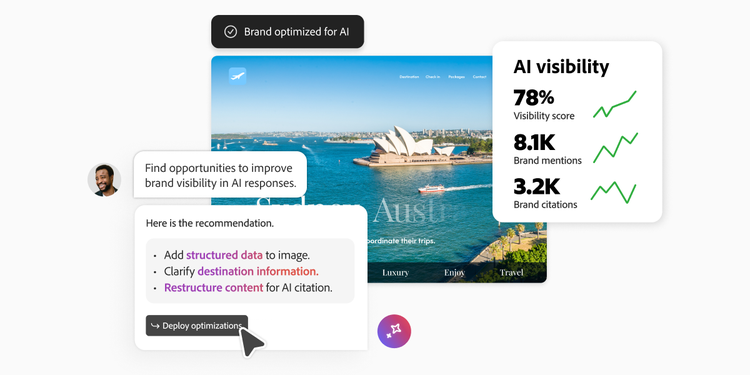
When customers want to know what to trust or buy, they ask an AI assistant and act on its recommendation. That answer is a single judgment, shaped by content, data, and governance a brand makes available. Staying visible is no longer the responsibility of marketing or IT alone. It is a shared problem, owned by CIOs and CMOs together.
Right now, a customer is asking an AI assistant which enterprise platform to consider, which insurance provider to trust, or which consulting firm to retain. The answer they receive comes from whatever data the model can find, like your product pages, a competitor’s blog post, or a two-year-old review. And the model doesn’t just pull from those sources. It synthesizes those signals into a single recommendation delivered to hundreds of millions of customers.
One in four customers already turn to AI-powered platforms as their primary source for information, purchase decisions, and recommendations, ahead of brand websites and online reviews.1 The version of your brand those customers encounter is not the one your creative team designed. It is the version made available through your data, content structure, and governance to the third-party AI systems now telling your story.
Marketing sets the strategy for the searches that matter most to your brand. However, the infrastructure that determines whether your brand actually surfaces is built by IT — and right now, most businesses are getting it wrong. According to the Adobe 2026 AI and Digital Trends Report, 80% of businesses have serious gaps in how they are showing up in AI platforms. Closing those gaps starts with IT and marketing working from the same playbook.
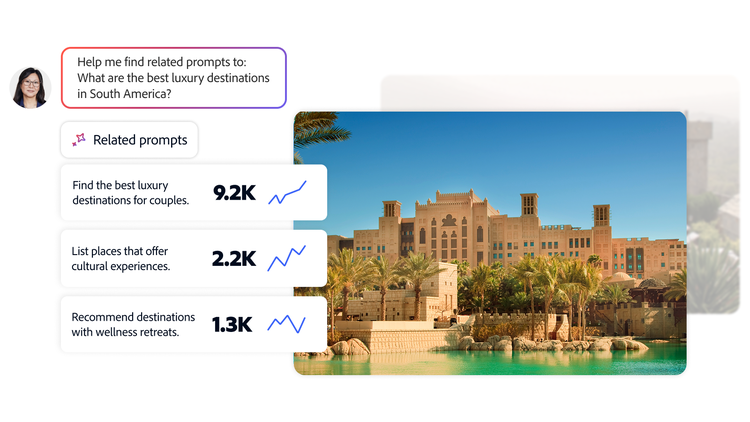
The CIO's role has quietly become one of the most important in the room when it comes to brand visibility. Not because IT has taken over marketing's job, but because the infrastructure IT builds now determines whether marketing's work actually reaches customers. This shift has been building for years. Nearly half of CIOs are now seen as leaders who proactively identify business needs, not just manage systems. But AI has made the transition urgent. When 39% of CIOs name AI-driven innovation as their top business priority for 2026 — a topic that didn't even crack the top three a year ago — it signals something bigger than a technology trend. It means the systems IT builds are now directly responsible for how customers discover, evaluate, and engage with a brand.
of CIOs say AI is already reshaping their operations or beginning to.2

of CIOs are tasked with researching and evaluating AI additions to the tech stack.2

of CIOs plan to become more involved with agentic AI over the next year.2
For CIOs and CMOs to truly work in tandem, they need more than shared goals — they need shared infrastructure. A unified system brings together the content, data, workflows, and AI decision-making capabilities that both functions depend on, inside a single governed architecture. When these four capabilities work together, marketing can move instantly, and IT can ensure every output is accurate, on-brand, and traceable. Here's what that looks like in practice.

Signal detection.
Understanding how your brand appears in AI-mediated experiences starts with connected data. First-party customer intelligence, competitive signals, and content performance data need to flow into the same system, governed by the right policies, available to the right agent at the right moment.
When they do, shifts in how AI represents your brand can be traced directly to content gaps or drops in engagement, giving IT and marketing a shared view of where to act next.

Content activation.
A connected signal is only useful if the system can respond to it. This requires structured, approved, and machine-readable content along with the metadata and brand context AI systems need to interpret and cite them correctly. When content is governed at the source, marketing can move quickly without sacrificing accuracy, while IT can be confident that every output reflects the brand as it was designed, not as AI happened to find it. The need for this fix is more urgent than it might seem. As per the Adobe 2026 AI and Digital Trends Report, 55% of businesses say they have strong AI governance policies, but only 43% follow them routinely. The gap isn't policy. It's enforcement. And enforcement is an organizational problem.

Omnichannel delivery.
Once the right content is activated, it needs to reach both human and AI audiences from a single source of brand truth. On third-party platforms, your brand doesn't just get mentioned in an AI answer — it shows up as an experience that can be explored and acted on. On your own properties, policy-aware AI assembles the right content for the right customer in real time, drawing from your governed source of truth rather than the open web. The same brand, everywhere it needs to be.

Continuous optimization.
The real value of a unified system builds over time. Every interaction, every correction, every piece of AI-generated output refined because it didn't quite reflect the brand feeds back into the system. What the brand learns in one cycle sharpens what it detects in the next, so the system doesn't just maintain brand presence, it compounds it.
A unified system is only as effective as the organization running it. Technology can connect content, data, and AI decisioning — but if the teams responsible for those things are still operating in separate lanes, the system underperforms. The operating model is what makes the infrastructure work. This means CIOs and CMOs must share more than just a strategy deck.

of IT leaders and 40% of marketing leaders name “shared vision” as a defining strength of their relationship.2
The organizations pulling ahead are rewiring how both functions work together. Here's what that looks like in practice:
DICK'S Sporting Goods is a good example of what this looks like when it's working. The company’s agentic readiness didn't come from a single technology investment, it came from building the operating model first. Cross-functional teams spanning product, architecture, analytics, and data science meant that when new AI capabilities arrived, DICK'S could move immediately. Earlier investments in centralized customer data and a decisioning engine meant the infrastructure was already there to build on.
When CIOs and CMOs work within that shared loop, stronger brand presence stops being something the organization fights for case by case. It becomes a built-in result of how it operates.
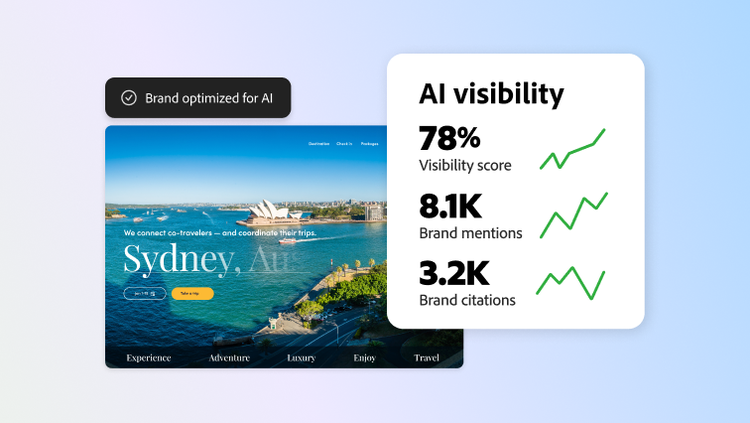
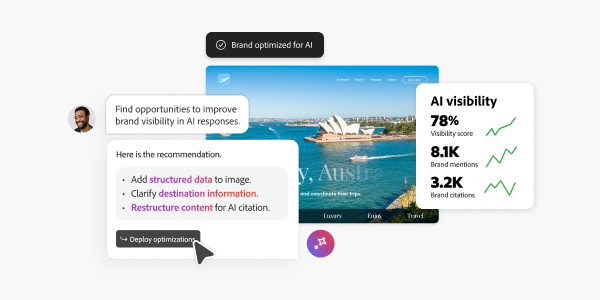
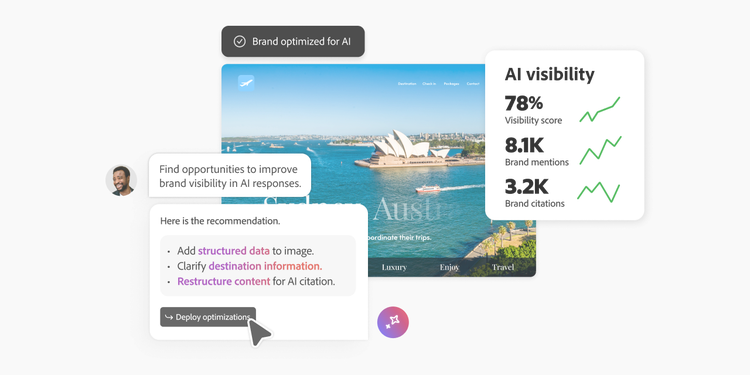
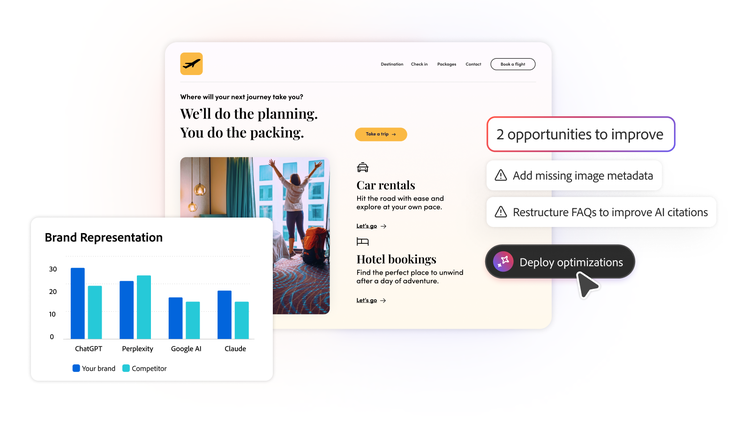
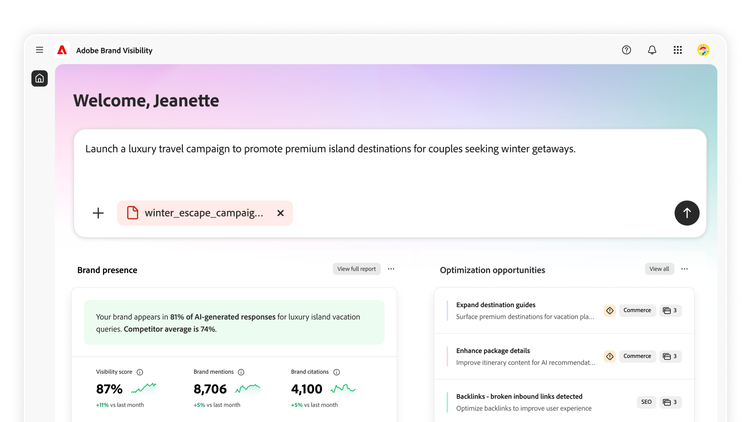
Adobe's solution gives you a real-time picture of how AI systems — ChatGPT, Perplexity, Google AI Mode, and others — represent your brand, and the intelligence to know exactly what to fix first. Optimizations deploy in minutes, whether through Adobe Experience Manager or at the CDN edge, without engineering support. And because it connects natively into Adobe Analytics and Adobe Customer Journey Analytics, every optimization ties directly back to pipeline and revenue — one connected system, from AI signal to measurable outcome.
The web will keep shifting. Agentic search isn't its last change. The brands building governed, AI-native infrastructure now aren't just solving today's visibility problem, they're laying the foundation for what comes next. Adobe offers CIOs and CMOs a shared platform to build it on. Its solutions for LLM optimization, agent orchestration, content creation, and brand governance are designed to move with the agentic web, not react to it.
This isn’t about platforms alone. A brand advantage in this environment does not come from the loudest campaign. It comes from the conditions the enterprise creates. The content AI can find. The data it can trust. The governance it can follow. And the partnership between leaders who make all three work together.
That customer asking an AI assistant which provider to trust? By the time you read this sentence, the question has been asked thousands more times. Each answer was assembled from whatever data, content, and context the enterprise made available. The organizations that will be visible, trusted, and chosen in those moments are not the ones that ran the best campaigns. They're the ones that built the systems and partnerships to do so.