
Strategy
Clear AI vision with ownership and
investment commitments.




High-tech marketing teams are rapidly deploying AI across content, personalization, customer experience, analytics, and automation. Yet, while adoption is accelerating, the organizational structures needed to govern, scale, and measure AI initiatives often lag behind.
This report explores how AI Leaders align ownership, decision-making, data access, and cross-functional collaboration to transform isolated AI deployments into sustainable and scalable initiatives that drive business value. Drawing on research findings, it highlights the five operating model decisions that distinguish AI Leaders from their peers.
Marketers in the high-tech industry are experimenting with and deploying artificial intelligence (AI) across a growing range of marketing and customer experience workflows. We conducted this research to understand whether the ownership, governance, measurement, and ways of working supporting this activity are evolving at the same pace. The key use cases covered include content creation and operations, personalization and targeting, creative and design, customer experience, data and analytics, and process automation. Based on our research, we noted that for many organizations, the activities supporting AI deployment are not evolving at the same pace.
As adoption expands, marketing functions often move at their own pace. Demand generation teams apply AI to campaigns and marketing automation. Product marketers use it in launch processes and content workflows, while customer marketers bring it into lifecycle engagement and customer experience. These applications can rely on different systems, data, and priorities, limiting visibility and coordination for the chief marketing officer (CMO), vice president (VP) of demand generation, and head of customer marketing.
Many of the processes connecting marketing with data and technology teams were designed for longer planning cycles. AI requires faster iteration, clearer decision rights, and shared access to data. Without these foundations, individual use cases can remain isolated and become difficult to scale.
This report examines five operating model decisions made by the strongest AI Leaders in the study, giving marketing leaders a practical framework for generating more value from investments already underway.

Hayley Nelson




MARKETS COVERED
Australia and New Zealand, Central Europe, India, Japan, Latin America, the Middle East, North America, Southeast Asia, South Korea, the United Kingdom (UK) and Ireland, and Western Europe.
The 342 AI Leaders referenced in this report come from the full study population of 5,633 senior executives across 12 industries. This is a global, cross-industry cohort rather than a high-tech-specific group. The cohort provides the benchmark used to compare the performance of the high-tech industry.
Each organization was assessed across six operating model pillars, with every pillar scored on a scale of 1 to 5. The six scores were combined into an operating model maturity (OMM) composite.
Strategy
Clear AI vision with ownership and
investment commitments.

Structure
Dedicated AI ownership with budget authority.

People
Roles and culture evolving for
an AI-enabled environment.

Governance
Risk framework calibrated
for AI velocity.

Technology
Infrastructure built for scale, not just pilots.

Workflows
AI embedded into how
work is actually done.
To qualify as a Leader, an organization had to meet two criteria: achieve an OMM composite above the top-quartile threshold of 3.27 and operate at the expanding or transforming stage of AI deployment. By applying both criteria, we identified 342 Leaders across 12 industries, equivalent to 6% of the 5,323 active respondents.
These organizations have established the ownership structures, governance, measurement frameworks, technology foundations, talent, and ways of working needed to make AI deployment repeatable and sustainable. The designation reflects the measured operating model maturity and deployment stage.
High-tech organizations have been launching a range of AI pilots across marketing and customer experience workflows. Amid this growing range, the operating model has often struggled to keep pace. Ownership remains unclear, measurement is limited, and coordination across marketing, data, and technology teams is inconsistent. This report examines those gaps and the actions taken by the Leader cohort to address them.


The 342 cross-industry AI Leaders have established the ownership structures, measurement frameworks, working relationships, and culture needed to scale AI-driven initiatives. Their advantage rests on five operating model decisions made as deployment progresses.

Leaders are 2.3 times more likely to have a formal AI owner with the title, mandate, and budget authority to work across product, demand generation, and customer marketing functions.

They define the ROI framework before deployment. Among Leaders, 44% measure ROI comprehensively, compared with 20% of high-tech organizations.

Marketing and IT share OKRs and are jointly accountable for outcomes. Among Leaders, 81% operate at the collaborative or integrated level, compared with 41% of high-tech organizations.

Leaders use failure to improve the next deployment. Among high-tech companies, 16% show destructive failure patterns. Among Leaders, the figure is under 1%.

Leaders identify practitioners who are already using AI effectively and give them the authority and support to extend their work. Among Leaders, 42% cite finding and empowering internal champions as their most effective culture action, ahead of every other lever measured.
PART ONE
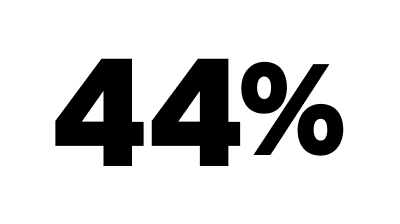
In the high-tech industry, 44% of the organizations are stuck in the Frozen Middle, which means AI is active within individual functions but the coordination needed to scale it remains limited.
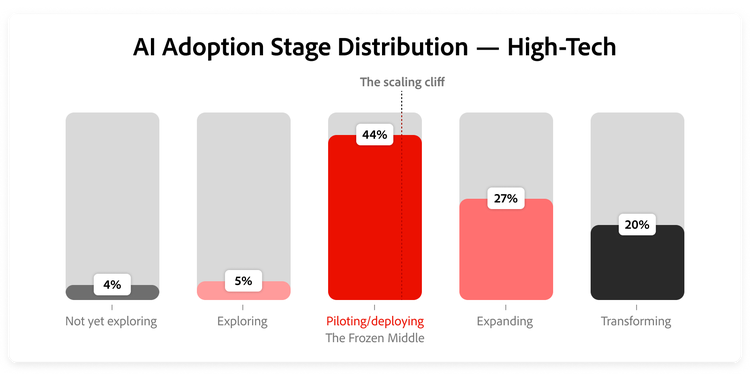
High-tech marketing teams adopt AI one use case at a time. Content-generation tools may sit with product marketing, audience targeting tools may sit with demand generation, and lifecycle automation tools may sit with customer marketing. Each moves forward on its own timeline, creating pockets of activity that are difficult to connect.
The Frozen Middle describes organizations that have progressed to piloting or deploying but have not built the coordination needed to scale. Data, learning, and results can remain within individual tools or teams, limiting the organization’s ability to compare outcomes, demonstrate ROI, and extend successful workflows.
Moving beyond this stage requires clear ownership, shared data access, and agreed decision rights across marketing and its technology partners. It also requires workflows that incorporate AI across teams instead of adding isolated tools to existing processes. When those decisions are deferred to future planning cycles, disconnected deployments accumulate and become harder to align around shared business outcomes over time.
Where ownership exists, it typically stops at the function boundary.
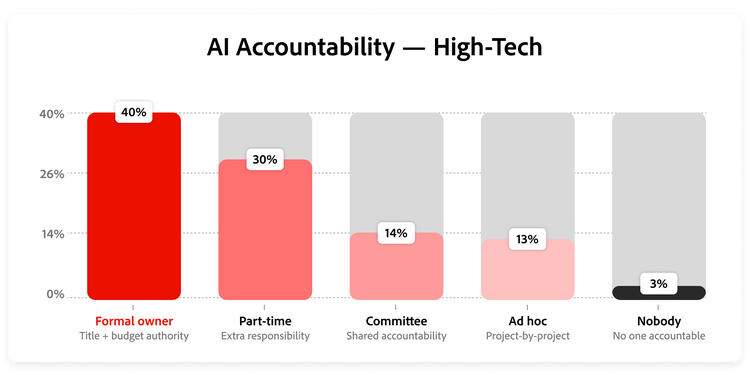
Within the marketing function, AI accountability may sit across product marketing, demand generation, and customer marketing. Delivery can also depend on sales, revenue operations (RevOps), product analytics, and technology teams. When responsibility is spread across these groups, it can be difficult to resolve competing priorities or make decisions about resource allocation.
An AI-driven lifecycle marketing workflow, for example, may require intent data from product analytics, customer relationship management (CRM) access from sales, and personalization capabilities from a customer experience platform. Without an owner with authority across the initiative, progress depends on separate teams reaching agreement.
Part-time ownership and committee-led accountability can leave decisions unresolved until after individual teams have moved ahead. A CMO or VP of demand generation can fill the role when the appointment includes authority across the content budget, ABM platform, and relevant data relationships. The requirement is a mandate that extends beyond a single marketing function or campaign.
Integration evaluation removes the largest share at the first gate.
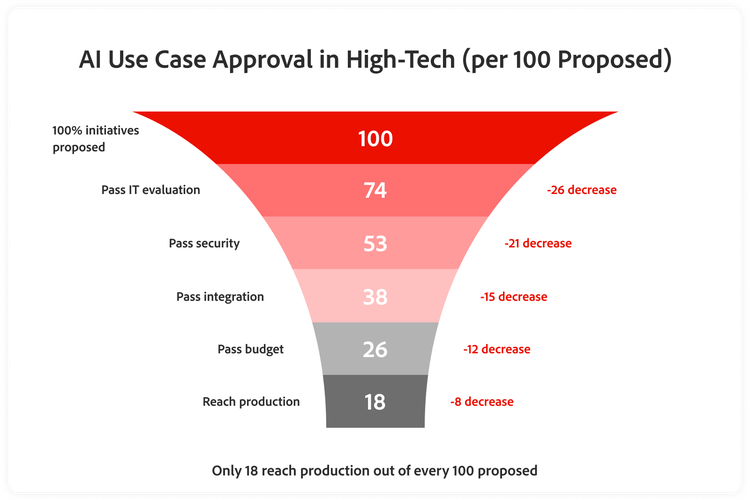
Moving an AI use case from idea to production requires several decisions across marketing and its technology partners. The survey follows proposals through initial IT evaluation, security review, integration assessment, budget approval, and production launch. In high-tech, integration assessment removes the largest share of proposals at the first measured gate.
The review considers integration complexity, data access and governance, security and privacy, compliance, cost justification, vendor approval, and timeline expectations. These checks determine whether a use case is practical to deploy. They are also aimed at preserving sight of the marketing outcome the work is intended to improve.
An ABM personalization workflow, product-qualified lead (PQL) routing process, or account-intelligence scoring model may depend on product data, CRM access, and intent signals. Organizations are likely to improve the chances of reaching production when data rights, system ownership, and integration requirements are settled during ideation, before formal review begins. This allows marketing and technology teams to evaluate feasibility and value together.
Among high-tech firms, 59% rely on relationship models shaped by annual planning cycles and sequential requests.
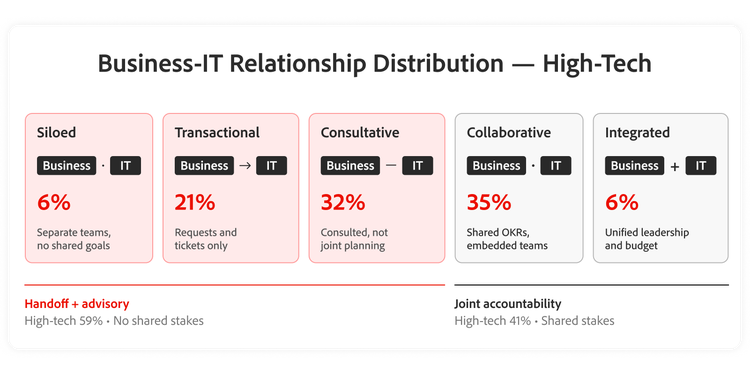
Marketing teams already adjust audiences, content, and campaigns as performance data changes. AI increases the need for that responsiveness. Yet many high-tech organizations still manage marketing and IT through sequential handoffs.
Whether the relationship is siloed, transactional, or consultative, the pattern is similar — marketing submits a request and IT responds. This approach reflects in annual planning cycles and quarterly campaign reviews. It does not support the faster testing, adjustment, and shared decision-making that AI requires.
Collaborative and integrated relationships bring marketing and its technology partners together as the work is defined. Shared OKRs give both teams responsibility for delivery and business outcomes. When demand generation, marketing operations, RevOps, and data engineering teams agree on the goal, briefing, build decisions, and measurement align toward the same direction. This allows teams to resolve data, integration, and timing issues as the work progresses, instead of passing them from one function to another through a ticket queue or approval process.
Most high-tech organizations still take a fairly unsophisticated approach to AI measurement, categorized as basic in the survey.
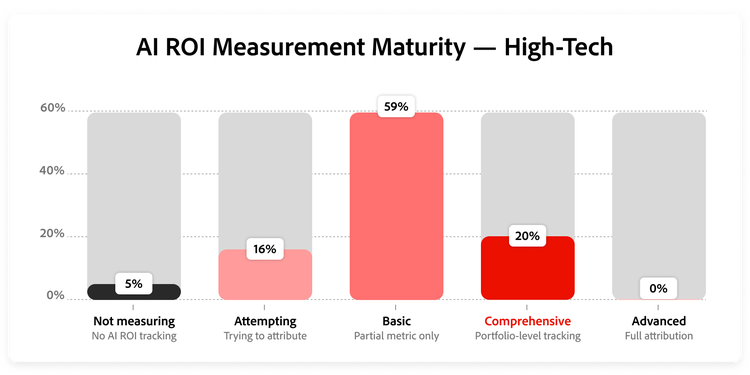
As AI becomes part of everyday marketing work, teams need to measure more than output. In practice, they may track content variations created, audiences scored, campaigns personalized, or hours saved. These measures confirm activity and efficiency, but do not consistently show whether AI improved engagement, conversions through the funnel, sales-cycle speed, or customer retention.
Stronger measurement begins before launch. Teams set the intended business outcome, record a baseline, and agree on how results will be assessed. Once a campaign is in market, seasonal demand, pricing changes, media activity, and sales capacity can make AI’s contribution difficult to separate. The same applies when teams assess whether a personalized experience reached the customer at the right time.
Clear pre-deployment measurement gives marketing leaders credible results for planning and budget discussions. In high-tech organizations, where ARR and NRR shape investment decisions, this evidence can strengthen the case for continued funding and wider adoption.
PART TWO

AI can affect many parts of marketing and customer experience. This report uses examples from demand generation, product marketing, customer marketing, and data and technology teams that support them. As work crosses these boundaries, part-time owners, committees, and ad hoc leads may lack the authority to resolve competing priorities.
Leaders address this by appointing a designated AI leader with a formal title, a clear mandate, and budget authority. This person is authorized to make decisions across functions when campaign, content, data, or customer experience priorities conflict. Formal ownership also supports other operating model behaviors. For example, Leaders are twice more likely to have collaborative marketing-IT relationships and 2.2 times as likely to measure ROI comprehensively.
The named AI leader needs access to marketing, data, technology, and customer experience teams. A CMO or VP of marketing can fill this role when the appointment includes authority beyond a single function or campaign. Organizations could establish that mandate within existing structures without replacing current reporting lines or governance frameworks.
Leaders treat measurement as a condition of deployment, giving marketing a clearer basis for investment decisions.
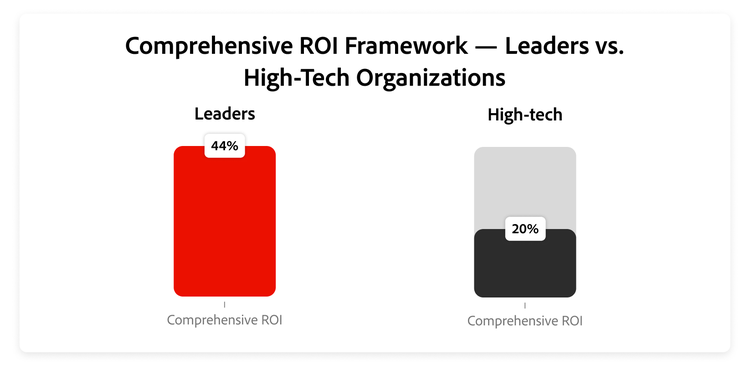
Marketing leaders need evidence early enough to guide funding and scaling decisions. Leaders build measurement into the design of each AI use case. Among Leaders, 44% have a comprehensive ROI framework, compared with 20% of high-tech organizations. Every Leader measures AI performance, while a material share of the industry does not.
Before launching content creation, personalization, audience targeting, or lifecycle automation, Leaders define the intended commercial or customer outcome. Measurement metrics may include engagement, conversion, win rate, deal velocity, NRR, customer acquisition cost (CAC) payback, and time-to-value. RevOps and customer success teams agree on the attribution approach before launch, giving marketing leaders evidence for the next ARR planning review.
Timing matters for use cases linked to changing customer behavior. Once a campaign, offer, or product release changes that behavior, the original baseline becomes difficult to reconstruct. Leaders record current performance before launch and assess the same measures afterward. This creates a clearer basis for continued investment and supports more confident future funding decisions.
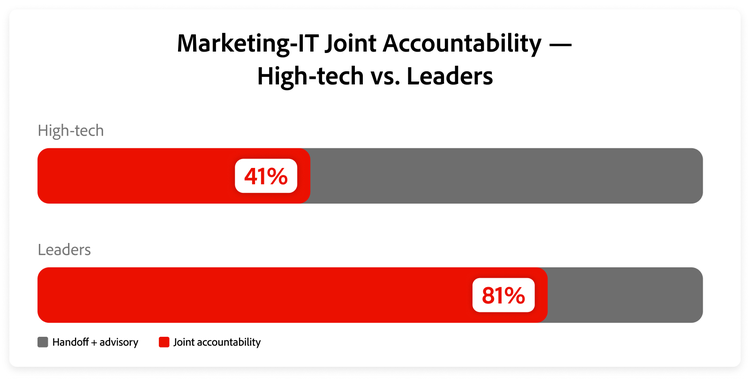
AI-supported marketing work depends on the CRM, data warehouse, product analytics platform, and other technology systems. A sequential handoff creates friction whenever data, technical support, or measurement needs to move between teams. Many high-tech organizations remain siloed or transactional, while others are consultative, meaning IT advises marketing without sharing accountability for outcomes.
Across the 342 Leaders, collaborative and integrated relationships are the norm. Marketing and its technology partners are involved from the time the brief is created. Demand generation and product marketing teams develop the scope with RevOps or data engineering instead of handing off a completed request.
Shared accountability continues through delivery and measurement. When the VP of demand generation and head of marketing operations share the same commercial goal in their performance reviews, the brief, build decisions, and measurement activities align around a single agreed direction. Leaders establish this partnership through shared OKRs within existing reporting lines, allowing both teams to work together without requiring an organizational restructuring.
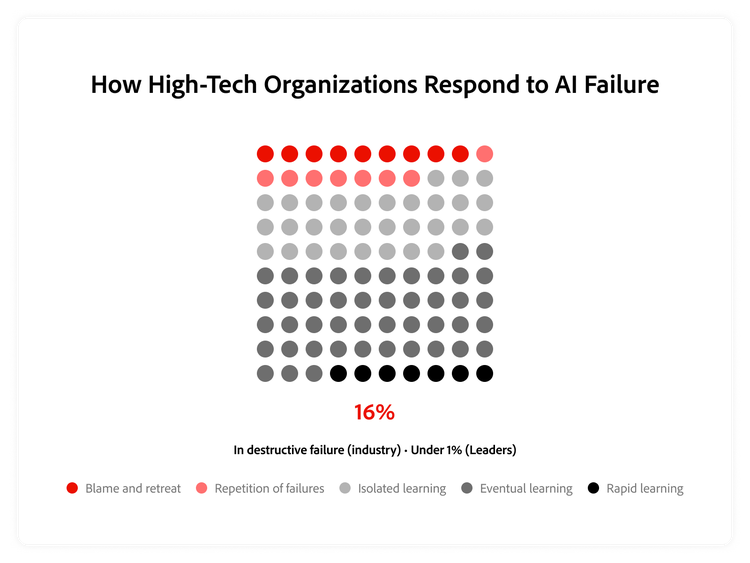
High-tech marketing runs on compressed timelines. Product launches follow quarterly release cycles, ABM activity is tied to commercial targets, and trial-conversion campaigns depend on adoption milestones. When an account-scoring model misfires or AI-generated content loses quality at scale, teams may quietly reassign blame and move ahead on schedule. The work continues, while the cause remains unexamined.
This decision affects other teams. Customer marketing and product marketing may carry the same flawed assumptions into the next campaign. A failed ICP segmentation model contains information the wider organization needs. Without a shared learning process across demand generation, customer success, and product marketing, those lessons may be lost and another team may repeat the mistake.
A learning culture becomes visible in regular operating reviews. The designated AI leader creates time for reflective discussions, allowing the team to examine what underperformed, why it happened, and what should change. When senior marketing leaders include this as a part of campaign and quarterly performance reviews, lessons can be shared across teams and applied to future work.
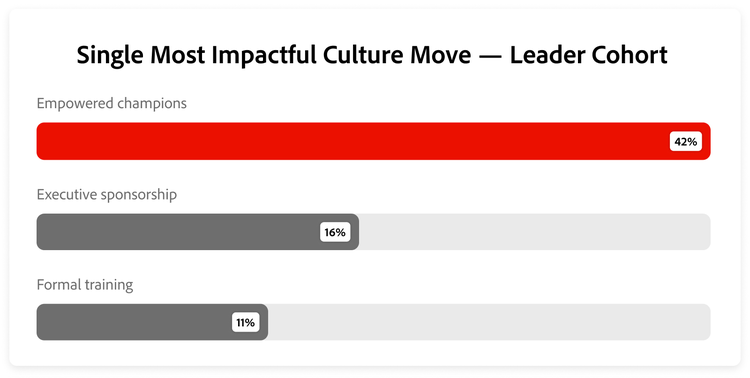
People are more likely to adopt AI when they see a colleague use it in familiar marketing work. In high-tech, it could be a demand generation manager using intent signals to sharpen an ABM brief, a content marketer improving product launch assets, or a lifecycle analyst building trial-conversion triggers from product data.
Leaders identify these practitioners and give them a small budget, recognition, and permission to extend their approach to adjacent teams. Evidence from a recognizable product line or ICP segment carries more weight than centralized training. Champions build influence by showing results in account intelligence, content velocity, or customer lifecycle automation.
Among high-tech organizations at the expanding or transforming stage, most have embedded AI leads within business units and functions. For a significant share, centers of excellence provide reusable support through prompt libraries, evaluation methods, and governance frameworks. Stronger relationships between marketing and its data partners reduce friction and make it easier to adapt proven AI practices consistently across teams.
These actions translate the Leader behaviors into practical steps for marketing leaders. They build on existing marketing, data, and technology capabilities and do not require a wholesale organizational redesign.
CONCLUSION
AI is redefining how businesses discover customers, create content, and orchestrate experiences across every channel. Capturing that potential takes more than access to models. It takes a unified data foundation, a connected content supply chain, and the governance to put AI to work with confidence.
This is what Adobe is built for. Adobe Experience Platform brings customer data together as the intelligence layer for AI, powering over a trillion experiences a year. Adobe CX Enterprise extends that foundation into an end-to-end agentic system that orchestrates the full customer lifecycle, from first interaction to lasting loyalty, while an integrated content supply chain embeds AI directly into creative and production workflows, grounded in brand standards and shared governance.
The result is a path beyond AI experimentation and into value realization on an open ecosystem that works across the tools teams already use. When organizations are ready to scale, Adobe brings the technology and the expertise to help them turn AI into a lasting competitive advantage.
Adobe empowers organizations to create impactful digital experiences. Our portfolio of customer experience products and services helps businesses put every interaction in context, understand what each customer needs right now, and design and deliver digital experiences that build loyalty and drive growth. Visit adobe.com to know more.
Incisiv is an industry insights and strategy firm combining close to a decade of industry trend data with primary research, messaging architecture, and content development to help enterprises navigate transformation, evaluate solutions, and unlock growth. Visit incisiv.com to know more.