Why this recognition matters.
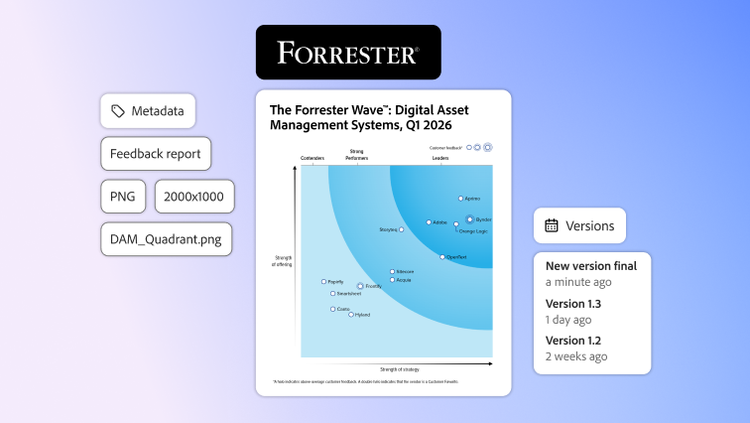
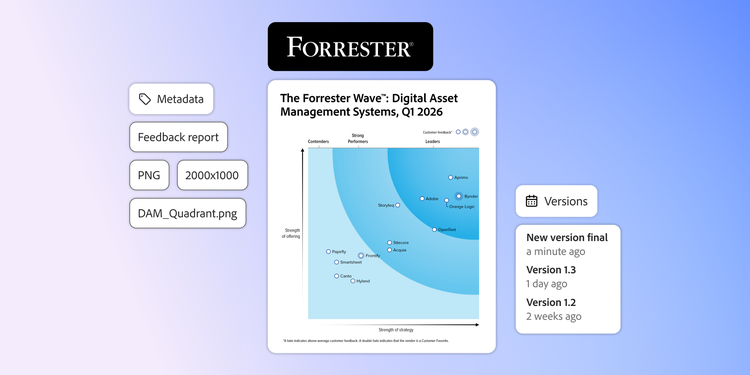
We are proud to share that Adobe has been named a Leader in The Forrester Wave™: Digital Asset Management Systems, Q1 2026 report. We believe this recognition reflects where the digital asset management (DAM) market is heading and the level of innovation enterprise organisations require as they navigate rising content complexity, accelerating AI adoption and increasing regulatory pressure.
This recognition is more than an industry milestone. It is the reason for this conversation about why DAM is evolving and why democratising it has become a strategic priority for enterprise leaders.
From enterprise library to intelligent infrastructure.
City libraries were once the centre of knowledge. If you needed information, you went there, searched the catalogue and relied on a librarian to guide you. When the Internet transformed information accessibility, libraries did not disappear. Instead, knowledge became accessible from anywhere and librarians evolved into digital stewards who ensured information remained trustworthy, organised and searchable online.
DAM is experiencing a similar transformation. The platform has traditionally served as the enterprise library for digital content — a centralised system of record where employees searched for approved assets to power customer experiences. Librarians or DAM administrators, managed structure, metadata and governance. But today’s content demands — speed, scale, personalisation and compliance — require a more embedded approach.
Work happens everywhere. The DAM must align.
In the current landscape, DAM can no longer function as a stand-alone destination. It must evolve into embedded infrastructure where content intelligence, governance and rights awareness are available directly within the tools where work happens.
Enterprises now operate in highly distributed digital environments. Designers work in Creative Cloud applications. Marketers build campaigns within work management systems. Sales teams activate assets inside CRM platforms. Commerce teams manage content across ecommerce channels. Increasingly, AI agents are also generating, adapting and activating content across these same systems. Every human and every agent operates within a specific tool or workflow. Moreover, Adobe is advancing this shift by enabling content intelligence and governance to be orchestrated across applications, allowing users and AI agents to access trusted assets without leaving their existing workflows.
When users or agents must switch applications to search for content in a separate system, inefficiencies multiply. Context switching slows time to market, reduces productivity and increases the likelihood of duplicate asset creation, outdated content usage and fragmented governance. In an agentic environment, automation can amplify both efficiency and error, escalating these risks.
Democratising DAM means embedding intelligent asset discovery, metadata, rights validation and governance directly into the flow of work. Simply providing an asset selector or window picker inside another application is not sufficient. Access to files alone does not provide the necessary context around usage rights, regional restrictions, expiry dates, brand compliance, accessibility standards or provenance.
Whether the user is a marketer launching a campaign or an AI agent assembling personalised content variations, one principle remains constant — context must travel with the asset. Governance must be machine-readable and policies must be enforced in real time.
DAM must evolve from being a destination application to serving as an integrated layer of content intelligence where rights awareness and compliance logic are programmatic and persistent. In the agentic era, this is not just about improving user experience. It is about ensuring that both humans and AI systems can create and activate content at scale with speed, confidence and control.
Content velocity is outpacing governance.
The rate of content creation has accelerated dramatically. Personalised customer journeys demand thousands of variations across regions, languages and channels. Always-on digital marketing requires continuous asset production. Generative AI is amplifying content velocity even further.
However, traditional approval processes and manual governance workflows cannot keep pace with this scale. Centralised validation models create bottlenecks that delay campaign execution. Business teams are under pressure to publish quickly, sometimes without complete visibility into usage rights or compliance requirements.
For example, consider a global retail brand launching a seasonal campaign across multiple regions under tight deadlines. A regional team selects what appears to be an approved lifestyle image from the content library. The creative is current and on-brand, but the model’s usage rights were licensed only for one market and expired in another. The campaign launches before the discrepancy is caught. The result is a forced takedown, wasted media spend, creative rework and legal review. What began as routine asset reuse becomes an operational and financial setback.
The growing gap between content creation speed and governance capacity introduces operational risk and compliance exposure. Today’s DAM must use AI to automate metadata enrichment, surface approved assets instantly, validate usage rights in real time and understand user intent to provide intelligent and contextual content recommendations.
The growing risk of unvalidated content.
Content risk is increasing alongside content velocity. Global regulations now demand greater transparency, accessibility compliance and responsible data practices. Enterprises must manage complex licensing agreements, regional usage restrictions and evolving brand standards across every channel.
The growth of AI-generated content introduces additional requirements for authenticity and provenance. Standards such as C2PA, the Coalition for Content Provenance and Authenticity, emphasise the need to track the origin and modification history of digital assets.
Without built-in rights management and provenance tracking within a DAM system, organisations risk publishing expired licensed imagery, distributing non-compliant assets or failing to disclose synthetic media appropriately. These missteps can lead to legal penalties, reputational damage and erosion of customer trust. A next-generation DAM solution must proactively guide users toward compliant and validated content before activation, not after issues arise.
The future of DAM is intelligent content guidance.
The future of DAM is not simply about storing final, approved content. It is about delivering intelligent content guidance across the entire content lifecycle.
AI is transforming DAM from a centralised repository into distributed, real-time intelligence embedded across enterprise workflows. Intelligent search delivers relevant and approved assets directly inside creative and marketing tools. Automated metadata tagging improves discoverability and reuse at scale. Embedded governance ensures policy compliance and rights awareness at the moment of use. Performance insights inform optimisation and future content strategies.
In leading organisations, this intelligence extends beyond the DAM platform itself — orchestrating content across planning, creation, management and activation systems throughout the content supply chain. It connects work management, creative production, asset governance and customer experience delivery into a unified operational model.
The modern DAM platform becomes an intelligent content advisor that empowers teams to move faster with greater confidence and control — not as a stand-alone system, but as a foundational layer of intelligence powering the entire enterprise content ecosystem.
What this means for enterprise leaders.
For IT leaders, this transformation reduces the proliferation of shadow repositories and fragmented systems while strengthening enterprise governance and security. For CMOs and marketing executives, intelligent DAM enables faster campaign launches, scalable personalisation and consistent brand experiences across global markets. For budget owners, improved asset reuse, reduced duplication and automated compliance lower operational costs and mitigate financial risk.
Structured content models and rich metadata become strategic investments that support both human collaboration and AI-driven workflows. Organisations that treat DAM as critical infrastructure rather than passive storage will be better positioned to compete in an AI-driven economy.
Adobe’s DAM vision for the content supply chain.
Adobe is advancing this vision by evolving core DAM capabilities — including discovery, governance, activation and insights — within a unified content supply chain architecture. AI-powered assistants support content creation, personalisation, validation, governance and optimisation across enterprise applications. By embedding intelligence throughout the ecosystem, Adobe helps organisations scale content responsibly while maintaining enterprise-grade control and compliance.
Reinforcing our position as a Leader.
We believe being named a Leader in The Forrester Wave™: Digital Asset Management Systems, Q1 2026, reinforces our commitment to this direction and reflects Adobe’s strength in AI-powered DAM, enterprise governance and end-to-end content supply chain innovation.
More importantly, our conversations with customers reaffirm this, highlighting the growing importance of democratising DAM so that intelligent content guidance reaches every team, in every workflow, across every channel.
The evolution continues.
When the library evolved in the digital age, knowledge did not disappear — it became accessible, intelligent and integrated into daily life. DAM is following the same evolutionary path. By democratising DAM and embedding AI-driven intelligence across the enterprise, organisations can accelerate experience delivery while protecting brand integrity, regulatory compliance and customer trust.
Learn more about Adobe’s evaluation in The Forrester Wave™: Digital Asset Management Systems, Q1 2026 report.
Forrester does not endorse any company, product, brand or service included in its research publications and does not advise any person to select the products or services of any company or brand based on the ratings included in such publications. Information is based on the best available resources. Opinions reflect judgement at the time and are subject to change. For more information, read about Forrester’s objectivity here.
Marc Angelinovich, Director of Product Marketing, is a distinguished expert in digital asset management and enterprise storage infrastructure, with nearly two decades of experience in advancing technology adoption for major brands. At Adobe, Marc is dedicated to transforming how organisations manage and leverage their digital assets, helping convert fragmented content operations into cohesive, high-efficiency ecosystems.