Inside the Middle East’s digital shift: What’s working, what’s next, and why it matters.
Milan Ruparelia and Hamza Naqshbandi
11-05-2025
Across the Middle East, digital transformation has become a cornerstone of national and business strategy. Countries like Saudi Arabia and the UAE are executing bold, long-term visions that aim to transition their economies away from oil dependency and towards knowledge-based, innovation-led growth. These ambitions are playing out in real time, with major investments flowing into digital infrastructure, AI, smart services, and citizen experience.
But the most striking shift isn’t just in policy. It’s in pace. Organisations across sectors — from public service to retail and banking — are racing to digitise, reimagine service delivery, and rebuild how customer relationships are forged. That shift is being driven by necessity as much as ambition. The region is home to one of the world’s youngest and most digitally connected populations, and expectations are rising fast.
Amid this momentum, however, many business leaders are confronting a familiar challenge: the gap between digital ambition and execution. Fragmented systems, underutilised data, and siloed operating models remain common obstacles. These gaps can slow down transformation efforts and dilute the impact of even the best technology investments.
At Adobe, our work with customers across the region has made one thing clear: bridging this gap requires more than a platform. It requires local context, end-to-end orchestration, and a clear path from insight to impact. Whether it’s scaling content operations, activating real-time data, or deploying AI in meaningful ways, organisations need solutions tailored to the pace and priorities of the Middle East.
Understanding digital transformation in the Middle East — on its own terms.
As transformation accelerates, so does the need for sharper, more localised insight. In our conversations with business and government leaders across the Middle East, one theme kept coming up: while there’s no shortage of global research on digital transformation, very little of it speaks to the region’s distinct realities.
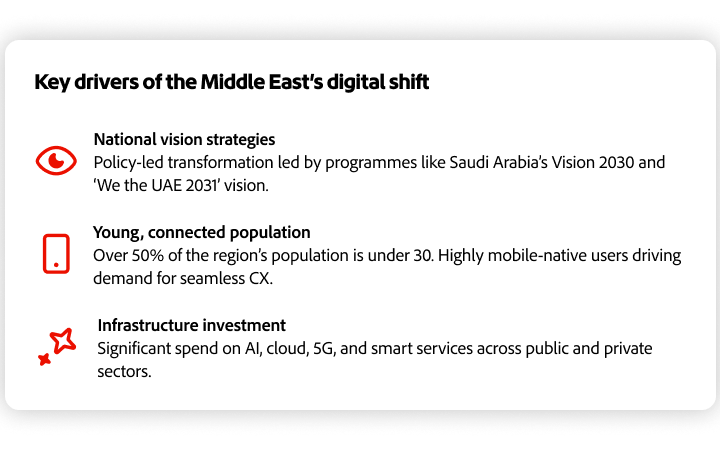
Most studies overlook the fact that change here isn’t just driven by consumer preferences or market shifts — it’s shaped by top-down national strategies, rapid infrastructure development, and a uniquely youthful, digital-first population.
That’s what prompted us to launch The Middle East Digital Shift: From Vision to Execution, Adobe’s first dedicated research report for the region. We partnered with London Research to survey 200 large enterprises across Saudi Arabia, UAE, Egypt, Qatar, and Kuwait. All respondents represented organisations with over USD 500 million in annual revenue, and the vast majority held director-level roles or above.
Our goal wasn’t just to capture high-level trends. We wanted to understand the real dynamics behind digital ambition — what’s working, what’s not, and where business leaders need to focus next to move from strategy to impact.
What makes this report different is its grounding in regional nuance. It explores AI adoption, content operations, and customer experience not through a generic lens, but in the context of the specific challenges Middle Eastern organisations face — from strict data sovereignty requirements to fragmented tech stacks and uneven CX maturity. These dynamics shape transformation in ways global studies often overlook, demanding a more tailored approach to strategy, capability building, and execution.
The result is a practical, data-driven snapshot of where organisations stand today, and a clear view of the strategic shifts needed to close the gap between vision and execution.
Three trends defining digital progress in the Middle East.
One of the clearest signals from this research is just how high the ceiling is for digital transformation in the Middle East. Ambition is not in short supply. Across industries, we’re seeing leaders who know where they want to go and are willing to invest to get there. Whether it’s AI experimentation, content automation, or rethinking customer experience, the direction of travel is unmistakable.
But transformation isn’t linear. Even the most forward-looking organisations encounter friction, from fragmented data and legacy systems to siloed teams and execution hurdles. The good news is these aren’t dead ends. They’re solvable hurdles, and the momentum is already there.
Nowhere is this more evident than with AI. An overwhelming 88% of surveyed organisations are either experimenting with or implementing AI, showing enthusiasm that outpaces most global regions. But only 15% currently rank it as the most impactful technology for business growth. That gap underscores a key challenge: organisations are intrigued by AI’s potential but uncertain about how to go from experimentation to enterprise-scale impact.
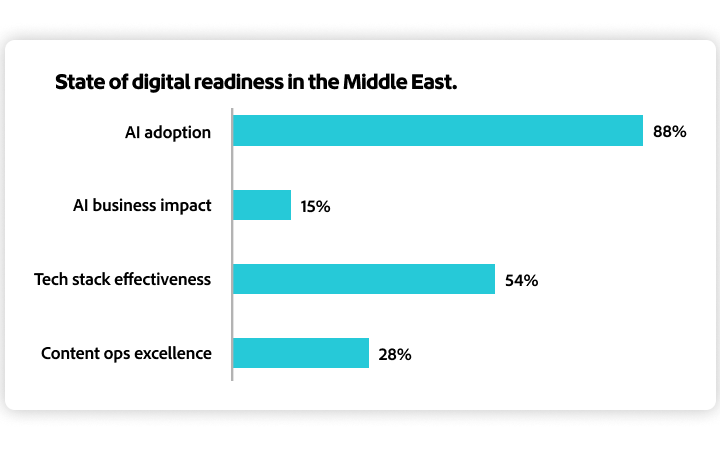
The challenge extends to broader digital infrastructure. While transformation is a strategic priority across the board, 54% of respondents rate their tech stack as only “moderately effective,” and only one in three say they have a fully integrated CX platform. These foundational gaps — siloed systems, point solutions, data stuck in channels — can slow down even the most visionary strategies.
Content is another pressure point. Personalisation demands are rising, but only 28% of businesses describe their content supply chains as very efficient. Disconnected workflows, unclear governance, and lack of visibility into performance are common blockers that slow content velocity. Nearly 60% of businesses say they struggle to prove the ROI of customer experience improvements, which makes it harder to secure buy-in, sustain momentum and scale what’s working.
In our view, the opportunity lies in orchestration. The pieces are already in motion. What’s needed is stronger integration of systems, teams, and strategy, so that digital ambition can be met with execution at scale.
From vision to value: How Middle East leaders can build for long-term impact.
If there’s one message we’d offer to digital leaders in the region, it’s this: digital transformation is no longer a strategic option — it’s a national and economic imperative. And while the ambition across the Middle East is clear, the path forward calls for more than isolated tech adoption. True transformation demands integration, orchestration, and an enterprise-wide commitment to experience-led growth.
At Adobe, we understand that reality. Our Experience Cloud solutions, underpinned by real-time customer data, connected workflows, and generative AI capabilities, are designed to help organisations turn insight into impact. We work with businesses not just to deploy technology, but to embed it in ways that drive long-term value across marketing, content, data, and customer experience.
We also understand that success in this region requires local context. Across markets like the UAE, Saudi Arabia, Qatar, and Egypt, we’ve seen how transformation is shaped as much by national vision and policy as it is by market forces and consumer expectations. That’s why we partner closely with leaders on the ground, aligning our solutions to local priorities and growth stages.
A standout example is the Royal Commission for AlUla (RCU), which is helping shape Saudi Arabia’s transformation into a global tourism hub. As part of Vision 2030, RCU launched the Experience AlUla platform — built on Adobe Experience Manager Sites as a Cloud Service — to deliver seamless, personalised digital journeys for visitors. Since the migration, the site has seen a 220% year-over-year increase in conversion rates, showing how experience-led strategies can drive measurable impact at scale. It’s a powerful signal that the region’s ambition is actionable.
The research makes it clear: the Middle East is entering a new chapter of digital maturity. The appetite for innovation is real, and the tools are available. What’s needed now is the right partnership — one that combines world-class technology with regional understanding and a shared commitment to meaningful, measurable outcomes.
Milan Ruparelia is Head of MENA Public Sector at Adobe, with nearly two decades of experience delivering MarTech and customer experience management value. He leads Adobe’s efforts to support Vision 2030 and accelerate digital transformation across the region.
Hamza Naqshbandi is Strategic Customer Value Director for the Middle East at Adobe. He advises C-suite leaders on experience-led transformation, helping organizations align digital vision with measurable outcomes through data, design, and personalization.
You can download the full research report The Middle East Digital Shift: From Vision to Execution.
https://business.adobe.com/fragments/resources/cards/thank-you-collections/firefly