New website checklist: what makes a strong business website in 2026?
Curious about what makes a must-have business website in 2026? We explore consumer expectations, business priorities, the role of AI and more.
26-10-2026

In an increasingly digital-first economy, a business’s website is one of its most important assets. Yet for many organisations, there remains a gap between having a website and making it work hard for their business.
With this in mind, we surveyed 1,000 employed UK adults to find out what makes a website a must-have business asset in 2026. We explore how things like AI-powered chatbots and generative AI can support different stages of website creation and management, from establishing a consistent tone of voice to selecting high-impact imagery, as well as the biggest put-offs for consumers, including intrusive ads. Finally, we also offer tips on how businesses can use Adobe Enterprise to build faster, smarter, and more engaging digital experiences.
How do website priorities vary across different industries and generations, and what does a high-performing site actually look like? Let’s find out.
New website checklist: key findings
First, it’s time to dive into some of our key findings, including how websites are being used today and the biggest issues that drive customers away.
Are websites being used to their full potential?
Just 22% of people said that their website is central to their marketing and growth strategy, while only 9% say that it generates the majority of their revenue. Meanwhile, 28% mentioned that they aren’t sure what role their website plays in their business.
This suggests that there’s still plenty of room for businesses to think more strategically about what their website sets out to achieve, whether the goal is generating leads, driving sales, or building customer trust.
Poor experiences drive customers away
So, after a user lands on a website, what are some of the main reasons they may leave? Over half of respondents (55%) said that they leave when met with too many pop-ups, while 44% leave if the website loads too slowly.
39% are deterred by pages that are cluttered or difficult to navigate, and 31% leave due to poor mobile performance.
A further 30% leave if it's unclear how to make an enquiry or purchase, and 19% said they would leave a website if they could not find what they needed within three clicks. This signals the importance of removing unnecessary barriers from the customer journey, whether that involves ensuring easy navigation or minimising inconvenient pop-ups.
What makes a website trustworthy?
Trust is another incredibly important part of the online experience, and it often comes down to getting the basics right. For instance, 35% mentioned the importance of clear pricing and service information on a website, while 32% are drawn to high-quality, up-to-date content. 31% of respondents also appreciate it when they can easily find clear contact information.
These might seem like small things, but when a customer can quickly find the information they need and understand what a business offers, they have more reason to stay on site before looking elsewhere.
The foundations of website success
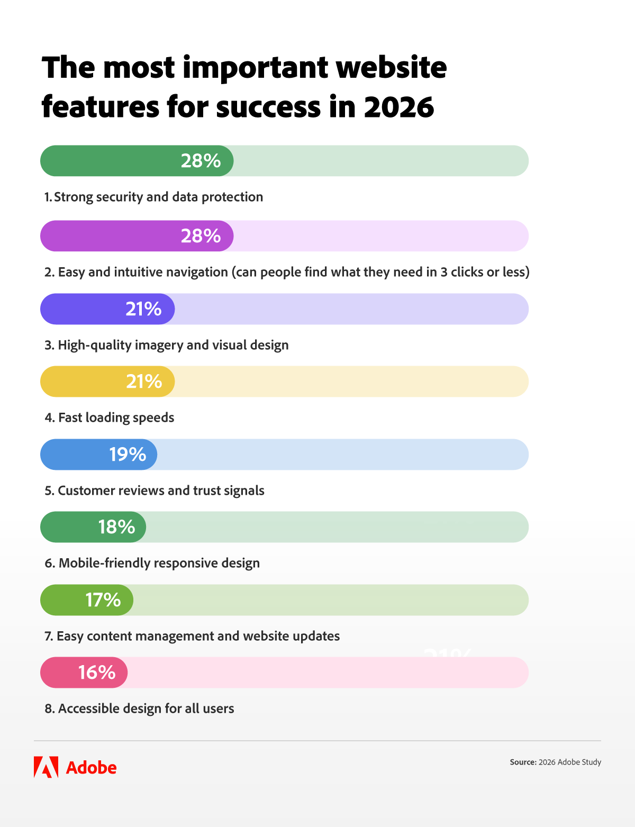
When asked about what they believe matters most for website success, respondents highlighted four key areas. Twenty-eight percent identified strong security and data protection as important, while the same proportion selected easy and intuitive navigation.
Twenty-one percent selected fast loading speeds, with the same proportion selecting high-quality imagery and visual design.
Is AI becoming part of the website toolkit?
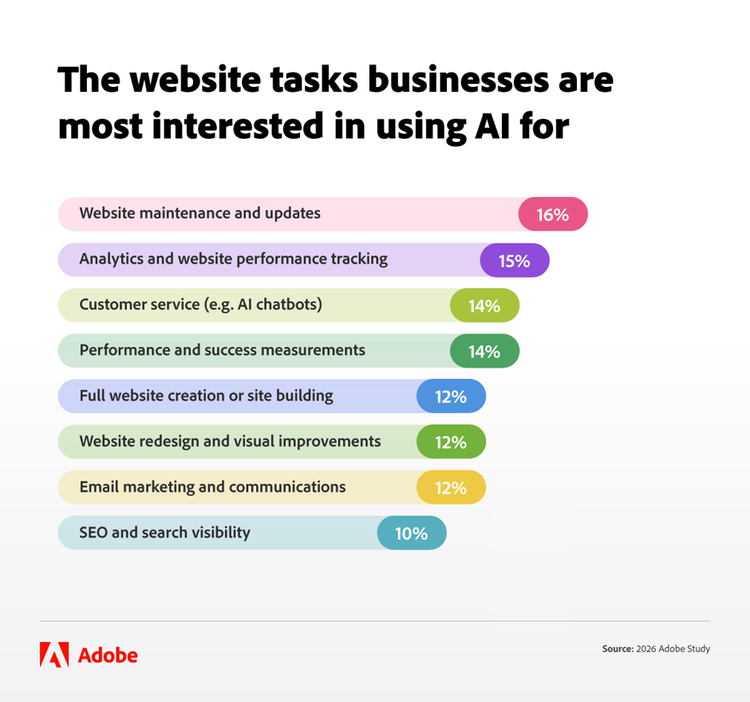
Interestingly, more than half of respondents (57%) said that they are interested in using more AI tools for website creation or management. Taking a closer look at this, the most popular potential uses include:
- Website maintenance (16%)
- Analytics (15%)
- Customer service (14%)
- Performance measurement (13%)
This points to an opportunity that goes beyond using AI to assist in image and copy generation, with many businesses now interested in using it to keep things running smoothly, and understand what’s happening on the customer journey.
Does age shape website expectations?
Next, let’s look into how opinions vary according to different age groups. We found that 35% of 25–34-year-olds say their website is central to growth (vs 12% of 55–64-year-olds), while 18% of 25–34-year-olds say their website generates most of their revenue (vs 4% of 55–64-year-olds).
25% of 55–64-year-olds say their business doesn't rely heavily on a website (vs 3% of 25–34-year-olds), and 37% of 55–64-year-olds aren't sure what role their website plays. This points to a clear generational divide, with younger respondents being more likely to see websites as drivers of growth and discovery.
Security and data protection
When it comes to security and data protection, 36% of 55–64-year-olds rank security as a top priority, compared with 25% of people aged 25–34. Trust in how personal data is handled is also a significant consideration, with 38% of 55–64-year-olds saying they would leave a site if they didn't trust how their data was used.
Digital performance
The generational divide continues when it comes to digital performance, particularly the importance of mobile-friendly websites. These are considered important by:
- 24% of 25–34-year-olds
- 22% of 35–44s
- 14% of 55–64-year-olds
- 9% of people aged 65 and over
Trust signals
There’s also a noticeable difference in what helps different age groups feel confident in a business. We found that younger respondents are more likely to value reviews (31%) and strong branding (25%), while those in the 55-64 age group mentioned the importance of easily identifiable contact information (37%) and clear pricing (39%).
Search engine visibility is also more of a priority for younger generations, with 21% of 25-34s mentioning this compared to just 4% of 55-64s.
How website priorities vary by industry
Age isn’t the only factor shaping attitudes towards websites, as things vary across different industries too.
The information technology sector stands out, with websites seen as strategic business assets rather than simply an online presence. For instance:
- 55% of IT respondents say their website is central to their marketing and growth strategy, compared with 22% overall.
- Only 4% of IT respondents say their business does not rely heavily on a website, versus 16% overall.
- Just 9% are unsure about their website's role, compared with 28% overall.
Creative industries also show strong commercial dependence, with more than a quarter (26%) of those in Creative Arts & Design saying their website generates the majority of revenue (vs 9% overall). This shows websites are functioning as sales channels, not just marketing tools. Interestingly, Creative Arts & Design also places high importance on mobile responsiveness (37%) and brand consistency (32%).
Security matters most in regulated industries, but is especially important for Accountancy (40%), Insurance (40%), and Law (35%). We also found that speed matters particularly to IT (53%), Law (65%) and Science & Pharmaceuticals (64%).
Across almost every sector, excessive adverts are the leading reason for people leaving a website, especially in Publishing (71%), Business Consulting (67%), and Public Services (65%).
Transform your website with Adobe Enterprise
While there’s no single criterion for the perfect website, with different audiences and industries having different priorities, there are some common requirements: it needs to be fast, easy to navigate, relevant, and secure.
If you’re looking to revamp your site and are wondering where to begin, Adobe Experience Manager Sites can help teams create, manage and deliver high-performing digital experiences more efficiently. Adobe Firefly can support the production of on-brand creative assets, while Adobe Analytics helps teams understand website performance and customer behaviour. Adobe Target can also support testing and personalisation, helping businesses continuously optimise the experience.
And the use of AI doesn’t need to stop once the website goes live, as tools are now providing new opportunities to deliver on customer expectations. There are various Agentic AI use cases, whether you’re hoping to automate specific tasks, analyse information, or support customer service needs.
If you’re looking for more insights into these technologies, our guide on Agentic AI vs Generative AI explores the differences. And if you’re searching for more ideas, we have plenty more resources for you to explore.
Methodology:
The New Website Checklist is the result of a comprehensive national survey conducted by One Poll on behalf of Adobe Enterprise. The survey polled 1,000 employed UK adults between 20.07.2026 and 24.07.2026.
Recommended for you
https://business.adobe.com/fragments/resources/cards/thank-you-collections/analytics