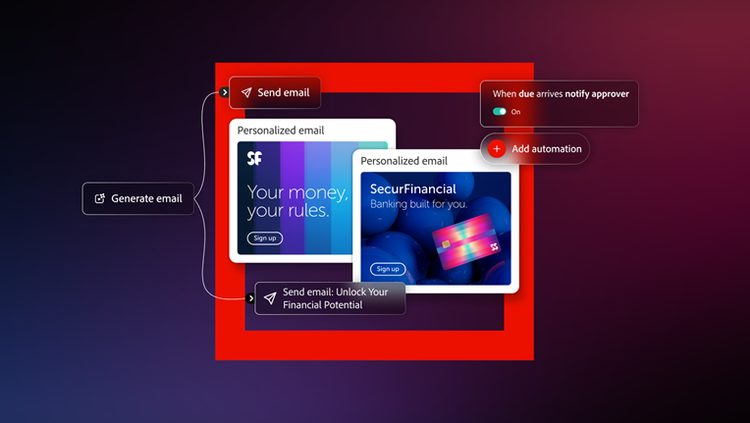
Agentic AI is far more than traditional generative AI tools. The artificial intelligence system is designed to elevate marketers’ roles, taking you from tactical executors to strategic leaders. Rather than merely generating answers to queries, it actively takes informed actions.
As Simon Murray, practice lead, FSI, Digital Strategy Group explains, it's not just about "interpreting the question and coming back with some information, but actually helping you make an informed answer. Then potentially actioning something on behalf of that user."
This capability will significantly impact the marketing landscape, freeing up time and creativity so teams can focus on high-level strategic and creative. Agentic AI is a tool that not only transforms roles and capabilities but also puts the focus on elevating human potential — rather than replacing it.
With insights from Murray, this article will explore the rise of agentic AI and how it can elevate marketing roles through well-integrated automation and AI-powered workflows. It will also discuss how to use agentic AI solutions responsibly.
Understanding agentic AI — beyond generative.
At its core, agentic AI refers to artificial intelligence systems designed to operate with a higher degree of autonomy, pursuing specific goals or objectives within an environment. These systems are characterised by their ability to:
- Perceive: Understand their surroundings and gather information or data.
- Reason: Process information, make decisions, and plan actions.
- Act: Execute those actions autonomously to achieve their goals.
- Learn: Adapt and improve their performance over time based on feedback loops and new data.
Agentic AI unlocks the potential for marketers to shift from tactical execution and repetitive tasks to higher-level strategic thinking and ethical oversight. Its autonomous nature enables it to take direct action on behalf of the user, whereas generative AI’s core purpose is to create content based on specific inputs (often a prompt). Generative AI is reactive while agentic AI can initiate actions, self-correct, and persist in pursuing a goal autonomously.
According to Murray, the key difference between generative AI and agentic AI is that the latter is “much more personalised, refined and fundamentally pragmatic.”
Agentic AI potential.
Naturally, there is some initial industry apprehension surrounding the potential of autonomous AI agents. This is especially apparent in heavily regulated sectors, like financial services (FSI). As Simon notes: “There is a bit of apprehension about the scariness of doing this type of stuff within regulations and making sure [businesses are] compliant”, but the potential for AI in industry is undeniable.”
Agentic AI emerges as "another kind of lever or another opportunity" for organisations to enhance their digital capabilities and deal with more mundane tasks, as Murray categorises it, this is "the low hanging fruit." It can take care of “automating routine processes” as well as “handling simple queries, transactions or processes” so businesses can focus on “more complex client needs.”
While there are obviously nuances in human interpretation, Murray describes the potential for a well‑optimised agent to work almost conversationally, “in the same way that a human would.”
Applications like Adobe Workfront can help manage AI agent workflows, allowing marketers to set the overarching goals for AI agents and move away from manual execution . Marketers can use AI capabilities to free up human creativity for what really matters — building deeper customer relationships and addressing more nuanced business challenges.
Elevating the marketer's role.
Agentic AI goes further than automation. It has the power to fundamentally change marketers’ roles, shifting a marketer’s core function away from manual, routine, or repetitive tasks to harness human potential for innovation, creativity, and strategic excellence. It’s not designed to replace marketers, but to elevate the role’s potential.
“Whether it’s a marketer or product person, the fundamental outcome is to make their life a little bit easier,” Murray explains, “You’re allowing them to go beyond the human scale.” In other words, it increases productivity, freeing up time to focus on other areas of the business that would benefit more from human input.
Murray reiterates that the value of agentic AI lies in scale and efficiencies. He provides the example that, during an employee performance check-in, AI capabilities allowed him to “synthesise the notes” he took during the session with the “inputs the employee gave” to address the specific points needed to be raised in the report.
Furthermore, AI agents can reimagine approaches to budgeting and planning. Marketers can set objectives for agentic workflows to complete manual tasks — such as creating a baseline budget — which a human can then review and refine. Once reviewed, the AI agent can formalise and send out summaries.
AI agents allow marketers to reallocate resources, test more ideas, and refine their brand storytelling. The correct approach to AI in digital marketing will enable teams to increase overall workflow efficiency while simultaneously creating space for higher-level strategic thinking and human creativity.
Focus on higher‑level thinking.
This shift from repetitive tasks to elevated actions frees up marketers to focus on more complex strategic problem‑solving. As Murray puts it, agentic AI is about “empowering people and getting them to work on higher value stuff” rather than spending hours on tasks that could be automated through well-defined agentic AI workflows. Agentic AI can "free up time (for marketers) to be more creative, rather than spending time creating a brief to send out to someone else… spend more time thinking about long term planning, strategic brand positioning or problem‑solving."
Through AI integration, Adobe Workfront can help marketers manage these elevated workflows and set goals for AI agents, enabling them to focus on creative innovation.
Hyper-personalisation at scale.
Customer expectations continue to shift towards hyper-personalised experiences, and agentic AI enables true one-to-one marketing at an unprecedented scale. Think dynamic, real-time personalisation for enhanced customer experiences and stronger brand loyalty at every touchpoint along the customer journey.
Where traditional machine learning (ML) models predict and generative models create content, agentic AI solutions have the agency to execute decisions, adapt to changing outcomes, and continually update with new data in a continuous feedback loop.
Dynamic personalisation.
Agentic AI-powered agents continuously analyse individual customer behaviour, preferences, and history in real time across different touchpoints on the user journey. This enables them to dynamically generate and deliver content that’s truly personalised to the end user or audience segment. Examples may include offers specifically tailored to that customer, accurate retargeting, or even suggesting next-best actions.
AI agents can use natural language selection to produce unique copy and machine learning to predict which content will lead to higher engagement. So, rather than manually crafting multiple ad variations, an AI agent can generate highly tailored messages for each individual customer.
Murray underscores the importance of context, and explains, “Context is everything~~, right?~~ So that to me is the nuance beyond generative (AI).”He goes on to clarify: “That's potentially where an agentic solution can ultimately create a better output." He expands that "A good agent would work in the same way that a human would.”
Using the example of a travel agent, Murray explains that if an individual rang a business asking for the best place to go on holiday, the person on the other end of the line would immediately respond with relevant questions, like “Do you want to go somewhere sunny, or do you want somewhere cold?” The outcome is focused “on the responses you get in the context the individual is providing you”, adapting in real-time rather than using a predefined script.
This agentic AI capability leverages data from platforms like Adobe Experience Platform (AEP) to power these personalised interactions. This enables enhanced customer experiences, higher engagement, and improved potential conversions.
Real‑time journey adaptation.
Autonomous AI agents can generate and deliver personalised content across entire customer journeys in real time. This guarantees relevance and timeliness for each individual customer. Adobe Journey Optimizer (AJO) uses agentic AI to orchestrate these adaptive customer journeys, prioritising a personal edge in every interaction.
Automating the campaign lifecycle.
Autonomous AI agents can transform your marketing practices by managing the entire lifecycle of digital campaigns. This enables continuous improvement, as the agents can monitor and analyse performance data, all while testing, learning, and evolving campaigns without needing human input. For example, marketing teams could define campaign goals and parameters, and agents could test the variants, select relevant channels, allocate spend and more, all in real time.
Agentic AI can handle everything from:
- Campaign ideation and diverse content generation, from copy to visuals.
- Target audience selection.
- Multi-channel deployment, from email and social media to paid ads.
- Performance monitoring, data analysis, and real-time adjustments for better ROI
Adobe GenStudio can leverage agentic capabilities to generate diverse content variations, including copy, visuals, and video scripts based on your brand guidelines. These variations can also be tailored to your overarching campaign objectives. Via Adobe Advertising Cloud, autonomous agents can automatically adjust bids, messaging, or creative elements for maximum ROI.
End-to-end automation.
End-to-end automation can significantly reduce manual effort. AI-first workflows are more than just automation on top of existing processes. Instead, they represent a complete redesign of processes, with human input ‘above the loop’ for oversight.
Automating the campaign lifecycle accelerates it. Agentic AI integration with Adobe Experience Platform (AEP) means that campaign optimisation is targeted and effective, informed by real-time, data-driven insights across different marketing channels.
Addressing challenges and ensuring responsible AI.
It goes without saying that there are significant challenges associated with agentic AI adoption. Robust data governance and quality standards are key to ensuring businesses remain compliant and maintain their brand reputation whilst accelerating output. There’s a real need for clear, ethical guidelines for autonomous decision ‑making to ensure brand safety.
According to Murray, “The challenge is obviously the accountability and auditability”, in the context of using agentic AI in FSI and regulated industries. In a scenario where a regulator needs to understand the dynamics of a situation, there must be “the whole paper trail” to explain how users’ decisions led to different outputs. Traceability within agentic AI workflows is vital to securing responsible buy-in from both the industry and consumer.
Some of the biggest risks for businesses are “doing the wrong thing by the client" and “not delivering the value you say you’re going to deliver.” He also points to the "disconnect between the expectations of the customer versus what the brand was delivering.” For example, the customer has “very high expectations of how you're going to use [their] data, and how secure that is and how governed it is” versus what they may be receiving from a customer journey or personalisation perspective.
But there’s the added consideration of competitor advantage. As Murray explains: “Everybody's looking at this (agentic AI) and trying to figure out what the right opportunities are to leverage these types of capabilities.” He expands: “The longer you spend navel gazing and trying to figure it out, guess what, someone's probably going to go ahead and do it and beat you to the punch.”
“You’re challenged as an organisation to effectively do two things: drive growth and revenue, but at the same time drive down cost and do things more efficiently. And that's obviously where the opportunity with AI comes in, in terms of being able to potentially do more, but in a more efficient and a more scalable fashion.”
Integration and oversight.
Seamless integration with existing marketing technology is key. Adobe Experience Cloud, powered by AEP, provides the foundation for industry-standard data governance, secure operations, and cross-function integration — all essential for responsible and ethical AI deployment.
Pragmatism and the enduring human element.
Success with agentic AI is centred onidentifying appropriate use cases and proactively planning for challenges. It is as much about knowing what agentic AI cannot do as it is about benefiting from its strengths.
In the context of FSI and regulated industries, Murray explains that businesses have already “invested an awful lot of time, effort and money into developing online and digital capabilities” in order to be available “24/7 for their individual customers so [agentic AI] is just another lever or opportunity to do that.”
But while AI offers incredible capabilities, human judgment and strategic direction remain crucial. Murray notes that it’s all about “being pragmatic and figuring out what you can and can't do, and what you can do short term — low effort versus high reward versus high effort, low reward.”
Value exchange and guidance.
Murray emphasises the "value exchange" where organisations must demonstrate their worth and “articulate what that value exchange is.” It’s essential for businesses to recognise that AI agents are powerful marketing tools, but they require clear instructions and continuous human monitoring. According to Murray, "They do what you tell them to do, but you still need to tell them to do it."
The human –AI partnership is paramount to be successful in this field. As Murray states, "The human interaction is always important… I like to think there's always going to be a need for human input. We are talking about machines, and whilst they can learn certain things, they still need to be taught and directed."
Agentic AI and marketers.
There’s no denying it — agentic AI has extraordinary potential to change the marketing world, from hyper-personalisation to a refocus on overarching strategy. While the opportunities to level up your processes are seemingly endless, it’s important to recognise that agentic AI is an augmentation tool designed to empower marketers, not to replace them.
According to Murray, a pragmatic approach to agentic AI is key. Marketers must manage customer expectations with responsible data use and ethical as well as compliance guidelines, while also driving growth and scalability to elevate the customer journey and reimagine internal processes.