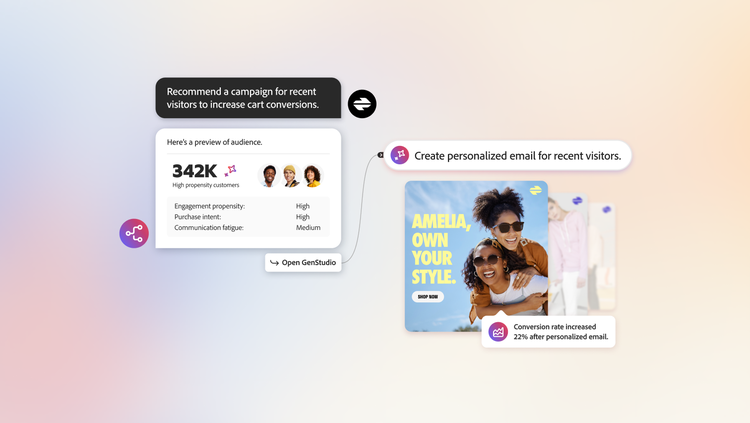
Winning the AI era: How autonomous decisioning is reshaping marketing in 2026.
Murthy Chandrapaty and Chakravarthy Kalva
07-17-2026
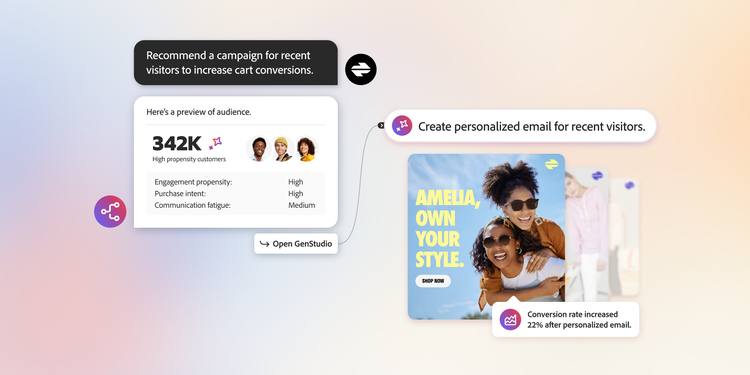
A perfect prediction can still make the wrong decision.
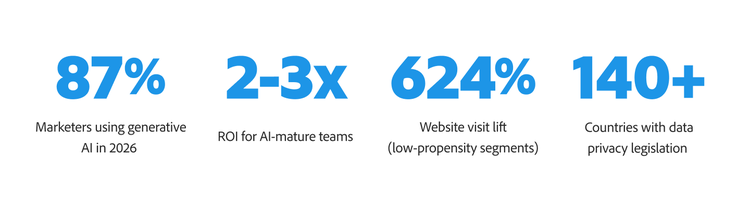
There's a phrase we keep coming back to when talking with marketing leaders this year: "the experiment is over." Not because AI has solved everything, but because the conversation has fundamentally changed. Two years ago, teams were still debating whether AI belonged in the marketing stack at all. Today, 87% of marketers use generative AI in at least one workflow and the question is no longer whether to adopt. It's how deep to go.
The gap we're watching, the one that will separate this decade's marketing winners from everyone else, isn't about model sophistication. It's about whether an organisation has bridged the space between likelihood and action. Between a prediction and a decision.
The critical divide: Prediction vs. decision intelligence.
Let’s understand why a 73% engagement score is just the beginning and what it actually takes to turn a signal into an outcome.
Traditional machine learning was built for prediction. Given enough data, modern models can tell you a great deal, for example, customers’ probability of engaging with a campaign or their churn risk, a particular segment’s propensity to buy and so on. Such outputs are genuinely useful. They're also, in isolation, not enough.
Here's the main distinction that teams draw constantly: A score is a signal, not a strategy. Prediction tells you likelihood. Decision intelligence tells you action. That difference sounds subtle, but its commercial consequences are enormous.
What's shifted in 2026 is the arrival of AI decisioning; systems that own the outcome end-to-end. Rather than handing a propensity score to a human analyst who then makes a judgement call, an AI decisioning layer ingests multiple signals simultaneously: engagement propensity, communication fatigue, real-time urgency, live business constraints. The system then decides autonomously: Send. Defer. Or Skip entirely. And it shows its working. Every decision comes with an inline explanation of why it chose to defer a message by 14 hours or why it elected to skip a customer rather than risk burning their attention.
Prediction vs. Decisioning: What changes.
The rise of agentic orchestration.
Marketers are no longer campaign operators. They've become air traffic controllers.
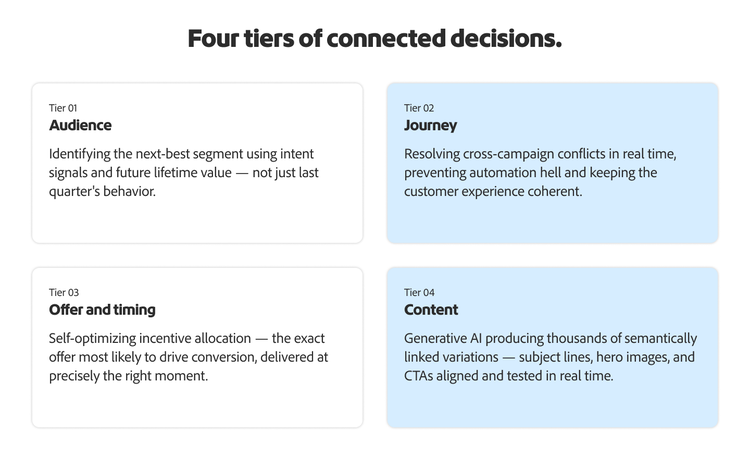
Something significant is happening to the marketing role and it's worth naming directly. We are moving beyond fragmented AI use cases toward a different kind of architecture entirely, one where autonomous agents manage end-to-end workflows with minimal human intervention. Practitioners are calling these "connected decisions." They co-ordinate actions across every tier of the customer lifecycle, running simultaneously and adapting in real time.
Previously, even teams with sophisticated ML tooling spent the majority of their time orchestrating campaigns manually. Agentic systems change this. The human function evolves from executor to governor: setting objectives, defining ethical guardrails, reviewing exceptions and course-correcting at a strategic level. 65% of marketing teams now have designated AI roles specifically focused on this kind of oversight.
A deep dive into send time optimisation: from scheduling convenience to core decisioning capability.
Send time optimisation (STO) used to be about finding the best time for the list of customers. Today, it's about finding the best time for each person on the list. That's an architectural shift, not an incremental improvement and the performance data reflects it.
Leading STO systems in 2026 don't just predict an optimal window.They reason about it in real time, weighing individual-level signals against live contextual data before every send. Each message is held in a delivery queue and released at the precise moment that recipient's engagement probability peaks. Research consistently finds that AI STO lifts open rates by 26% on average, with click-through improvements of 41% versus fixed-schedule sends.
Performance lift: AI-optimised timing vs. fixed batch send.
The shift from 'best time for the list' to 'best time per person' is not incremental, it's architectural. And it's the kind of capability that, once embedded, compounds with every campaign that runs through it.
Trust, ethics and the cookie-less reality.
With 140+ countries now carrying data privacy legislation, trust has become a structural competitive advantage, not a compliance tickbox.
The death of third-party cookies was debated, delayed and has now finally arrived. The industry's response was more sophisticated than most pessimists predicted. Rather than a collapse in targeting capability, leading organisations used the transition as an architectural forcing function. They rebuilt their data foundations on first-party and zero-party data, captured through genuine value exchange.
Zero-party data, which is the information customers share proactively through preference centres, quizzes and onboarding flows, is now the primary fuel for AI personalisation at organisations pulling ahead. The insight here is straightforward: Customers will share data when they trust the brand and can see a direct benefit from doing so.
The regulatory landscape continues to accelerate this shift. As of 2026, over 140 countries have enacted data privacy legislation and 20 US states now have comprehensive consumer privacy laws in force — including new frameworks in Indiana, Kentucky and Rhode Island that took effect in January. Compliance is no longer a single event; it's a sequence of dates that runs through 2030.
Ethics-driven AI decision framework — 2026 operational layers.
The manipulation guard layer is worth flagging specifically, because it represents something relatively new: AI systems actively detect when other automated processes are crossing an ethical line. As agentic systems become more capable, this kind of internal governance is going to matter considerably more.
Proving the ROI of the autonomous era.
Productivity gains are no longer enough. The conversation has shifted to measurable business outcomes and the data is starting to arrive.
For the first two years of enterprise AI adoption, the dominant success metric was cost reduction. And it delivered. 45% of teams have successfully lowered operating costs through AI-driven automation. But leadership appetite has shifted. The 2026 conversation is about revenue. Specifically, the provable link between AI decisions and financial outcomes.
What separates the 60% of advanced teams now reporting 2-3× ROI is a common architectural feature: they've closed the loop between AI actions and financial metrics. Every send/defer/skip decision is tagged to downstream conversion events, enabling true attribution at the decision level and not just at the campaign level.
The most striking individual data point we've seen this year: A 624% lift in website visits for low-propensity segments that received AI-driven contextual nudges instead of blanket discount offers. Many of these customers were never getting the right message at the right moment. And the moment they did, they responded. Contextual relevance, delivered at machine scale, turns out to be a more effective incentive than a promotional code.
The economics have started to compound in ways that are hard to reverse. Teams that have closed the attribution loop are now making decisions about which customers to skip entirely, protecting margin and long-term relationship health simultaneously. That's a qualitatively different kind of marketing than anyone was practising three years ago.
The 12-month window.
The organisations that will define the next decade are making their foundational bets right now. The window is shorter than most leadership teams expect.
The transition from static journey maps to adaptive management operating systems is the defining transformation of 2026. This isn't a software upgrade cycle, it's an architectural reckoning. As AI systems begin to reason through conflicts and optimise based on real-time outcomes rather than pre-built rules, the gap between leaders and laggards will compound faster than most people expect.
What makes this moment unusual is that the advantage being built right now isn't about having better tools. It's about learning velocity. The organisations that start making AI-driven decisions today are accumulating training signals that their competitors haven't even begun generating. That gap widens with every campaign that runs.
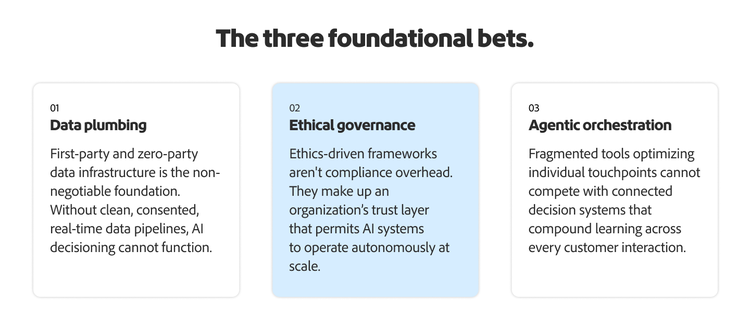
A useful way to think about this: The three pillars above aren't sequential. You can't do ethics governance properly without data plumbing and agentic orchestration without ethical governance is genuinely risky. They need to develop together, which is precisely why organisations that start now have an advantage that isn't easily replicated by those who start later.
The teams we're watching most closely in 2026 aren't necessarily the ones with the biggest budgets or the most sophisticated models. They're the ones that have made a clear organisational commitment to all three pillars simultaneously and are measuring the right things to know if it's working.
Chakravarthy Kalva is a Product Manager at Adobe specialising in customer journey management, with deep expertise across Adobe Campaign and Adobe Journey Orchestration. He works at the intersection of CX Enterprise strategy and emerging AI and agentic technologies, helping organisations move from siloed campaign execution to connected, autonomous decisioning at scale. Chakravarthy's work focuses on translating the promise of agentic AI into practical, production-ready workflows, bridging the gap between platform capability and real-world marketing outcomes.
Murthy Chandrapaty is a Principal Architect at Adobe specialising in Adobe Experience Platform architecture, with a focus on data governance and AI governance, helping organisations build the principled data foundations that responsible AI decisioning demands. He has held senior engineering and architecture roles across Adobe Campaign, Adobe Marketing Cloud and Adobe Experience Platform and is a recognised industry speaker who brings both architectural rigour and strategic perspective to connect data infrastructure with real-world marketing impact.
Recommended for you
https://business.adobe.com/fragments/resources/cards/thank-you-collections/generative-ai