How leaders can cross the AI adoption gap.
A leadership agenda and operating model for responsible AI at enterprise scale.
The C-suite guide to go from pilot to enterprise capability.
The challenge most enterprises face isn’t realising AI’s potential but harnessing it. They’re blocked by scale, fragmented processes and misaligned metrics. As AI spreads across teams and channels, the execution starts to break down. As data splinters, accountability blurs and risk is engaged too late in the process.
This guide proposes a cross-functional operating system that bridges these gaps. It translates KPIs into shared targets, assigns clear lifecycle ownership and establishes a consistent governance rhythm. The result is tighter alignment across marketing, technology and risk functions around a single decision-making cadence. With that foundation in place, AI deployment becomes a repeatable enterprise capability that accelerates outcomes, builds trust and compounds measurable impact.
The adoption gap at a glance.
AI tools are delivering measurable returns, but only a small fraction of enterprises have turned early successes into meaningful, organisation‑wide adoption. Many remain stuck on proofs of concept that never progress into broader execution. This pattern holds across industries and company sizes. Organisations struggle to turn individual use cases into pilots and, ultimately, operational policy.
The issue isn’t the technology. It’s the operating environment around the work — incentives that pull in different directions, late handoffs and unclear ownership as initiatives move from promising to production. The good news is that these barriers are solvable when leaders approach AI adoption as an integration opportunity rather than a collection of disconnected experiments.
Across the enterprise, each function makes rational decisions — just not from a shared frame of reference. Chief information officers (CIOs) and chief technology officers (CTOs) own the stack but rely on legal’s guardrails and marketing’s domain expertise. Chief marketing officers (CMOs) want personalisation and speed, yet often struggle to align AI outputs with brand‑safe, compliant KPIs. Chief financial officers (CFOs) need clear proof of return but lack metrics that link model performance to commercial outcomes. Without co-ordination, efforts move at different speeds and progress slows at the points where teams need to work together.
This fragmentation is most obvious in risk functions. Legal and compliance want to contribute early because their expertise is essential to responsible deployment. Security understands data vulnerabilities and privacy monitors regulatory requirements. Yet many organisations bring these partners in only at procurement, review or launch. At this point, timelines are fixed and changes are costly. This late involvement creates friction that could be avoided with earlier collaboration.
To understand how widespread these challenges are and where organisations are getting stuck, Adobe partnered with a market research firm to survey more than 400 senior enterprise leaders with direct decision‑making authority over organisational AI implementation globally. The research reveals a consistent pattern. AI initiatives are advancing, but cross‑functional collaboration is not keeping pace.
The resulting cross-functional gap is reflected in the data below, which shows how often key departments are included at the appropriate phases of AI pilot projects.
information security
regulatory
compliance
privacy
When risk, security, privacy and legal teams help shape deployment from the outset, they reduce exposure, eliminate rework, speed up approvals and make scaling far more predictable.
This guide is for leaders who see AI’s value and now face the challenge of making it work across the enterprise. It proposes an operating rhythm built on three imperatives — a shared KPI bridge, clear lifecycle ownership and a steady governance cadence — enabling marketing, technology and risk teams to make decisions as one system. Because scaling AI isn’t about ambition. It’s about alignment. And without fixing the points where work intersects, the enterprise never achieves the scale it seeks.
What signals reveal and why adoptions fail.
The data below highlights three signals that reliably forecast whether an enterprise can industrialise and scale AI — and where adoption is most likely to stall. It tracks programmes as they move from localised success to enterprise capability.
Three executive imperatives to transform your organisational approach to AI.
Going from early wins to enterprise capability depends less on intent and more on whether the organisation can convert momentum into co-ordinated action with fewer handoffs, clearer accountability and a shared definition of what “ready” means. Proof is often fragmented across functions, as tech can show performance, risk can surface constraints and marketing can demonstrate impact. This dynamic makes it difficult for leadership to connect those signals to an aligned enterprise decision to invest, govern and scale.
The enterprises that have implemented a formal process to co-ordinate their leadership around a shared AI vision and execution system are outperforming the ones who haven’t.
of companies with established mature, responsible AI practices will see more productivity gains than the 79% that do not.
of companies tracking bias will outperform the 51% flying blind.
monitoring harmful outputs will avoid the incidents that sideline the 67% who don’t.
These aren’t projections. They’re the predictable outcomes of whether an enterprise builds the operating mechanics required to scale safely and consistently.
Because financial metrics account for two-thirds of business decisions, leaders need a shared scorecard that translates technical performance and risk posture into business impact, so teams aren’t optimising in parallel with incompatible definitions of success. Without that translation layer, organisations don’t stall for lack of ambition; they stall because proof can’t travel cleanly across functions.
Technical teams demonstrate clear performance improvements and the enthusiasm is real — 86% of IT leadership and 84% of business users see AI's potential. But scaling requires alignment across functions and shared ownership from the start, so cross-department co-ordination becomes a series of handoffs rather than parallel progress.
The following three imperatives support an integrated operating model for closing that gap.
- Establish a KPI bridge that translates functional success into enterprise outcomes.
- Define lifecycle ownership so accountability doesn’t blur as initiatives move from assess to pilot to adoption to operation.
- Install a predictable governance rhythm so issues surface early, context isn’t lost and momentum isn’t renegotiated at every checkpoint.
Each imperative requires collaboration, giving leaders one line of sight from reliability to velocity to business impact. This model is not a one-time roll-out, but a repeatable cadence that keeps adoption moving as the tech, the rules and the enterprise evolve.
Imperative one: Build a shared KPI bridge.
Tech, marketing and risk functions optimise for legitimate outcomes, but they’re measuring success in different languages, with different proof points and thresholds. The result is fragmented evidence and a leadership team that can’t confidently commit resources to scale.
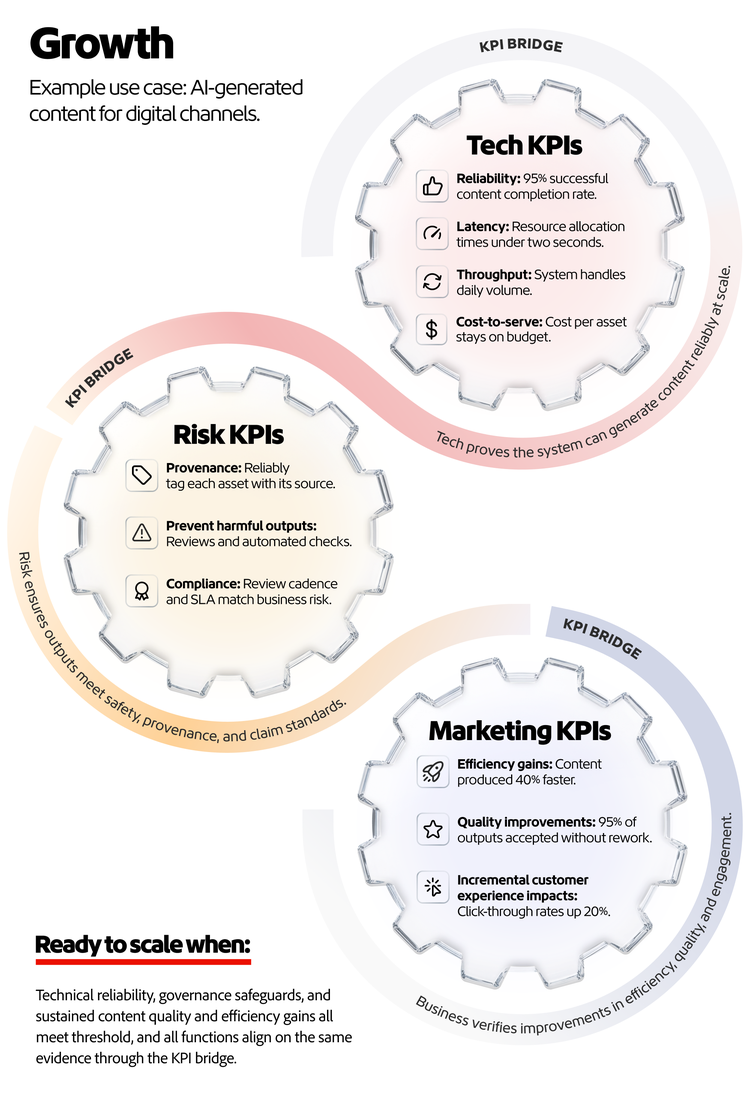
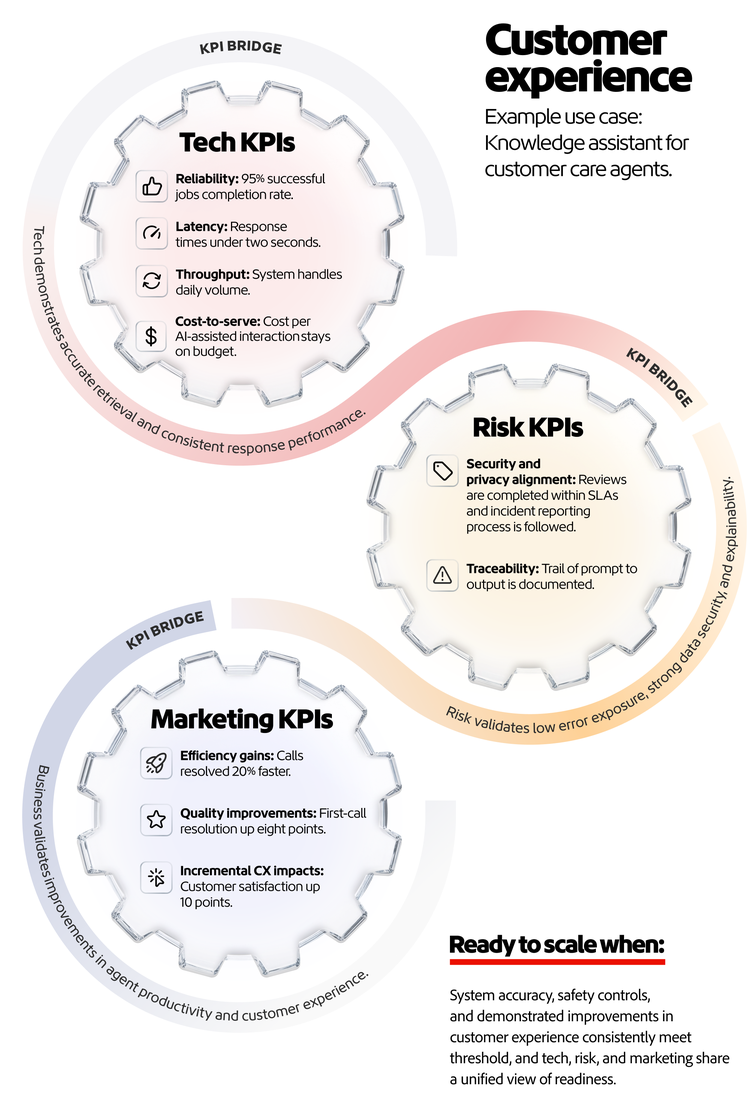
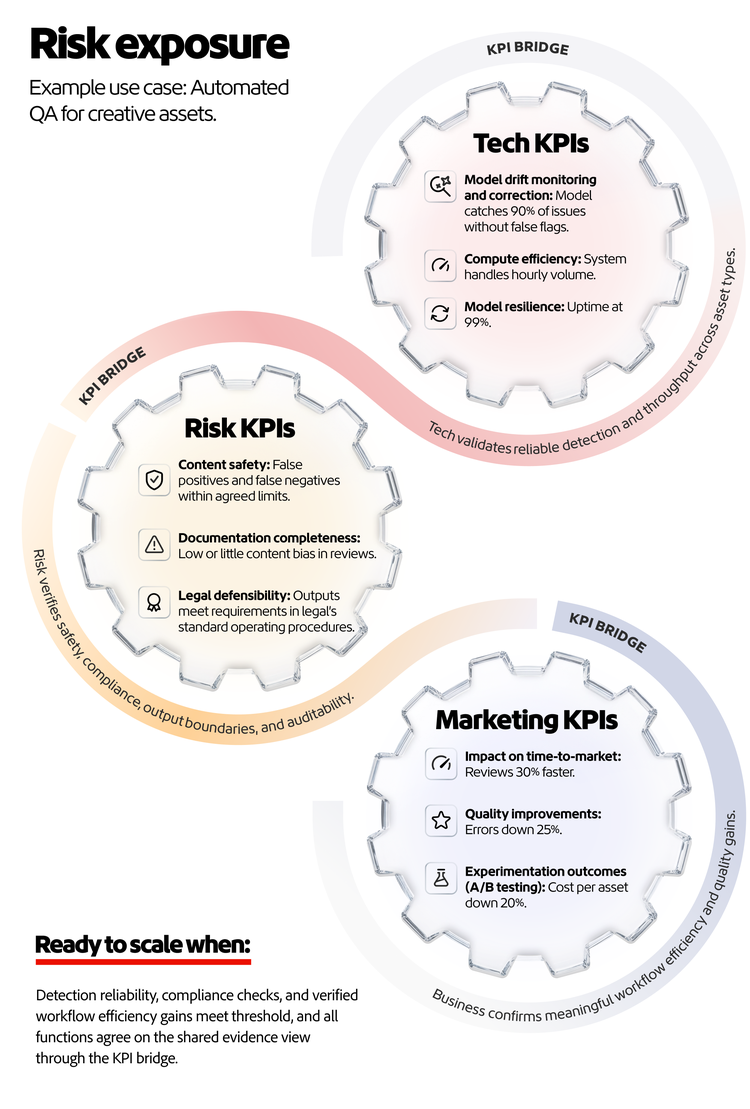
A shared KPI bridge is the translation layer that makes the throughline visible across functions. Reliability drives velocity. Velocity drives business impact (growth, cost-to-serve and customer experience). Governance provides the confidence and control required to scale. It isn't so much that KPIs are competing as they are incomplete in isolation. Connected through a shared bridge, these KPIs tie each function’s performance to the aligned enterprise objective, scaling AI with performance, control and measurable impact.
When that translation is made explicit, teams stop operating via sequential handoffs and start functioning within a shared system. The KPI bridge creates shared proof, so decisions move on evidence and persuasion.
Think of the organisation like a gearbox. Tech, marketing and risk can each generate motion on their own, but momentum only happens when the gears mesh. The KPI bridge is the chain that connects them — so reliability, velocity and safety operate in tandem, each rotation transferring force to the next function. Instead of spinning independently, the enterprise moves forward as one.
The table below operationalises that alignment. It helps teams map any AI initiative to the enterprise objective, clarify what each function must prove and define a single ready-to-scale gate using shared evidence.
A shared KPI bridge not only works to align incentives and reduce friction, but it also gives leadership a more constructive and coherent approach to transitioning from AI pilot to organisation-wide adoption.
- Funds and prioritises against shared proof, not functional promises.
- Sets thresholds upfront by clarifying what ready to scale means across reliability, responsibility and results.
- Creates a repeatable scorecard that travels across use cases, preserving momentum as scope expands.
When technology, marketing and risk teams use a shared measurement framework, scaling becomes much easier. Instead of risk slowing things down due to misalignment or rework, the function becomes an early‑stage partner that accelerates progress. As a result, early wins turn into repeatable, standard operating capabilities.
Imperative two: Make ownership explicit with a lifecycle RACI.
Most organisations have AI governance documented somewhere, but the breakdown in accountability occurs when leadership asks, “Who owns this once we scale?” Only about half of organisations actively track bias in AI outputs and only a third monitor for harmful content, even as most track accuracy. Not because leaders don’t care, but because ownership of the evidence trail was never designed end-to-end, especially once early deployments become business-as-usual.
Early deployments can seem deceptively simple. One small team handles everything, including data, models, outputs and monitoring. Ownership is clear because it’s concentrated. Then scaling begins and responsibilities spread across multiple teams, platforms and partners. Accountability blurs as the stakes and scale increase. Questions that once had a single durable answer — who owns provenance, who monitors outcomes, who approves scale, who responds when something goes wrong — start bouncing between functions.
That’s where risk compounds, not because the deployment becomes irresponsible, but because the process becomes ownerless at the handoffs. Marketing, technology and risk can each produce valid progress in isolation, but without explicit ownership across phases, effort doesn’t convert into enterprise momentum. The organisation slows down right when it’s trying to accelerate.
Organisations that scale well intentionally assign ownership, phase by phase. The ones that don’t usually didn't decide against it. Rather, no one is explicitly accountable for the evidence trail (metrics, controls, monitoring) once it crosses from pilot activity into operating capability.
External partners amplify the issue. When AI depends on third-party data, models or delivery platforms, ownership questions multiply fast: Who’s accountable for data provenance? Who monitors testing and reliability of the models? Who owns the response when a customer flags problematic AI content?
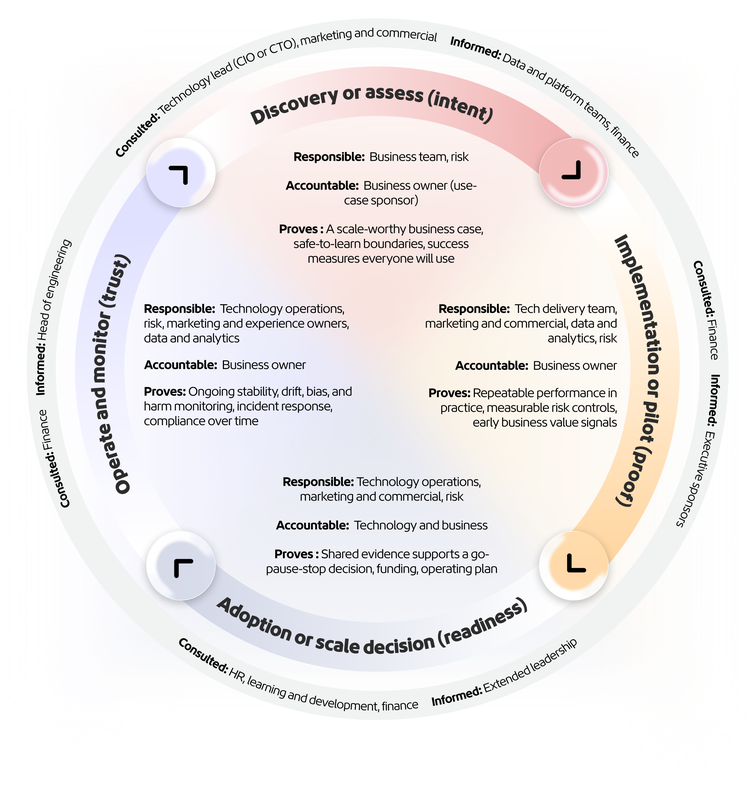
A lifecycle RACI shifts the focus from governance documentation to operational ownership, ensuring accountability doesn’t evaporate when a pilot scales. The table below illustrates how responsibility and accountability should transfer as initiatives move from intent to proof to scale decision to sustained operation, so ownership is designed into the journey, not renegotiated at each checkpoint.
Lifecycle ownership is the alignment that keeps the system from grinding. In a gear train, even a slight misalignment causes friction — and as a result, speed drops and the mechanism overheats. AI adoption behaves the same way. When ownership is unclear, handoffs are messy, success criteria shifts, decisions get re-litigated and progress slows just as momentum should build.
Clear ownership aligns the gears. When everyone knows who owns what data, performance, safeguards and decisions, the teeth interlock instead of colliding. When every tooth (or team) of the gear knows where it fits and how, each phase connects cleanly to the next and the enterprise can scale with confidence and continuity.
Make ownership explicit inside your walls and across third parties, especially around brand safety, provenance, bias monitoring and experience delivery. Name owners for data, models, outputs and monitoring. Make it unambiguous who’s accountable when something goes wrong and when it’s time to move forward.
The checklist below is designed to help teams pinpoint where ownership will break at scale and where leadership concerns concentrate.
Are accountable owners named for each phase (intent, proof, readiness, trust)?
Is a clear owner assigned for the evidence trail once in operation (metrics, controls, monitoring)?
Are third-party responsibilities explicit (provenance, channel monitoring, incident response)?
Is there a defined escalation path and decision owner when risk issues surface?
At the scale gate, are marketing, tech and risk aligned on who owns the decision and who owns ongoing accountability?
Once ownership breakdowns are visible, the next question is speed. How does leadership surface and resolve those gaps early, before they become weeks of rework? This is exactly what a disciplined governance rhythm is designed to do.
Imperative three: Establish an operational rhythm with standard artefacts and escalation cues.
Without a shared way to make the call to scale, the same AI initiative gets interpreted differently by each function. Technology sees a model that performs. Marketing sees velocity and impact. Risk partners see open questions that haven't been resolved. The result — success becomes a negotiation instead of a unified decision.
That re-litigation cost is the adoption gap in motion. When reviews are ad hoc, every checkpoint becomes a fresh debate over which evidence counts, which risks matter now and who has standing to decide. Teams end up re-justifying work that's already been proven because the enterprise lacks a repeatable mechanism to evaluate it.
The fix is not more process but rather a predictable rhythm that turns cross-functional alignment into muscle memory. That rhythm should do three things every time:
- Bring the right decision-makers together at the right altitude.
- Review a consistent set of proof in a consistent format.
- Produce a clear outcome — go, pause, remediate or route — with named owners and timelines.
This is where many organisations accidentally split the system. They build cadence without standard artefacts, so meetings generate opinion. Or they create artefacts without cadence, so documentation piles up without converting into decisions. The advantage is integrating both — a repeatable decision package that travels with the initiative across the lifecycle, so progress isn't re-litigated at each handoff. Done right, the artefacts don't feel like paperwork. Instead, they become the common language that lets marketing, tech and risk partners evaluate the same initiative through one coherent lens.
Once a rhythm is established, it must include exception triggers and routeing rules, so teams don’t waste time debating whether an issue is serious enough or who should engage. When a trigger is hit, the system should route the issue automatically to the right forum (initiative, leadership or executive) within a defined response window. That’s how you prevent weeks of rework —issues surface early, decisions happen at the right level and momentum stays intact as models evolve, regulations shift and new use cases enter the pipeline.
Even with a strong cadence and consistent evidence, AI adoption will stall unless the organisation knows how to respond when conditions change. That is where escalation should function like a tiered, trigger-based gearbox — routine issues stay within the normal review cycle, threshold breaches shift the work into an expedited leadership review and high-severity events route directly to an executive decision. The point is pre-agreeing to the triggers, the decision-makers, the evidence and the response time so the system shifts gears automatically and momentum isn’t lost.
Regardless of what parameters leadership establishes, they should review their progress and escalation path on a fixed rhythm. And when an issue arises — latency misses, bias threshold breaches and performance drops — there’s no debate whether to raise it. The system routes automatically to the accountable owner already defined.
To effectively run governance on a predictable cadence and anchor it with shared artefacts, leaders need to establish:
- Bimonthly execution reviews at the initiative level and monthly portfolio reviews at the leadership level, so each are structured around the same KPI bridge view and RACI ownership map.
- Escalation triggers that tie directly to KPI thresholds, so the question is never “should we raise this?” but rather “what level does the RACI say this belongs to?”
When the rhythm is running, leaders respond to pre-agreed signals using shared proof — not to the loudest voice in the room.
How technology, marketing and risk run as one system.
Establishing these three imperatives will reshape your organisation’s operating model. Once this established workflow turns into a daily routine, it becomes a repeatable way of working that takes AI from scattered pilots to a concrete plan to scale initiatives across the business. It’s a lightweight baseline that closes the gap between ambition and repeatable adoption.
Instead of overwhelming teams with heavy process before they even get started, this model focuses on the essentials:
- A shared KPI bridge so every function measures progress in the same language.
- Lifecycle ownership so accountability doesn't blur as initiatives scale.
- A governance rhythm with standard artefacts and escalation triggers so decisions happen on evidence, not opinion.
As your AI strategy matures, you can layer on more complexity. Start with what you can sustain. Simplicity makes this work repeatable and scalable.
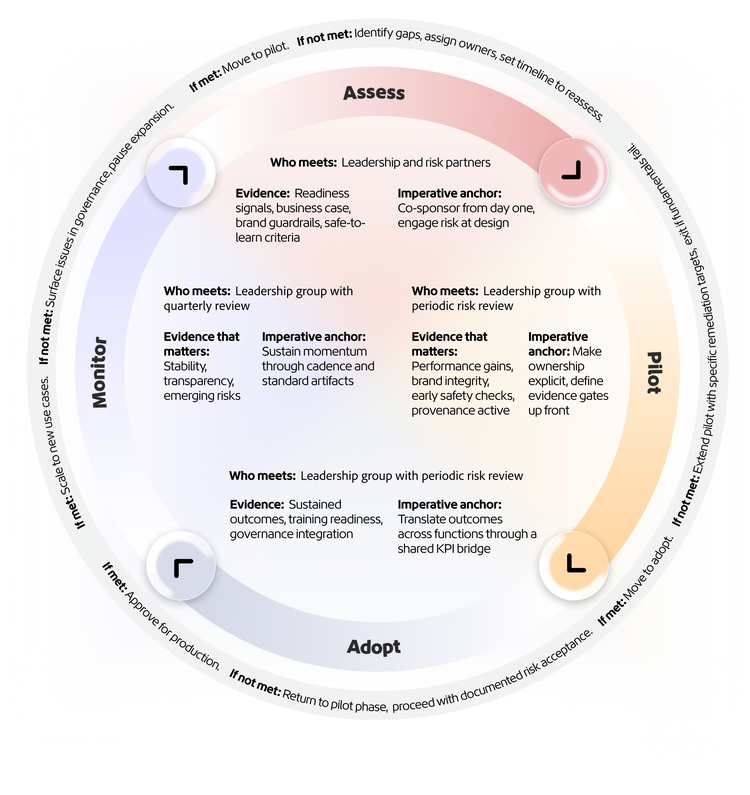
Evidence that matters.
The table below gives you a quick, scannable view of how decisions move through the operating model, requiring evidence at every phase. It’s designed to help executive teams formulate a phase-gate decision tree (and keep reviews consistent across initiatives).
How to put these imperatives to work.
The operating model becomes practical when leaders apply it to a specific initiative. Here's how that works in practice.
Closing the gap.
The adoption gap is real and it can have lasting consequences. Organisations that are proactive will unlock AI’s productivity benefits while maintaining trust and compliance. Those that don’t will stay stuck in pilot mode, watching competitors zip ahead at Mach 10 speed.
Looking at our organisational-wide gearbox, we can see that, ultimately, the adoption gap is not a failure of technology. It is the predictable result of a system in which the gears are spinning but not engaging. Technical teams generate evidence of reliability, marketing proves business impact and risk establishes safeguards. Without a way to translate and synchronise the value of these individual signals, each gear spins out on its own axis. Activity is high, but momentum goes nowhere without a connected translation chain.
The breakthrough is recognising that enterprise AI only scales when these gears mesh. Co-sponsorship connects intent. A KPI bridge translates performance, value and safety into a shared definition of ready. Clear lifecycle ownership aligns handoffs so the teeth interlock instead of grind. Finally, a predictable governance rhythm with cadence, standard artefacts and clear exception triggers across company roles, all work together to provide the torque an organisation needs to move forward together. When even one gear is misaligned, the system spins or stalls. When they engage, force transfers across functions and pilots begin driving continuous enterprise capability.
The three imperatives tackle those dynamics head-on, creating executive-level commitments that make scale possible. The operating model then turns those commitments into practical ways of working.
None of this requires an organisation to start from scratch. But it does require leadership to make two deliberate moves:
First, pressure-test your highest-priority AI initiative against the KPI bridge. Bring tech, marketing and risk into one room and ask a simple question: “Does every function agree on what ready to scale means for this initiative?” If the answer is “no,” that's your first gap to close. Build the shared evidence view before the next review cycle.
Second, co-design guardrails with risk, tech and marketing. When these three departments work in lockstep through the entire process, rather than at one step, this shift in process is the biggest high-level change an organisation can make to scale AI.
These aren't transformational undertakings. They're the kind of moves a leadership team can make within the quarter. When evidence is shared and clear ownership is established, the predictable cadence builds momentum. Each initiative that scales with the model becomes proof that the model works, which makes the next initiative easier to fund, easier to govern and faster to scale.
The companies that scale AI fastest won’t necessarily have the best models, but they’ll have the best process. The framework exists and the operating model is here. The only gap remaining is execution.
Stop managing tools. Start managing scale.
Explore Adobe's responsible AI resources for frameworks, tooling and implementation approaches that help your organisation close the adoption gap.
Sources.
"Powering Enterprise AI Adoption with Research-Backed Guidance,” GLG and Adobe, October 2025.