There is no one-size-fits-all solution in Agile. The best framework for your organisation will depend on its size, structure and specific needs. Below, we’ll explore the most common scaled Agile frameworks, arranged by complexity.
Scrum at scale (S@s).
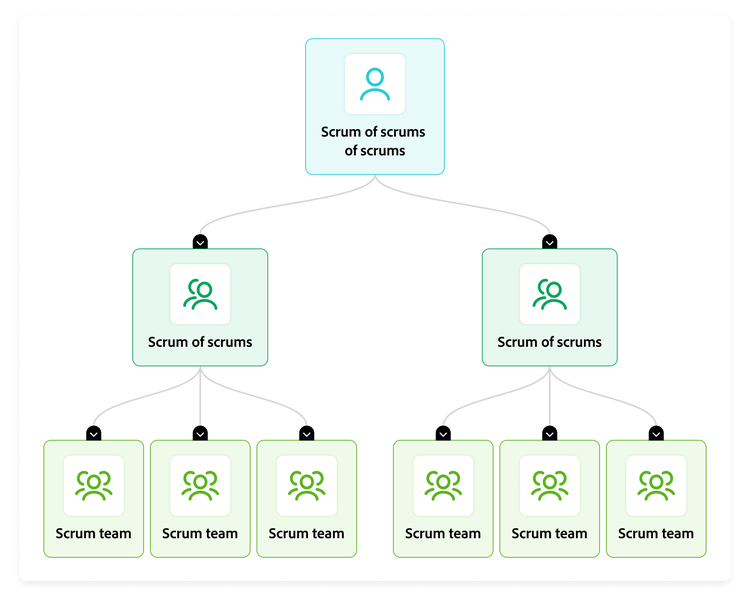
Scrum at scale (S@s) is a simple framework for scaling Agile, making it ideal for organisations new to the process. Building on the familiar Scrum methodology, it offers a clear path to expand Agile across teams.
Scrum at scale extends Scrum principles beyond individual teams to the organisational level.
How it works:Scrum at scale uses a pyramid-like structure with development teams at the base and other teams layered on top to represent contributors and stakeholders. This hierarchy ensures clear roles, processes and approvals.
Key features:
- Self-organising teams led by scrum masters.
- Transparent, iterative work cycles with regular sprint reviews.
- A focus on breaking down large goals into manageable tasks.
Best suited for:Smaller organisations or teams looking to scale Agile without adding significant complexity.
Large-Scale Scrum (LeSS).
Large-Scale Scrum (LeSS) is a streamlined framework for scaling Agile, ideal for organisations seeking simplicity and focus. Built on core Scrum principles, it emphasises team collaboration and minimising complexity, offering a practical approach to scaling Agile across multiple teams.
How it works:LeSS consolidates multiple Scrum teams under a single scrum master and product backlogue, enabling all contributors to work together on the same timeline.
Key features:
- All contributors focus on the same deliverables within synchronised sprints.
- Encourages Lean principles to minimise waste and increase efficiency.
- Emphasises collaborative sprint reviews to break down communication silos.
Best suited for:Organisations needing slightly more structure than S@s while retaining simplicity.
Disciplined Agile (DA).
Disciplined Agile (DA) is a flexible framework for scaling Agile, designed to adapt to the unique needs of each organisation. By integrating a wide range of Agile and Lean practices, it provides a comprehensive toolkit for teams to navigate complexity, improve processes and achieve business agility.
How it works:DA provides a toolkit to tailor Agile practices to an organisation’s unique workflows, focusing on mindset, people, flow and practices.
Key features:
- Combines Scrum principles with flexibility for leadership to customise workflows.
- Addresses the needs of the entire organisation, not just development teams.
- Ideal for organisations requiring adaptable, scalable solutions.
Best suited for:Enterprises looking for a structured yet flexible Agile framework.
Scaled Agile Framework (SAFe).
The Scaled Agile Framework (SAFe) is a comprehensive methodology for scaling Agile across large organisations. It provides structured guidance for aligning teams, improving collaboration and managing complex initiatives. By integrating Lean, Agile and DevOps principles, SAFe enables organisations to deliver value at scale while maintaining agility and responsiveness.
How it works:SAFe organises teams into Agile Release Trains (ARTS), each focused on specific deliverables. Portfolio-level activities define the vision, which trickles down into tasks for teams.
Key features:
- Iterative, incremental progress with Lean principles.
- Emphasis on collaboration across multiple teams.
- Offers extensive training and certification options.
Best suited for:Large organisations with multiple teams working on complex, interdependent projects.