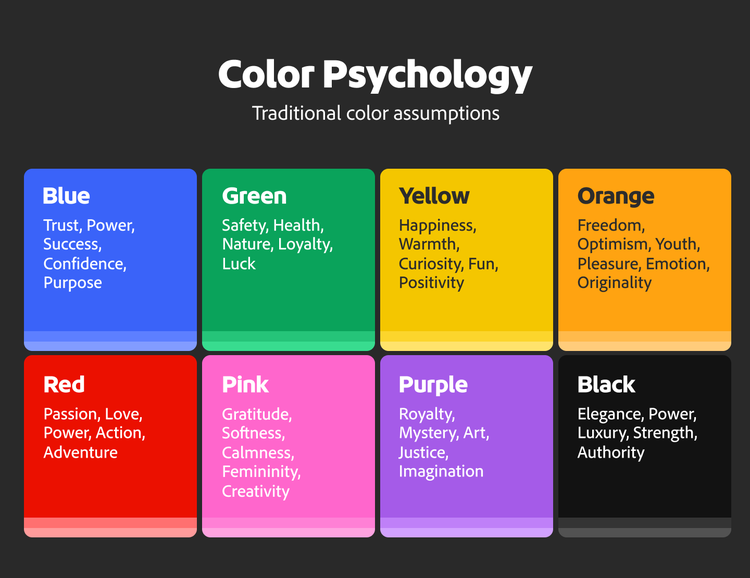
Colour psychology has guided creative decisions for marketers for decades. Red signals urgency. Blue indicates trust. Green suggests growth. These associations are widely accepted and often instinctively applied across campaigns.
Colours give creative teams a shared language and a quick solution to align design choices with intent and goals. But modern advertising environments demand more than just symbolic interpretations.
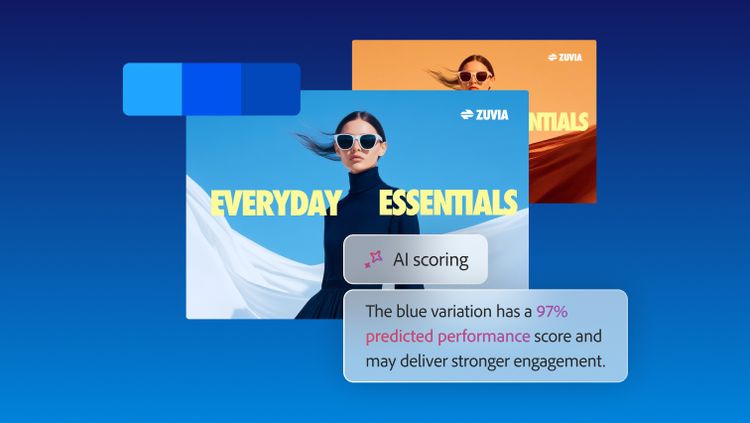
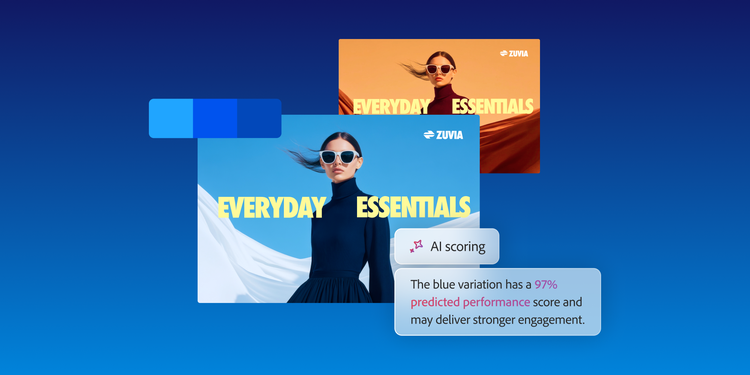
This is where AI scoring comes into play. It evaluates creative assets based on real-world performance. AI scoring looks beyond what a colour is supposed to communicate and focuses on what that colour does within a specific ad asset.
AI scoring helps determine how colours affect visibility, readability, engagement and ultimately, conversion. This takes traditional colour theory a step further by making colour decisions more performance-led.
Colour psychology is still valuable as it offers direction and context, but it works best as a starting point. It should be a way to frame a hypothesis, not a rule to follow without question. AI scoring should be used to test whether that hypothesis holds up when exposed to real audiences, channels and competitive environments.
This article will cover:
- What colour psychology can and can't predict
- How AI scoring evaluates ad creative
- Bringing colour psychology and AI scoring together
- Why contrast, readability and accessibility matter
- Common AI scoring mistakes to avoid
- Testing colour decisions with AI scoring
- The future of colour strategy is creative intelligence
What colour psychology can and can't predict.
Colour psychology is the study of how different colours can influence our emotions, thoughts and behaviour. Although perceptions of colour can vary from person to person, certain colours tend to inspire common emotional responses.
For example:
- Red for urgency, excitement or action
- Blue for trust, calmness and reliability
- Green for growth or sustainability
- Black for sophistication or luxury
- Yellow for energy and optimism
Businesses, designers and marketers often use colour psychology to influence how their brands, products or experiences are perceived. Choosing the right colours can help to communicate a message, create a specific mood or encourage certain actions.
These choices and traditional attributions are not arbitrary. They are the result of repeated cultural exposure, category conventions and design patterns that have evolved over time. When applied well, they can help a message land faster and feel more intuitive to the audience.
But they are not universal truths.
The meaning of colour changes depending on where and how it is used. Audience expectations, cultural context, product category, platform norms and even competitor creative all influence how a colour is interpreted. A hue that works in one campaign or region may perform differently in another. Factors such as saturation, brightness, contrast and surrounding colours can also influence perception and decision-making.
More importantly, colour alone does not determine performance.
A colour might feel emotionally right but still underperform if it interferes with how the creative functions.If text isn’t legible, if the product blends into the backdrop or if the call-to-action button isn’t visible, the intended meaning becomes secondary.
In practice, this means colour psychology has a natural ceiling. It can suggest direction, but it cannot predict outcomes. It tells you what a colour may signal. It does not tell you whether that signal translates into attention, engagement or conversion.
That gap is where performance-based approaches begin to matter.
How AI scoring evaluates ad creative.
AI scoring approaches creative from a different angle. Instead of analysing what a colour represents, it evaluates how that colour contributes to the ad’s overall effectiveness.
There are two primary ways this evaluation typically pans out:
- Pre-launch creative scoring: Uses trained models and historical data to predict how an ad might perform before it goes live. This allows teams to compare variations early and reduce the likelihood of underperforming.
- Outcome-based performance scoring: Looks at live campaign data and evaluates creative based on actual results such as click-through rate, conversion rate, engagement rate and qualified leads in the sales pipeline.
In both cases, colour is not chosen in isolation. It is chosen strategically as part of a broader system of visual signals, including text and background contrast, consistency with brand guidelines, image clutter, historical performance patterns and platform, audience and funnel-stage context.
Bringing colour psychology and AI scoring together.
The true value for digital marketers and creative teams is found when colour psychology and AI scoring are used together to ensure a fully informed approach to content.
While colour psychology provides a lens for approaching creative direction, AI scoring tests whether that direction performs under real conditions. When used together, they create a more complete decision-making framework.
Where colour psychology and AI scoring align.
There are many situations where traditional colour theory and performance data reinforce each other.
For example, a high-contrast accent colour can draw attention to a call to action and make it easier for users to take the next step. Consistent use of brand colours can strengthen recognition across channels and improve recall over time. Colours that align with category expectations can reduce cognitive load and help the audience process the message more quickly.
In these cases, colour psychology works because it supports clarity and intent and strengthens the message rather than competing with it. The creative choices fit the brand, appeal to the senses of the audience, improve readability, support campaign goals and drive measurable results.
Where AI scoring challenges colour theory.
There could also be instances where creative performance data may challenge long-held assumptions. A colour may carry the 'accurate' symbolic meaning but still fail to perform in context.
For example, a red CTA might attract attention, but if it overwhelms or distracts from the core offering, it can reduce effectiveness. A blue-heavy design may feel trustworthy, but it might feel overused within certain categories. A black palette may signal premium positioning, but it can reduce readability in certain formats.
These are some situations where traditional assumptions fall short. AI scoring fills the gap by showing how colour interacts with other variables such as layout, contrast, density and placement. It shows whether the intended meaning translates into a functional advantage.
Colour theory vs. AI scoring: A comparison.
How AI reshapes brand colour psychology.
AI scoring does not replace brand colour psychology — it strengthens decision-making. Colour psychology and consistency still matter, especially for recognition and recall.
What changes is how those colours are evaluated in performance environments. Marketers and creative teams should treat traditional colour conventions as assumptions and use AI scoring to validate them.
Instead of asking whether a colour fits the brand, teams can ask whether it performs effectively in different contexts and environments. Does it hold attention in a fast-moving feed? Does it differentiate the brand in a crowded category? Does it support both recognition and action?
This introduces a more dynamic way of thinking about colour. Brand colours remain central, but their application becomes more flexible and informed by data.
Within an ad, this might mean adjusting how dominant a brand colour is, introducing contrast treatments to improve clarity or adapting colour use based on audience segment or funnel stage.
Why contrast, readability and accessibility matter.
While colour psychology focuses on emotional meaning, AI scoring prioritises functional clarity. How people actually engage with ads is central to the process. As most interactions are quick, attention can be lost if the message is not immediately clear.
This makes basic visual principles critical.
Text must be readable without effort. Calls to action need to be clearly visible. Products need to stand out against their background. The overall layout should guide the eye in a logical sequence.
Colour plays a central role in all of this, but it must be applied through a performance-led lens. A palette that looks refined may weaken contrast. A bold colour may attract attention but reduce legibility if used incorrectly. A visually rich design may introduce too much noise and hide the most important elements.
Colour accessibility addresses these challenges and improves usability, clarity and audience reach. It can be defined as the process of using colour in a way that makes content readable and understandable for people with different visual abilities.
In advertising, colour choice accessibility best practices include strong contrast, readable text, visible CTAs and not relying on colour alone to communicate meaning.
Common AI scoring mistakes to avoid.
When combining colour psychology with AI scoring, most teams fall into certain patterns that can weaken the process. These can dilute campaign effectiveness and alter results.
The most common mistakes that marketers and creatives should avoid are:
- Treating AI scores as absolute truth: Teams often treat AI scoring as definitive rather than directional. Scores can inform decisions, but they should not replace judgement. Remember, creative decisioning still matters.
- Applying a one-size-fits-all approach: Another issue is applying the same colour psychology across audiences and channels. What works in one environment may not translate to another.
- Testing multiple variables at once: Testing itself can also become a challenge when too many variables are changed simultaneously. It becomes harder to identify what drives results, leading to unclear insights and inconsistent decisions.
- Optimising only for clicks: Focusing on immediate metrics without considering long-term impact can sometimes backfire. A colour that attracts attention and drives clicks may not always align with brand perception or conversion quality.
- Ignoring accessibility and readability: These factors are often treated as an afterthought. Yet, as user expectations increase and attention spans decrease, they play an important role in how creativity is evaluated and experienced.
- Relying heavily on brand colours: Marketers often treat brand colours as fixed rules and assume they will perform across every ad format. This approach may not always deliver the best results across different environments.
Avoiding these pitfalls requires consistency and discipline. It also requires moving away from one-off decisions toward a structured approach built on repeatable testing and contextual decision-making.
Testing colour decisions with AI scoring.
To test colour choices with AI scoring practically, marketers need a structured testing approach that combines intuition with validation.
The recommended steps are:
- Start with identifying brand guidelines, audience context and campaign goals.
- Use colour psychology to form a clear hypothesis and base creative choices on context.
- Create controlled creative variations focused on colour differences instead of changing everything at once.
- Use AI scoring to evaluate and validate potential asset performance before launch.
- Measure outcomes using campaign metrics such as CTR, conversion rate, CPA, ROAS and engagement.
- Document findings by platform, audience, funnel stage and campaign type.
Marketers should test across variables such as CTA colour and contrast, dominant colour, accent colour, background colour, product-to-background contrast, text contrast, saturation levels, light versus dark palettes, brand colour dominance, offer-label treatments and even colour use by funnel stage.
The findings can be used to make more informed creative decisions and strengthen future campaigns with confidence.
The future of colour strategy is creative intelligence.
Colour strategy was once guided largely by intuition and convention and is now a part of a broader, measurable system of creative intelligence.
This does not diminish the role of design or creativity. On the contrary, creative teams gain more clarity around what works, why it works and where to explore further.
Colour psychology continues to provide meaning and direction, while AI scoring introduces accountability and helps measure performance. Testing connects both to real outcomes and together, they shift colour from a subjective choice to a measurable lever.
To summarise, the strongest colour strategies are not built solely on what colours are traditionally believed to mean. They are built on understanding how those colours perform in real-world environments and what they help audiences notice, understand, process and feel.
For organisations managing high-volume ad campaigns, this level of alignment becomes essential.
With a solution like Adobe GenStudio, teams can create, deliver and optimise on-brand ad campaigns by applying insights across creative workflows.
Recommended for you
https://business.adobe.com/fragments/resources/cards/thank-you-collections/genstudio