How to scale content localization without sacrificing quality.

Many global marketing leaders face the same dilemma: the demand for localized content is exploding, while marketing budgets remain stagnant. You need to reach audiences in São Paulo, Singapore, and Stockholm with messaging that resonates culturally. However, most marketing teams can’t triple in size to handle the workload.

Marketing leaders face inconsistent brand voices and constant pressure to spend less while producing more content faster. The old way of translating content, one piece at a time, can't keep up with today’s digital content demands.

The good news is that top brands have found a better way. By combining smart automation with strategic workflows, they are scaling across dozens of markets without losing the quality their customers expect. This article explores what a content localization strategy looks like with AI tools, what factors slow down your regional teams, and how orchestration platforms help meet content localization demands for enterprises.

Understanding content localization.

Understanding localized content requires moving beyond simple translation of a piece of content from one language to another. While translation converts words from one language to another, localization adapts the entire message for a specific market. This includes everything from imagery and cultural references to regulatory requirements and color choices that carry different meanings across cultures.

Consider a financial services brand launching a retirement campaign. In Germany, the messaging might emphasize security and stability. In Brazil, the same campaign might focus on family legacy. The product is the same, but the emotional resonance shifts based on the cultural context.

The distinction is even sharper when considering transcreation. This process goes further than localization by recreating content from scratch to capture the original intent and emotional impact in a new context. This allows creative teams to develop entirely new expressions that achieve brand objectives while honoring local sensibilities. By moving beyond literal translation, brands avoid taglines that might fall flat or even offend in a new market. An example of this is when Intel entered the Brazilian market with its “Sponsors of Tomorrow” campaign. Intel found that the literal translation of “sponsor” didn’t communicate the idea of providing results today, so it adjusted the messaging to “Apaixonados pelo Futuro” (Passion for the Future). This example illustrates the difficulty of localizing content to be culturally relevant for global enterprises.

Managing the content spectrum with AI.

The modern content supply chain balances three distinct needs: translation for informational content, localization for market-specific adaptation, and transcreation for high-impact creative assets. AI-driven orchestration is transforming how enterprises manage these needs. Brands can significantly increase content production speed while lowering the cost of individual assets. This can be achieved by unifying content localization workflows and building a localization strategy.

Machine learning models can now identify which content can flow through automated workflows. For instance, natural language processing can detect cultural nuances that might pose a brand risk, while computer vision analyzes imagery for regional accuracy.

Automating these routine tasks allows enterprises to scale their content volume, enabling them to expand into new markets without a proportional increase in spending. A robust strategy recognizes that while technical documentation may only need accurate translation, brand campaigns require full transcreation.

Enterprise brands often categorize assets by the level of adaptation required to streamline the choice between translation, localization, and transcreation. Building these categories into a translation management system allows you to route assets to the right workflow automatically. This approach reduces decision fatigue for regional teams while ensuring that every asset meets high-quality standards.

Solving the creative collaboration bottleneck.

The primary obstacle to scaling content localization often comes from stakeholder coordination rather than technology. Teams at headquarters create campaigns with specific brand guidelines. However, regional offices need the flexibility to adapt messaging for local audiences. Lack of clear workflows can lead to one of two outcomes: ineffective global content or off-brand regional variations.

Successful enterprises solve this by establishing brand guardrails. These guardrails empower regional autonomy without producing content that doesn’t follow brand standards. The key is distinguishing elements that must remain consistent globally and those that regional teams can adapt freely.

Building centralized asset libraries and brand guardrails.

Efficiency increases when regional marketers work from centralized asset libraries rather than recreating materials from scratch. These libraries serve as a single source of truth, offering approved photography, iconography, and design elements. This eliminates the costly duplication that occurs when each market sources its own creative.

Locked templates take this concept further by defining exactly which elements can be modified. For example, a template might allow a regional team to customize headlines and body copy while locking the logo placement, color palette, and typography. This approach gives marketers the freedom to localize messaging while maintaining the visual consistency that makes a brand unique.

Integrating brand guardrails directly into the templates allows teams to spend less time monitoring regional outputs and more time on high-level strategy. Brands can now expand into new markets and increase their creative output without needing to match that growth with more spending.

Breaking down silos between global and regional teams.

Effective collaboration requires more than just shared assets. Collaboration needs visibility into campaign timelines, performance metrics, and compliance status. When regional teams operate in isolation, they lack strategic context. Conversely, when headquarters maintain too much control, local market opportunities are often missed or fall short due to mismatched messaging within a region.

The most successful enterprises establish clear roles across the content lifecycle:

  • Global teams: Own brand strategy, core creative development, and compliance frameworks
  • Regional teams: Own market adaptation, local channel optimization, and cultural validation

Stakeholder handoff points that are clearly defined and supported by the right platforms can help enterprises transition seamlessly from global content strategy to local execution.

Scaling content localization and maintaining quality with Adobe GenStudio.

Managing a global content lifecycle requires more than scattered tools and manual handoffs. Additional content across markets, channels, and languages makes maintaining both speed and quality difficult.

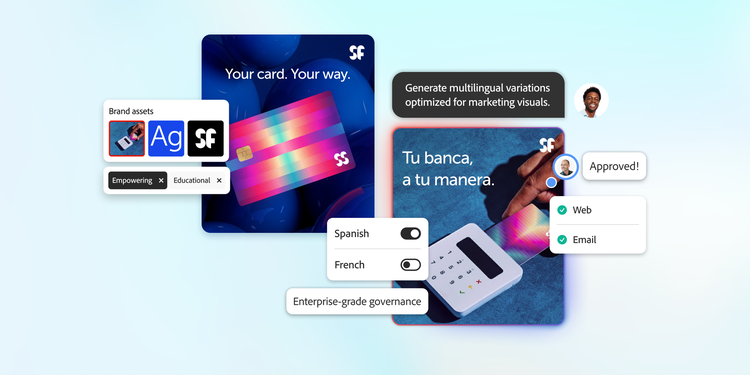
Adobe GenStudio addresses this challenge by serving as an orchestration layer that connects creative development, localization, review, and activation into a single, unified workflow. Instead of managing disconnected steps, teams operate within a system designed to scale both consistency and velocity.

A unified workflow in action.

To understand how this works in practice, consider how a typical campaign flows:

  • Creation: Headquarters develops the master campaign in a primary language.
  • Automation: Adobe GenStudio for Performance Marketing generates translations and applies brand and compliance checks to every variant.
  • Validation: Only flagged assets are reviewed by regional teams and everything else moves forward automatically.
  • Compliance: A complete, auditable history is maintained for every asset and decision.

This approach resolves the core tension in localized production. Regional teams gain the flexibility to adapt messaging for local audiences, while headquarters retains confidence that every asset meets brand and regulatory standards.

Automated quality at scale.

Quality assurance shifts from manual inspection to configurable, automated control with GenStudio. Teams define brand and compliance rules once, and those guardrails are applied consistently across thousands of assets throughout creation and localization. Rather than reviewing everything, teams focus only on what needs attention:

  • Compliant content moves forward automatically.
  • Flagged content is routed to the right regional reviewers.
  • Every decision is captured in a complete, auditable history.

This exception-based model reduces risk, shortens review cycles, and ensures governance without slowing production.

More importantly, it changes how localization scales across regions. Enterprises rely on AI-powered guardrails to maintain both speed and consistency across markets.

Multi-asset activation, minus the friction.

Multi-asset activation further streamlines distribution across channels. Campaigns for platforms such as Meta or LinkedIn can be adapted, reviewed, and published in the same environment:

  • No more constant context-switching between tools.
  • Regional teams gain real-time visibility into performance.
  • Headquarters retains clear oversight of brand consistency and governance.

The result is more agile global content operations where markets move quickly without sacrificing control.

How to begin streamlining your content supply chain.

Adopting an orchestration approach doesn’t require rebuilding everything at once. The most effective starting point is understanding where your current workflow breaks down.

Begin by mapping your existing process and identifying the most complex or time-consuming handoffs. These friction points represent the greatest opportunities for localization automation.

Focus first on:

  • Common compliance issues
  • Steps that create bottlenecks
  • High-impact channels where speed matters most

Establishing guardrails in these areas can allow teams to quickly build confidence in the system and create momentum for broader transformation.

For enterprises operating across dozens of markets, this approach redefines what’s possible. Campaigns that once required months of coordination can now launch in parallel, increasing content volume, accelerating time to market, and enabling growth without a corresponding rise in budget.

Explore Adobe GenStudio to discover how an AI-powered content supply chain can transform your global content operations.

Let’s talk about what Adobe can do for your business.

Get started