Customer Loyalty Flywheel: How to build retention.

Adobe for Business Team

03-25-2026

Every CMO today faces a familiar challenge: deliver standout customer experiences while proving ROI faster, all with fewer resources. Marketing success used to be defined by how efficiently you could fill the funnel. More leads meant more opportunities and growth followed a predictable, linear path. But that model has reached its limit. Customer acquisition still matters, but the real pressure has shifted to retention. Why? Because attracting new customers often costs more than the revenue they generate, while loyal customers drive repeat purchases, advocacy and sustainable growth.

As it stands, the customers you already have are far more valuable than the ones you’re trying to acquire. Loyal customers buy more often, stay with you longer and advocate in ways no campaign can replicate. This can lower acquisition costs and strengthen long-term growth, but only if you have the visibility and systems to understand what keeps them engaged.

The real challenge isn’t recognising the value of retention. It’s that most organisations struggle to measure it, influence it and scale it in a meaningful way. The traditional funnel isn’t built for that.

That’s why more modern marketing teams are shifting from funnels to the Customer Loyalty Flywheel, a model built on momentum, not attrition. When your customers have better experiences, they stay. When they stay, they buy more. And when they buy more, they advocate. The energy they create feeds back into the system by lowering your acquisition burden.

This article breaks down what that flywheel looks like, the metrics that reveal its true strength and why measuring retention is so difficult without a unified view of the journey.

Here’s what’s inside:

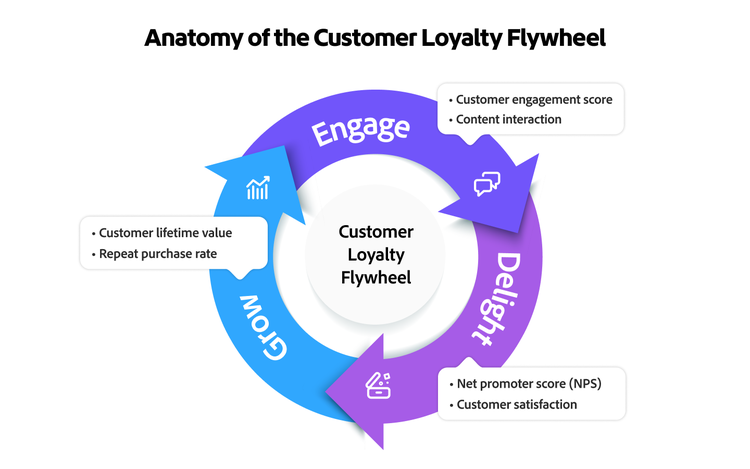
Diagram showing the cyclical nature of the Customer Loyalty Flywheel with its stages and relevant customer retention metrics.

The Customer Loyalty Flywheel: A modern model for sustainable growth.

If the traditional funnel was built for a world of predictable customer behaviour, the Customer Loyalty Flywheel is built for the world CMOs operate in today, one defined by continuous interactions, fluid expectations and journeys that don’t end at conversion.

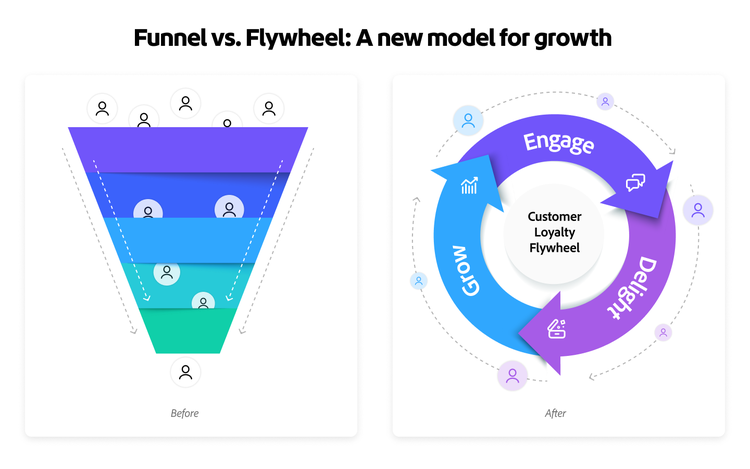
At its core, the flywheel reframes growth as a cycle, not a line. Instead of pushing prospects through a sequence of steps and hoping they emerge as customers, the flywheel centres the people who already trust your brand. Their experiences, satisfaction and engagement supply the momentum that fuels repeat revenue and advocacy — which, in turn, lowers your cost to acquire the next wave of customers.

What makes the flywheel powerful is its compounding effect. When customers feel valued, they stay longer. When they stay longer, they contribute more revenue. When they contribute more revenue, they become advocates. And that advocacy creates new demand with a level of authenticity that no ad spend can match.

For CMOs, this model offers something the funnel never truly delivered: a growth engine that becomes more efficient over time, not more expensive. But the flywheel only works when you can see and understand the full customer experience. Visibility into satisfaction, retention and engagement — and how they influence one another — is what keeps the wheel turning. Without that clarity, even the best brand experiences lose momentum. The flywheel represents modern growth: cyclical, compounding and powered by the customers who already believe in your brand.

The three forces that power the flywheel: Satisfaction, retention and engagement.

The Customer Loyalty Flywheel isn’t driven by a single moment or metric. It gathers momentum through three interconnected forces that shape how customers experience and ultimately value your brand. Understanding these forces is essential, because they’re often the earliest indicators of whether your growth engine is accelerating or losing steam.

The 5 customer retention metrics that reveal your flywheel’s momentum.

If the Customer Loyalty Flywheel is your growth engine, your retention metrics are the dashboard that tells you whether it’s accelerating, stalling or quietly losing power. These metrics aren’t just operational indicators; they are strategic signals. The most effective retention metrics don’t just measure outcomes; they help you to understand why customers stay, buy again or advocate for your brand.

Together, these metrics provide a high-resolution view of customer health and future revenue potential. To see how these indicators interact in a real-world environment, you can model your own retention data within the Customer Journey Analytics sandbox.

Side-by-side comparison of the traditional marketing funnel against the modern Customer Loyalty Flywheel.

Why most CMOs can’t measure retention accurately.

By the time retention metrics show a problem, the damage is often already done. A dip in repeat purchases, a rise in churn or a sudden drop in engagement usually reflects issues that have been building for months. For many CMOs, the hardest part isn’t interpreting the data, it’s trusting it. That’s because most organisations are still operating with customer data scattered across platforms, teams and channels. Marketing owns engagement. Sales owns accounts. Product owns usage. Support owns satisfaction. Finance owns renewals. Each tells a part of the story, but no one sees the whole thing. That’s where the real problem lies.

Without a unified view of the journey, retention becomes an exercise in guesswork. You see symptoms like churn or declining CLV but not the causes. You know where customers are leaving, but not why. You spot friction, but can’t trace it back to the specific interactions, touchpoints or experiences that created it.

This lack of clarity has real consequences:

Without a unified data foundation, the flywheel simply cannot spin. Shifting from a funnel to a flywheel requires moving beyond traditional, disconnected analytics toward a system that can 'stitch' these moments together in real time.

This is where Adobe Customer Journey Analytics comes into play. Unlike traditional tools that leave data in silos, Customer Journey Analytics unifies cross-channel data, online and off-line, into a single, real-time view. It allows you to stitch together the entire customer lifecycle, giving you the insight needed to understand exactly why your flywheel is spinning or stalling.

The platform that makes the flywheel work.

Even the strongest retention strategy can’t succeed without the right platform. The flywheel only gains momentum when you can clearly see what customers are experiencing and act on those insights in real time. That requires two things CMOs rarely have in one place: a unified view of the journey and the ability to personalise at scale. Adobe’s integrated journey solutions were built to deliver both.

Measure what matters with Adobe Customer Journey Analytics.

Unlike traditional tools that leave data in silos, Adobe Customer Journey Analytics unifies cross-channel data, both online and off-line, into a single, customer-level view. It allows you to see the entire lifecycle, finally giving you clarity on what drives satisfaction, loyalty and churn.

With a unified view, you can see:

Brightline uses Customer Journey Analytics to get a full view of its customers across every channel. This understanding of behaviour enables them to identify what drives loyalty and personalise interactions in the moments that matter.

Act on insights with Adobe Journey Optimizer.

If Customer Journey Analytics shows why customers stay or leave, Journey Optimizer lets you respond instantly. It delivers personalised, context-aware experiences across channels from one platform — without the operational complexity of multiple tools. With Adobe Journey Optimizer, teams can:

Transform retention into a competitive advantage.

Insight followed by action results in a retention engine that scales. Retention has become one of the strongest competitive advantages available to CMOs today. When customers feel valued and understood, they stay longer, buy more and advocate on your behalf, creating a compounding effect no acquisition budget can match.

The Customer Loyalty Flywheel provides a modern framework for this kind of growth, grounded in the metrics and moments that shape long‑term value. But its impact depends on having a clear view of the customer journey and the ability to act on insights quickly.

With Customer Journey Analytics, organisations can finally bridge the gap between data and action. This unified approach allows you to uncover the hidden drivers of loyalty, resolve friction before it leads to churn and deliver the real-time, personalised experiences that sustain momentum at scale.

Get started with Customer Journey Analytics to measure your flywheel’s momentum.

https://business.adobe.com/fragments/resources/cards/thank-you-collections/customer-journey-analytics