From experimentation to impact: Brands in Asia-Pacific and Japan take AI adoption to the next level
Duncan Egan, Vice President of Enterprise Marketing, Asia Pacific and Japan – Adobe
05-27-2025

For years, brands have worked to refine their understanding of customers—mapping preferences, tracking behaviours, and segmenting audiences with increasing precision. But understanding alone is no longer enough. The real opportunity now lies in prediction. Customers don’t just want brands to respond; they expect them to anticipate their needs and deliver seamless, personalised interactions that feel authentic.
Yet, despite these expectations, Adobe’s 2025 AI and Digital Trends report shows that many brands continue to fall short. Our annual global study highlights the common hurdles—and how leading brands are overcoming them. The most successful are taking bold steps to unlock AI’s full potential, shifting from efficiency-driven automation to AI-powered engagement.
The AI shift is already underway
Across Asia Pacific (APAC) and Japan, consumers show a growing preference for AI-powered interactions over static web experiences. Agentic AI is well positioned to deliver on this promise, setting the stage for widespread use of customer-facing AI agents. Unlike traditional AI, which operates within predefined rules, agentic AI can reason and make decisions based on real time customer interactions to deliver intuitive and highly personalized experiences. This dynamic approach unlocks deeper, more meaningful engagement, positioning AI as an active participant rather than a passive tool and paving the way for hyper-personalisation.
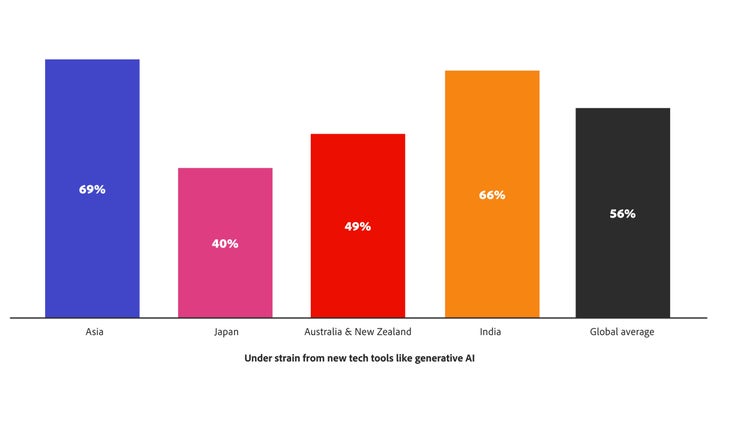
CMOs and senior marketing leaders know the power of personalisation, with 91% agreeing it will drive growth in 2025. Buoyed by the expectation that generative AI will improve the speed and volume of content production, the technology is increasingly being deployed. But it comes at a price, according to marketing and CX teams, with many signalling AI implementations as a strain on workflows. This is notably higher in India (66%) and Asia (69%), with both markets outstripping the global average (56%).
Impact of AI on marketing teams
This further opens the door for agentic AI, facilitating its application in an operational context to perform repetitive, high-volume and time-consuming tasks like data collection, database management and content delivery.
The integration of generative and agentic AI allows brands to personalise the customer experience rapidly and at scale, fundamentally transforming marketing efforts to create stronger connections and achieve more significant results.
The transformation is already happening, but significant challenges remain.
The roadblocks holding brands back
The biggest obstacle? Data. Most leaders across the region (83.5% on average) say fragmented, siloed, and inconsistent customer data continues to hinder personalisation. Brands struggle to meet evolving consumer expectations without unified platforms that provide real-time insights—the greatest influence in technology stack purchase decisions over the next 12-24 months. While many companies invest in technology to connect the dots, true personalisation will remain out of reach until data flows seamlessly across solutions built for integration and interoperability.
Ownership of customer experience delivery is another critical challenge. The customer journey and the technology underpinning it spans multiple teams—marketing, service, operations, IT—but who truly owns it? Throughout the region, opinions differ. Three-quarters of marketing leaders claim ownership, often pointing to their own teams or CX functions, while technology leaders see AI-driven experiences as an IT responsibility. This disconnect leads to fragmented customer experiences, making it harder to deliver a seamless, AI-powered journey. As brands push AI beyond automation and into deeper engagement, internal teams face mounting strain. Implementation isn’t just about capability—it requires restructured workflows and alignment across the organisation.
Privacy and governance concerns add another layer of complexity. Across Japan, India, Australia and New Zealand, compliance remains a key barrier to scaling AI initiatives. Elsewhere in Asia, siloed data is their biggest roadblock. Despite these regional market differences, one thing is clear: AI’s full potential won’t be realised until brands address these foundational issues.
A region on the verge of transformation
AI adoption across the region is uneven. Many brands remain in the pilot phase, testing capabilities and evaluating impact. Others have moved beyond experimentation—integrating AI to drive measurable business outcomes.
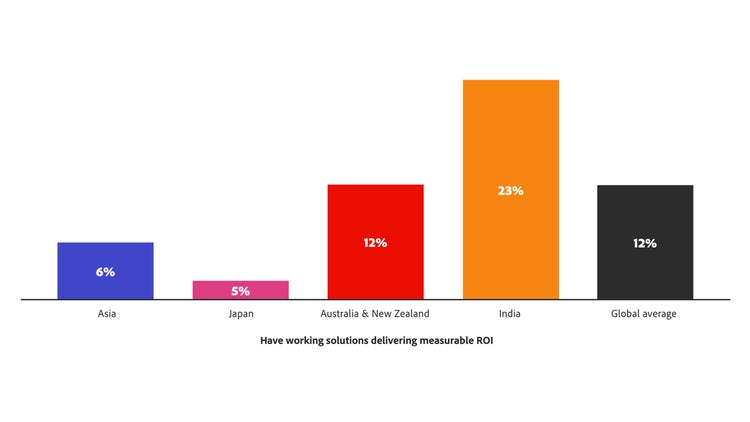
India stands out as a leader, delivering AI-driven results at twice the global average. Meanwhile, brands in Australia and New Zealand are seeing returns in line with that standard (12%), while Asia and Japan lag at 6% and 5%, respectively. While much of the region is still assessing AI’s potential, India’s early success highlights what’s possible when AI is deployed with purpose.
Status of generative AI implementation for marketing and customer experience
The path forward
As AI investment accelerates across the region, the momentum is undeniable. But unlocking its full value requires more than investment—it demands a fundamental shift in how brands manage data, structure teams, and govern AI deployment. For those who can solve these challenges, the opportunity is immense.
Agentic AI isn’t just the next evolution—it’s the key to unlocking truly predictive, frictionless engagement. When paired with generative AI, it opens new possibilities for real-time, hyper-personalised interactions at scale. The brands that break down silos, establish clear ownership of the customer journey, and harness AI to deliver personalised, intuitive and authentic experiences will set the standard for the future and reap the benefits.
To understand how AI is transforming customer experience orchestration, read the Adobe 2025 AI and Digital Trends Report.