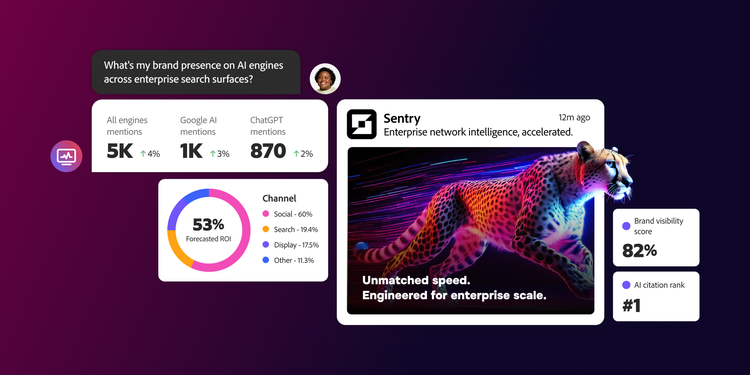
The 'Search Everywhere' Playbook: A holistic strategy for modern discovery.

Search is no longer a single channel. It’s a distributed decision system. Between July 2024 and February 2025, AI-driven referrals in the US grew more than tenfold, with conversion rates and revenue per visit quickly approaching those of traditional search. At the same time, buyers now validate decisions across social platforms, communities and AI assistants even before visiting a website.

The new model creates a material business risk for enterprises. Traditional SEO and analytics only measure human clicks, while AI systems summarise, interpret and recommend content without sending traffic. Brands can perform well in classic SERPs and still be invisible or misrepresented in AI-generated answers.

The Search Everywhere Playbook reframes discovery as a surface-agnostic system. It expands optimisation from rankings to presence, clarity and trust across search engines, social search, generative AI and app shops. Success is measured not just by traffic, but by AI citations, share of voice, brand representation and downstream revenue impact. A holistic search strategy ensures brands are consistently represented wherever discovery happens across search engines, social platforms and AI assistants.

For CMOs and marketing leaders, the imperative is clear: Modern discovery requires machine-readable content, shared sources of truth, cross-functional governance and new measurement infrastructure. Platforms like Adobe LLM Optimizer provide the operational layer to monitor AI visibility, benchmark competitors and turn insight into action. This helps protect brand relevance as discovery becomes more AI-mediated.

For a long time, search optimisation in enterprise marketing was largely focused on one goal: win the traditional search engine results page (SERP). This was often viewed with a Google-only lens. In that era, brands invested in SEO, content strategy and personalisation to drive visibility and engagement across digital channels.

It’s undeniable that this foundation still matters, but it no longer covers the full discovery journey. There’s a significant transition in which the customer journey increasingly begins outside a traditional search engine. It now begins with an AI assistant and these systems don’t just index content; they summarise, interpret and recommend it before a user ever visits a website.

Research on generative AI evolution shows that, from July 2024 to February 2025, web traffic from AI-driven referrals increased more than tenfold in the US and that AI referrals are quickly closing the gap with traditional channels in conversion rates and revenue per visit.

This isn’t the full picture. People still use classic search for navigation — to check pricing, find docs and log in. But they validate on social and community platforms and they ask AI systems for synthesis. In a single buying motion, a prospect might use TikTok for a quick tutorial or demo, Google to find an official product page, Reddit threads for peer feedback and ChatGPT or Perplexity to compare options and summarise pros and cons.

Generative AI assistants powered by LLMs are becoming a primary front door to brand discovery, shifting search from link-hunting to synthesised answers and recommendations. This creates a visibility and measurement gap because traditional analytics were built for human visits, so enterprise teams need machine-readable, structured content and ongoing monitoring of mentions, citations and visibility across AI-driven queries and competitors.

For CMOs, VPs of Marketing and SEO leaders, the enterprise challenge isn’t whether SEO is dead. It’s that legacy SEO programs only optimise part of discovery and traditional measurement was built for human visitors and clicks. Classic analytics platforms weren’t designed for intelligent agents, leaving brands with limited visibility into how AI crawlers and assistants access and reference content. AI systems like ChatGPT and Perplexity may focus only on basics such as the page title and navigation and overlook the rich content your customers care about, including product descriptions, pricing and promotions. The result is that a site can be invisible to AI even when it performs well in traditional SEO.

The solution is a surface-agnostic mindset: Treat every platform where people ask questions and every system that generates answers like a search engine. That is the heart of Search Everywhere Optimisation, often described as holistic SEO. It’s a holistic search strategy that makes your brand discoverable, understandable and actionable across traditional search, social search and AI-driven answer engines. If your teams already invest in omnichannel strategies, this is the discovery counterpart: omnichannel search built around intent signals and brand presence, not just channel distribution. This complements, but is distinct from, omnichannel marketing strategies, which focus on creating seamless experiences with consistent messaging across touchpoints.

What is Search Everywhere Optimisation?

Search Everywhere Optimisation is the practice of optimising brand content and digital assets so they can be discovered, understood and cited across search engines, social platforms, AI assistants and app shops.

Unlike traditional SEO, which focuses primarily on rankings in search engines, Search Everywhere Optimisation ensures brands are visible and accurately represented across the full discovery ecosystem. It is search optimisation built for the reality that discovery happens in many places and is frequently mediated by AI systems that interpret and summarise.

Omnichannel strategies or omnichannel marketing, are defined as integrating touchpoints into a seamless, consistent experience. This same principle applies to how people discover and evaluate brands today. Search Everywhere Optimisation builds on this holistic view, but anchors on discovery and intent — what people and machines do when they’re trying to understand options, shortlist vendors or confirm the truth behind a claim.

The main difference is turning attention from ranking to presence. In classic SEO, the primary goal is high SERP rankings. AI SEO shifts the focus from ranking alone to being consistently understood and trusted across search engines, social platforms and AI-driven discovery systems.

In AI-powered search, the goal is to be recognised as an authoritative, trusted source because agents synthesise information, weigh credibility and curate answers from multiple data sources. This is the new landscape of AI search: keyword relevance still matters, but the ability to be interpreted clearly and trusted now determines whether you’re cited, recommended or ignored.

At enterprise scale, this also serves as risk mitigation. From a digital marketing perspective, there’s a persistent reality: Platforms change algorithms in ways that can affect visibility and ROI measurement across complex journeys is difficult.

How AI search changes marketing measurement.

Search Everywhere Optimisation spreads discovery across multiple surfaces and expands what you measure. It’s not only about rank and traffic, but also brand presence in AI answers, share of voice, citations and downstream impact.

Traditional SEO vs. AI search (GEO) metrics

Measurement area
Traditional SEO metrics
GEO or AI search metrics
Why the metric evolved
Visibility
Impressions, average rank
AI citation presence, share of voice in AI answers
AI engines deliver answers instead of ranked lists. Visibility is measured by inclusion and prominence within the response.
Discoverability
Keyword rankings
Prompt coverage, topic-level presence
User intent is expressed through prompts and topics, not discrete keywords.
Traffic
Organic sessions, clicks
Zero-click influence, branded search lift
AI answers often resolve intent without a click, repositioning value from visits to influence.
Engagement
Bounce rate, time on page
Citation depth, answer persistence
Engagement moves from on-site behaviour to how often content is reuse by AI systems.
Authority
Backlinks, referring domains
Authoritative source inclusion, analysts, Wikipedia, PR
LLMs favour corroborated, trusted sources over raw link volume.
Relevance
Keyword-to-page relevance
Prompt-to-intent alignment across journey stages
GEO optimises audience and journey-stage intent rather than page-level keyword matching.
Content performance
Top landing pages
Topic performance across funnel
Performance is measured holistically across the customer journey, not by URL alone.
Competitive analysis
SERP share, backlink gaps
Competitive citation share in AI answers
AI responses often compare multiple brands within a single answer.
Optimisation loop
Rank changes after updates
Prompt-level experimentation results
Optimisation requires continuous testing at the prompt and response level.
Business impact
Conversions from organic traffic
Influenced pipeline and downstream demand
GEO visibility can influence business outcomes even when no direct click occurs.
Sentiment
No results in SEO
Positive, neutral and negative themes across platforms
It directly reflects audience perception and brand affinity signals that GEO reporting captures natively.

From a measurement standpoint, Search Everywhere Optimisation requires expanding analytics beyond clicks and rankings to include AI citations, share of voice in generated answers and accuracy of brand representation.

AI search marketing tactics in a search everywhere strategy.

AI search marketing tactics are the operational practices brands use to ensure their content is accurately interpreted, trusted and cited by AI-driven search and answer systems. This is generative engine optimisation (GEO), also called answer engine optimisation (AEO). It’s a discipline focused on visibility, accuracy and influence in AI-driven search environments, including zero-click journeys where the answer is delivered without a website visit.

In a search everywhere strategy, these tactics should be built into your operating model:

  • Design content for AI interpretation. Agents synthesise information and prioritise quality, context and veracity. If content is unclear, unstructured or not machine-readable, it risks being overlooked or misrepresented.
  • Establish shared sources of truth. Consistent messaging across touchpoints is core to omnichannel operations. In AI-led discovery, it becomes critical because systems draw on off-domain sources, like publicly indexed forums, that shape how your brand is described, even if you don’t control them directly.
  • Align teams around discovery outcomes. LLM optimisation is cross-functional and requires shared dashboards, owners and aligned goals across marketing, SEO and communications.
  • Embed governance and feedback loops. Monitor your AI footprint and take corrective action when representation falls short, especially in opaque ecosystems where agent logic is rarely transparent.
  • Build adaptability into workflows. There’s a rapid change underway, with algorithms shifting and AI agent logic evolving. A sustainable model assumes continuous updates to content, technical delivery and measurement.

Key terms for modern search and AI discovery

Search Everywhere Optimisation (SEvO or SEOx)
A holistic approach to making a brand discoverable, understandable and actionable across search engines, social platforms, AI assistants and app shops.

Generative engine optimisation (GEO)
The practice of improving how often and how accurately a brand appears in AI-generated answers and summaries.

Answer engine optimisation (AEO)
Optimising content so AI systems can extract, trust and present it directly as an answer.

Machine-readable content
Content structured in ways that automated systems like crawlers and LLMs can reliably parse meaning, context and facts.

Zero-click journey
A discovery path where the user receives synthesised information without visiting the brand’s website.


Search Everywhere Optimisation: The four components of a holistic search strategy.

A search everywhere approach works best when it’s treated as a system rather than a set of disconnected campaigns. Here’s a practical framework that connects classic SEO with social search and AI-led discovery and adds app store optimisation as a fourth pillar.

Search engine optimisation is the source of truth.

Within a search everywhere framework, SEO evolves into holistic SEO, where technical performance, content quality, structured data and machine-readability work together to support both human users and AI systems.

SEO is still the foundation because it is where much of your authoritative content lives. In a search everywhere strategy, that home base also needs to be readable and usable by machines that summarise and cite content.

AI systems may capture only a partial version of a page, missing critical details such as product descriptions and pricing. A practical way to start improving AI search visibility is to evaluate machine-readability and compare what a person sees to what an agent can retrieve. Browser extensions can provide a fast diagnostic to measure machine-readability, highlight content hidden from agents and help teams identify high-impact pages to fix first.

Social media optimisation as intent and validation.

Social platforms are not only channels for awareness. They function as intent-driven search surfaces where buyers look for authenticity and proof. Social media marketing is about connecting with your audience in a two-way dialogue, supported by practices such as community management, engagement, consistent profiles and analytics. It also notes that customers search for brands on social media during the purchase process.

Search Everywhere Optimisation treats those behaviours as discovery signals, not nice-to-have engagement. Reddit, for instance, is a forum-style platform where users start threads around specific topics and businesses can engage with communities aligned with their target audiences. For enterprise teams, this means investing in community-relevant content, answering high-intent questions and maintaining consistency, so decision-makers can validate what they hear elsewhere.

If your organisation needs a broader playbook for planning, governance and team structure, you can check the Definitive Guide to Social Media Marketing. It is a resource covering platform selection, omnichannel integration, team structure and measurement.

Generative engine optimisation (GEO) as the new discovery layer.

This is where generative engine optimisation (GEO) becomes critical. GEO focuses on improving how often and how accurately a brand appears in AI-generated responses. Agents synthesise information, weigh credibility and deliver distilled answers in systems that are less transparent than traditional SEO. Brands should track AI referral traffic and discovery behaviour because appearing in generative AI responses is now often tied to being in a consideration set.

Measurement becomes a key differentiator in AI-driven discovery environments. Unlike traditional search, where rankings and traffic provide clear signals, AI-driven answers require new ways to track visibility, influence and brand representation. Key capabilities include:

  • A visibility score for tracking brand presence in AI-generated answers
  • Competitor benchmarking
  • Opportunities for content and technical improvements, including schema and crawlability
  • Collaboration across marketing, SEO and communications

To compete in an AI-driven discovery environment, modern marketing and technology leaders need capabilities that go beyond traditional SEO and analytics.

This is where platforms like Adobe LLM Optimizer become critical. They serve as the operational layer for monitoring AI visibility, connecting discovery signals to business outcomes and enabling teams to move from insight to action.

Adobe LLM Optimizer is a generative AI-first application for generative engine optimisation designed to help brands enhance their visibility, accuracy and influence in AI-driven search environments. It provides insights into brand presence in AI-generated answers, prescriptive content recommendations and automated optimisation fixes.

If you want a practical overview of capabilities, dashboards and set-up concepts, see this Adobe LLM Optimizer overview.

App store optimisation as search real estate.

For many brands, app shops are not solely consumer channels. They are discovery surfaces for customer portals, partner tools and employee experiences. At the same time, the ecosystem continues to grow.

App store optimisation (ASO) is the discipline of improving an app’s visibility and conversion rate inside app shops to drive more organic downloads. If you understand SEO, the mental model is familiar: align metadata to intent, make the listing convert and iterate.

Make discovery consistent, measurable and actionable.

Search is now a distributed system, spanning traditional engines, social and community validation, generative AI answers and app store discovery. Winning in this environment requires one shared source of truth, machine-readable content that agents can accurately interpret and an operating model that keeps your brand represented consistently across every surface. The teams that lead will measure beyond clicks and rankings to include visibility and citations in AI answers, then use those insights to prioritise fixes and improvements.

To get started, evaluate your current AI visibility and content readiness and see how Adobe LLM Optimizer can help you monitor representation, benchmark competitors and turn discovery insights into action.

Building the enterprise search everywhere operating model.

If Search Everywhere Optimisation is the strategy, the operating model is how you make it real. Enterprises often split SEO, social and AI into separate teams with distinct goals. But the discovery layer is converging. AI systems may access on-domain content and draw on off-domain sources, including publicly indexed forums, to shape the narrative they present. If those inputs are inconsistent, the brand's voice becomes inconsistent, which affects trust.

A holistic search strategy only works at enterprise scale when it is supported by a clear operating model that includes shared governance, unified content sources and consistent measurement across web, social and AI discovery.

Two moves that can help.

First, align on a shared discovery mission. LLM optimisation is cross-functional and emphasises collaboration through shared dashboards, owners and aligned goals across marketing, SEO and communications. Beware of a Frankenstack of siloed tools. Instead, focus on governance and clear structures that help teams co-ordinate around a single source of truth. In practice, many teams solve this by creating a discovery council or search everywhere workflow that unifies priorities like truth, consistency and influence across web, social and AI discovery programmes.

Second, build a unified content supply chain based on core assets. Omnichannel strategies emphasise consistent messaging and processes that evolve with customer needs. Search everywhere applies the same principle to discovery: one high-authority asset can be adapted for multiple surfaces like web content, AI-readable summaries, community conversation starters and social explainers without creating separate truths.

This is where infrastructure matters. Adobe LLM Optimizer helps teams identify and benchmark AI visibility. It understands what content AI systems access and moves from insight to action with prescriptive recommendations and rapid implementation, reducing handoffs and helping organisations govern brand presence across generative platforms. To operationalise this approach, tools like Adobe LLM Optimizer help ensure your brand is AI-ready.

Read more about the shifting search landscape.

Search Everywhere Optimisation and AI discovery FAQs.

Let’s talk about what Adobe can do for your business.

Get started