
New Zealand Government's AI Readiness | Adobe Australia

Why AI readiness is the next test for the New Zealand government

New Zealand’s public sector has spent several years building stronger digital foundations. Programs such as the Service Modernisation Roadmap, the continued evolution of Govt.nz, and investments in shared platforms and digital identity are helping agencies create more connected, accessible and efficient services. The results are showing.

The newly released Digital Government Index (DGI) for New Zealand reveals continued improvement in overall digital maturity, with the national DGI score increasing from 66.5 to 68.8.

The index assesses government websites across three foundational areas: the quality of the citizen experience, the technical performance of digital services, and the ability of people to independently access and use those services. Together, these show how effectively individual agencies are delivering digital government.

Traditional measures of digital maturity remain important, but they no longer provide a complete picture as a new challenge emerges.

Citizens are increasingly using AI-powered tools to find information, answer questions and navigate services. In response, this year's DGI introduces a new AI readiness assessment alongside the three core index measures.

Measuring digital government performance

Adobe’s annual DGI evaluates:

  1. Customer Experience – how effectively citizens can complete tasks online
  2. Site Performance – the technical quality, authority and speed of a site
  3. Digital Self-Service – accessibility and readability of information, and the ability for all users to independently navigate services
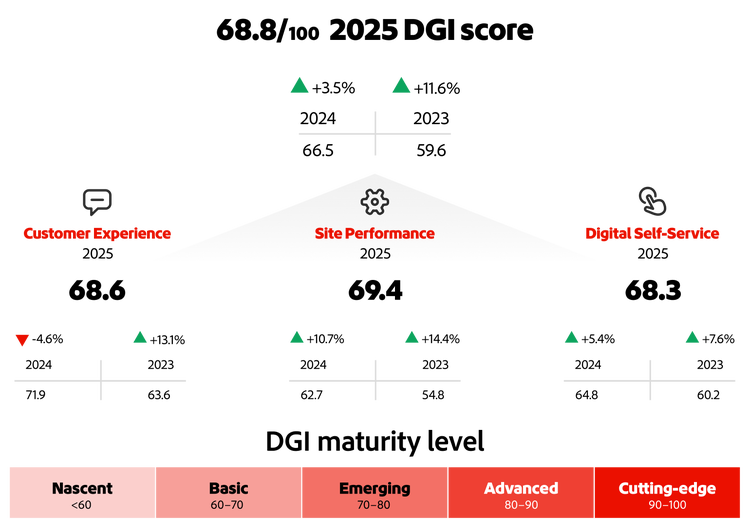

The strongest gains came from Site Performance and Digital Self-Service. Customer Experience, however, moved in the opposite direction. This decline highlights the growing reality facing governments globally that strong technical foundations do not automatically translate into a better citizen experience.

New Zealand’s position among digital leaders

New Zealand continues to compare favourably relative to its regional and global peers. The country ranks second in the Asia-Pacific (APAC) region and remains among the world’s leading digital governments. It achieved the highest Customer Experience score in APAC and second globally, despite a modest decline from 2025.

It additionally ranked second internationally for Site Performance, while the Digital Self-Service result lagged global counterparts including the UK, Australia, Canada and the United States.

The highest-ranking government websites in the study continue to share common characteristics. They provide a clear front door to government services, maintain strong accessibility standards and deliver more personalised experiences that help citizens find relevant information quickly and easily.

AI readiness becomes a new priority

The fundamental measures remain important indicators of digital maturity. However, citizens are no longer interacting with government information exclusively through websites and search engines. As AI-powered assistants become part of how people discover information and navigate services, governments must also consider how their content is found and represented beyond their own digital channels.

This shift is reflected in this year’s DGI through the introduction of an AI readiness assessment.

The assessment evaluates how well government information is positioned to be discovered, understood and trusted within AI-driven environments.

It examines three areas:

  • Trust and authority – the credibility and reliability of government information
  • Technology structure and discoverability – how easily content can be accessed, indexed and surfaced by AI systems
  • Brand and content relevance – whether government information is recognised, referenced and recommended within AI-driven discovery channels

Across the agencies assessed, the average AI readiness score was 57.6/100, with individual scores ranging from 53.0 to 60.8.

The strongest results were recorded in trust and authority. Government websites are widely viewed as credible sources, giving them a significant advantage as AI systems seek trustworthy information. However, organisations scored considerably lower in discoverability and content relevance. This means many agencies possess reliable information that is technically accessible to AI systems, yet that content is not consistently surfaced, referenced or cited within AI-generated responses.

The agencies best positioned for the future will be those capable of combining strong governance, authoritative content and high-quality digital experiences with the technical structures required for AI discovery.

The path ahead

The 2025 DGI results paint a picture of a public sector that is progressing with purpose. Investment in accessibility, service modernisation and shared digital capabilities are delivering measurable improvements across the index.

As AI becomes part of how citizens find information and engage with services, agencies will need to think more broadly about discoverability, authority and content design. The challenge is ensuring those services can be found and trusted wherever citizens choose to engage.

To learn more, download the Adobe Digital Government Index for New Zealand 2025 here.

About the Adobe Digital Government Index for New Zealand

Adobe's Digital Strategy Group developed the annual Digital Government Index for New Zealand in 2025. The analysis covered the official websites of the following New Zealand councils, government departments and ministries: Auckland Council, Inland Revenue — Te Tari Taake, New Zealand Department of Internal Affairs — Te Tari Taiwhenua, Ministry of Education — Te Tāhuhu o te Mātauranga, and Ministry of Social Development — Te Manatū Whakahiato Ora.

Let’s talk about what Adobe can do for your business.

Get started