of citizens globally rank ministry websites as top engagement channels.1


REPORT
Beyond digital: Readying for the AI era.
Fourth edition

JUMP TO SECTION
Foundations for a future-ready public service
The Digital Government Index framework
Progress builds, but evolving user needs reveal new priorities
Building momentum exposes the next wave of challenges
AI readiness in focus: The next horizon for digital government.
Personalisation in focus: Designing government services around people, not processes
The anatomy of best-in-class digital government service delivery
Pathways to experience-driven government
What’s next
The public sector in New Zealand continues to shift from digital enablement to experience-led delivery. What was once a focus on bringing services online is now a drive to shift to a more coherent government model, where digital success is defined by how consistently and confidently citizens interact with public services across their lives.
Adobe’s new Digital Government Index for New Zealand provides a comprehensive view of how ministries and departments are advancing their digital maturity. It examines how public sector organisations can strengthen trust, coherence and relevance as AI increasingly influences how people discover, interpret and interact with government information.
Read the report to see how New Zealand’s leading agencies are aligning strategy, investment and service design to respond to rising expectations and prepare for an AI-enabled future.

The fourth edition of Adobe’s Digital Government Index for New Zealand highlights this progress. New Zealand’s public sector is benefiting from a more coordinated approach to delivery, supported by platforms and programmes that reduce duplication and enable greater interoperability. Investments in the updated Service Modernisation Roadmap, shared components and evolving digital services, including the Govt.nz app and the Ministry for Social Development’s Services for the Future programme, are shaping a more connected and reliable digital landscape.
As the environment becomes more advanced, new opportunities and considerations arise. Supported by the Public Service AI Framework, the New Zealand government is building internal AI capability, guided by safe and responsible implementation. While this investment lays important foundations, it must now be accompanied by a focus on a new external challenge, maintaining discoverability within AI-driven search.
The inclusion of AI readiness in this year’s evaluation reflects this change and highlights the rising importance of ensuring government information and services are easily found, trusted and accurately represented by both humans and machines. Early results show mixed capability, indicating that strong performance in the underlying measures does not automatically guarantee visibility in this emerging landscape. As AI transforms how people search for and consume information, discoverability is a vital complement to AI adoption, requiring agencies to address it intentionally, balancing innovation with clarity, governance and public trust.
Across dimensions, this year’s findings illustrate a sector that is progressing with purpose, strengthening core capability, expanding inclusive design practices and adapting to new modes of discovery and interaction. By continuing to build on these strengths and evolving content, structure and experience design in step with user needs, New Zealand's public sector is well positioned for the next phase of digital government and ready to deliver in the AI era.
New Zealand’s digital transformation programmes are enhancing efficiency through strategic, long-term investments, eliminating overlap, improving interoperability and modernising service delivery. The all-of-government Service Modernisation Roadmap (SMR) v2 coordinates reusable digital components, shared standards and a unified delivery approach across agencies, helping to lower overall costs and speed up procurement and development cycles. Initiatives such as the Govt.nz app, with its digital wallet and credentials, are aimed at unifying access to services. Projects like the Ask Auckland Council AI assistant and Ministry of Social Development (Te Manatū Whakahiato Ora)’s Services for the Future reforms make it easier for people to access services. At the same time, they reduce internal workload and lift productivity across government service delivery.
Recent digital initiatives across the public sector in New Zealand signal a clear commitment to designing services that work for all citizens. Under the SMR, agencies must adopt consistent design and accessibility standards, while the Ministry of Social Development (MSD)-led programmes for accessible information formats ensure services can be delivered in Easy Read, New Zealand Sign Language (NZSL), audio and other inclusive formats. Emerging initiatives, such as the Govt.nz app and the digital identity ecosystem, are designed to be accessible — supporting access across devices, abilities and evolving citizen needs.
As AI increasingly influences how people search for and access government information online, the availability of content to AI-powered tools is becoming a baseline capability for government service design and delivery. Individual agencies worldwide are at different stages of preparedness, creating both risks and opportunities. While AI readiness doesn’t always align with current digital maturity levels, it highlights the importance of building a trusted, unified digital presence that serves both people and machines.
of citizens globally rank ministry websites as top engagement channels.1

of digital-only channel users in New Zealand report high satisfaction, vs. 76% non-digital and 74% mixed2

of citizens globally say agency websites are effective in personalisation3
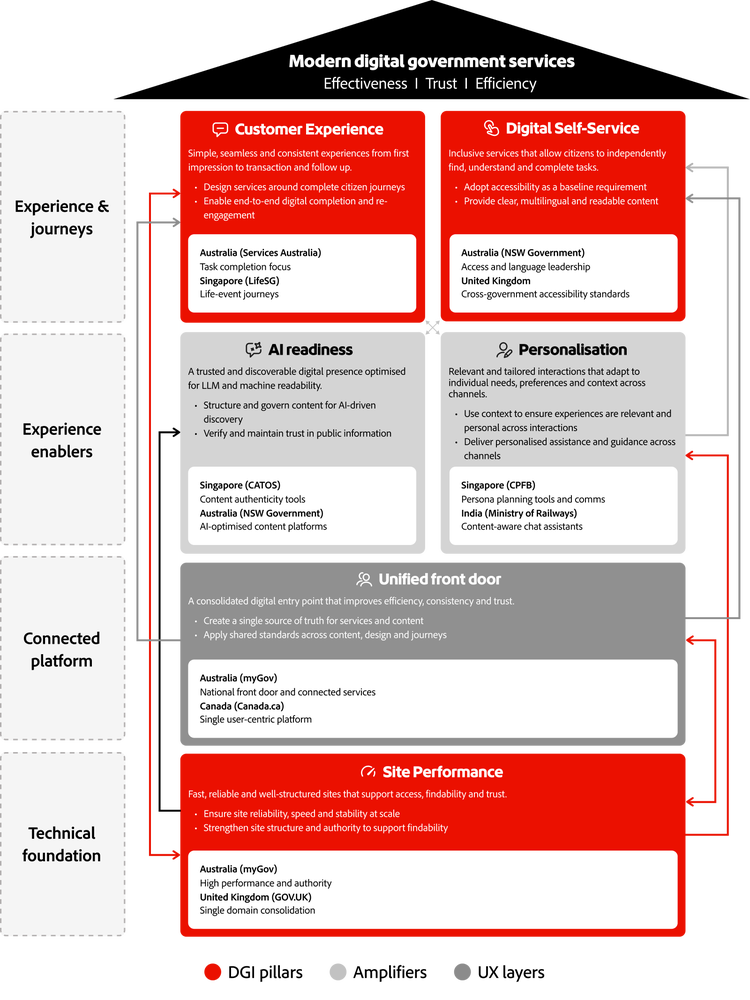
Adobe’s Digital Government Index (DGI) provides a clear view of how well governments deliver online services. It not only benchmarks the digital maturity of departments and agencies but also serves as a practical guide to help identify opportunities to streamline and enhance citizen interactions.
Higher DGI scores translate into better civic outcomes. As more people easily engage with digital services, governments gain efficiency, reduce delivery costs and reinvest in further enhancements.
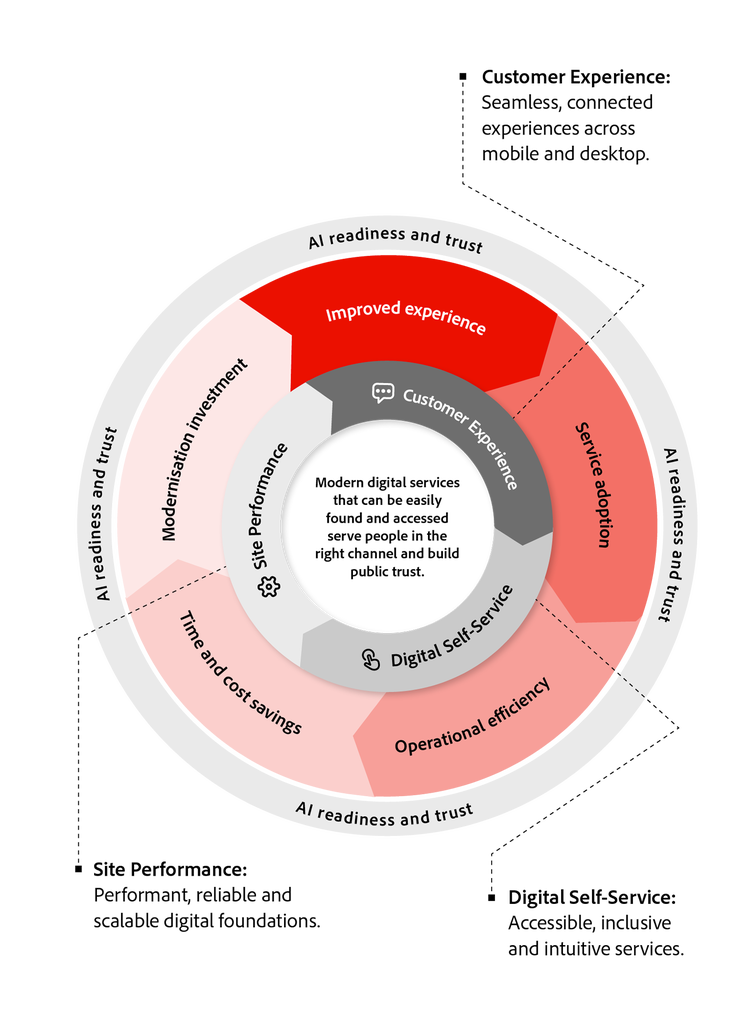
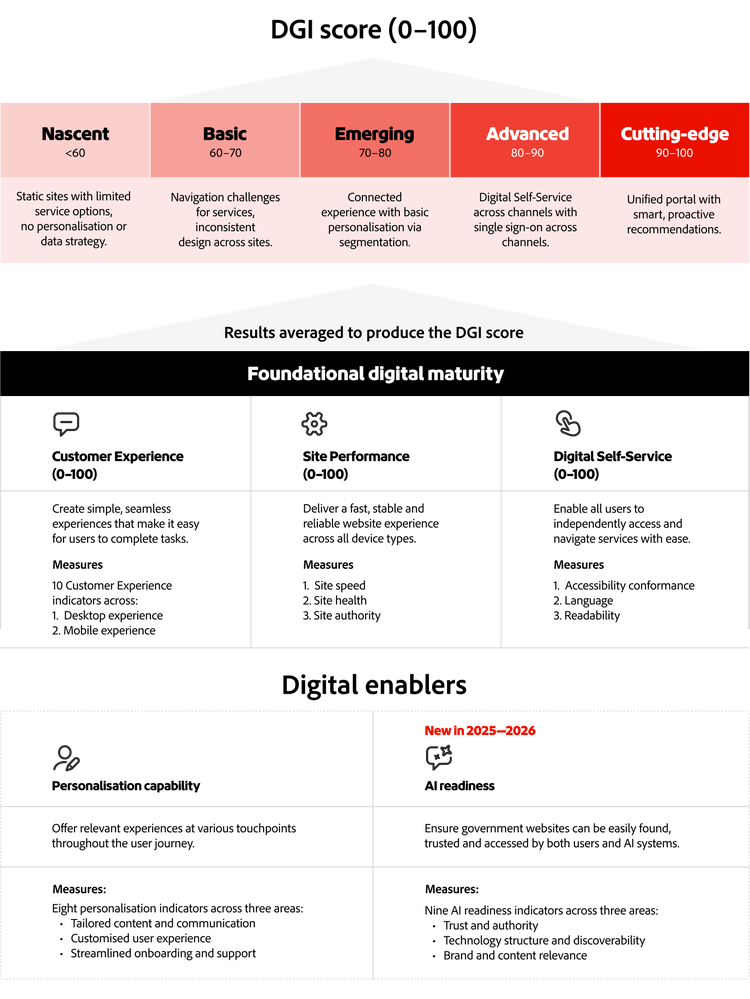
The DGI assesses effectiveness across three interconnected foundational digital maturity dimensions: Customer Experience, Site Performance and Digital Self-Service. It assigns a score out of 100 to each, then averages the results to produce a single index.
To capture what makes services accessible, usable and convenient for all citizens, the report also evaluates two key digital enablers. Personalisation capability, which measures how effectively departments and ministries deliver relevant, user-centred experiences, and AI readiness, which assesses how easily websites can be found, trusted and accessed by both people and AI-assisted search tools.
THE 2025 DGI RESULTS
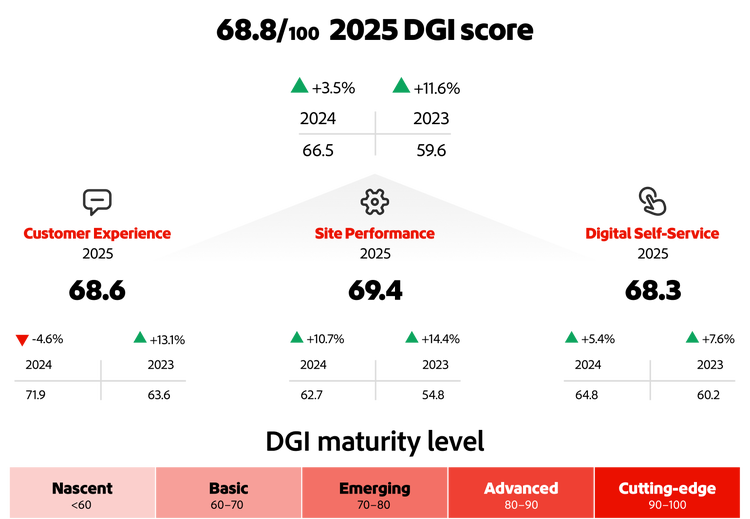
New Zealand’s overall DGI score increased from 66.5 in 2024 to 68.8 in 2025, driven by improvements in Site Performance and Digital Self-Service. These gains reflect a stronger technical baseline, faster and more reliable platforms and continued progress in accessibility and independently navigable online pathways.
Alongside these improvements, the 2025 results show a decline in Customer Experience. While the underlying systems and accessibility measures continue to mature, user experience outcomes have not kept pace. Together, the results indicate a digital environment where capabilities are strengthening, but further attention is required to ensure that improvements in performance and self-service translate into more consistent, intuitive and effective citizen experiences.
In 2025, the DGI assessed the websites of 115 government departments, agencies, ministries and statutory boards across the globe. The United Kingdom (UK) once again took the top spot, supported by strong oversight from the UK Government Digital Service, which helps maintain performance. UK government websites must meet specific accessibility standards and publish accessibility statements, as well as ensure ongoing monitoring and regular updates to make sure these commitments are upheld. This consistency reinforces the region’s ongoing leadership and offers insights into how it maintains the quality of digital services over time.
Across markets, DGI top performers share common traits: They serve as a central front door for citizens to provide a seamless experience across services, they maintain high accessibility standards and they offer more personalised, user-focussed experiences. These qualities explain why they consistently top the index.
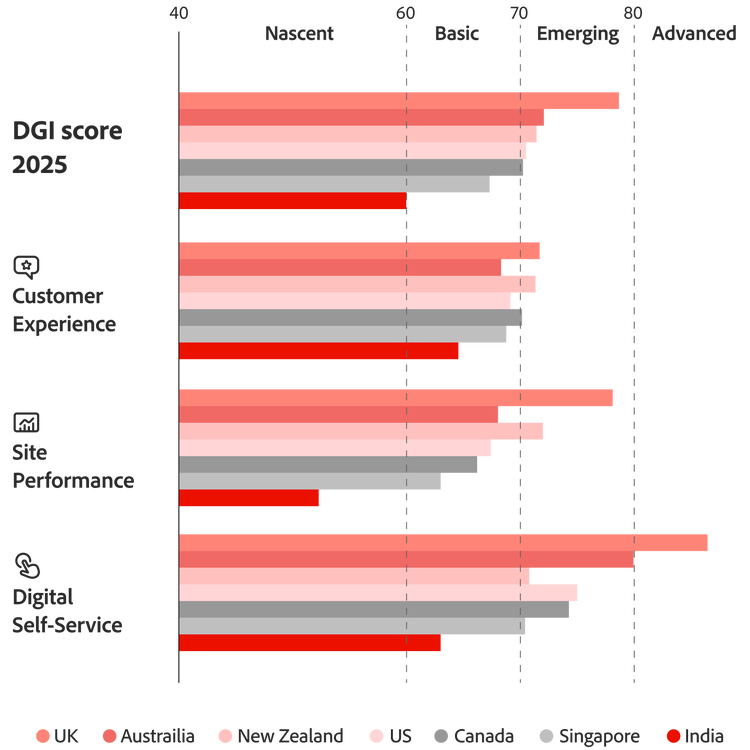
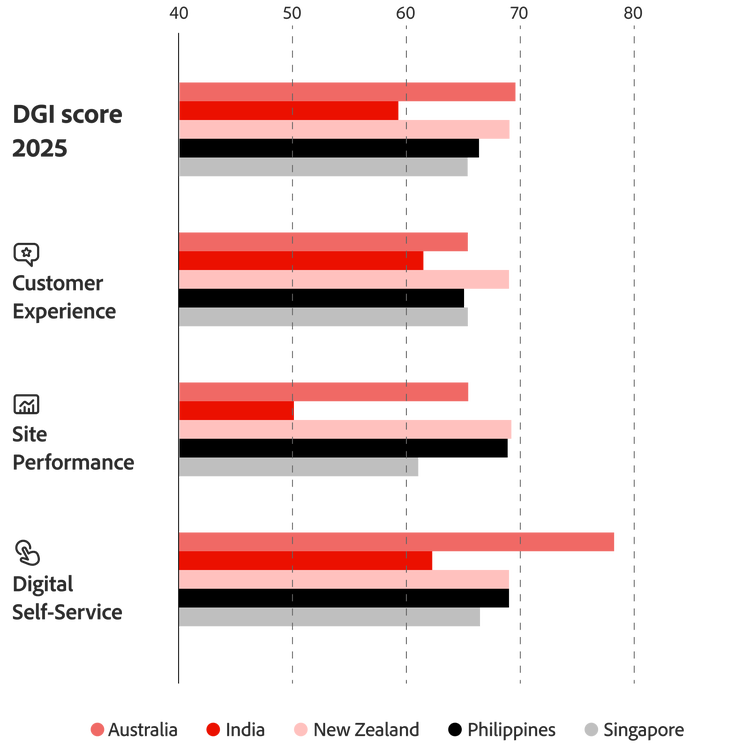
It leads the region in Customer Experience and ranks second globally, highlighting the clarity, usability and inclusiveness of its digital services — even as this measure declined slightly in 2025.
New Zealand also ranks first in Site Performance, demonstrating fast, reliable and well-structured platforms and places joint second in Digital Self-Service, reinforcing its commitment to accessible and independently navigable services.
Collectively, these results point to a digital ecosystem that is maturing deliberately, built on strong foundations and a sustained focus on seamless, citizen-centred delivery at scale.
UNPACKING PERFORMANCE
Customer Experience assesses how effectively governments deliver simple, seamless online interactions that enable users to complete tasks efficiently. It is evaluated across mobile and desktop devices, accounting for digital diversity and examining how an individual’s unique circumstances — including any visual, cognitive, motor or hearing differences — influence their experience.
New Zealand’s 2025 DGI Customer Experience score was 68.6, a 4.6% decline overall, with individual agency scores ranging from 64.8 to 73.6. Several general factors can contribute to lower performance in online customer experience. For example, experience declines when content, navigation or functionality is confusing, cluttered or slow. On desktop, excessive text, complex menus or poor layout can make it more difficult for users to find information efficiently. On mobile, issues such as small clickable areas, slow loading times or pages that aren’t responsive to screen sizes can frustrate users and increase abandonment. Across both device types, inconsistent design and inaccessible content reduce usability, making the overall experience less satisfying.
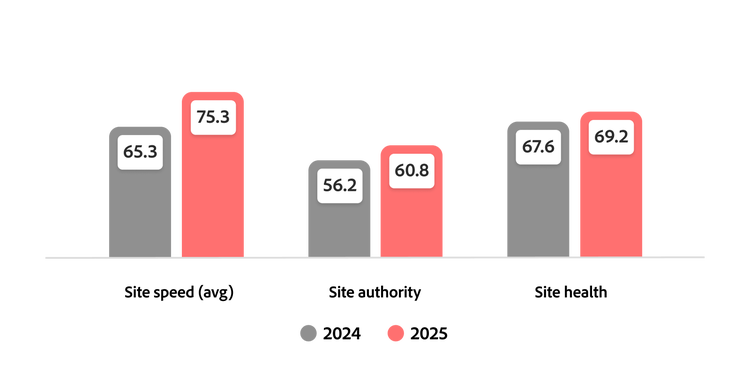
Site Performance is assessed using three measures: site speed, site authority and site health. Site speed measures how quickly a website loads on mobile and desktop devices. Site authority reflects a site’s credibility and potential to rank in search results, largely driven by backlinks. Site health captures broader technical quality, including security, content and site structure. Together, these factors influence both user experience and search visibility.
The 2025 Site Performance result improved, driven by gains across all three sub-measures. Both desktop and mobile site speeds increased, suggesting system optimisations such as infrastructure improvements, enhanced caching and more efficient third-party integrations. A corresponding lift in site authority suggests that departments and ministries are strengthening their digital presence through improved content, stronger backlinks and reduced fragmentation across multiple sites. Meanwhile, improved site health suggests that security vulnerabilities and technical errors have been reduced.
The three sub-measures are interrelated — faster load times improve user experience and site health, while a technically sound site is easier to index and rank, indirectly supporting stronger authority. Although each metric can be improved individually, a truly high-performing site requires attention to all three. As this report explores in more detail, poor results in any of the Site Performance metrics can impact an agency’s AI readiness, as AI-powered search prioritises fast, reliable sites with strong authority.
The Auckland Council’s digital initiatives, including the rollout of consolidated platforms such as the myAUCKLAND portal and the Welcome to Auckland guide, strengthen the structural and technical fundamentals that drive better Site Performance results. By moving towards modern, modular technology stacks and rationalising older, fragmented properties into unified digital experiences, the council reduces bloat, simplifies delivery pathways and enables faster load times, directly enhancing site speed.
The Digital Self-Service assessment measures how easily users, including those with diverse needs or who use assistive technologies, can locate and navigate government services independently. It evaluates three areas:
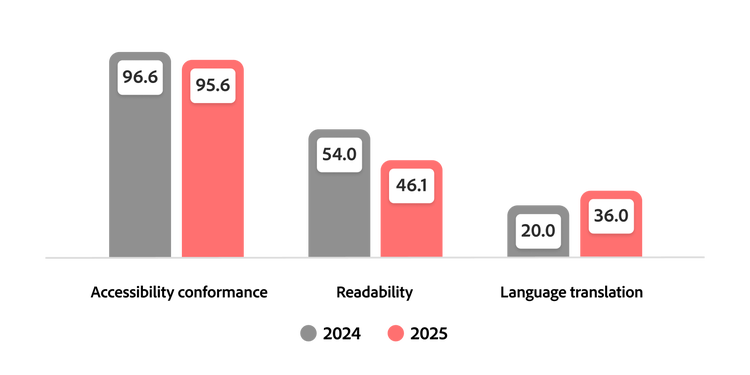
New Zealand’s Digital Self-Service result paints a mixed picture. Accessibility conformance and mobile friendliness remain at near-perfect standards, reflecting a strong commitment to inclusive design principles and consistency across devices. There is also a significant improvement (+80.5%) in language translation capabilities, indicating substantial progress towards reaching a broader, more diverse audience.
However, readability has decreased by 14.6%, dropping the average below 50, with agency scores ranging from 28.4 to 55.7. The test rewards clarity and penalises dense or complex writing, including the use of jargon. This highlights the need to simplify language and structure and to prioritise communication that enhances accessibility and usability.
The overall results indicate that, although services are improving technically, the way information is written and presented is becoming harder for some users to understand. This points to a need for renewed focus on clarity and emphasises the importance of ongoing improvements to maintain effectiveness.
Inland Revenue (IR)’s continued investment in end-to-end digital services, alignment with all-of-government standards and participation in a shared platform under the SMR directly support strong performance across accessibility, language and readability metrics. By standardising service design, content structures and interfaces across its online channels, the agency improves accessibility conformance. Centralised digital platforms and reusable components make it easier to introduce and maintain multilingual content and translation capabilities at scale. Together, these initiatives create more inclusive, readable and adaptable digital services.
AI READINESS IN FOCUS
Globally, efforts to embed AI into government service delivery are hampered by budget limitations and fragmentation stemming from legacy systems and organisational constraints.4 The New Zealand public sector has directed effort towards initiatives supported under the whole-of-government SMR (v2) and Public Service AI Framework, including the evolution of the Govt.nz app as a central digital front door for citizens. Underpinning these programmes and rollouts is a clear understanding that well-structured data and content are essential to AI-supported service delivery.
While these inward-facing endeavours have been developed and deployed, a new external challenge has emerged. As citizens increasingly turn to AI assistants and agents to find and access information and services, government content must be discoverable, trusted and accurately presented by AI-powered search engines and other tools, just as it is by human users. AI readiness is now a critical driver of effective and accessible digital government.
In response to this shift, the 2025 DGI introduced an assessment to measure how effectively government websites perform in an AI-driven landscape. Alongside measures of foundational digital maturity, it evaluated how well government websites can be found, trusted and used by both people and AI systems. It examined three areas:
By bringing these measures together, the evaluation not only reveals the current performance of government websites but also their readiness for an AI-enabled future.
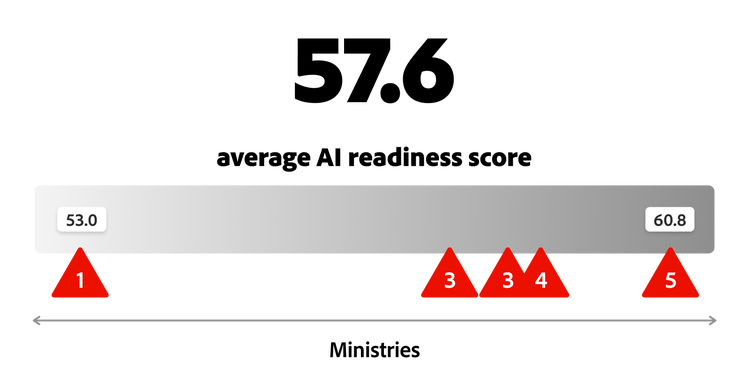
The AI-readiness scores range from 53.0 to 60.8, reflecting the diversity of agency roles. Government websites that offer open, unauthenticated services or public information tend to perform more strongly on some AI-readiness measures, as their content is easier for LLMs to find and reference. In contrast, service delivery ministries that operate behind secure logins naturally score lower on specific indicators, though it does not imply lower overall digital maturity.
When New Zealand’s agencies are assessed across the three AI-readiness pillars, trust and authority scored the highest on average. This means that government information is seen as credible and reliable, making it a trusted source for AI tools when responding to queries. Agencies also perform strongly on crawlability under the technology structure and discoverability pillar, meaning their information is technically accessible to AI systems. However, AI visibility under the same pillar is low. This lowers the overall technology structure and discoverability pillar score and, more importantly, means that trusted government information is not being consistently surfaced in AI-generated responses.
Brand and content relevance is the lowest-scoring pillar in the AI-readiness evaluation. While some government websites demonstrate strengths, including high brand recognition, low citation scores and uneven LLM traffic referrals mean their content is not being consistently found or referenced by AI systems. This reduces their visibility and effectiveness in AI-generated responses, despite their credibility as sources.

Inland Revenue (IR)’s focus on modernising digital services and adhering to the SMR strengthens performance across measures of credibility, machine accessibility and AI search trust. As a long-established statutory authority, IR already benefits from a highly credible and authoritative domain. Consolidating services onto secure, standardised digital platforms reinforces reliability through consistent governance, data integrity and up-to-date content.
PERSONALISATION IN FOCUS
As expectations for digital government continue to rise, personalisation has become an integral lever for reducing friction and improving citizens' interactions with public services. When departments recognise individual circumstances, such as life stage, location, language needs or prior government engagement, services become easier to navigate, more relevant and less time-consuming.
To assess how consistently personalisation is implemented across the public sector, Adobe analysed digital service interactions across the citizen journey, gaining insights into each agency’s specific capabilities. Among the agencies evaluated, average scores range from 37.5 to 68.8, highlighting inconsistent adoption and a significant opportunity to improve performance across the system.
The analysis shows that personalisation is most commonly embedded at the start of the journey. Services and updates, site search and login experiences are the areas where tailored content, contextual prompts and pre-filled information are most frequently observed. These early-stage capabilities help users orient themselves quickly and reduce the effort required to access information or initiate tasks. In contrast, later stages, including registration, form completion and assisted support, show more limited and inconsistent use of personalisation, reflecting the complexity of delivering coherent, end-to-end experiences.
Progress in this area is linked to the strength of New Zealand’s shared digital foundations. Investments under the SMR, the use of reusable platforms and components and the continued evolution of digital identity and credential services are enabling government departments and ministries to personalise experiences more safely and consistently. Together, these initiatives support the delivery of more responsive, context-aware services while maintaining high standards of privacy, security and public trust.
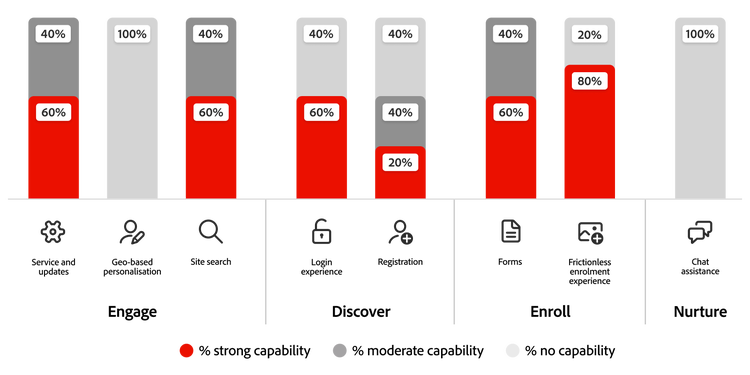
Inland Revenue demonstrates moderate to strong capability across most stages of the citizen journey. The myIR personalised digital portal provides users with a single view of their situation, including entitlements, tax, student loans and the KiwiSaver retirement savings scheme, all accessible through one dashboard. It offers tailored actions based on users’ status and obligations, delivering contextual services that emphasise different tasks depending on employment status. It also provides personalised guidance and decision support, along with proactive reminders and nudges linked to specific obligations and timelines of users.
• Slow site speed creating barrier to access
• Accessibility not consistent across ministries
• Ensure site reliability and stability to support increased site traffic
• Adopt accessibility
Reduced:
• Call centre volumes
• Pages per visit
• Returning visitors
Visit duration:
• Abandoned forms
• Customer complaints
Increased:
• Transactions initiated
• Transactions completed
• NPS
• Trust
• Low search authority impacting findability of content
• Content not optimised for LLM or AI-led discovery or agentic AI
• Inconsistent tagging or metadata
• Single source of truth for content across all areas and level of government
• Structure and tag content using machine-readable metadata
• Distributed authoring and approval capabilities with LLM publishing workflows
• Use AI to ensure adherence to brand and tone guidelines
• Verify AI-generated and summarised content using data provenance tools
Reduced:
• Call centre volumes
• Pages per visit
• Returning visitors
Visit duration:
• Abandoned forms
• Customer complaints
Increased:
• Transactions initiated
• Transactions completed
• NPS
• Trust
• Content not optimised for mobile
• UX is not optimised for mobile
• Mobile features are not utilised fully in design
• Design adaptive experiences optimised for mobile devices
• Enhance mobile security and login simplicity
• Provide voice and chat-based support to improve access
Reduced:
• Call centre volumes
• Pages per visit
• Returning visitors
Visit duration:
• Abandoned forms
• Customer complaints
Increased:
• Transactions initiated
• Transactions completed
• NPS
• Trust
• Citizens must repeatedly provide information
• Limited access and automation of application process
• Citizens unable to re-engage life journey from where they left off
• Lack of personalisation in digital interactions
• Drive end-to-end digital service completion enabled by automation and AI
•Use context to ensure each citizen’s experience is relevant and personal
• Deploy generative AI to simplify forms and scale personalised communication
• Connect and share citizen data across the government based on privacy and consent
Reduced:
• Call centre volumes
• Pages per visit
• Returning visitors
Visit duration:
• Abandoned forms
• Customer complaints
Increased:
• Transactions initiated
• Transactions completed
• NPS
• Trust
• Content not available in all languages
• Content is not suitable for lower literacy levels
• Content is not tailored for individual groups
• Provide multi-lingual and multi-modal content using AI or translation services
• Use AI-driven voice functionality or natural language chatbots with multi-lingual support
• Generate simplified summaries for low-literacy audiences and LLM consumption
• Provide the ability to have content served in easier to read formats or in video
• Personalise content based on preferences and behaviours of citizens to ensure timely support
Reduced:
• Call centre volumes
• Pages per visit
• Returning visitors
Visit duration:
• Abandoned forms
• Customer complaints
Increased:
• Transactions initiated
• Transactions completed
• NPS
• Trust
Every year, Adobe’s DGI evaluation aims to deepen the understanding of how digital government services are evolving in New Zealand and internationally. While progress in building digital maturity continues at a steady pace, the most recent results reveal that delivering truly user-centric digital services remains a complex challenge and highlights an opportunity to offer more seamless, tailored and consistent citizen interactions.
We partner with government ministries and statutory boards to embed the index framework and strengthen ownership across the citizen journey. By leveraging digital enablers, such as personalisation capability and AI readiness, we help build the digital maturity required to deliver services that meet citizen needs — today and in the future.
To understand how your benchmarking performance compares and discuss specific opportunities, please contact John Mackenney at mackenne@adobe.com for a preliminary discussion.
Adobe's Digital Strategy Group developed the annual Digital Government Index for New Zealand in 2025. The analysis covered the official websites of the following New Zealand councils, government departments and ministries:
Each of the three foundational digital maturity dimensions was assigned a score between 0 and 100, with the average producing the overall DGI score.
The team also analysed two digital enablers using the following methods: