


Watch the Adobe Summit session to see how Lumen is using Adobe GenStudio for Performance Marketing and agentic AI to transform account-based marketing.
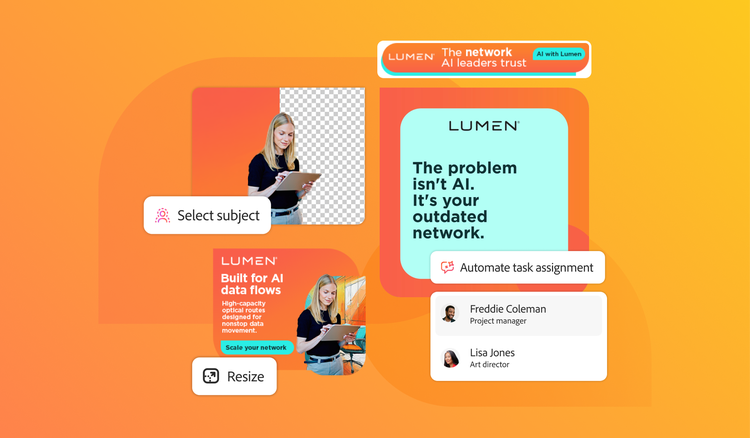

70 hours
saved per campaign concept
15x
increase in social content scale
$5 million
in annual savings

“We didn’t drop AI on top of the old process; we redesigned the process around it. AI handles the rote work, while our people own the idea, the story, and the judgment about what’s good. Humans lead; agents accelerate.”
Ryan Asdourian
EVP & Chief Strategy & Marketing Officer, Lumen Technologies
AI and people power a new marketing model.
Lumen Technologies provides the network infrastructure behind the AI economy. But bringing that same speed and intelligence to its own marketing operation presented a different kind of infrastructure challenge.
Lumen markets across five personas, seven verticals, and three stages of the customer journey. A single account-based campaign can require more than 1,200 assets. Like marketing organizations everywhere, its teams were being asked to deliver increasingly personalized experiences across more audiences and channels — without increasing budgets and headcount at the same pace.
“Every CMO I talk to is staring at the same math problem: demand for content is going up, but headcount isn’t,” says Ryan Asdourian, EVP and Chief Strategy and Marketing Officer at Lumen. “You can’t hire your way out of that, and you can’t burn your team out trying.”
Lumen had already built a connected, Adobe-powered content supply chain to help teams create, approve, and scale on-brand campaigns faster. Now, Moria Fredrickson, Vice President of Brand and Digital Experience at Lumen, and her team saw an opportunity to rethink the operating model itself — bringing people and AI together to reduce repetitive work, accelerate production, and scale personalization.
The ambition wasn’t simply to make more content faster. It was to build a marketing operation designed for a new era — one where AI handles more of the production burden while people stay focused on customer insight, storytelling, creativity, and judgment that differentiate the brand.
Scaling personalization without scaling the burden.
For Fredrickson and the teams bringing Lumen’s marketing experiences to life, the challenge wasn’t a lack of ideas. It was everything required to turn those ideas into hundreds — or thousands — of relevant, on-brand experiences.
For Lumen’s “Waves” campaign, that meant creating dozens of personalized versions across LinkedIn, Meta, and display, all while keeping the creative relevant and consistent for each audience.
Copywriters, designers, marketers, and operations teams spent valuable time creating versions, resizing assets, setting up projects, and tracking approvals. Every additional audience and channel multiplied the production burden.
“We had been trying for years to tailor our campaigns to every audience, but doing it manually had become nearly impossible,” Fredrickson says. “We were executing version after version to keep up, and it was taking too much time away from our strategic and creative work.”
Yet scale couldn’t come at the expense of the brand. Every experience still needed to feel relevant, consistent, and distinctly Lumen.
“If we got this wrong, we weren’t just missing a number,” Asdourian says. “We would be putting the brand and the trust we’ve earned from our customers at risk.”
The opportunity was to redesign the content supply chain around what people and AI each do best —keeping human creativity and judgment at the center while using AI to remove friction from the work around it.
The human + AI operating model.
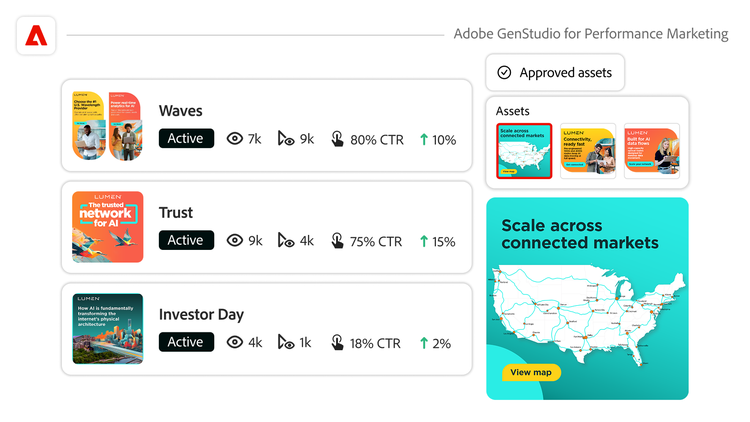
For Fredrickson and her team, this new process begins with the decisions only people can make. Campaign teams define the customer, strategy, story, and creative direction. Designers build the core visual system in Adobe Creative Cloud while copywriters and strategists shape the messaging.
From there, every step in the content supply chain shares the same brand context, audience data, and approval workflow — so what the creative team sets in motion stays connected as it scales across channels and teams.
The brief flows into Adobe Workfront, where connected workflows automate project setup, task coordination, and approvals — giving project managers and teams earlier visibility without chasing updates. That integration alone moved workflows roughly 50% faster by eliminating the lag between briefing and project setup.
With the creative direction set, designers use Adobe Firefly Custom Models to extend approved concepts across formats and audiences. Because the model is trained on Lumen’s approved brand assets, teams produce on-brand variations instead of correcting generic outputs later, saving approximately 70 hours per campaign concept. Designers remain responsible for the creative idea and quality, while AI accelerates the production that follows.
Approved copy, imagery, and templates then move into Adobe GenStudio for Performance Marketing, where content marketers can quickly adapt campaign variations for different personas and channels. Adobe Real-Time CDP brings together customer data and audience segments, while Adobe Target helps personalize and optimize experiences in market. Together, they connect audience intelligence with content and performance insights to help marketers deliver more relevant experiences.
As more of Lumen’s growth, solution, and mass marketing teams take part in content creation, Adobe Express for Business makes brand standards easy for non-designers to apply. Locked templates and brand kits allow them to create on-brand content quickly and confidently. Approvals route through Workfront, while assets feed into GenStudio for Performance Marketing to keep the content supply chain connected.
“We didn’t drop AI on top of the old process; we redesigned the process around it,” Asdourian says. “AI handles the rote work, while our people own the idea, the story, and the judgment about what’s good. Humans lead; agents accelerate.”

“The hidden win is how Adobe lets us combine the ingenuity of our team with the processing power of AI, so each can focus on the work they do best. That has allowed our teams to unlock their creativity in new ways, with more time to innovate, grow, and think strategically.”
Moria Fredrickson
Vice President of Brand and Digital Experience, Lumen Technologies
Turning greater capacity into lasting momentum.
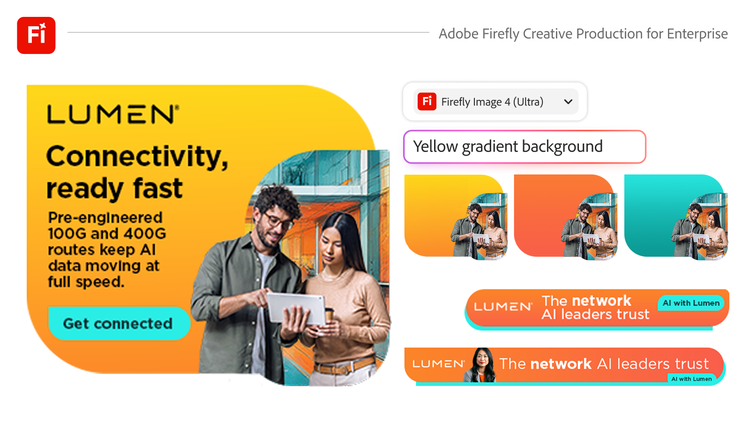
Lumen’s AI-powered workflow is changing both the pace of production and the work people have time to pursue. Automated content production through Adobe Firefly Creative Production for enterprise has brought creative production in-house, saving an estimated $5 million annually. People retain control of creative direction, review, and approval, while automation reduces repetitive production work, and that capacity can be redirected toward higher-value creative and marketing work.
Firefly Creative Production for enterprise is a key part of that shift, bringing repeatable creative production workflows in-house and automating work that previously required teams to manually build and adapt asset after asset. Once creative direction is established and core assets are approved, Lumen can use those workflows to scale multiple variations of creative across audiences and channels without requiring creative resources to grow at the same rate.
“The hidden win is how Adobe lets us combine the ingenuity of our team with the processing power of AI, so each can focus on the work they do best,” Fredrickson says. “That has allowed our teams to unlock their creativity in new ways, with more time to innovate, grow, and think strategically.”
Linear handoffs have given way to a connected, real-time workflow that keeps creatives, marketers, operations teams, and AI systems aligned from concept through execution.
As teams reclaim that capacity, they can scale content without scaling the production burden. Lumen has achieved a 15-fold increase in social content scale, with content marketers producing email campaigns 5 to 10 times faster than before. That model is already supporting business growth. Lumen’s order-booked sales increased 292% in the first half of 2026 compared with the same period in 2025.
Leading into the agentic era.
Looking ahead, Lumen plans to deepen AI-powered personalization and testing through Adobe Target and Firefly; expand GenStudio for Performance Marketing into additional channels, including early work on AI-driven CTV ad creation; and extend Adobe Firefly Services and APIs. As Adobe adds capabilities such as Adobe Brand Intelligence, AI Collaborators in Adobe Workfront, and Adobe CX Enterprise Coworker, Lumen sees an opportunity to connect intelligence across even more of its planning, production, and optimization workflows.
“Where we’re headed is a human plus AI advantage that runs across everything,” Asdourian says. “The principle doesn’t change as we scale — Coworker agentic workflows carry orchestration, and our people carry the ideas.”
By building this model inside its own marketing organization, Lumen is bringing its operations closer to the future it helps customers create. Humans lead; agents accelerate — and Lumen is living that principle before it asks anyone else to.
Recommended for you
Title
Lumen builds an agent-powered content supply chain.
cardDate
2026-10-28
cardImage
CardDescription
Lumen connects teams and AI using Adobe GenStudio, Workfront, Firefly, and Express.
primaryTag
caas:content-type/customer-story
Tags
caas:content-type/customer-story, caas:products/genstudio, caas:products/workfront, caas:products/firefly, caas:products/creative-cloud-for-enterprise, caas:products/adobe-express, caas:products/adobe-real-time-cdp, caas:products/adobe-target, caas:products/content-supply-chain, caas:industry/telecommunications

