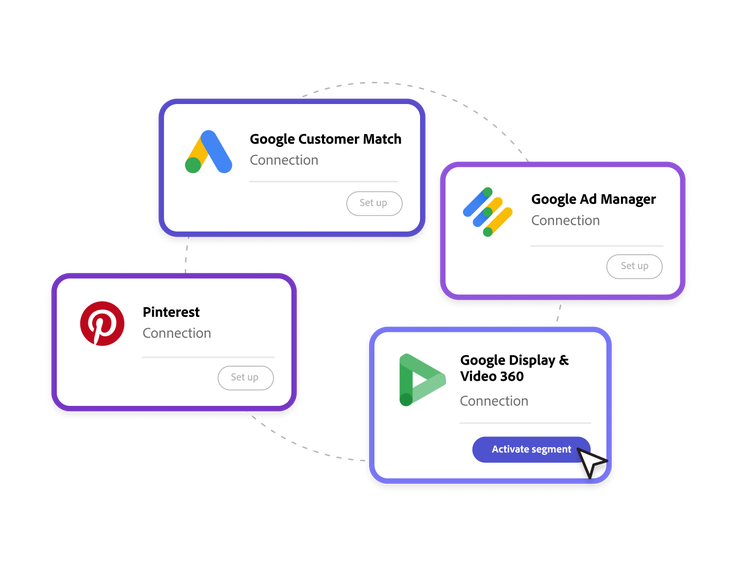
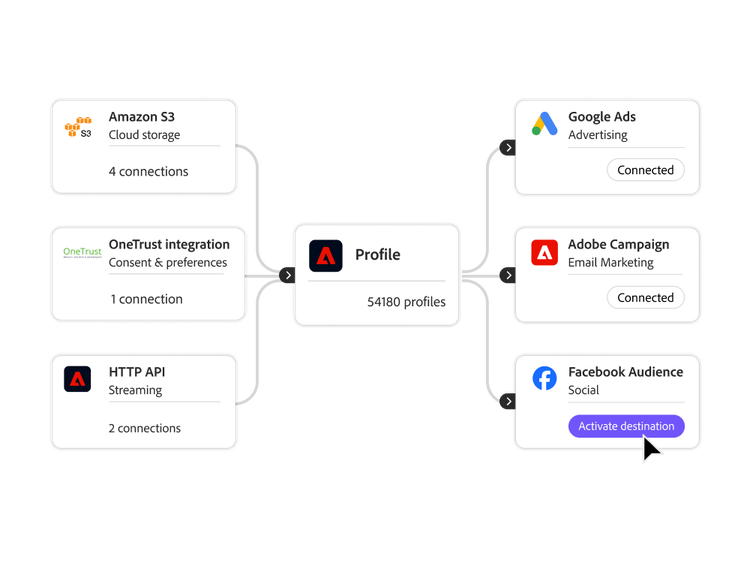
It means you can send the audiences you build to a wide range of destinations, both Adobe and non-Adobe and act on them on your own properties in real time.
Real-Time CDP connects to a large ecosystem of prebuilt destinations, from paid media and social platforms to email, call centres and connected devices and it also drives on-site and in-app personalisation directly. Activation covers full-profile integration, not only forwarding event-level data, so the enriched profile you built is what reaches each channel.
Real-Time CDP activates audiences (it sends a defined group of profiles to a destination for targeting), while
Journey Optimizer orchestrates journeys (it decides the next step, message and timing for an individual across a multi-step flow). Activation answers "who should this campaign reach"; orchestration answers "what happens next for this person and when."The two are complementary and share the same Real-Time Customer Profile, so an audience activated from Real-Time CDP can also be the entry point to a Journey Optimizer journey without moving data between tools.
Adobe Real-Time CDP Collaboration is a data clean room application for reaching audiences through advertising and publisher partners, whereas standard activation sends your own audiences to your own destinations. In Real-Time CDP Collaboration, you and a partner match and analyse audiences in a privacy-safe environment (using algorithms that represent audiences without moving or exposing the underlying customer data), then discover overlaps, activate to the partner's channels and measure results, all without third-party cookies. It is currently in limited availability by region, so confirm availability for your market with your Adobe representative before planning on it.
Yes, through
Adobe Real-Time CDP Connections, the data-collection layer that captures streaming behaviour through Adobe's Edge Network and updates the profile in real time, which is what enables same-page and next-page personalisation on your own properties. Because qualification can happen in the moment, a visitor's action can change what they see in the same session, rather than waiting for a batch process to catch up. This is the on-property side of activation, complementing the destinations you send audiences to.
Yes,
governance travels with the data into activation, so the labels, policies and consent rules you set are enforced at the moment an audience goes to a destination. You assign marketing actions to each destination and if an activation would violate a data usage policy or a consent state, it is blocked and the reason is shown. This means "activate anywhere" does not mean "activate without controls"; the same enforcement that governs the profile governs where it can go.