Like most marketers, I thought AI was going to change everything overnight. Write my copy. Generate my images. Brainstorm campaign ideas. Optimize performance. It felt like a cheat code for marketing. And to be fair, it can do all of those things. It's made it easier to get started, explore ideas, and punch above your weight, especially if you're on a smaller team.
But two years in and I'll be honest: the reality is a bit more nuanced.
The problem isn't whether AI can produce outputs. It's whether those outputs actually hold up when you're trying to run real campaigns, under real constraints, with little time to spare. Because when you're on a lean team, "almost there" is still quite far.
Where AI helps (and where it falls short).
Let me walk through where AI has actually landed for me and most of the growth marketers I talk to.
Across the board, AI is excellent at getting you started. Need email copy? You're out of the blank page instantly. Need creative? You've got options in seconds. Need campaign ideas? It'll give you a solid list to react to.
That alone is a big deal. For small teams especially, removing that initial friction is half the battle. But getting started and getting something out the door isn't quite the same thing. There's usually a gap between the first output and something you feel confident about actually using, whether it's tone, fit, or just a sense that it's not quite there yet. So, you make a few tweaks. Then a few more. Then you pause and wonder if you're helping the tool, or if the tool is helping you.
The real constraint: Context.
The issue isn't that AI isn't powerful enough. It's that it doesn't have enough context.
We had a customer recently share their experience trying an AI feature on a non-Adobe marketing platform. They gave it a detailed prompt: define a segment of users on a free plan, last active between 30 and 60 days ago, with a product engagement score above 70. All the variables were there. The output was, in their words, nonsensical — it returned a segment that included recently active paid users and excluded most of the free-tier accounts they were trying to reach. Their reaction was, "I'll never use this again."
That's the risk with AI in marketing. The first experience matters. If the output isn't trustworthy, adoption stops before it starts. AI is intelligent, but it's not omniscient. The difference between a helpful output and a useless one is the same as the difference between asking a random person for advice versus asking a coworker who knows your business inside and out.
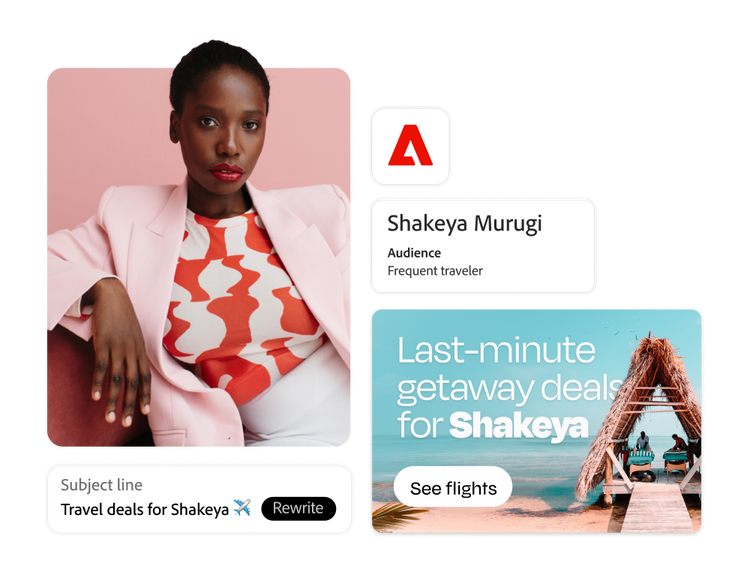
Marketing is an inherently context-heavy discipline. The old adage — the right message, to the right person, at the right time — is fundamentally a data and context problem. Personalization isn't a tactic anymore; it's the baseline expectation, and executing it requires knowing your customer data, business logic, past performance, and brand inside and out. That's a lot of context. Too much to paste into a chat window. For most mid-market teams, there isn't a budget to waste on broad, generic campaigns. Precision matters. Context isn't just helpful — it's the job.
Introducing Adobe CX Enterprise Coworker: Marketing at the speed of thought.
That realization shaped how we have approached AI for marketing.
The challenge wasn't building another tool that could generate copy, images, or campaign ideas. Plenty of tools can do that. The challenge was building something that understands enough about your business to generate outputs you can actually use.
We understand that building these workflows can take time and expertise to develop, so Adobe simplified the creation of agentic workflows with a pre-packaged campaign module for more agile teams.
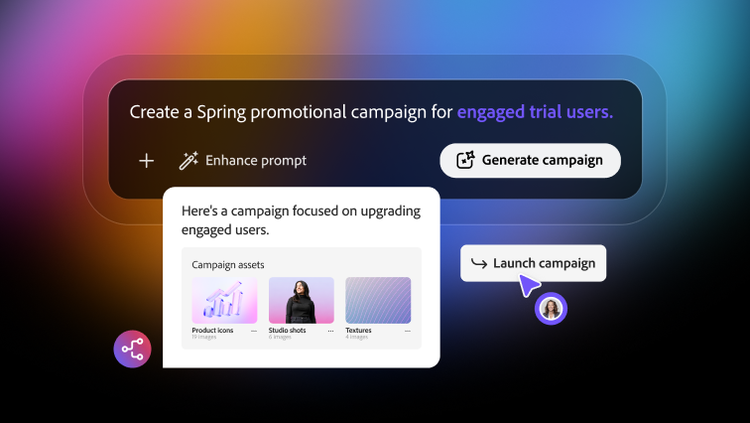
Within CX Enterprise Coworker, a "Campaigns" module operates out-of-the-box with the essential components of a campaign ready to deploy from a single prompt. Instead of navigating menus, configuring rules, and stitching together workflows, marketers simply describe what they're trying to accomplish. Upload an audience and the system uses your brand's URL to generate assets and recommend a campaign end-to-end.
In other words, we didn't just add AI to the workflow. We reimagined the marketing campaign workflow around a conversation with a marketing expert.
What you can do with the Campaigns module.
Adobe's new offering is a paradigm shift for agile marketers, letting them now generate entire campaigns from a single prompt.
We've created a marketing-native LLM, one that isn't reasoning from general knowledge but from the specific context of your business — your customer segments, past campaigns, brand assets, offers, and current journeys. This is vibe marketing: the ability to move from intent to execution at the speed of a conversation, without sacrificing the intelligence and personalization that actually drives results.
For marketers on lean teams who need value from AI today, here are the skills we've pre-packaged:
- Brand kit assembly: Uses your URL to build a brand context layer with fonts, colors, images and even tone of voice to inform every output.
- Campaign plan creation: Recommends a plan and set of discrete tasks for your objective.
- Content generation: Generates on-brand assets specific to the audience and campaign objective.
- Journey design: Places generated content into a customer journey, including sequencing.
- Analytics and insights: Through natural language queries, ask what's working, what isn't, and why.
What this looks like in practice.
The clearest way to show the difference is through a real campaign scenario. Consider a free-to-paid conversion campaign, the kind every B2B SaaS marketer knows well, and knows it is painful to build properly.
In the past, you'd build a rule like this:
IF customer_segment = "free_users"
AND subscription_expiry = "May 2026"
AND engagement_score ≥ 80
THEN enroll in journey = "paid_conversion_v3"
WITH offer = "first_year_discount_20pct"
That rule took someone an afternoon to build properly. They had to figure out the right engagement score threshold (is 80, right? Maybe it should be 70?), identify an existing, high-performing journey for this use case, find and validate the offer code, test the segment before launch, and manually QA the trigger logic.
With CX Enterprise Coworker, we want you to simply describe your goal: "I want to convert free users who are most likely to pay before their trial ends in May. Use our best-performing offer."
The system would then analyze your audience list, historical conversion rates, available journeys, and active offers. Using all of this context, CX Enterprise Coworker would build the campaign and recommend thresholds based on past performance data.
Go from manual workflows to agile customer engagement — designed for lean teams, powered by AI.
We believe this conversational way of working represents a shift in how work gets done. It makes sophisticated marketing strategies easier to execute and iterate on — even for small organizations. Campaigns like welcome series, win-backs, product education flows, and product announcements can be built and refined in minutes instead of days.
For agile marketers navigating complex stacks and increasing performance pressure, it's not just another feature. It's a new way to work.
CX Enterprise Coworker Campaigns is now available, and you can test it out for yourself during a free trial* where eligible teams can get full access to the product experience as we continue to shape the future of AI-powered customer engagement.
Whether you're looking to move faster, do more with lean teams, or simplify how campaigns get built and optimized, now is the time to see what a conversational approach can unlock.
* Free trial available from June 11, 2026 through October 1, 2026. Trial includes full access to all available product features. Limited to 5,000 emails per month, one instance per user (subject to change). A business email address is required for signup. Upgrade to a paid plan is not currently available.