Summary of key findings.
Marketers are betting on AI with real optimism and rapid adoption. Teams expect budgets, content output, and automation to grow, but their confidence rests on assumptions about consumers that don't always hold up.
To understand how marketers are planning for 2027, and how their plans align with consumer expectations, Adobe surveyed more than 1,500 US respondents (502 marketing professionals and 1,011 general consumers). The findings were analyzed by industries and generations to identify market- and audience-specific trends.
- Half of marketers (50%) feel more confident about 2027 than they felt about 2026, while only 17% feel less confident.
- AI tools and automation (74%) represent the largest planned increase in investment among marketers for 2027, ahead of content production (58%) and data and analytics (55%).
- Marketers estimate that the median share of automated marketing tasks will increase from 20% at present to 35% by the end of 2027.
- Consumers say competitive pricing (79%) will be the number one driver of loyalty in 2027, but only 48% of marketers say the same.
- Accuracy and credibility (66%) are the leading factors that consumers believe will determine whether content is worth their time and attention in 2027.
- Consumers say that products failing to match their marketing claims is the number one reason they would lose their trust in a brand (45%). Marketers rank this factor last among their concerns (18%).
- Marketers say agentic AI and autonomous workflows (22%) will represent the largest area of AI growth within their organizations in 2027, followed by content creation (14%).
According to our survey, a wide trust gap exists between marketers and consumers, who are misaligned about what will matter most in building loyalty and trust in 2027. With over half of marketing teams already reporting that they’re stretched past operating capacity, closing this gap will determine which brands earn consumer trust in the coming year.
The right tools can help teams build trust by empowering them to scale content creation while keeping assets accurate and on brand. Ultimately, trust is won or lost through consistency between what's promised and what's delivered. Adobe Firefly Enterprise Solutions helps teams create and manage content at scale, while Adobe GenStudio for Performance Marketing lets them create and launch high performing, on-brand content variations in minutes. Marketers can meet the moment by quickly creating more versions of their best ads or replace underperforming ads in minutes. Plus, with built-in brand validation and review workflows in Adobe GenStudio for Performance Marketing help maintain accuracy and alignment across assets.
50% of marketers feel more confident about 2027 vs. 2026.
Confidence is climbing as 2027 approaches. Among the surveyed marketers, 50% say they feel more confident about their prospects than they did in 2026, and confidence tracks closely with budget expectations.
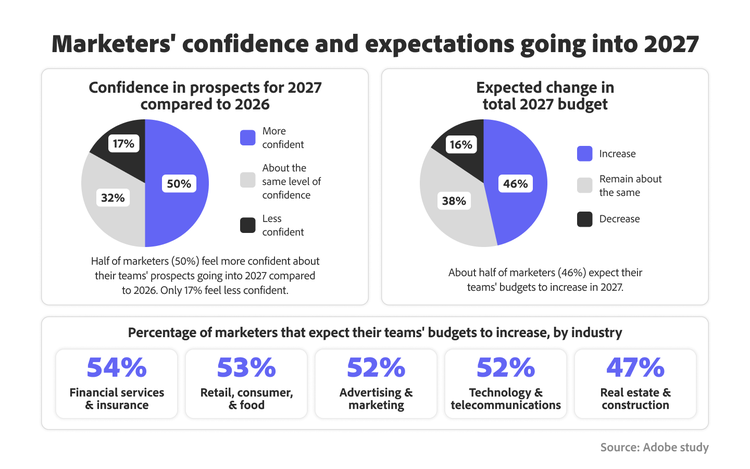
Nearly half of marketers (46%) expect their teams’ budgets to increase in 2027, while 38% expect budgets to remain steady and 16% expect them to decrease. The financial services and insurance industries lead the way, with 54% of marketers expecting budget increases, followed by retail, consumer, and food (53%), and advertising and marketing (52%).
Top industries by share of marketers that expect their teams’ budgets to increase in 2027.
- Financial services and insurance: 54%
- Retail, consumer, and food: 53%
- Advertising and marketing: 52%
- Technology and telecommunications: 52%
- Real estate and construction: 47%
Confidence aligns closely with budget expectations. The financial services and insurance industries again lead, with 59% of marketers feeling more confident about 2027 than they did about 2026, followed by advertising and marketing (54%) and healthcare and wellness (53%).
Top industries by share of marketers who feel more confident going into 2027.
- Financial services and insurance: 59%
- Advertising and marketing: 54%
- Healthcare and wellness: 53%
- Retail, consumer, and food: 53%
- Entertainment and leisure: 50%
AI marketing trends: Content, data, and analytics are the top investment priorities in 2027.
Marketers expect AI tools and workflow automation to see the largest increase in investment in 2027, well ahead of the other seven categories surveyed. AI is evolving from an experimental tool to an enterprise standard. Content creation and production, data and analytics, and social media and influencer marketing complete the list of top investment priorities.
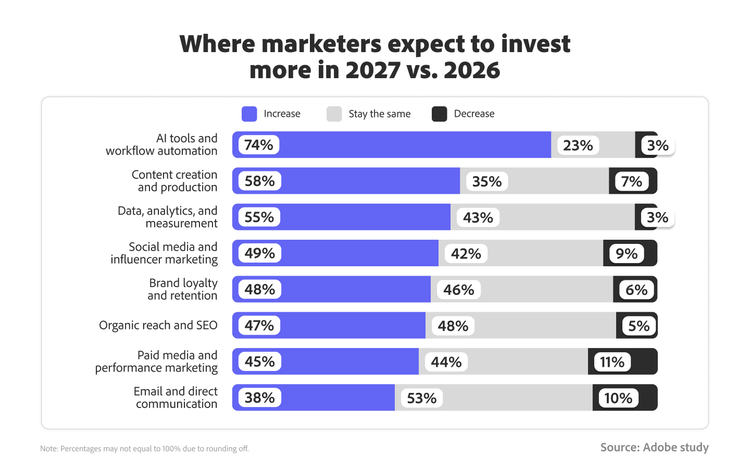
AI tools and workflow automation are the runaway leaders in planned investment: 74% of marketers expect spending in this area to increase in 2027, while just 3% expect it to decrease. Content creation and production (58%), data and analytics (55%), and social media and influencer marketing (49%) follow as the other top investment priorities.
Marketers in real estate and construction are the most likely to expect increased spending on AI tools and workflow automation (88%). The advertising and entertainment industry leads in planned investment in content creation (66%), while marketers in real estate and healthcare are most likely to expect increased investment in data and analytics (67%).
How can businesses use AI to improve marketing?
Marketers are putting budget behind AI: 74% expect to increase spending on AI tools and workflow automation in 2027, and they expect the median share of automated tasks to grow from 20% to 35% by the end of the year. The practical starting point is repetitive work, such as reporting, adapting content for different channels, and analyzing audience data. Pair AI with human review and clear brand guidelines so that output stays accurate and on brand.
More than half of marketers say they are overstretched.
As content demands rise ahead of 2027, maintaining an effective content marketing strategy is becoming increasingly difficult. We asked marketers how much they expect their content output to grow in 2027 and whether their current capacity can support the anticipated workload.
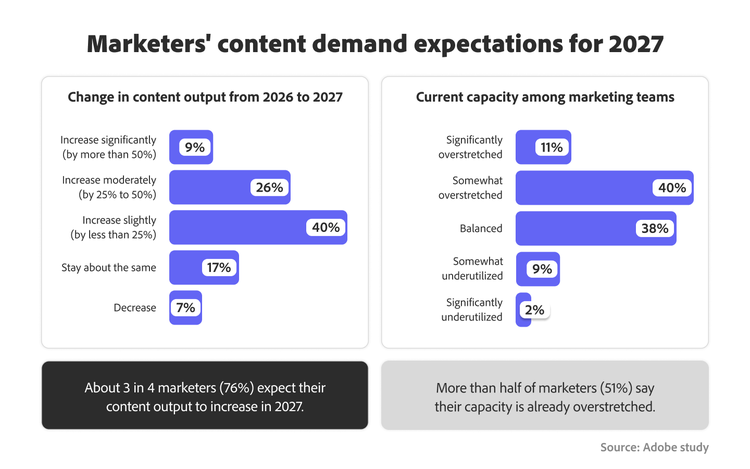
Three in four marketers (76%) expect content output to increase in 2027, and more than a third expect it to increase by 25% or more. This growing workload is expected to fall on teams already stretched thin: more than half of marketers (51%) say their teams are overstretched, while only 11% say their teams are underutilized.
This pressure isn’t felt equally across generations. Gen Z marketers are the most likely to say they are overstretched (58%), followed by millennials (51%) and baby boomers (50%). Gen X marketers are the least likely to say they are overstretched (44%).
With content output set to keep climbing and more than half of marketing teams (51%) already overstretched, most marketers are being asked to do more without additional capacity. Firefly Enterprise Solutions can help these teams create and adapt content at scale.
The biggest marketing challenges of 2027.
Even with expected budget increases, additional funding may not fully alleviate the pressure marketers are likely to face in 2027. Budget constraint is the top challenge marketers expect to face (36%), closely followed by AI adoption and integration (34%). Competitive pressure and AI-driven search disruption for organic visibility tie for third place (28% each), while talent and team capacity rank fifth (24%).
The top five marketing challenges of 2027, according to marketers:
- Budget constraints: 36%
- AI adoption and integration: 34%
- AI-driven search disruption and organic visibility: 28%
- Competitive pressure: 28%
- Talent and team capacity: 24%
What will be the most in-demand marketing roles in 2027?
With new challenges come changing talent priorities. To better understand this shift, we asked marketers which roles they expect to be the most in demand in 2027.
More than one in three marketers (36%) say AI prompt engineers or AI content specialists will be the most in-demand marketing professionals in 2027. AI-related skills are moving to the center of marketing teams’ hiring plans, but the data also shows continued demand for more established marketing roles.
The top-five in-demand marketing roles:
- AI prompt engineer or AI content specialist: 36%
- Data analyst or marketing intelligence specialist: 28%
- Social media manager or community manager: 25%
- SEO and organic growth specialist: 22%
- Content strategist or content director: 21%
SEO and organic growth specialists rank fourth (22%), and AI-driven search disruption ties for third among marketers' biggest 2027 challenges (28%). As AI search changes how buyers find brands, organic visibility is becoming a hiring priority.
Marketers vs. consumers on loyalty, trust, and content in 2027.
Marketers and consumers don't always agree on what matters most when it comes to building customer loyalty. We asked both groups directly and compared the areas where their expectations align and where they diverge.
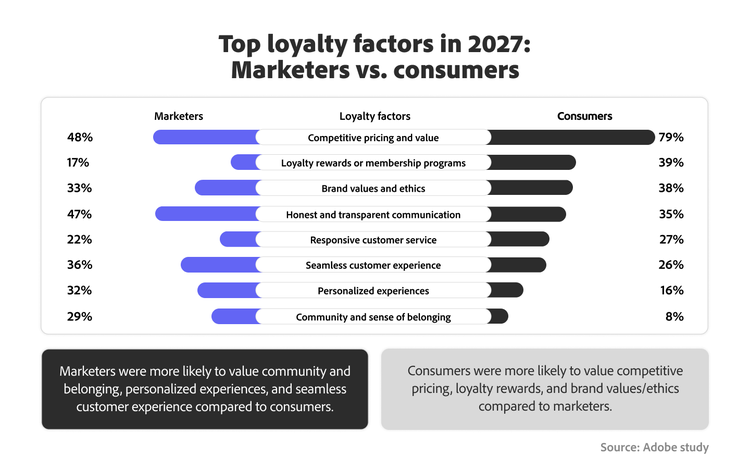
When asked what will matter most for earning customer loyalty in 2027, consumers and marketers place their emphasis in different places. Consumers overwhelmingly cite competitive pricing and value, with 79% naming it their top factor for earning customer loyalty, followed by loyalty rewards or membership programs (39%) and brand values and ethics (38%). For most consumers, price and tangible value remain the clearest path to loyalty.
Among marketers, 48% name competitive pricing and value as a top factor for earning customer loyalty, but they place nearly as much weight on honest and transparent communication (47%) and brand values and ethics (33%). This suggests that many are counting on trust and messaging to carry more of the retention effort than price alone.
The contrast is sharpest where marketers' priorities deviate from consumers’ expectations. Marketers are more likely than consumers to emphasize community and belonging (29% versus 8%), personalized experiences (32% versus 16%), and smooth customer experience (36% versus 26%). This points to a broader disconnect — while marketers prioritize relationship-building, consumers evaluate loyalty in more concrete, transactional terms.
Consumers say accuracy and credibility make content worth their time and attention.
According to the survey data, accuracy and credibility top the list, but marketers underestimate their importance to consumers.
Note: Respondents could select up to three options.
Accuracy and credibility stand out as the top factors consumers consider when deciding whether content is worth their time and attention, with 66% naming them among their top three priorities. Marketers recognize their importance too, but significantly underestimate their value to consumers. Only 43% place accuracy and credibility in their top three, creating a 23-point gap between the two groups. This disconnect suggests that many marketers may undervalue just how strongly trustworthiness influences consumers’ decisions to engage with content.
Consumers say products that don’t match marketing claims are the top reasons they lose trust.
When it comes to factors that could erode trust in 2027, consumers and marketers aren't on the same page. The factor that ranks first among consumers’ concerns is the last among marketers’ concerns.
Note: Respondents could select up to three options.
For consumers, the top reason for losing trust in a brand in 2027 is straightforward: products that don't match their marketing claims, a factor cited by 45% of respondents. Marketers, however, rank this concern last, with only 18% identifying it as a top factor. This 27-point gap is the widest difference in the table.
While marketers focus on emerging concerns such as AI-generated content and generic messaging, many may be overlooking a far more basic driver of distrust: whether the product delivers on its marketing promises.
Which marketing channels will consumers trust more or less in 2027?
Not every channel is gaining or losing trust at the same rate. As 2027 approaches, consumers say they'll rely more on some sources and tune out others entirely.
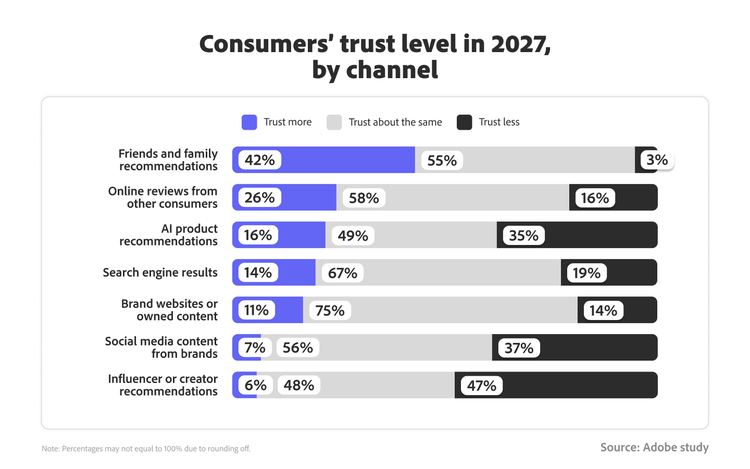
Personal recommendations remain the most trusted source as 2027 approaches, with those from friends and family leading the way. Among consumers, 42% say they'll place more trust in these recommendations in 2027, followed by online reviews from other consumers (26%) and AI-driven product recommendations (16%).
On the other end, influencer and creator recommendations top the list of sources that are losing consumers' trust. Among consumers, 47% say they'll trust these recommendations less in 2027, followed by social media content from brands (37%) and AI-driven product recommendations (35%).
The AI-driven product recommendations factor appears on both lists, suggesting that consumers remain divided over how much to trust them.
Marketers expect over a third of tasks to be automated by the end of 2027.
Marketers report that a median of 20% of marketing tasks are currently automated and expect that figure to reach 35% by the end of 2027. Here's how this expectation varies by industry.
Financial services and insurance marketers expect the largest increase in automated tasks across industries, from 20% at present to 40% by the end of 2027. Industrial and manufacturing marketers expect the highest overall level of automation (43%) by the end of 2027, while public sector, education, and nonprofit marketers expect the lowest (25%). Meanwhile, transportation and logistics will likely see the smallest increase (+8 points).
Expectations for task automation by the end of 2027 also vary by generation:
- Gen Z: 20% to 35%
- Millennials: 20% to 30%
- Gen X: 24% to 40%
- Baby boomers: 33% to 50%
Implementing agentic AI is marketers' top AI priority for 2027.
Marketers view implementing agentic AI as their biggest opportunity in 2027, but skill gaps and budget constraints could slow progress.
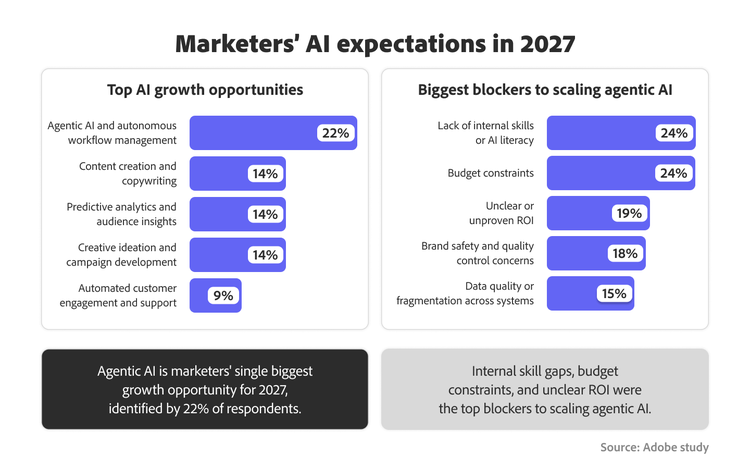
Agentic AI and autonomous workflow management stand out as marketers' top AI priority for 2027, cited by 22% of respondents. This figure is well ahead of content creation and copywriting and predictive analytics and audience insights, which are tied at 14% each. Marketers are less focused on using AI for individual tasks and more interested in using it to manage broader administrative workflows.
Lack of internal skills or AI literacy and budget constraints are tied as the top blockers to scaling agentic AI, with each cited by 24% of marketers. Unclear or unproven ROI follows at 19%. The technology's potential is outpacing most teams' readiness to implement it. Without clearer proof of ROI, securing budgets and stakeholder buy-in may be difficult.
How can brands use AI agents to improve marketing results?
Brands can start by using AI agents to handle repetitive, multistep workflows, such as campaign scheduling, audience segmentation, and performance reporting. This would free up marketers to focus on strategy and creative work. Rather than deploying agentic AI across the organization at once, brands should pilot the technology within a single, high-volume workflow, keep a human in the loop on review and approval at every stage, measure the results, and use the findings to build a business case for further investment. Closing the internal skill gaps matters just as much as the technology itself. Brands that invest in AI literacy training alongside implementation stand to scale agentic AI more successfully than those that treat the technology as a plug-and-play solution.
Where marketer ambition meets consumer reality in 2027.
Marketers have plenty to feel good about heading into next year. Most expect budgets to increase and believe that automation will handle 35% of marketing tasks by the end of 2027. With automation focused largely on administrative tasks, marketers could free up valuable time and resources. However, that optimism sits alongside significant pressure: content demand is set to keep climbing, even as teams report that they are already stretched beyond capacity. Confidence alone won't close the gap in trust between marketers and consumers. The brands that get pricing, trust, and content quality right will be best positioned to earn loyalty in 2027.
The trust gap between marketers and consumers is clear in one statistic — consumers’ top reason for losing trust in a brand is that a product doesn't match its marketing claims, yet marketers rank this issue last among their own concerns. Adobe GenStudio for Performance Marketing is built to help close that gap specifically. Its brand validation and review workflows help ensure assets align with your brand guidelines before they go live, so the content you publish stays accurate and consistent.
To learn more about closing the gap between marketer expectations and consumer reality, explore Adobe GenStudio for Performance Marketing.
Methodology.
This article is informed by proprietary research conducted by Adobe. The study surveyed 502 full-time marketers and 1,011 consumers across the United States, providing a 95% confidence level with a ±4.4% margin of error for marketers and a ±3.1% margin of error for consumers. Marketers were asked about their current and future expectations, plans, and challenges in 2027. Both consumers and marketers were asked about what they expected to become bigger purchasing and loyalty factors in 2027. As with all self-reported data, results may reflect personal perceptions and experiences rather than actual behaviors.
Frequently asked questions.
How can businesses use AI to improve marketing?
What is the marketer-consumer trust gap?
What are marketers' top investment priorities for 2027?
What will be marketers' biggest challenge in 2027?
Which channels will consumers trust more in 2027?
How is AI changing the future of marketing?
Recommended for you
https://business.adobe.com/fragments/resources/cards/thank-you-collections/generic