Where generative AI stops: The operational gaps agentic AI fills.

Adobe for Business Team

08-03-2026

Enterprises have rapidly embraced generative AI, deploying it across content creation, customer service, and data analysis. Yet many organizations are discovering a fundamental limitation: generative AI excels at producing outputs, but it is not designed to execute workflows from start to finish on its own.

The gap between generative AI and agentic AI reflects the difference between completing individual tasks and achieving business outcomes. This operational disconnect leaves teams managing manual handoffs and fragmented processes. Agentic AI offers one path forward, extending AI capabilities from isolated generation to coordinated execution across enterprise systems.

This article will cover:

Strengths and limitations of generative AI.

Generative AI has changed how enterprises approach content creation, ideation, summarization, and analysis. These systems turn prompts into text, images, code, summaries, and other outputs with speed and scale that would be difficult to match manually. For enterprise teams, generative AI is a powerful starting point for drafting marketing copy, creating product descriptions, generating social content, summarizing meeting notes, and producing initial code snippets.

The limitations of generative AI in business operations.

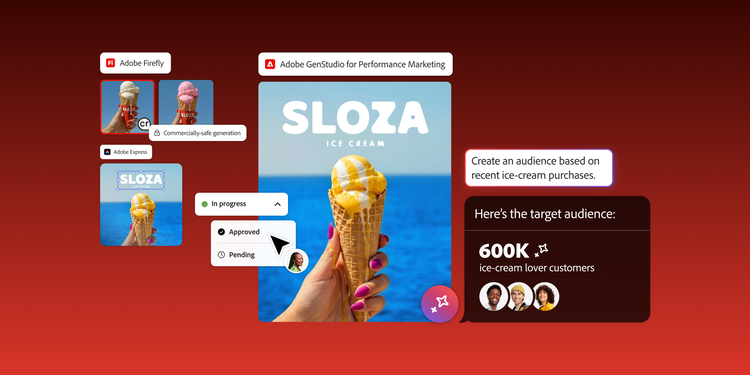
However, generative AI is not designed to manage the broader workflows that turn those outputs into business results. It can create a campaign asset, but it typically cannot coordinate the steps required to approve, publish, personalize, measure, and improve that asset across enterprise systems.

The core limitations include:

This creates a gap between generated output and operational execution. Organizations can produce more content faster, but still depend on manual handoffs to publish that content.

How agentic AI fills operational gaps.

Agentic AI addresses a core limitation of generative AI: it moves beyond producing outputs to coordinating the actions needed to achieve a defined outcome. Instead of responding to a single prompt, agentic systems work toward a goal, break that goal into steps, interact with connected tools, and adjust based on results while operating within human-defined guardrails.

How agentic AI works.

Agentic AI typically follows a goal-oriented process. A user or system defines the objective, and the agent breaks that objective into sequenced tasks. It then interacts with enterprise applications, data sources, and workflow systems to complete those tasks, evaluate progress, and adapt when conditions change. Where generative AI may create a campaign asset, agentic AI helps coordinate the next steps required to move that asset through approval, activation, measurement, and optimization.

The practical value of agentic AI comes from its ability to reduce manual coordination across systems and teams. Key capabilities include:

For enterprise teams, this shifts AI from a productivity tool to an operational support tool. A campaign that once required manual handoffs across planning, creative, approval, activation, and reporting moves through those stages with greater speed and consistency, while humans retain control over strategy, oversight, and critical decisions.

How agentic AI coordinates complete workflows.

Orchestration is where agentic AI moves from individual task execution to coordinated workflow management. Instead of completing one step at a time, agentic systems connect planning, content creation, approvals, activation, measurement, and optimization.

For example, a campaign workflow may move from creative development to compliance review, audience selection, and multi-channel deployment. A personalization workflow may connect customer data signals, segmentation, content selection, and delivery timing. A content supply chain workflow may coordinate asset creation, metadata tagging, approval routing, and distribution.

Traditional automation usually follows predefined rules and flows. Agentic orchestration adds more dynamic planning, contextual reasoning, and adaptive sequencing within established guardrails. That flexibility helps enterprise teams reduce manual handoffs while maintaining visibility and human control.

Building an agentic AI strategy.

Moving from generative AI experimentation to agentic AI implementation requires more than selecting a new tool. It requires a strategy for identifying where work slows down, where systems are disconnected, and where human teams are spending too much time coordinating repeatable steps.

A practical agentic AI strategy starts with workflows, not technology. Enterprise teams should look for processes where generative AI already creates value, but downstream execution remains manual. These are often the areas where agentic AI has the clearest impact. The next step is connecting that output to the systems, decisions, and approvals required to move work forward.

The strategic steps for building agentic AI capabilities include:

  1. Identify workflow gaps. Audit current processes to find where workflows stall. Look for manual handoffs, disconnected tools, approval delays, duplicate data entry, and points where teams need to move information between systems.
  2. Define repeatable processes. Prioritize workflows with clear steps, predictable patterns, and measurable outcomes. Agentic AI is most effective when teams define the goal, the required inputs, the sequence of actions, and the conditions that require human review.
  3. Integrate data and systems. Agents need access to the tools and information required to execute tasks. This may include connections to customer data platforms, content management systems, marketing automation tools, analytics platforms, or workflow management systems.
  4. Apply governance and control guardrails. Define what agents can do independently, where approvals are required, and when issues should be escalated to a human. Guardrails should cover permissions, brand standards, compliance requirements, data usage, and auditability.
  5. Measure operational impact. Evaluate agentic AI with metrics besides content volume or time saved on individual tasks. Useful metrics may include campaign cycle time, approval speed, personalization coverage, number of manual handoffs, number of errors, and workflow completion rates.

The best starting points are high-volume, repeatable workflows where speed, consistency, and coordination directly affect business outcomes. For many enterprise teams, this may include campaign execution, content supply chain management, personalization, reporting, or customer experience workflows. Starting with focused use cases helps teams prove value, refine governance, and build toward broader coordination over time.

From generative AI adoption to agentic AI implementation.

Enterprise AI maturity typically moves through three phases: experimentation, integration, and coordination. In the experimentation phase, teams test generative AI on isolated tasks such as content creation, analysis, and summarization. In the integration phase, they embed AI tools into existing workflows and connect outputs to downstream processes. In the orchestration phase, agentic AI coordinates multi-step execution across systems, teams, and data sources.

Many organizations are either in the experimentation or integration phase. They have adopted generative AI tools and achieved localized productivity gains, but the work required to turn AI-generated outputs into executed campaigns is still manual. Content can be created faster, but campaign approvals, audience activation, performance measurement, and optimization still depend on disconnected handoffs.

Teams need connected systems, governed workflows, clear escalation paths, and measurable use cases where coordination can improve speed, consistency, or scale. This makes agentic AI adoption less about replacing generative AI tools and more about adjusting internal workflows and processes to be able to effectively configure agentic AI systems.

Operational execution beyond AI outputs.

The trajectory of enterprise AI is shifting from individual task completion to workflow execution. Adobe’s 2026 AI and Digital Trends report suggests that while organizations are already seeing gains in productivity and personalization from AI, many still face data, alignment, and skill gaps that limit their ability to scale AI into business workflows. Generative AI produces. Agentic AI executes. That distinction defines the next phase of enterprise AI adoption. Organizations that successfully bridge this gap can move from producing more content to coordinating the actions that turn content, data, and decisions into business results.

Success requires governance frameworks that maintain human oversight, orchestration capabilities that connect disparate systems, and a strategic focus on workflows where execution speed delivers a competitive advantage. Agentic AI provides the foundation to turn AI outputs into coordinated actions across systems, teams, and touchpoints.

See how Adobe CX Enterprise Coworker coordinates agents, reasoning, and customer experience across your stack.

https://business.adobe.com/fragments/resources/cards/thank-you-collections/generative-ai