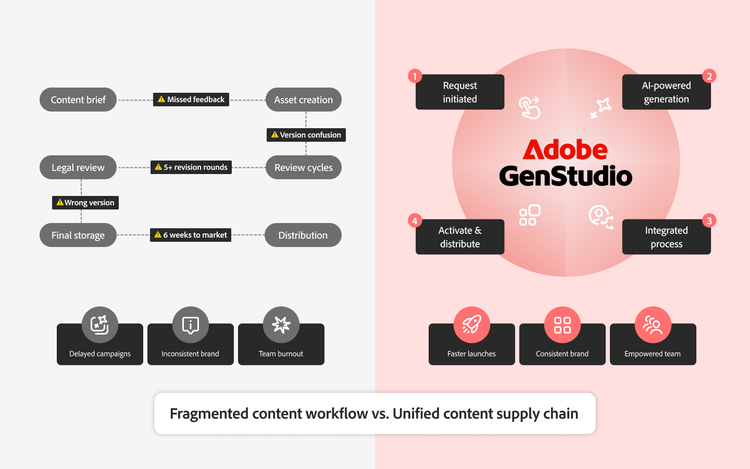
Many marketing teams often use various platforms to manage their day-to-day tasks. Despite a robust martech stack, the journey from a creative concept to live content remains slow and difficult. Fragmented content workflows waste valuable time across teams and cost enterprises money, revenue, and budget.
A fragmented content workflow occurs when content creation, review, and distribution happen across disconnected systems and siloed teams. Multiple stakeholder reviews stretch across email threads, shared drives, and project management platforms. Creative teams work on one tool while brand compliance happens on another. Legal reviews are done in isolation from marketing feedback, resulting in significant downtime between production stages.
Assets created for a campaign launch may be delayed while waiting for feedback from team members navigating a busy inbox. Similarly, feedback may be missed entirely during review cycles, and teams are forced to track the right document. Teams must also set clear SLAs with stakeholders for content review timelines to avoid delays caused by competing priorities or additional requests.
The costs of this fragmentation fall into two categories — visible and invisible. Visible costs show up clearly on balance sheets. These appear as lost revenue from delayed campaigns, traffic drops, and the direct expense of maintaining several platforms that don’t work together. But invisible costs can prove equally damaging. Teams pay the price through mental fatigue, repetitive manual work, and a loss of brand consistency.
Between measurable revenue loss and content production delays, the cost of broken content creation workflows is higher than most realize. Examining these impacts illustrates why a unified content strategy can be valuable. This blog provides a clear roadmap for transitioning your team to a more connected way of working.
In this article, we examine: