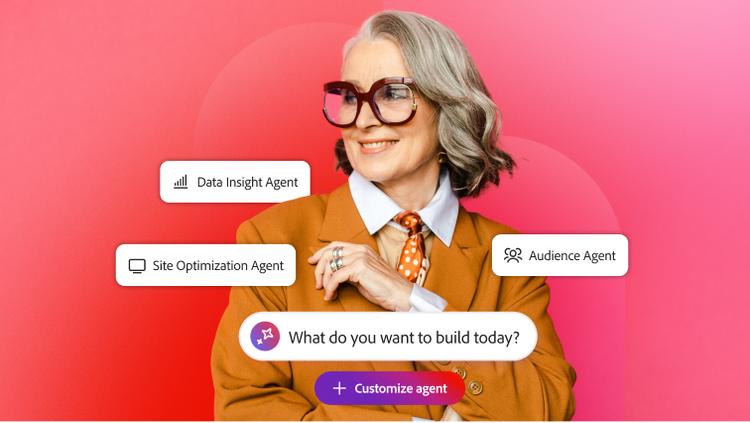
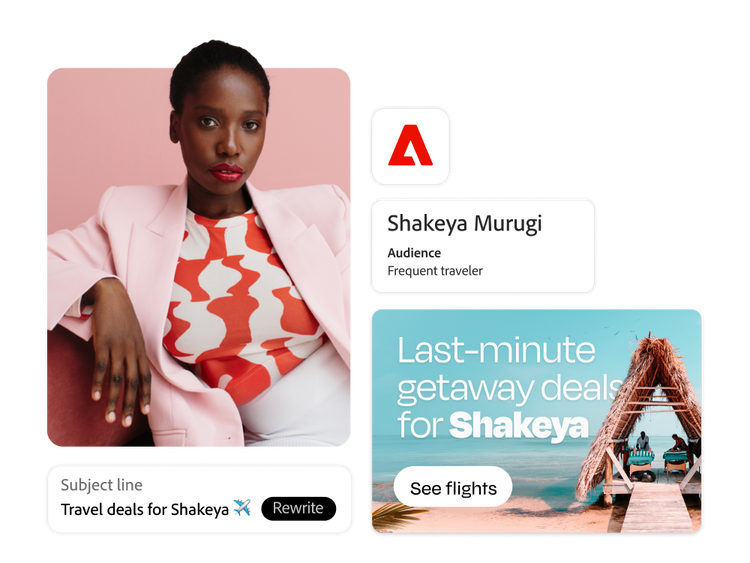
Agentic AI for marketing: Reimagine end-to-end customer experiences with AI-powered agents.

Learn how Adobe helps you put agentic AI to work across the marketing lifecycle with consistency, control, and scale.

Making agentic AI work at enterprise scale.

Agentic AI represents the next phase of marketing performance, enabling organizations to connect insights, decisions, and execution across the customer experience. As customer journeys become more complex and expectations rise, enterprises need systems that can operate across data, content, and workflows in a coordinated way.

This guide explains how agentic AI supports that shift and why it is becoming a priority for marketing and customer experience leaders. You’ll learn what enterprises need to scale agentic AI responsibly, how Adobe’s unified data and orchestration foundation enables coordinated execution, and where AI agents deliver the greatest impact across the marketing lifecycle. The guide also explores when and how organizations can extend Adobe’s agentic system to support custom workflows, providing a practical path from experimentation to enterprise-wide impact.

Agentic AI is the new frontier in marketing performance.

Generative AI has dramatically sped up how marketing teams produce content. Work that once required long cycles can now be completed in hours, enabling teams to support more channels, more formats, and more personalization than ever before. But as content volume increases, a deeper challenge has become clear.

Creating more content is not the same as delivering better customer experiences. Many leaders now recognize that while generative AI speeds up creation, it is not enough to accelerate the marketing and customer experience workflows required to meet today’s customer demands. The coordination, decisioning, and execution work that surrounds content remains complex and manual, shifting the bottleneck from creation to experience delivery.

This gap is fueling the adoption of agentic AI, which represents the next stage of value creation. AI agents can understand goals, make context-aware decisions, and assist with the complex steps required to bring one-to-one customer experiences to life, allowing teams to reduce manual effort, respond to changes faster, and shift their focus from operational tasks to strategic direction.

The momentum is significant: agentic AI is expected to create $450–650 billion in annual value by 20301.

What is agentic AI and how does it work?

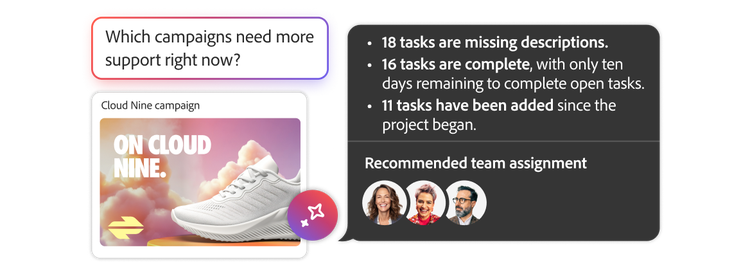
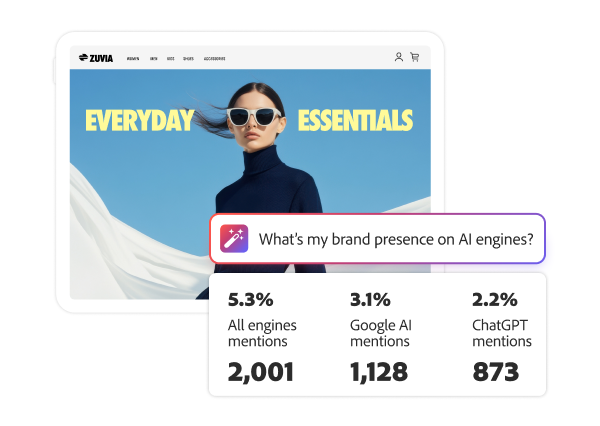
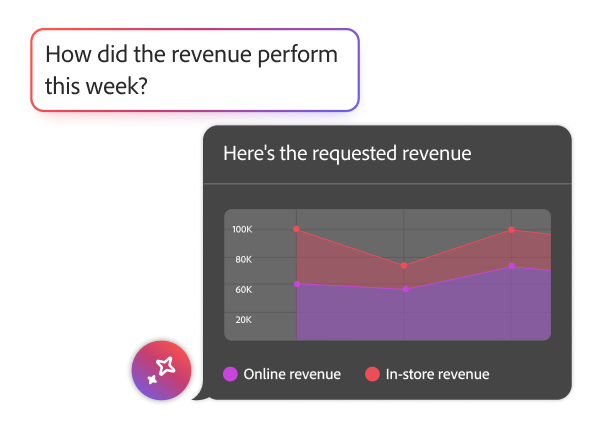
Agentic AI refers to intelligent systems composed of agents that can reason, act, and coordinate work in real-time. These agents can understand goals, take initiative, monitor dashboards, trigger workflows, and collaborate across functions while keeping people in control through oversight and approvals.

Read the full guide: What is agentic AI?

What is the difference between agentic AI and generative AI?

Generative AI speeds up and scales the creation of content, concepts, and ideas, while agentic AI goes further by helping teams execute the work around that content by planning, deciding, optimizing, and coordinating actions across systems. Both work best when paired together across marketing operations.

Read the full guide on generative AI vs agentic AI.

Adobe is uniquely positioned to shape this next chapter by applying agentic intelligence to the areas where it creates the most enterprise value. Instead of treating AI as a series of point tools, Adobe connects agents across the full marketing lifecycle and provides a unified platform with real-time data and governance as the foundation, enabling organizations to move from task-level automation to coordinated, end-to-end experience performance.

This guide explores the practical path to scaling agentic AI for the enterprise with Adobe, revealing the core capabilities that define an enterprise-ready platform, why a foundation of trusted and governed data is non-negotiable, and how Adobe has designed agentic tools to manage complex, end-to-end workflows. You will discover exactly where our agents deliver high-impact value across the full marketing lifecycle and understand when and how you can extend this unified system for custom business solutions.

What enterprises need to take agentic AI from concept to scale.

Interest in agentic AI is rising quickly, with two out of five organizations already investing significantly in this space, and a similar number of organizations in early testing or proof-of-concept stages. As more teams explore agentic AI, the question becomes what enterprises need to deploy agentic AI successfully at scale.

For agentic AI to support real customer experience work, it needs a strong, unified foundation. Teams must have access to reliable customer signals, clear understanding of content and context, and a shared view of what is happening across marketing and experience operations. When information is scattered or workflows are fragmented, AI can only handle narrow tasks in some pockets of the organization.

Agentic AI adoption is accelerating.

40.3%

of organizations are investing significantly in agentic AI2.

43.9%

of organizations are in early testing or proof-of-concept stages3.

When customer data, content knowledge, and operational insights are connected, AI agents can contribute to the full journey. Three qualities become especially important for organizations to adopt as they move forward.

1. Transparent oversight: It ensures teams understand how decisions are made, where intervention is needed, and how agent-driven actions lead to outcomes.

2. Unified operational context: It aligns planning, activation, personalization, and optimization around the same view of customers, content, and journeys.

3. Business-level adaptability: It allows organizations to expand and refine agentic use cases as strategies evolve, and new opportunities emerge.

Together, these qualities help organizations use agentic AI in a way that feels dependable, coordinated, and aligned with business goals. They create an environment where decision-making becomes faster and more consistent, enabling teams to shape customer experiences with greater relevance and precision.

Which industries can benefit from agentic AI?

Any industry that handles complex customer journeys or large-scale content can benefit from agentic AI. Retail, travel, media, and telecom see strong gains in speed and personalization. Regulated sectors like finance and healthcare benefit too, but require stronger governance, visibility, and security controls to meet compliance needs.

Why Adobe’s approach to agentic AI delivers enterprise value from the start.

For enterprises to realize the dependable, precise, and business-aligned vision of agentic AI, they need a platform that unifies data, governance, and orchestration from day one. Adobe brings these pieces together through Adobe Experience Platform, our single system of truth for unifying, analyzing, and activating customer data, and its agentic layer — Adobe Experience Platform Agent Orchestrator.

Think of it like navigating a complex journey. Adobe Experience Platform serves as the satellite system, continuously tracking where customers are, what they need, and where they’re headed. Experience Platform Agent Orchestrator acts as the navigation system, using that real-time intelligence to chart the best path forward and coordinate AI agents across marketing, content, and experience operations to help teams deliver the right experience at every step.

This foundation gives organizations a consistent, secure, and scalable environment for deploying AI agents across their marketing and customer experience workflows. The four capabilities below highlight what makes Adobe’s approach distinct.

1. Real-time customer and content data

2. Enterprise-grade governance, privacy, and security

3. Deep integration across marketing, content, and experience products

4. Scalable and extensible agent architecture

Where Adobe Experience Platform Agents add value across the marketing lifecycle.

Agentic AI delivers the most impact when it fits naturally into the workflows that move marketing forward. Adobe designs its agentic tools around the core stages that shape modern customer experience orchestration, helping teams remove bottlenecks, act on insights faster, and maintain consistency across channels and teams.

Here’s how Adobe’s AI agents support and accelerate different stages of the marketing lifecycle.

The agents highlighted across these six stages are part of a growing ecosystem, as Adobe continues to introduce new agents that support evolving marketing needs and unlock additional value across the marketing lifecycle. You can visit the Experience Platform Agent Orchestrator page to learn more.

How Adobe’s agentic architecture powers end-to-end execution.

The true power of Adobe’s agentic approach lies in how its agents work together. Each agent and agentic solution delivers value on its own, but their impact multiplies when they operate with shared intelligence, governance, and purpose. This system-level coordination is what turns task automation into end-to-end execution.

Adobe Experience Platform anchors the system with a single source of customer and content understanding. Layered on top, Adobe Experience Platform Agent Orchestrator builds on this foundation by interpreting goals, generating task plans, and coordinating how Experience Platform Agents collaborate. This architecture ensures consistent results across workflows, even as teams scale automation into new areas.

To understand this system more clearly, let’s answer a few common questions on how Adobe’s agents work.

1. How do Adobe’s agentic AI tools coordinate the work behind each use case?

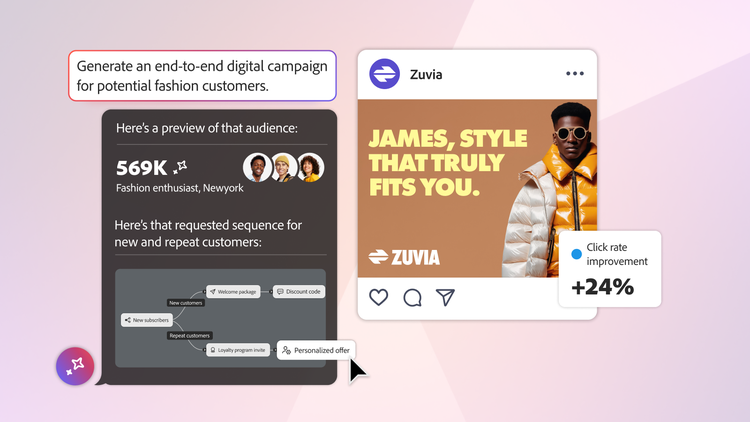
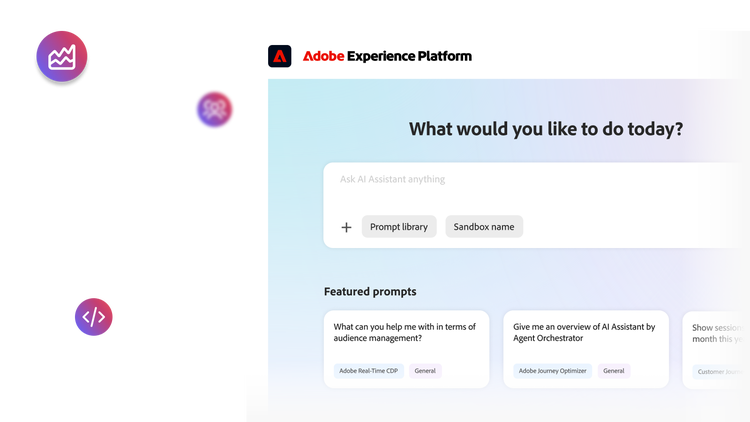
Adobe’s agentic system follows a consistent pattern. When a practitioner states a goal, Agent Orchestrator interprets the request, creates a task plan, and routes work to the relevant Experience Platform Agents. Once tasks are complete, outputs are validated for accuracy and alignment with business rules. This coordinated flow is powered by four core components:

  • Conversational interface: Where users interact with agents through prompts or natural-language inputs.
  • Reasoning engine: Interprets goals and constraints and turns them into a sequence of tasks.
  • Functional agents: Specialized agents that execute specific tasks, such as retrieving data, analyzing information, generating content, or validating outputs.
  • Knowledge base: Grounding information, patterns, and context that ensures reliable, context-aware decisions.

These components enable Experience Platform Agents to complete tasks in ways that are transparent, explainable, and aligned with enterprise governance.

2. How does Adobe use agentic AI across products to improve business efficiency?

Experience Platform Agents are designed to operate as part of a connected network. Each agent focuses on domain-specific tasks, and when workflows span products or require deeper analysis, multiple agents can be coordinated to deliver complex, end-to-end use cases across Adobe applications. Agent Orchestrator acts as the connection point between these experiences, ensuring that each agent has the context needed to achieve shared goals.

This means audience insights can shape journeys, content governance can guide activation, and optimization signals can feed directly into planning. And all this happens without marketers having to stitch these steps together manually.

3. How do Adobe agents integrate with data to stay accurate and on-brand?

Adobe’s AI agents connect to data through Adobe Experience Platform, which provides the governance, permissions, and validation rules that determine how information can be used. This keeps agent outputs grounded in accurate data and ensures decisions reflect brand guidelines, privacy requirements, and enterprise policies. It gives teams the confidence to scale automation while maintaining alignment with organizational standards.

When to extend Adobe’s agentic system for custom workflows.

Adobe’s pre-built agents are designed to support the core workflows most marketing teams rely on. For most organizations, these agents provide immediate value out of the box. But at enterprise scale, teams can sometimes encounter requirements that go beyond standard workflows. These may include:
  • Integrating with proprietary or legacy systems
  • Applying industry-specific policies and approvals
  • Automating workflows shaped by unique operating models

In such cases, customization allows organizations to extend Adobe’s agentic system, so automation reflects their own rules, data, and business logic without breaking governance or oversight.

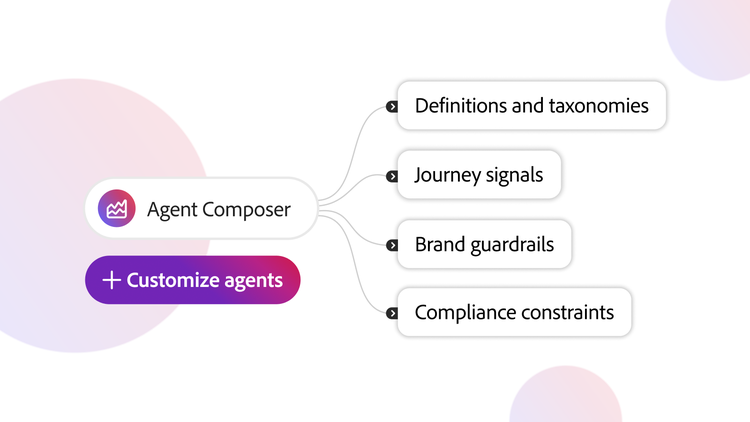
Experience Platform Agent Orchestrator provides the foundation for this extensibility. It allows organizations to tailor how agents behave, introduce custom agentic applications where deeper domain expertise is required, and coordinate multiple agents across Adobe and non-Adobe environments. Through Agent Composer, enterprises can extend Adobe’s agents in a few practical ways:

1. Configure agent behavior for brand needs: Teams can embed approval paths, compliance checks, and governance rules directly into how agents operate. A financial services firm, for instance, can enforce stricter review steps for any customer-facing content generated by AI, ensuring outputs meet regulatory standards before activation.

2. Introduce custom agentic apps for specialized workflows: Some use cases may require deeper domain knowledge or tighter safeguards. Custom agentic apps can address these needs while complementing Adobe’s pre-built agents. For example, a healthcare provider can use a custom app trained on clinical language and regulatory criteria to review content before publication.

3. Coordinate multiple agents across systems: Agents, whether pre-built or customized, can share context, validate one another’s outputs, and complete multi-step workflows spanning Adobe and non-Adobe environments while remaining within a single governance model. This makes it possible to automate complex processes without fragmenting governance or oversight.

4. Extend agentic capabilities into everyday work environments: Marketers can access Adobe-powered workflows directly inside familiar productivity tools, reducing context switching. Integrations, such as Adobe Marketing Agent for Microsoft 365 Copilot, allow marketers to access Adobe Experience Cloud workflows directly within tools like Word, Excel, or Teams.

This flexibility allows enterprises to start with proven agents and extend them as complexity grows — scaling agentic AI in a way that remains controlled, transparent, and aligned with business priorities.

Take the next step in your AI journey with Adobe’s agents.

Agentic AI is redefining what marketing and customer experience teams can achieve. It shifts the center of gravity from accelerating content production to connecting insights, decisions, and execution in ways that unlock speed and scale. As the landscape evolves, the advantage will belong to organizations that can integrate their workflows, act with confidence, and adapt to customer needs in real time.

Adobe’s portfolio of purpose-built agents helps teams make this shift with clarity and control. By supporting the full marketing lifecycle — and doing so in a coordinated, governed, and context-aware way — Adobe provides a practical path to scaling agentic AI where it delivers meaningful business impact.

Organizations that act early will be best positioned to meet rising expectations, unlock new efficiencies, and deliver more dynamic, responsive experiences across every touchpoint.

Ready to use agentic AI in your business?

Explore what agentic AI can do for you. Speak with an Adobe AI expert and dive into real use cases that grow your business.

Let’s talk about what Adobe can do for your business.

Get started