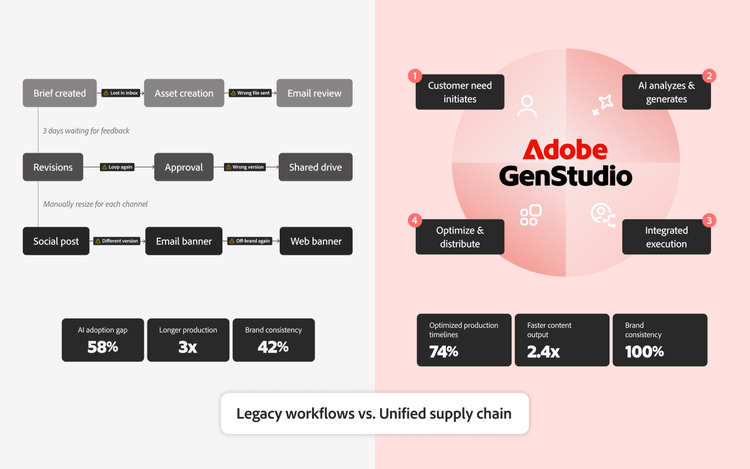
Chief information officers managing enterprise martech stacks face a recurring obstacle. Large enterprises operate dozens of creative and marketing tools that differ between departments or that are inherited through acquisitions. Different departments using different tools that aren’t integrated can create data silos and workflow dead ends that stall productivity.
Enterprise creative platforms must meet requirements that consumer-grade tools cannot. Robust security measures, including single sign-on, role-based access controls, and comprehensive audit logging form the baseline.
Enterprises also require infrastructure that scales. This includes asset management systems capable of handling millions of files, collaboration features that synchronize teams across time zones, and analytics that directly connect creative decisions to enterprise outcomes.
Industry-specific demands.
Different sectors face distinct content production challenges that some solutions don’t solve.
Financial services: These enterprises operate under strict regulatory oversight. Every customer-facing asset requires documented approval workflows, version histories, and audit trails to ensure compliance. Workflows must have these checkpoints embedded, to prevent regulatory action and reputational damage, without creating bottlenecks.
Retail brands: Retailers must navigate relentless seasonal cycles and trend-driven demand. A single 'hero' image often requires dozens of variations optimized for different channels and markets. In this environment, the ability to scale output determines competitive positioning.
B2B: These enterprises require sales enablement materials that maintain brand consistency across diverse regions and languages. Field teams need the flexibility to customize content for specific prospects without compromising corporate identity or messaging accuracy.
Ecommerce operations: These enterprises produce product content at an extreme scale. Managing thousands of SKUs requires images and specifications that adapt to various marketplace requirements and localization needs. At this volume, manual production methods aren’t viable for maintaining quality.
Shifting to orchestrated production.
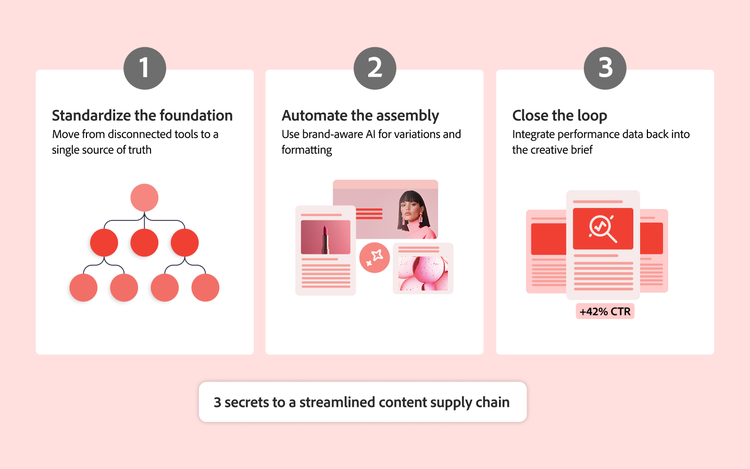
Meeting these diverse requirements demands a shift in thinking about creative work management. To successfully unlock the power of personalized content at scale, enterprises must orchestrate content supply chains.
Orchestrated content production means every stakeholder, from brand managers to regional marketers to agency partners, operates within a unified system. Briefs flow directly into production queues. Reviews happen in context rather than through email attachments. Approved assets automatically populate distribution channels. Performance data influences creative decisions.
Creative collaboration at enterprise scale requires breaking down legacy departmental bottlenecks. Designers, copywriters, strategists, and analysts must share visibility into the same workflows rather than operating in parallel silos. Coordination increases and flows naturally when all stakeholders see the same information, instead of in scheduled status meetings that require all stakeholders to be available.
This transformation requires alignment around shared processes between teams and departments and clear accountability structures. Technology enables this change, but people and processes determine how efficient workflows can be. Enterprises that invest to change processes alongside platform implementation consistently see stronger adoption and faster time to value.
Successful transformations start with an accurate assessment of current inefficiencies. Mapping existing workflows reveals where time is lost, where version confusion introduces errors, and where approval bottlenecks delay delivery. These pain points guide prioritization and help build enterprise-wide support for change. Adobe’s own journey illustrates the best practices required to drive this level of marketing efficiency and scale.