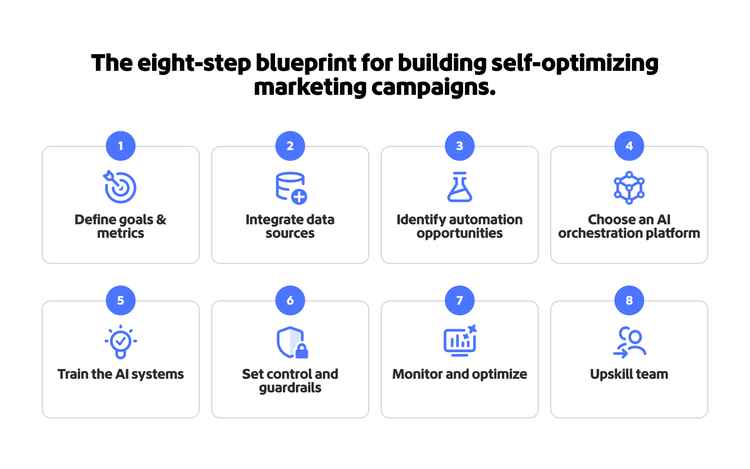
Building self-optimizing marketing campaigns requires more than adopting individual AI tools. It requires creating an integrated, intelligent system where multiple components work together seamlessly. The following eight-step framework guides marketers through this approach.
Each step builds on the previous, creating a foundation for AI-driven marketing strategies that can deliver measurable results. Understanding how to create a self-optimizing campaign starts with recognizing that you are building an intelligent system.
Step 1: Define clear goals and metrics.
Agentic systems need a defined objective. The first step is establishing clear, measurable goals for your AI agent to pursue. Without them, the system cannot determine what success looks like or how to achieve it.
Establish key performance indicators (KPIs) that directly connect to business outcomes. For performance marketers, key metrics may be Return on Ad Spend (ROAS), conversion rates, customer acquisition costs, and customer lifetime value. These metrics become the north star for AI campaign management, guiding every automated decision the system makes. Precise goals allow the system to optimize toward defined outcomes, directly impacting ROI. Vague objectives produce vague results; specific targets enable specific improvements.
Step 2: Integrate your data sources.
An autonomous marketing system is only as intelligent as the data it can access. Effective campaign optimization depends on timely access to the most relevant customer, content, and performance data across key online and offline touchpoints.
Connect all relevant data platforms into a single ecosystem: advertising platforms, customer relationship management (CRM) systems, e-commerce data, website analytics, and customer service records. This integration creates the foundation for closed-loop AI-driven marketing, where insights from one channel inform decisions across all others.
Adobe Experience Platform provides an ideal foundation for this unified data architecture, bringing together behavioral, transactional, and profile data into a single customer view. With comprehensive data integration, your autonomous system can make informed decisions in real time rather than relying on incomplete information.
Step 3: Identify high-impact automation opportunities.
Not every marketing task benefits equally from AI automation. The key is identifying repetitive, data-intensive, decision-heavy work where speed and pattern recognition matter.
Focus on areas such as audience refinement, content and offer selection, send-time optimization, journey orchestration, experimentation, and channel-level optimization. These repetitive tasks benefit from systems that can process a lot of signals.
Agentic AI for campaign optimization excels in these scenarios because the volume and velocity of decisions exceed human capacity. For example, tools that automate audience creation and optimization can continuously refine segments based on real-time behavioral signals, identifying high-value prospects that manual analysis would miss. Start with these high-impact areas to demonstrate value before expanding automation across your marketing operations.
Individual AI tools operating in isolation can create fragmented, inconsistent experiences. Success with multi-agent marketing systems requires a central platform that coordinates multiple specialized agents working toward unified goals.
Think of this orchestration layer as a conductor directing an orchestra. Each instrument, or agent, has specialized capabilities, but the conductor ensures they play together harmoniously. Without coordination, you have noise rather than music.
The next phase involves configuring, grounding, and contextualizing your AI agents using your business data and constraints. Generic algorithms produce generic results; training on your unique data creates an advantage.
An AI agent can learn what works for your specific audience, products, and brand. Educate the system by providing historical campaign data, customer interaction patterns, and conversion information. This training phase ensures agents understand the nuances of your business, from seasonal patterns to customer preferences.
Quality configuration directly impacts the quality of decisions an AI agent can make. The data foundation established in Step 2 becomes critical here because comprehensive and accurate data produces more effective AI-driven marketing strategies. Invest time in this phase to ensure your system learns from the best possible information.
Step 6: Set learning parameters and human controls.
Autonomous does not mean unsupervised. Human oversight remains essential for responsible, effective AI campaign management. Marketers must define clear boundaries within which the system can operate independently.
Establish specific guardrails: maximum budget thresholds that trigger alerts, brand safety guidelines that prevent inappropriate placements, and approval workflows for sensitive actions or significant strategic shifts. These controls ensure the AI agent operates within acceptable parameters while still having freedom to optimize.
The goal is partnership, not replacement. AI executes at scale and speed that humans cannot match, but humans provide strategic direction, creative vision, and ethical judgment. Define which decisions the system can make autonomously and which require human approval. This approach keeps your brand protected while still benefiting from automation’s efficiency.
A truly autonomous system never stops learning. Real-time campaign optimization requires continuous monitoring, analysis, and refinement based on performance data. Establish dashboards that track AI agent performance against your defined KPIs. Look for patterns: where does the system excel, and where does it struggle? Use these insights to refine parameters, adjust goals, or provide additional training data.
This closed-loop marketing AI approach creates a feedback loop. Performance data informs strategy refinements, improving future performance. Improved performance can then generate new insights. Tools for autonomous testing and optimization can continuously experiment with variables. These tools automatically identify and scale winning approaches while deprioritizing underperformers. This continuous improvement process is where AI in performance marketing delivers compounding value over time.
Step 8: Upskill your team for strategic oversight.
As AI handles tactical execution, the marketer's role fundamentally evolves. The final step in building self-optimizing campaigns is preparing your team for this new process.
Develop capabilities in areas that complement AI strengths: data analysis and interpretation, AI strategy and system design, cross-functional collaboration, and creative direction. These skills help marketers effectively create self-optimizing marketing campaigns.
Position this evolution as an opportunity for professional growth. Marketers who master these skills become more valuable, not less. They transition from campaign managers to strategic leaders, designing and overseeing intelligent systems that execute their strategic vision.