Psychographic segmentation examples for your marketing campaign.

As a marketing leader, you understand that customer expectations directly impact business outcomes. While demographic data provides a foundational view of your audience, it only scratches the surface. To truly connect with customers and drive growth, you need to understand their deeper motivations. This is the strategic power of psychographic segmentation marketing.

Psychographics are the attributes that reveal the inner world of your customers, highlighting their interests, values, attitudes, and lifestyles. These attributes uncover the crucial why behind your customers’ actions and purchasing decisions.

For a chief marketing officer (CMO), this data is the key to unlocking a deeper, more strategic understanding of your audience. It goes beyond surface-level characteristics to reveal core motivations. This insight is the foundation for building genuine brand affinity, as it allows your teams to:

  • Craft messaging that resonates on an emotional and personal level.
  • Develop value propositions that align with what your customers truly care about.
  • Create brand experiences that foster loyalty and drive long-term growth.

By gathering these qualitative insights, you can then apply them through powerful techniques like psychographic segmentation to build highly targeted and effective marketing campaigns. In contrast, demographics provide the foundational, statistical data that describes your audience. This is the who in your customer profile — and includes quantifiable attributes such as:

  • Age
  • Gender
  • Income
  • Location
  • Occupation
  • Education level

While essential for defining a target market, demographics alone can be misleading. For example, a group of professionals aged 35–50 might look identical on paper, but psychographics reveal that one segment is driven by innovation and social status, while another prioritizes family and security.

These distinct motivational profiles require entirely different marketing strategies. Understanding these underlying drivers is critical for developing campaigns that don't just reach an audience but truly influence them. For effective, actionable personas that power your growth strategy, you need both demographic and psychographic data to achieve the most complete and strategic view of your customers.

This post will cover:
Examples of actionable psychographic segmentation.

When building your personas, consider these psychographic segmentation examples to inform your strategy.

Personality traits

Personality influences whether a buyer makes an impulse purchase based on a fear-of-missing-out (FOMO) offer or if they require in-depth case studies and data before deciding.

Knowing your audience’s personality traits allows you to craft the right messaging and choose the channels that will be most effective.

Consider segmenting based on traits like:

  • Emotional vs. logical
  • Leader vs. follower
  • Idealistic vs. realistic
  • Early adopter vs. skeptic

Lifecycle stage

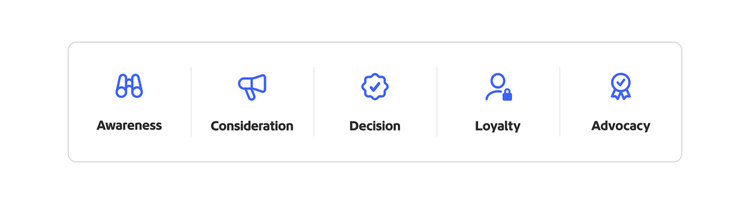
Five-stage customer lifecycle funnel with icons: Awareness, Consideration, Decision, Loyalty, and Advocacy.

Lifecycle marketing involves tailoring your approach based on a customer's relationship with your brand. A lead who just discovered your brand requires a different message than a loyal, repeat customer. Targeting by lifecycle stage is essential for optimizing the customer journey and maximizing lifetime value (LTV).

  • Awareness: Paid ads, social media, and influencer partnerships.
  • Consideration: In-depth educational content, how-to videos, and email marketing.
  • Decision: Case studies, social proof, free trials, and demos.
  • Loyalty & Advocacy: Exclusive offers, loyalty programs, and referral rewards.

Interests and hobbies

Targeting people based on their personal interests, such as sustainability, fitness, technology, or travel, allows you to create more authentic and resonant campaigns. Understanding these interests helps you align your brand with what your customers are truly passionate about, building a stronger emotional connection.

Attitudes or beliefs

A customer's beliefs, influenced by their upbringing, education, and culture, shape their worldview. Crafting campaigns that align with these beliefs is crucial for both acquiring new customers and retaining existing ones. Common attitudes for segmentation include:

  • Family-oriented
  • Environmentally conscious
  • Driven by innovation
  • Focused on wellness and health

Activities

How your audience spends their time reveals their priorities and values. Whether they are sports fans, avid readers, or DIY enthusiasts, their activities shape where they spend both time and money. This data directly impacts how — and where — you should market to them most effectively.

Social status

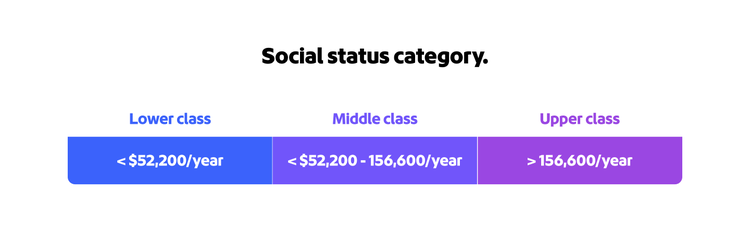
A customer's social status, both their actual and desired status, can significantly influence their purchasing habits. Some consumers buy products to align with their current standing, while others make aspirational purchases to project a desired image. Understanding these different motivators allows for more nuanced and effective messaging, particularly for luxury or premium brands. Marketers typically segment social status into three categories:

  • Lower class: This includes households that earn less than $56,600 a year. Price-sensitive and value-driven.
  • Middle class: This includes households that earn between $56,600 and $169,800 a year. A diverse group receptive to quality and premium features, but still budget-conscious.
  • Upper class: This includes households that earn greater than $169.800 a year. Influential buyers focused on luxury, quality, and exclusivity.
Three-tier income chart showing how marketers segment social status: lower-, middle-, and upper-class households.

How to build a psychographic data strategy.

Once you've identified which psychographic data points are most relevant to your business, you can compile the data through several strategic methods.

  • Survey current customers: Surveys are a direct way to collect psychographic data. You can ask customers about their values, interests, and motivations. With the right platform, survey responses can be automatically integrated with individual customer profiles, enriching your understanding of each segment.
  • Leverage web analytics: Your web analytics are a goldmine of behavioral data. Analyze which content resonates most with different segments, which paths lead to conversion, and what user actions reveal underlying interests. This quantitative data can validate and enrich your psychographic profiles.
  • Conduct focus groups and market research: Focus groups provide qualitative insights into your audience’s attitudes and beliefs. For a broader view, market research firms offer industry-specific data that can help you understand your audience and spot emerging trends.

Ways to improve marketing campaigns with psychographic segmentation.

Combined with demographic data, psychographic segmentation marketing provides a complete, well-rounded picture of your target audience. This deeper understanding allows you to craft campaigns that connect on an emotional level, drive meaningful engagement, and deliver measurable business results.

However, finding, storing, and activating this complex data at an enterprise scale can be challenging. Solutions like Adobe Audience Manager help you build the best audiences across any channel or service. Go beyond limited, media-based integrations and put your customers front and center.

Let’s talk about what Adobe can do for your business.

Get started