Clark County accelerates digital government with Adobe Experience Manager.
Jonathan Benett
03-17-2026
Clark County, Nevada, is one of the most dynamic communities in the United States — home to more than 2.4 million residents and nearly 40 million annual visitors. Its digital footprint is just as complex, spanning dozens of departments and hundreds of independent microsites, with a broad set of services ranging from public safety to permitting community resources. And until recently, county leaders agreed on one thing: for more than a decade, its digital experience simply couldn’t keep up.
“Residents couldn’t find what they needed. Our website was outdated, fractured, and inconsistent,” says Bob Leek, chief information officer for Clark County. “We needed a complete transformation, not just a new website.”
At the center of this modernization effort was Adobe Experience Manager Sites with Edge Delivery Services — providing Clark County a fast, flexible, and centralized platform that unifies content, streamlines workflows, improves accessibility, and delivers a more intuitive experience for residents and visitors.
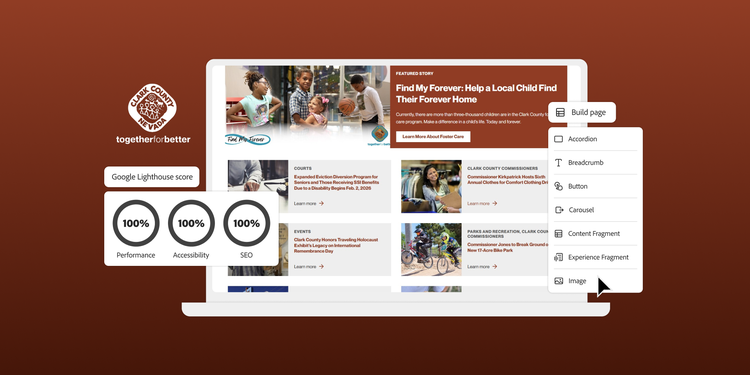
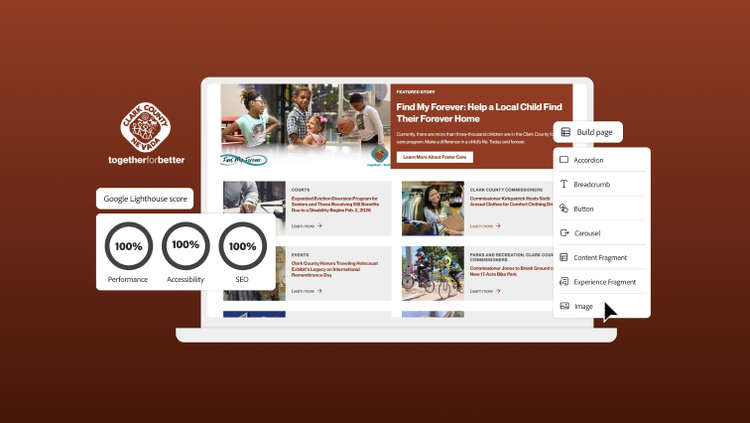
In just nine months, the Clark County team migrated 3,500 pages and 28,000 digital assets into the new platform. Almost immediately, site performance improved significantly, with Google Lighthouse scores increasing from the 50 to 70 range to 100 across desktop and mobile — a level of speed and stability the previous platform simply couldn’t reach. And when the new site launched, it handled more than 900,000 visitors in the first 15 days without any delays — a surge that would have strained the old infrastructure.
Patrick Walker, Clark County’s digital development manager in the Office of Communications and Strategy, put it bluntly: “What we had before was like an old pickup truck trying to pull a semi-trailer up a hill. Adobe Experience Manager Sites with Edge Delivery Services is a fully loaded, new semi-truck — it can pull anything up the hill, no problem.”
A resident system stretched too thin.
Embarking on this transformation was no small undertaking (or easy decision), and the stakes were high. Clark County’s site serves as a digital gateway to essential public services: emergency alerts, court information, business licenses, voting resources, social services, and other critical citizen information that can’t be cut off, even for a day. But the previous experience was more than 10 years old and no longer supported the county’s needs.
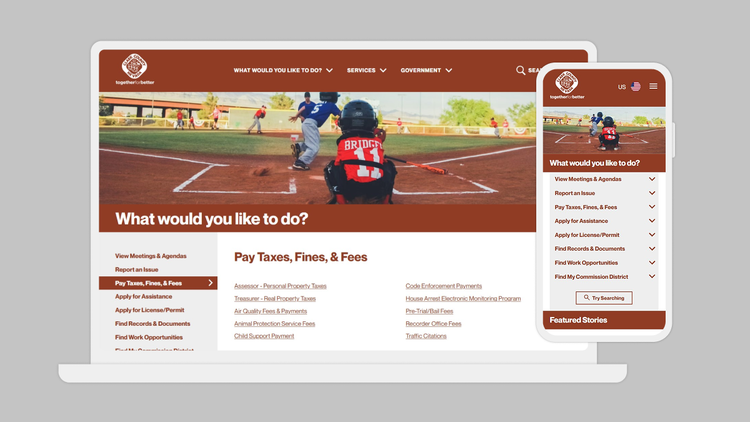
County residents speak 12 primary languages, which means county forms must all be translated accordingly. Pages were often outdated or abandoned, making critical updates slow or impossible. At the same time, departments operated independently, using different site structures, templates, and branding, resulting in inconsistent and confusing navigation and limited accessibility. Mobile users — especially first-time visitors — struggled most.
“The truth is, our web experience had been stuck for a very long time,” Walker says. “There was no unified information architecture, no consistent brand, and no clear workflows.”
For a community of this size and diversity, the impact was significant — residents often struggled to find even basic services on the website.
“The work we’re doing sets us up for the next decade of digital government. Adobe is helping us build an experience that truly serves our residents — today and long into the future.”
Bob Leek
Chief Information Officer, Clark County, Nevada
A holistic approach to scaling smarter.
Leek knew the county needed to fix the root of the problem, not just redesign the surface. His vision for improving the overall digital experience for Clark County residents, businesses, visitors, and employees came to life with the launch of the 360 Program — a multiyear transformation designed to rebuild the county’s entire digital ecosystem. The program focused on four foundational pillars:
Unified information architecture (IA)
Consistent design and brand system
Centralized governance and workflows
Modern technology infrastructure
Experience Manager Sites with Edge Delivery Services became the technology backbone supporting these pillars.
“We weren’t looking for a Band-Aid,” Leek explains. “We needed a platform that could scale across dozens of departments and help us build a long-term digital strategy.”
With Experience Manager Sites, the county gained:
A centralized content management system (CMS), replacing fragmented department sites
A unified component library and design system
Web Content Accessibility Guidelines (WCAG) for ensuring compliance and improved accessibility
Consistent navigation and search across all content
Clear ownership and structured approval workflows
A foundation for future personalization and AI
To ensure those standards carried through every request and update, the county used Adobe Workfront to connect planning and execution. Workfront ties intake, production, approvals, and publishing directly to Experience Manager Sites — giving teams one governed path from request to page launch. The result is a coordinated system where content moves faster, ownership is clear, and departments work from the same playbook.
Turning complexity into clarity.
The 360 Program paired Clark County teams with Adobe experts to rethink the digital experience from the ground up. The biggest early lift was redesigning the information architecture (IA), the blueprint for how residents navigate services.
To support the rollout, the county trained more than 120 web liaisons across 40 departments using the document-based authoring approach in Edge Delivery Services. Because publishing now happens in familiar tools like Microsoft Word and Google Docs, liaisons picked it up quickly — a dramatic shift from the old system, where even simple updates often required technical help.
“There were pages we didn’t even know existed. Bringing everything into one IA forced us to finally map ownership, content strategy, and what really mattered to residents,” Walker says.
“Once we rolled out the new authoring tools in Edge Delivery Services, our users were very happy with the process,” Leek adds. “These are not your traditional tech and content people — they are engineers, administrative assistants, social workers, and others who have a dozen other responsibilities besides updating their webpages. But because of the simplicity of the tool and the guardrails, you don't see that learning gap anymore.”
The county now has:
A unified IA that eliminates redundancy and guides residents clearly
A consolidated design system ensuring consistency across departments
A centralized, searchable content repository in Experience Manager Sites
Accessible templates designed for clarity, mobile performance, and inclusivity
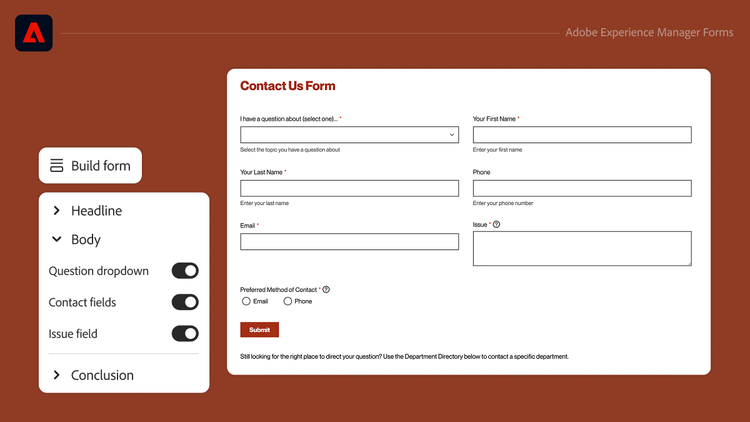
While modernizing its web foundation, the need to adopt digital web-based forms also became clear. The county responded and digitized dozens of paper-based forms using Adobe Experience Manager Forms, enabling citizens to submit requests for critical government services faster than ever before.
Together, these improvements streamlined more than a decade of fragmented content — creating the most cohesive digital foundation the county has ever had.
Winning for the future.
Clark County’s early results show how quickly the new foundation is paying off. The unified IA — approved across all departments for the first time — has eliminated years of structural inconsistency. Ownership models are now clearly defined, reducing confusion around updates and governance. Teams are producing new content faster with consistent templates and content blocks, and integrated workflows with Workfront and Experience Manager Sites have noticeably accelerated internal processes across departments.
“The strategy behind the 360 Program and our collaboration with Adobe finally gave us the structure we’ve needed for years,” Walker says. “For the first time, everyone is moving in the same direction.”
These early wins validate a simple principle: build the foundation right, and everything else gets easier to scale.
A resident-first future.
With Experience Manager Sites and the 360 Program in place, the county is further enhancing its digital experience with AI-driven workflows, recommendations, and more intuitive service pathways.
Working with Adobe, Clark County is exploring AI-powered form creation capabilities in the Experience Production Agent to accelerate delivery of citizen‑ready digital services. Built using simple natural language prompts with AI Assistant in Experience Manager Forms, the agent-assisted form creation was dramatically faster when compared to the county’s historically complex, manually built forms. This capability now enables county staff to quickly create adaptive, accessible forms that streamline service delivery, reduce administrative burden, and lower the technical barrier to creation.
“The work we’re doing sets us up for the next decade of digital government,” Leek says. “Adobe is helping us build an experience that truly serves our residents — today and long into the future.”
Jonathan Benett is an IT business and digital experience leader with more than 25 years of experience in IT modernization through digital transformation in the public sector. He is currently the chief of Global Government Solutions at Adobe.