The content supply chain starts before content exists.
Most organizations think their content supply chain begins when someone creates a piece of content.
They're wrong — it begins much earlier. It starts with ideation. When a business stakeholder identifies a need. When someone decides a campaign, asset, webpage, email, video, or product launch needs to happen. When a marketer submits a request. Long before an asset is created, approved in a workflow, uploaded to Adobe Experience Manager Assets DAM, or surfaced in search results, decisions are being made that will ultimately determine whether that content is discoverable, reusable, governed, and valuable.
Yet, this is where many organizations get it wrong.
Millions of dollars are invested in digital asset management platforms, workflow tools, AI-powered tagging, and search technologies. Teams spend months debating metadata schemas, taxonomy structures, folder hierarchies, and governance models. Despite these investments, users still struggle to find content, duplicate assets continue to be created, and adoption remains lower than expected.
The reason is surprisingly simple. The quality of a content ecosystem is often determined by the quality of its intake process.
The content supply chain begins with a request.
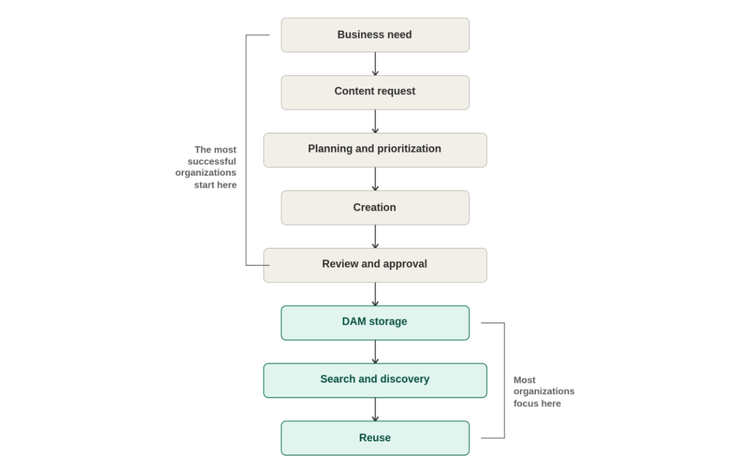
For years, organizations have focused their content supply chain efforts on content creation, approval workflows, and asset management. While these capabilities are important, they occur well after most critical decisions have already been made. When content requests arrive with incomplete information, unclear objectives, inconsistent naming conventions, or missing business context, every downstream team is forced to compensate. Project managers spend time clarifying requirements. Creative teams reinterpret business needs. Marketers manually update metadata. DAM administrators attempt to establish order after the fact.
What appears to be a metadata problem often started as an intake problem. What appears to be a search problem often started as an intake problem. What appears to be a content reuse problem often started as an intake problem.
Organizations frequently view metadata as something that should be added after content is created. In reality, some of the most valuable metadata already exists at the beginning of the process. Projects have owners. Campaigns have objectives. Products have business units. Content serves specific audiences. Assets are associated with regions, markets, channels, and initiatives.
The challenge isn’t creating metadata. The challenge is capturing it at the right time and ensuring it remains connected to the content throughout its lifecycle.
Why disconnected systems create disconnected content.
As a Principal Content Supply Chain Consultant at Adobe, one of the most common issues I see across organizations is the separation between work management and asset management.
Work management tools capture the business context behind a request. Asset management systems store and distribute the final content. Unfortunately, these two environments often operate independently, creating information gaps that follow content for years.
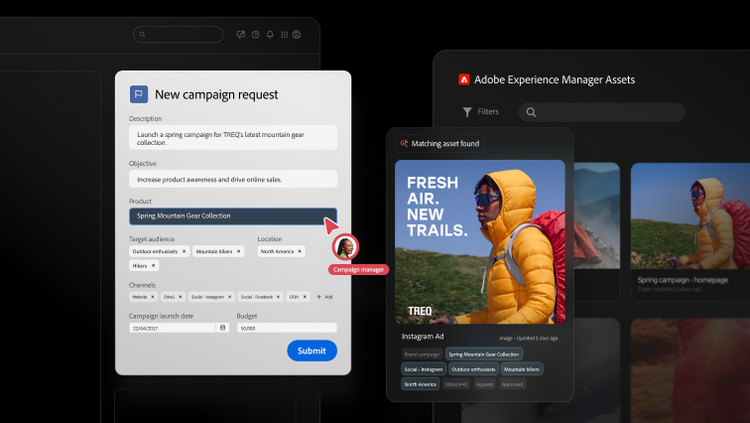
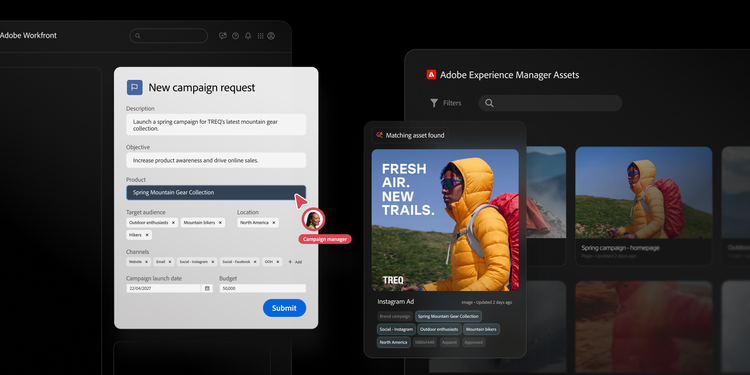
Consider a common scenario. A marketing manager submits a request for a campaign via Adobe Workfront. Information about the target audience, region, business objective, product line, and launch timeline is captured in the request process. As work progresses, approvals are completed, content is created, and assets are eventually uploaded into Adobe Experience Manager Assets. At that point, much of the original business context has been lost.
Six months later, another team needs content for a similar initiative. They search, but struggle to find the asset because the information they’re searching for was never carried forward from the original request. The asset exists. The value exists. The investment has already been made, but the content might as well not exist because it can’t be found. This is where connected content supply chains create value. When intake, workflow, metadata, governance, and DAM processes operate as part of a unified ecosystem, the information collected during planning becomes the foundation for search, automation, reporting, compliance, and reuse.
The organizations that generate the most value from their content aren’t necessarily creating more content. They’re making better use of the content they already have.
Intake quality impact.
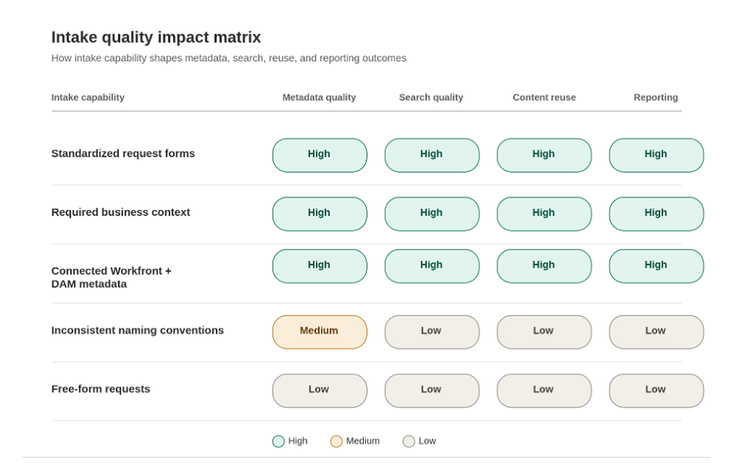
The pattern across intake capabilities isn’t subtle. When mapping specific intake practices against the outcomes they influence, most organizations discover the same thing — quality doesn’t degrade gradually as you move downstream. It’s set almost entirely at the point of intake, and every downstream system inherits it.
Standardized request forms, required business context, and connected Workfront and Adobe Experience Manager Assets metadata all produce high quality across metadata, search, content reuse, and reporting. That’s not a coincidence. Each of these capabilities forces business context to be captured once, at the moment of creation, in a structured format that downstream systems can consume without translation.
Free-form requests produce the opposite result. Low quality shows up across every single outcome, not just metadata. This is the clearest evidence that a metadata problem, a search problem, a reuse problem, and a reporting problem can all trace back to the same root cause — an intake process that never asked the right questions in a consistent way.
Inconsistent naming conventions occupy an interesting middle position. Metadata quality lands at medium because some structured information is still being captured, but search, reuse, and reporting all drop to low. Partial structure at intake doesn’t translate into full value downstream. Search algorithms, recommendation engines, and reporting dashboards all depend on consistency, not just presence, of metadata. A field that exists but is populated five different ways across five regions is barely more useful than a field that doesn’t exist at all.
The takeaway for content leaders is direct — if you want to improve search, reuse, or reporting, the highest-leverage investment is very often not in those systems themselves. It’s in fixing intake. The matrix shows that the capabilities with the broadest downstream impact, standardized forms, required context, and connected systems are also the ones organizations most often treat as optional or as an afterthought during a DAM implementation.
Design backwards from search.
The matrix shows what happens when intake ignores search. Here’s how to design intake to account for search.
Many Adobe Experience Manager Assets implementations begin by designing a folder structure. Others begin with metadata workshops. Some start by evaluating AI tagging capabilities. While these discussions are important, I often recommend starting somewhere else entirely.
Start with search. Ask users a simple question:
What do you need to find six months from now? The answer to that question should influence every design decision that follows.
If users need to find content by product, campaign, audience, market, service line, business unit, geography, or channel, that information must be captured consistently from the beginning. This mindset fundamentally changes how organizations think about content operations. Instead of asking: "What metadata should we add?"
They ask: "What information will future users need to search for?"
Instead of asking: "How should we organize content?"
They ask: "How will people find and trust content?"
The most successful Adobe Experience Manager Assets implementations I've supported all share a common characteristic — they were designed around future retrieval, not current storage.
Search isn’t an Adobe Experience Manager Assets feature.
Search is the outcome of hundreds of governance, process, and metadata decisions made throughout the content lifecycle. When business context is captured consistently, search improves. When search improves, reuse increases. When reuse increases, duplicate content creation decreases. The downstream benefits are significant.
A real-world example.
I recently worked with a global organization undertaking a content supply chain transformation initiative. The team initially focused on governance, metadata standards, and folder design. Like many organizations, they viewed the repository as the center of the problem.
As we evaluated the broader content lifecycle, a different pattern emerged.
Teams were submitting requests using inconsistent naming conventions. Product information was being entered differently across regions. Audience details were often missing or buried within free-form descriptions. Campaign information was captured for project execution but not carried forward into long-term asset management.
The DAM team was spending significant effort attempting to classify and govern content after it had already been created.
Instead of focusing solely on repository governance, the organization redesigned its intake process. Required metadata fields were introduced earlier in the process. Business context was standardized across request types. Governance measurements were expanded to include intake quality, not just DAM compliance.
As a result, metadata quality improved substantially because much of the information was now captured before content creation began. Search became more effective, reporting became more meaningful, and teams gained greater confidence that they could locate and reuse existing assets.
The lesson was straightforward — the organization's DAM improved because the intake process improved.
Practical takeaways for content leaders.
If you're evaluating your content supply chain strategy, start upstream.
Consider the following questions:
- Are we capturing business context at the point of request?
- Can metadata collected during intake be reused throughout the content lifecycle?
- Do our work management and DAM systems share common business information?
- Are we designing taxonomy and metadata around future search needs?
- Do we measure intake quality with the same rigor as metadata quality?
- Can users reliably find and reuse content created six months ago or one year ago?
Organizations often assume that content supply chain transformation begins with technology selection, DAM governance, or AI enablement. In my experience, it starts with a much simpler question — are you capturing the right information before content exists? Because by the time an asset reaches your DAM, many of the decisions that determine its long-term value have already been made.
The content supply chain doesn't begin with content. It begins with ideation.
Read more about Adobe’s content supply chain solution.
Recommended for you
https://business.adobe.com/fragments/resources/cards/thank-you-collections/content-supply-chain