Customer Loyalty Flywheel: How to build retention.

Every CMO today faces a familiar challenge: deliver standout customer experiences while proving ROI faster, all with fewer resources. Marketing success used to be defined by how efficiently you could fill the funnel. More leads meant more opportunities, and growth followed a predictable, linear path. But that model has reached its limit. Customer acquisition still matters, but the real pressure has shifted to retention. Why? Because attracting new customers often costs more than the revenue they generate, while loyal customers drive repeat purchases, advocacy, and sustainable growth.

As it stands, the customers you already have are far more valuable than the ones you’re trying to acquire. Loyal customers buy more often, stay with you longer, and advocate in ways no campaign can replicate. This can lower acquisition costs and strengthen long-term growth, but only if you have the visibility and systems to understand what keeps them engaged.

The real challenge isn’t recognizing the value of retention. It’s that most organizations struggle to measure it, influence it, and scale it in a meaningful way. The traditional funnel isn’t built for that.

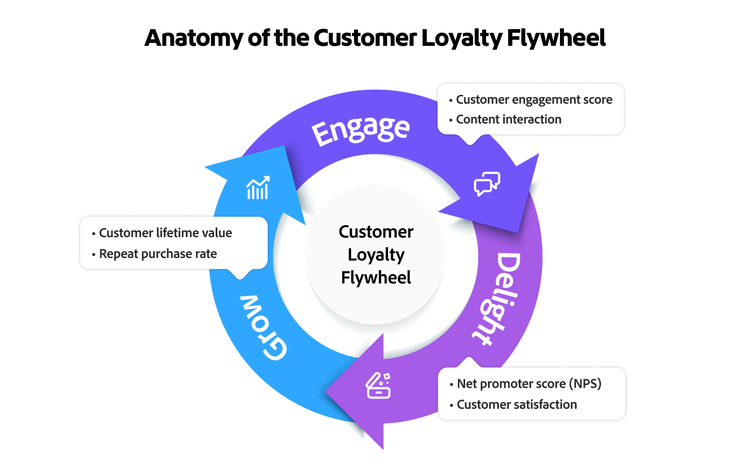
That’s why more modern marketing teams are shifting from funnels to the Customer Loyalty Flywheel, a model built on momentum, not attrition. When your customers have better experiences, they stay. When they stay, they buy more. And when they buy more, they advocate. The energy they create feeds back into the system by lowering your acquisition burden.

This article breaks down what that flywheel looks like, the metrics that reveal its true strength, and why measuring retention is so difficult without a unified view of the journey.

Here’s what’s inside:

Diagram showing the cyclical nature of the Customer Loyalty Flywheel with its stages and relevant customer retention metrics.

The Customer Loyalty Flywheel: A modern model for sustainable growth.

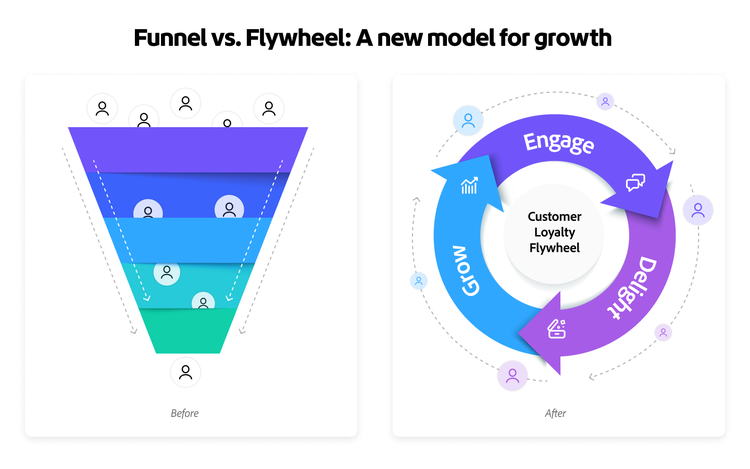
If the traditional funnel was built for a world of predictable customer behavior, the Customer Loyalty Flywheel is built for the world CMOs operate in today, one defined by continuous interactions, fluid expectations, and journeys that don’t end at conversion.

At its core, the flywheel reframes growth as a cycle, not a line. Instead of pushing prospects through a sequence of steps and hoping they emerge as customers, the flywheel centers the people who already trust your brand. Their experiences, satisfaction, and engagement supply the momentum that fuels repeat revenue and advocacy — which, in turn, lowers your cost to acquire the next wave of customers.

What makes the flywheel powerful is its compounding effect. When customers feel valued, they stay longer. When they stay longer, they contribute more revenue. When they contribute more revenue, they become advocates. And that advocacy creates new demand with a level of authenticity that no ad spend can match.

For CMOs, this model offers something the funnel never truly delivered: a growth engine that becomes more efficient over time, not more expensive. But the flywheel only works when you can see and understand the full customer experience. Visibility into satisfaction, retention, and engagement — and how they influence one another — is what keeps the wheel turning. Without that clarity, even the best brand experiences lose momentum. The flywheel represents modern growth: cyclical, compounding, and powered by the customers who already believe in your brand.

The three forces that power the flywheel: Satisfaction, retention, and engagement.

The Customer Loyalty Flywheel isn’t driven by a single moment or metric. It gathers momentum through three interconnected forces that shape how customers experience and ultimately value your brand. Understanding these forces is essential, because they’re often the earliest indicators of whether your growth engine is accelerating or losing steam.

  • Customer satisfaction: The catalyst for momentum.

    Every strong flywheel begins with one thing: a customer who feels genuinely valued. Satisfaction is delivering an experience that reassures buyers they made the right choice. It’s often the clearest predictor of future behavior. When satisfaction is high, it sets off a chain reaction. Customers complain less, trust more, and open themselves to deeper engagement. When it falters, the flywheel slows long before the metrics reveal a problem.

  • Customer retention: The force that sustains growth.

    Retention is where the real ROI lives. It’s the measure of how well your organization keeps the customers it worked so hard to acquire, and it’s the opposite of churn, both mathematically and emotionally. Retention reflects consistency, reliability, and the value customers feel over time. Strong retention means predictable revenue, healthier margins, and a lower dependence on paid acquisition. Weak retention, on the other hand, can quietly erode growth even when pipeline numbers look strong. Retention is the outcome of every experience the customer has had so far.

  • Customer engagement: The energy that keeps the flywheel moving.

    Engagement represents the ongoing relationship between customers and your brand. It shows up in the moments between purchases, interactions that signal curiosity, trust, or a desire for deeper value. Highly engaged customers explore, respond, share, and return. They participate in your ecosystem, which makes them significantly harder for competitors to win away. Engagement is often the earliest signal of whether customers are moving toward renewal, expansion, or attrition. Engagement keeps the flywheel from stalling. It connects the satisfaction that starts momentum with the retention that sustains it.

The 5 customer retention metrics that reveal your flywheel’s momentum.

If the Customer Loyalty Flywheel is your growth engine, your retention metrics are the dashboard that tells you whether it’s accelerating, stalling, or quietly losing power. These metrics aren’t just operational indicators; they are strategic signals. The most effective retention metrics don’t just measure outcomes; they help you understand why customers stay, buy again, or advocate for your brand.

  • Customer lifetime value (CLV)

    Customer lifetime value reveals the long-term revenue potential of each customer. This is one of the clearest indicators of whether your retention strategy is working. Rising CLV means your experiences and messaging are deepening customer value; dropping CLV warns that loyalty is weakening before churn shows up.

    Why it matters: It helps prioritize high-value segments, justify investments in customer experience, and model future revenue more accurately.

    B2B example: Instead of viewing CLV broadly, enterprise leaders should segment customers into high- and low-CLV groups to tailor specific account management campaigns, ensuring high-value accounts receive the 'high-touch' service needed to secure renewal.

  • Customer churn rate

    Churn rate tells you how many customers are leaving, and it’s often the most significant performance metric in the business. Churn isn’t just a number; it signals breakdowns in experience, support, product fit, or value perception. Reducing churn requires proactive strategies, such as improving customer satisfaction and personalizing experiences through effective customer relationship management. Adobe Customer Journey Analytics has an anomaly detection feature that allows you to find statistically significant spikes or drops in customer churn.

    Why it matters: Even a small increase in churn can erase months of acquisition gains, making it one of the fastest ways to lose flywheel momentum.

    B2B example: For subscription-based enterprise models, it is critical to track churn specifically around contract renewal periods. Analyzing the specific journeys leading up to attrition helps identify whether product fit, service issues, or pricing caused the churn.

  • Repeat purchase rate

    This metric captures how often customers return after their initial purchase — a direct measure of customer loyalty and long-term revenue health. For SaaS and B2B environments, this includes renewals, seat expansions, and cross-sell activity.

    Why it matters: A rising repeat rate shows that your offerings deliver sustained value. A declining one signals friction that needs immediate attention.

    B2B example: In a SaaS environment, this often involves cross-selling or upselling additional seats or modules. A rising repeat-purchase rate indicates that your 'land and expand' strategy is working.

  • Net promoter score (NPS)

    Net promoter score (NPS) measures customer advocacy by asking a straightforward question: “How likely are you to recommend our business to others?” A high NPS reflects strong loyalty and retention — essential elements of the flywheel. Monitoring NPS can help identify friction points that impact customer satisfaction.

    Why it matters: Advocacy reduces acquisition spend and boosts credibility in ways paid channels simply can’t match.

    B2B example: Use post-purchase or post-onboarding NPS surveys to identify your “Promoters.” These are your prime candidates for case studies and referrals, which are essential for B2B credibility.

  • Customer engagement score

    Engagement reflects how actively customers interact with your brand across channels, website visits, content consumption, product usage, event participation, and more.

    Why it matters: It is often the earliest signal of intent. High engagement predicts renewal and expansion; declining engagement often precedes churn.

    B2B example: By tracking behaviors such as webinar attendance, whitepaper downloads, or feature usage frequency, you can assign an engagement score. High scores correlate with lower churn, enabling success teams to intervene with low-scoring accounts before they leave.

Together, these metrics provide a high-resolution view of customer health and future revenue potential. To see how these indicators interact in a real-world environment, you can model your own retention data within the Customer Journey Analytics sandbox.

Side-by-side comparison of the traditional marketing funnel against the modern Customer Loyalty Flywheel.

Why most CMOs can’t measure retention accurately.

By the time retention metrics show a problem, the damage is often already done. A dip in repeat purchases, a rise in churn, or a sudden drop in engagement usually reflects issues that have been building for months. For many CMOs, the hardest part isn’t interpreting the data, it’s trusting it. That’s because most organizations are still operating with customer data scattered across platforms, teams, and channels. Marketing owns engagement. Sales owns accounts. Product owns usage. Support owns satisfaction. Finance owns renewals. Each tells a part of the story, but no one sees the whole thing. That’s where the real problem lies.

Without a unified view of the journey, retention becomes an exercise in guesswork. You see symptoms like churn or declining CLV but not the causes. You know where customers are leaving, but not why. You spot friction, but can’t trace it back to the specific interactions, touchpoints, or experiences that created it.

This lack of clarity has real consequences:

  • It undermines confidence in your strategy. When every team has a different version of the truth, it’s impossible to make decisions with certainty.
  • It makes it harder to justify investments. You can’t defend CX spends or retention programs if you can’t demonstrate their impact.
  • It slows your ability to act. By the time fragmented data makes its way into reports, the customer has left.
  • It increases dependence on acquisition. Without understanding what keeps customers loyal, teams default to filling the top of the funnel again.

Without a unified data foundation, the flywheel simply cannot spin. Shifting from a funnel to a flywheel requires moving beyond traditional, disconnected analytics toward a system that can 'stitch' these moments together in real time.

This is where Adobe Customer Journey Analytics comes into play. Unlike traditional tools that leave data in silos, Customer Journey Analytics unifies cross-channel data, online and offline, into a single, real-time view. It allows you to stitch together the entire customer lifecycle, giving you the insight needed to understand exactly why your flywheel is spinning or stalling.

The platform that makes the flywheel work.

Even the strongest retention strategy can’t succeed without the right platform. The flywheel only gains momentum when you can clearly see what customers are experiencing, and act on those insights in real time. That requires two things CMOs rarely have in one place: a unified view of the journey, and the ability to personalize at scale. Adobe’s integrated journey solutions were built to deliver both.

Measure what matters with Adobe Customer Journey Analytics.

Unlike traditional tools that leave data in silos, Adobe Customer Journey Analytics unifies cross-channel data, both online and offline, into a single, customer-level view. It allows you to see the entire lifecycle, finally giving you clarity on what drives satisfaction, loyalty, and churn.

With a unified view, you can see:

  • Which experiences truly influence retention
  • Where customers slow down, disengage, or drop off
  • How behaviors connect across channels and teams

Brightline uses Customer Journey Analytics to get a full view of its customers across every channel. This understanding of behavior enables them to identify what drives loyalty and personalize interactions in the moments that matter.

Act on insights with Adobe Journey Optimizer.

If Customer Journey Analytics shows why customers stay or leave, Journey Optimizer lets you respond instantly. It delivers personalized, context-aware experiences across channels from one platform — without the operational complexity of multiple tools. With Adobe Journey Optimizer, teams can:

  • Initiate real-time experiences in response to current user actions.
  • Reduce friction in moments that lead to churn.
  • Scale consistent, relevant experiences automatically.

Transform retention into a competitive advantage.

Insight followed by action results in a retention engine that scales. Retention has become one of the strongest competitive advantages available to CMOs today. When customers feel valued and understood, they stay longer, buy more, and advocate on your behalf, creating a compounding effect no acquisition budget can match.

The Customer Loyalty Flywheel provides a modern framework for this kind of growth, grounded in the metrics and moments that shape long‑term value. But its impact depends on having a clear view of the customer journey and the ability to act on insights quickly.

With Customer Journey Analytics, organizations can finally bridge the gap between data and action. This unified approach allows you to uncover the hidden drivers of loyalty, resolve friction before it leads to churn, and deliver the real-time, personalized experiences that sustain momentum at scale.

Get started with Customer Journey Analytics to measure your flywheel’s momentum.

Let’s talk about what Adobe can do for your business.

Get started