Running customer education, partner training, and employee skilling programs in a tech company means operating in a state of permanent catch-up. The business moves faster than any training cycle was designed to handle, and most learning platforms were built for an environment that moves at a much slower pace. The gap between what your audiences need and what your current platform can deliver tends to widen quietly, until it shows up in your metrics, your support queue, or a conversation with leadership you were not prepared for.
This guide covers what learning leaders across customer education, partner training, and employee skilling should look for in a Learning Management System (LMS) for tech companies, and how a modern learning platform makes it easier to serve every audience without stretching your team thin.
The unique challenges tech companies face in training employees, customers, and partners.
Tech is at the bleeding edge of AI-led change, which is why your training programs never quite feel fast enough, no matter how quickly you build them. You are always playing catch-up with what the business needs, and the gap shows up differently depending on which audience you are responsible for.
-
Why corporate training falls short for employee skilling in tech.
As a learning leader at a tech company, your role comes with a full set of competing priorities, and intentional content revision consistently loses out to enrollment management, compliance deadlines, and new-hire onboarding. So, the learning paths stay as they are, get outdated before anyone notices, the mandatory modules get completed, the boxes get ticked, and nobody talks about the fact that the program is serving a version of the workforce that has already moved on.
Research from Lighthouse Research and Advisory found that the most common reason employees take training is that someone required them to, and only one in three say it is fully aligned to their actual job. A sales engineer on a newly formed team and a solutions architect three years into their role should not be on the same learning path, but in most corporate training LMS platforms, they are. The right employee skilling program on a personalized learning platform gives each person a path that reflects where they are, what their role requires, and where the business needs them to go.
-
Why tech companies struggle with customer training.
Taking on a customer education role at a tech company often means inheriting a content library that has grown faster than anyone planned to manage it. Something changes in the business, and you suddenly find yourself trying to figure out which courses on the customer training software need updating, tracking down a subject matter expert who has four other things on their plate, and coordinating reviews across teams that are all moving at different speeds.
What makes it harder is the range of people your customer training academy has to serve. Customers at different stages, on different tiers, in different markets, all expecting content that speaks to where they are. And even within the same account, the training needs look nothing alike. An administrator onboarding to a new product needs a completely different experience than a manager trying to get their team up to speed, or an analyst looking to go deeper on a specific workflow. The gap between what each of them needs and what your customer education program currently offers tends to grow quietly, until it shows up in your support queue or your completion numbers. The right customer training software delivers customer education at scale, integrated inro your digital experience, so learning feels like a natural part of the journey rather than something customers have to go looking for.
-
Why tech companies find it difficult to scale partner training programs.
Most partner training programs fail to account for the fact that you are not just training one type of partner. You are building a program for resellers who need to know how to sell, implementation partners who need to go deep on the technical aspects, and referral partners who need just enough context to open a door. The content that works for one rarely works for another, and most of the time, you are adapting and rebuilding content on your generic partner training LMS rather than starting from scratch.
Certification completion rates tell you who has finished the training. They do not tell you who understood it, who is applying it, or which partners are a liability in a customer conversation right now. Getting to that level of visibility in most partner learning management systems means manual work and several spreadsheets. The best partner training LMS gives you that picture without the chase.
How to choose the best LMS for tech companies.
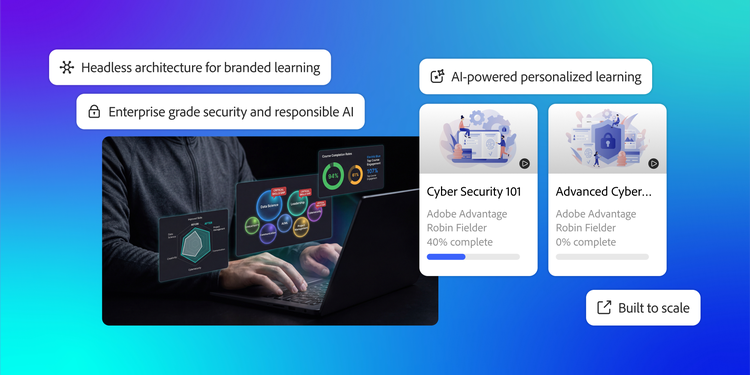
A legacy LMS was built for a world where training moved slowly, and audiences were predictable. The best LMS for tech companies is built for the world you are working in, with capabilities that serve different audiences on a single platform without the overhead of managing multiple systems. Here are the capabilities you need to look out for when evaluating an LMS for tech and SaaS based companies:
1. Headless capabilities for a branded learning experience.
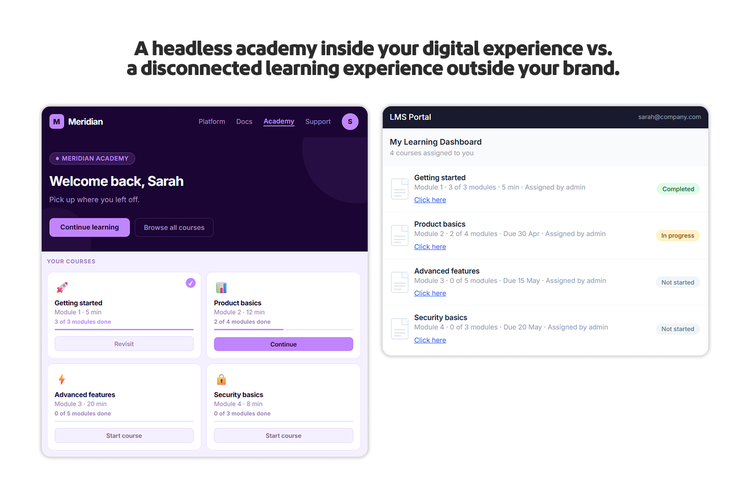
Your customers have a relationship with your brand, and every touchpoint either strengthens it or creates a small moment of doubt. Training is one of those touchpoints. When your customer is redirected to a portal that looks nothing like the experience they came from, something feels off, even if they cannot explain why. They are no longer in your world. They are in a learning environment that could belong to any company, and that gap, however small, affects how they experience your brand.
https://www.youtube.com/watch?v=7r_Lk2fZTw4&t=1s
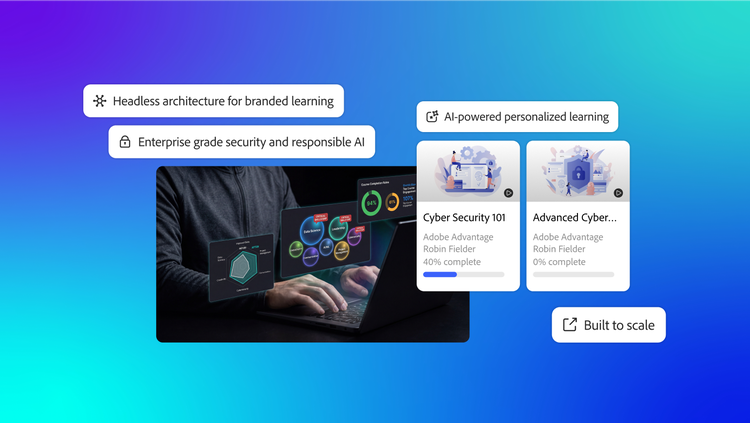
A customer training software that supports headless architecture changes this by enabling you to deliver training inside your own website, mobile app, and other digital touchpoints. Customers find your customer education academy without being sent there, engage with it on their own terms, and are more likely to adopt new features without needing hand-holding from your customer success team. That is what the best LMS for tech companies makes possible — a customer education experience that feels built into the brand rather than bolted onto it.
Adobe Learning Manager also offers a non-logged-in experience that most learning platforms do not, so your customers, partners, and employees can browse and search your learning catalog before they sign in, discover what is available, and self-register with ease. The value of what you have built is visible from the very first touchpoint, before anyone has committed to logging in.
2. Reducing developer and agency dependency in building learning experiences.
You probably have a clear picture of what your training should look like. The challenge is that turning that picture into a live experience depends on a developer queue or an agency timeline that was not built around your priorities.
The best LMS for tech companies gives your learning team the ability to move without that dependency. Custom layouts, role-based pages, and flexible content widgets can all be configured without writing code. Your customer education lead, your partner enablement manager, and your L&D team can build and update branded customer education and partner training experiences on their own schedule, without waiting on anyone.
3. The UX your learners expect, and your admins need.
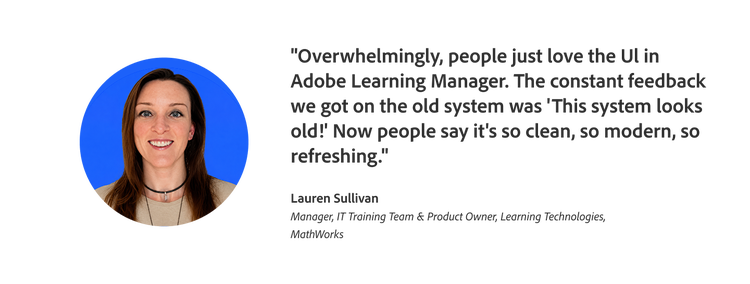
Tech companies have set a high bar for user experience. A platform that is hard to navigate is a platform people avoid. An admin who has to navigate five screens to set up a simple enrollment will find a workaround that creates more problems than it solves. A customer who lands in a training environment that feels dated will form an impression of your brand that has nothing to do with the quality of your content.
The best LMS for tech companies should hold up to the same standard your learners hold everything else to. Your employees, your customers, and your partners interact with well-designed software every day, and they bring those expectations with them when they log into your learning platform.
When the experience feels dated or difficult to navigate, engagement drops, and no amount of good content makes up for a platform people do not want to spend time in.
4. AI for personalized learning across every audience.
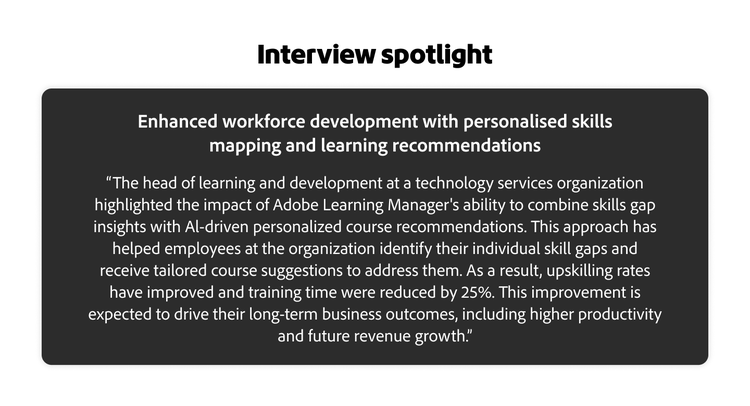
Most learning platforms have added AI somewhere. What separates the best LMS for tech companies is where that AI shows up. On an AI-powered learning platform, AI should be working at every point in the learning journey, for the learner trying to find the right content, for the admin trying to manage a complex program, and for the leader trying to understand what is working across all three audiences.
When you are evaluating a learning platform for your tech company, these are the AI capabilities worth asking about.
- AI-powered personalization and search: Can your platform tell the difference between two learners in the same role who are at completely different points in their journey? It should be able to recommend content by role, product, and skill level, drawing on a large enough dataset to feel genuinely tailored rather than generic. And when your learners search for something, can the platform understand what they mean rather than just matching their keywords? It should be able to surface context-aware results from course metadata and integrated external sources like YouTube and LinkedIn Learning.
- AI-powered admin support: Your admin team probably spends more time than they should looking up answers that the platform should already be able to give them. A good LMS for tech companies should be able to answer complex configuration questions conversationally, provide task guidance and feature walkthroughs, and draw on verified documentation to make sure the answer is reliable. That is what reduces errors, cuts time-to-resolution, and gives your team back the time they need for work that actually matters.
- Conversational learning support: Learning rarely stops at the end of a module. Your learners will have questions mid-course, after a session, or when they are trying to apply something they covered weeks ago. The platform should be able to transcribe content across formats, including SCORM files, videos, documents, and PDFs, and give your learners contextualized answers with citations drawn from what they have already taken. It should also help them go further, generating summaries, talking points, and scripts grounded in trusted course content, so the learning translates into something they can use rather than something they completed.
- Personalized learning paths: Most learning paths were built for a version of a role that may no longer exist. Your learners deserve something that reflects where they actually are. A good platform should let your learners have a conversation about what they want to develop and build a tailored path from internal content and integrated external sources, mapped to their existing skills and proficiency levels. The difference between a learning path that was assigned and one that was built around the individual is usually the difference between training that gets completed and training that’s applied.
- AI coaching and role plays: Some skills only develop through practice, and practice is hard to get before you are in a real situation. Your customer success teams, sales engineers, and partner managers often have to handle difficult conversations, product questions, or objections under pressure. A good platform should let them practice those scenarios through AI-powered role plays, configured around your industry, your product, and the specific situations your teams face. After each session, the platform should deliver a detailed analytical report covering tactical knowledge, soft skills, strengths, and areas for improvement, so the practice actually translates into better performance.
- Conversational reporting: Most learning leaders spend more time building reports than reading them. You should be able to ask a question about your training data and get an answer without having to set up a report first. Which partners have completed their certification? Which teams have the biggest skill gaps? Where are learners dropping off in your customer education program? A good platform should let your managers and learning leaders explore, create, and modify reports through a conversational interface, so the data that matters is accessible when you need it rather than locked behind a reporting workflow.
5. Responsible AI that enterprise tech and SaaS companies can trust.
When AI makes a recommendation in your learning platform, you should be able to understand why it made it. When it handles learner data, you should know exactly how that data is being used and protected. For tech and SaaS companies operating under GDPR, SOC 2, and ISO 27001, anything less creates risk that compliance teams will not accept.
Adobe's approach to AI in Learning Manager is built on three principles that enterprise tech companies should look for in any AI powered learning platform. Accountability means the platform takes ownership of AI outcomes, tests for potential harms, and has processes in place to address unanticipated results. Responsibility means the AI is designed with inclusivity in mind, with bias mitigation built into development rather than addressed after the fact. Transparency means you have a clear picture of how the AI works, what data it draws on, and what controls are available to you.
On the data side, your learner data and content should be protected within a secure enterprise cloud environment and never used to train models outside your own instance. For tech and SaaS companies building customer training programs, partner enablement strategies, and employee skilling initiatives on top of an AI learning management system, that level of trust is a baseline requirement. The best AI-powered LMS should meet it without you having to ask.
Your learners do not think about formats. They think about what they need to know and when they need to know it. Sometimes that is a self-paced module they can complete at midnight before a certification. Sometimes it is a live session where they can ask questions. The best LMS for tech companies should let you design for both without treating them as separate programs.
Adobe Learning Manager lets you combine self-paced online content, instructor-led training, and virtual classroom sessions within the same course or learning path, including nested learning paths that mix formats depending on what each audience needs. Assessments and quizzes embedded within blended courses give your instructors a clearer picture of how learning is landing across formats, not just whether someone completed a module.
For your learners, Learning Manager provides a self-service calendar with a clear view of upcoming sessions so they can select the slot that works for them. If they miss a session, the platform handles unenrollment and re-enrollment automatically, without your admin team having to intervene.
For your admins, everything sits in a single interface. Setting up classrooms, managing enrollments, assigning instructors, and running live classes through Adobe Connect, Microsoft Teams, or Zoom all happen from the same place. Attendance tracking and detailed reports on learner progress and instructor utilization mean you are not piecing together the picture from multiple sources after the fact.
7. Learning in the flow of work across every audience.
Learning that requires a context switch is learning that gets skipped. Not because your learners do not want to learn, but because every time they have to leave the tool they are working in, open a new tab, log into a separate platform, and find the right course, a small amount of mental energy goes into the switch itself rather than the learning.
The best LMS for tech companies should meet your learners where they already are. For your employees, that means learning that surfaces inside Salesforce, Microsoft Teams, and other enterprise platforms without requiring a separate login.
Learning Manager offers a non-logged-in experience that most learning platforms do not. Your customers should be able to browse your customer training academy before they log in, so that the value of what you have built is visible from the first touchpoint.
Most learning platforms are not built with growth in mind. They are built for the size of the organization at the time of purchase, and the gaps tend to show up gradually, in slower load times, in user caps nobody mentioned during the sales process, and in integrations that stop working when the volume increases.
Learning Manager addresses this through a scalable architecture built on Amazon Web Services, Akamai, and Brightcove that supports virtually unlimited users. SSO integrations with Okta, OneLogin, and Oracle Identity Federation mean your learners access the platform through your existing login infrastructure. For tech companies already running on Adobe, native integrations with Experience Manager Sites, Marketo, and Commerce mean your learning ecosystem connects to the tools your business already depends on.
How to evaluate the best LMS for tech companies: A handy checklist.
Choosing a customer training platform, a partner learning management system, or a corporate training LMS is rarely a straightforward decision for tech companies. Your requirements span multiple audiences, multiple use cases, and a product environment that keeps evolving.
The table below is a handy checklist to help you evaluate LMS providers on the capabilities that matter the most — across customer education, partner enablement, and employee skilling.
The goal is to help you make a decision grounded in operational reality rather than a feature checklist. Given how central AI for personalized learning has become to the best LMS for tech companies, the table also covers how each capability holds up when AI is part of the equation.